


The GRE is hard in a way you can measure, because it is scored against a fixed reference group rather than against a passing standard. Difficulty is the percentile cost of a scaled point: between 150 and 160 one verbal point moves you 4.3 percentile places on average and one quant point moves you 2.7, which is why a 160 is the 82nd percentile in verbal and exactly the 50th in quant.
That is the honest answer to "is the GRE hard". It depends far less on the questions than on which section you need the points in.
- The current averages are 151.39 verbal and 157.62 quant, a gap of 6.23 scaled points between the two section means.
- The same scaled score is two different results. A 160 ranks 32 percentile places higher in verbal than in quant.
- Verbal points are expensive low on the scale, quant points are expensive high. From 160 to 170 a quant point is worth 3.9 percentile places and a verbal point only 1.7.
- The maths stops at a second course in algebra. No trigonometry, no calculus, and a basic on-screen calculator is provided.
- Quant allows 104 seconds per question and verbal 91, so verbal is the tighter section on the clock.
- No quant score reaches the 90th percentile. A perfect 170 in quant is the 89th.
Our recommended GRE prep course:

Target Test Prep GRE
Deep quant and verbal coverage with 4,000+ practice questions. Try full access for 5 days.
No code neededPros
- 4,000+ practice questions with 2,000+ video explanations
- Strong analytics, error tracking, and custom test builder
- 320+ GRE score guarantee framework
Cons
- Verbal depth can feel secondary to quant
Hard against whom? The reference group decides
The GRE has no cut score. Your verbal and quant results are reported on a 130 to 170 scale, and the number that admissions reads next to each one is a percentile rank, meaning the percent of test takers who scored lower than you did.
So "hard" is really a question about a population. ETS builds that population from everyone who tested in a rolling three-year window, and the current window in the GRE General Test interpretive data runs from July 1, 2022 to June 30, 2025. Here is what that group actually scored.
| Measure | Mean | Standard deviation | Test takers |
|---|---|---|---|
| Verbal Reasoning | 151.39 | 8.43 | 788,021 |
| Quantitative Reasoning | 157.62 | 9.90 | 790,864 |
| Analytical Writing | 3.46 | 0.85 | 785,720 |
Two things in that table do most of the work on this page. The quant mean sits 6.23 points above the verbal mean, so the people who take the GRE are, as a group, much stronger on the maths side. And the quant standard deviation is wider, 9.90 against 8.43, so quant scores are more spread out.
ETS also reports that verbal and quant scores correlate at only .44. Being good at one is a weak predictor of being good at the other, which is worth knowing before you assume your weaker section will come along for the ride. If you want the full score-by-score table rather than the summary, our GRE score percentiles guide has it.
The same score is two different results
This is the part that surprises people. Because each section is ranked against its own distribution, one scaled score carries two completely different meanings depending on which section it came from.
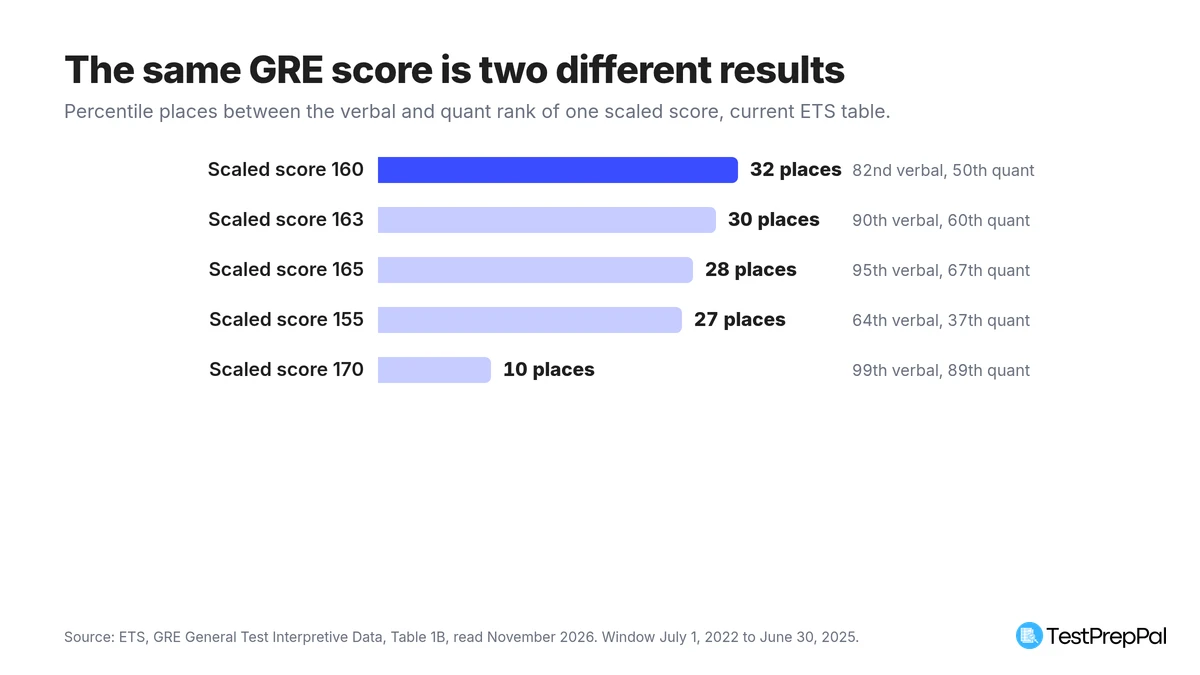 The percentile distance between verbal and quant at identical scaled scores. Source: ETS interpretive data, Table 1B.
| Scaled score | Verbal percentile | Quant percentile | Places apart |
|---|---|---|---|
| 155 | 64th | 37th | 27 |
| 160 | 82nd | 50th | 32 |
| 163 | 90th | 60th | 30 |
| 165 | 95th | 67th | 28 |
| 170 | 99th | 89th | 10 |
A 160 quant is the median. The same 160 in verbal beats four out of five test takers. Nothing about the questions changed, only the people you are ranked against.
The practical consequence is that a combined total hides more than it shows. A 320 made of a 160 and a 160 puts you at the 82nd and the 50th. The same 320 made of a 165 verbal and a 155 quant puts you at the 95th and the 37th. Those two applicants do not look alike to a program, which is why our guide to a good GRE score sets targets per section and per field rather than one number. You can check any pair of scores in the GRE percentile calculator.
Where the points get expensive
Difficulty has a price, and the price changes as you move up the scale. Divide the percentile movement by the scaled points it takes, and the two sections behave in opposite ways.
| Band | Verbal, percentile places per point | Quant, percentile places per point |
|---|---|---|
| 150 to 160 | 4.3 | 2.7 |
| 160 to 170 | 1.7 | 3.9 |
Low on the scale, verbal points are the expensive ones. The single steepest step on either table is verbal 152 to 153, which moves you from the 48th percentile to the 54th: six percentile places for one correct answer's worth of score. High on the scale it flips. Above 160 a quant point is worth more than twice what a verbal point is worth, because that is where the quant crowd is packed.
If you are near the middle of the verbal scale, one more verbal point is the cheapest percentile gain available anywhere on the GRE. If you are already above 160 in quant, each further point is the most expensive thing you can chase.
There is also a ceiling that no amount of work gets you past. The 90th percentile in verbal is a 163. In quant there is no 90th percentile at all, because a perfect 170 stops at the 89th. A flawless quant section is still, statistically, one in nine.
Sponsored
Target Test Prep GRE
Deep quant and verbal coverage with 4,000+ practice questions. Try full access for 5 days.
No code neededPros
- 4,000+ practice questions with 2,000+ video explanations
- Strong analytics, error tracking, and custom test builder
- 320+ GRE score guarantee framework
Cons
- Verbal depth can feel secondary to quant
The maths is not the hard part
The content ceiling is lower than the reputation suggests. ETS states the scope of GRE Quantitative Reasoning plainly: high school mathematics and statistics generally no higher than a second course in algebra, with no trigonometry, no calculus and no other higher-level mathematics. Constructing proofs is not tested. Inferential statistics is not tested. A basic on-screen calculator is provided, in this section only.
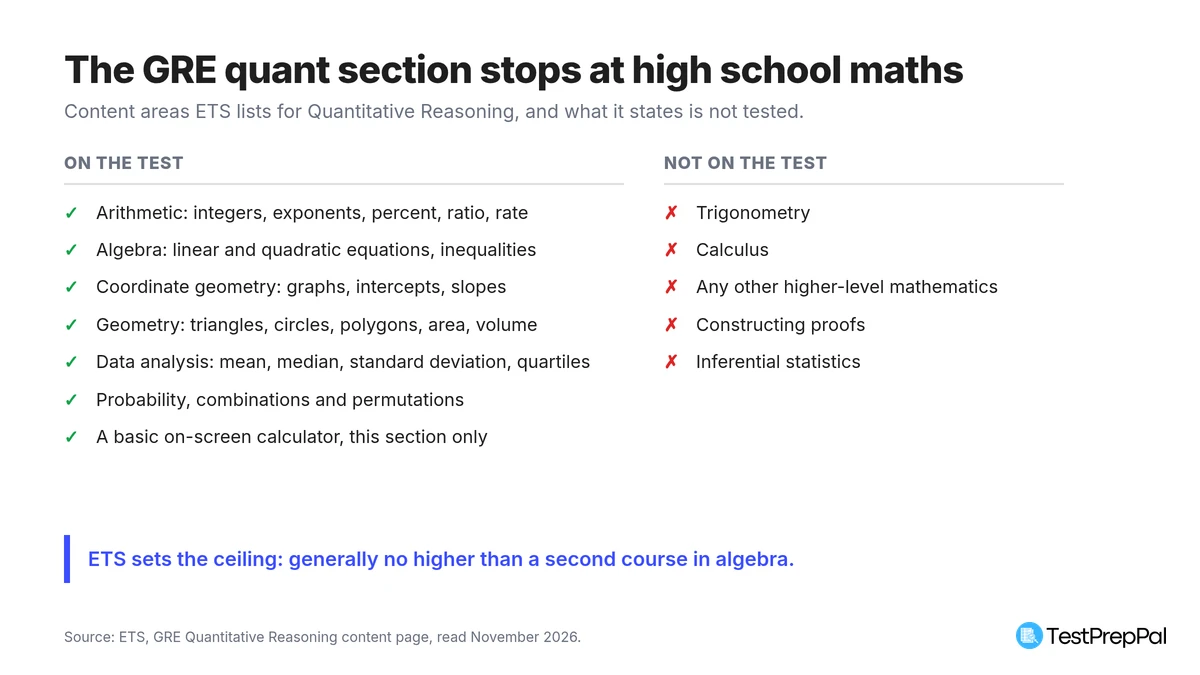 What the GRE quantitative section covers and what ETS states it leaves out. Source: ETS quantitative reasoning content page.
So the difficulty in quant is not the mathematics. It is that a very strong field is answering questions drawn from a syllabus most of them finished years ago, which compresses everyone into a narrow band of scores and makes each point cost more.
What actually makes it hard
Two things, and neither is advanced content.
Vocabulary breadth in verbal. About half of GRE Verbal Reasoning is passage based and the other half asks you to complete sentences and paragraphs. The passages assume no specialist knowledge and every answer is available in the text, so reading comprehension rewards care rather than background. Text Completion and Sentence Equivalence are where breadth bites. Sentence Equivalence gives you one blank and asks for the two choices that produce sentences meaning the same thing, with no credit for a partially correct answer. Getting one of the two right is worth exactly nothing, which is why GRE vocabulary work pays off more than it does on most exams.
The clock, but not where people think. The GRE test structure is five sections in about 1 hour and 58 minutes: one 30-minute Analyze an Issue task first, then two verbal sections of 12 questions in 18 minutes and 15 questions in 23 minutes, and two quant sections of 12 questions in 21 minutes and 15 questions in 26 minutes.
| Section | Questions | Minutes | Seconds per question |
|---|---|---|---|
| Verbal, both sections | 27 | 41 | 91 |
| Quant, both sections | 27 | 47 | 104 |
A common claim is that the maths gives you under 90 seconds a question. The official allotment is 104 seconds for quant and 91 for verbal, so quant is the more generous section by 13 seconds a question. Verbal is the one where a slow start costs you, and a reading passage can eat three of those 91-second budgets before you answer anything. The way to find out which section squeezes you is to sit some free GRE practice questions under a real clock rather than untimed.
Section one matters more than it looks
Verbal and quant are section-level adaptive. ETS puts the first section of each measure at average difficulty, then sets the difficulty of the second section by how you did on the first. Your score then reflects the total number of questions you answered correctly across both sections together with the difficulty level of those sections.
That raises the stakes on the opening section of each measure without capping anything. A weak first verbal section routes you to an easier second one, and an easier section carries less scoring weight. It is a reason to spend your warm-up before the test rather than during it, and a reason the whole sitting is shorter than it used to be: at under two hours there is no break and fewer questions to absorb a bad patch. If you are planning the calendar around that, how long the GRE is breaks the timing down section by section, and the GRE study plan generator builds the weeks before it.
For most people the honest summary is this. The GRE is not conceptually hard. It is a precision exercise on a crowded curve, under a clock, with a vocabulary tail that takes months to grow. That is a different problem from a hard exam, and it responds to different preparation. If you are deciding where to put your months, start at the GRE hub or compare GRE prep courses.
GRE difficulty FAQs
What is a 90 percent GRE score?
In verbal, a 163 is the 90th percentile. In quant there is no 90th percentile to reach: the maximum score of 170 sits at the 89th, so even a perfect quant section leaves roughly one in nine test takers level with you. If someone quotes a single 90th-percentile GRE number, they are adding two sections that ETS ranks separately.
Is 320 a bad GRE score?
A 320 is well above the 309 combined average, but the split matters more than the total. A 160 and a 160 is the 82nd percentile in verbal and the 50th in quant. A 165 verbal with a 155 quant is the 95th and the 37th. Check your own pair against the field averages before judging the total, because a quant-heavy programme reads those two 320s very differently.
How hard is the GRE without studying?
The honest reference point is the mean: 151.39 verbal and 157.62 quant across nearly 800,000 test takers, most of whom did prepare. Sitting cold puts you below that group on the parts that reward familiarity, particularly Sentence Equivalence and quant pacing. The content will not be unfamiliar, but the format and the clock will be, and both are learnable in a way vocabulary breadth is not.
Is the GRE harder than the GMAT, LSAT or MCAT?
Not a question anyone can answer as a fact, because the exams use different scales, different reference groups and different content. On content scope alone, the GRE's maths is capped at a second course in algebra with a calculator provided, which is a narrower syllabus than the MCAT's science sections. Our GRE and LSAT comparison sets out that kind of comparison on a stated basis rather than on feel.
Can you prepare for the GRE in one month?
One month is enough to learn the format, fix pacing and raise a quant score that is rusty rather than weak. It is usually not enough for verbal, where gains come from vocabulary breadth that accumulates over months. If a month is what you have, spend it on timed sections and the two question types that punish partial knowledge, then book a date that leaves room for a retake.
We may earn commissions from some links on this page, but this does not affect our reviews or your experience.