


ETS has never published a GRE vocabulary list, so the only words it has ever put its name to are the ones printed in its own practice tests. Across the four Verbal Reasoning sections of the two free official practice tests, that comes to 235 distinct words and phrases, and 39 of the 70 questions turn on knowing one of them.
- ETS publishes no official GRE vocabulary list. The 235 words below are every answer choice from its two free practice tests.
- Only 72 of those words were ever the credited answer. The other 163 were wrong answers you still had to understand to rule out.
- 22 of the questions were Text Completion, 14 were Sentence Equivalence, and 3 were vocabulary-in-context questions inside a reading passage.
- Across four official sections, only 3 words repeat. Betting on any fixed list to "cover" the test is a weak bet.
- Recognition beats recall here: you need to know roughly what six words mean in nine seconds, not write their dictionary entries.
Our recommended GRE prep course:
Target Test Prep GRE
Deep quant and verbal coverage with 4,000+ practice questions. Try full access for 5 days.
No code neededPros
- 4,000+ practice questions with 2,000+ video explanations
- Strong analytics, error tracking, and custom test builder
- 320+ GRE score guarantee framework
Cons
- Verbal depth can feel secondary to quant
Where this list comes from
Every word on this page was pulled out of two documents: the Verbal Reasoning sections of ETS Practice General Test 1 and Practice General Test 3, both free, both published by the people who write the test. Each test has two Verbal sections, one of 15 questions in 21 minutes and one of 20 questions in 28 minutes, for 70 Verbal questions in total.
Of those 70, we counted 39 that cannot be answered without knowing what a particular word means. Those 39 questions printed 238 answer choices between them, which resolve to 235 distinct words and phrases: 200 single words and 35 phrases like "a brake on" and "susceptible to".
Then we checked each word against the Test 1 answer key and the Test 3 answer key. Only 72 of the 235 were ever credited as correct. The remaining 163, about 69 percent of the set, were there to be eliminated.
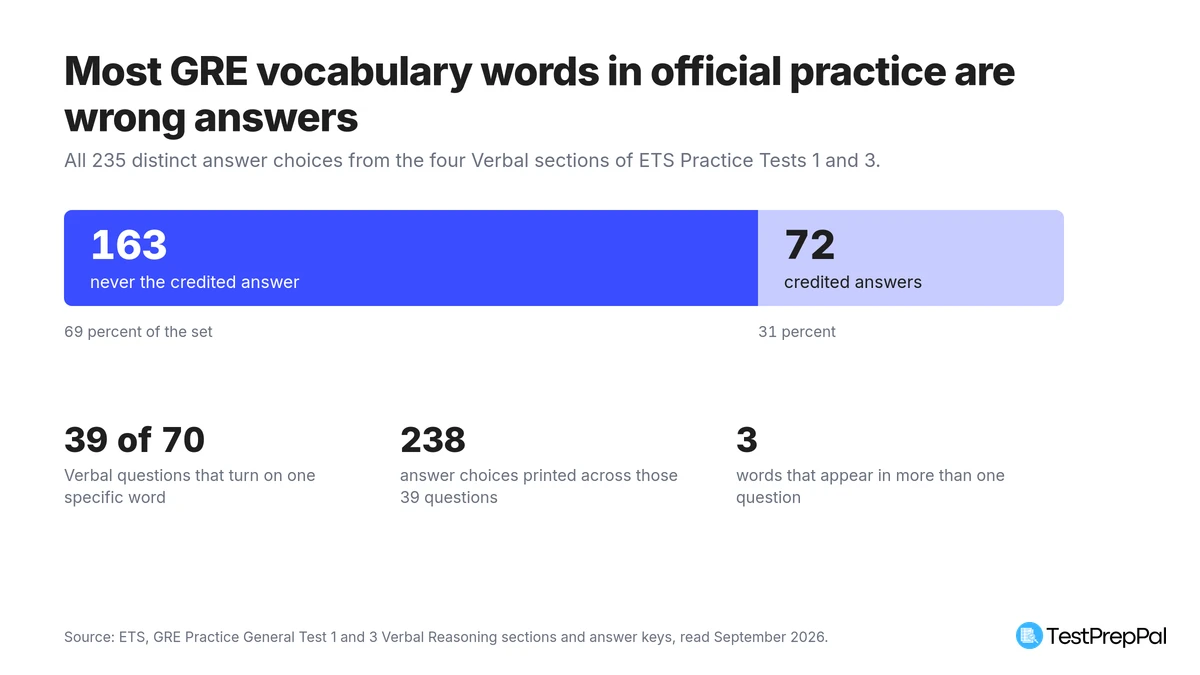 Every distinct answer choice in the Verbal sections of ETS Practice Tests 1 and 3. Source: ETS practice tests and answer keys, read September 2026.
That ratio is the most useful thing in this article. Two out of every three words ETS put in front of you were wrong answers. You do not get credit for knowing them, and you cannot skip them either, because you cannot eliminate a choice you do not understand.
The list, tagged by question type
Words in bold were credited as correct answers in the official key. Everything else appeared as a wrong answer. A word can show up under more than one heading.
Text Completion words (138)
acknowledge, adventurous, amaze, ambiguity, ambivalence, anoint, anticipate, antiquity, art, assuage, banal, beautiful, befriend, beguile, benign, brilliance, casual, cinematic, circumstantial, clear, clearheaded, coalesce, collude in, commercial, commonplace, complex, complimented, conceal, confound, consequence, consolidated around, construe, contemporary, contemptuous, cosmopolitan, create, credulity, crowded, crucial to, cynical, deep, defiant, delicacy, detached, disappear, discern, discussed, dismiss, dismissing, disparaged, disregard, disregard for, disregarded, doctrinaire, dramatic, eclectic, elusive, emerge, erudite, exculpate, exigent, exposition, extraneous, fastidious, fiction, galvanize, gloom, haphazard, harmonious, ignore, imperturbable, inalienable, incorporated into, indefatigable, indifferent, insightful, insincere, insular, intuitive, inventiveness, invulnerable, irritated at, judicious, less sanguine, logical, maladroitness, maturity, mimicking, missing from, modish, more cynical, multifaceted, narrative, nettle, objurgation, observation, omniscience, opportunism, overlooked, painstaking, panned, partiality, partiality toward, partisan, partisanship, perseverance, please, plentiful, polarize, polemical, polluted, portentous, precedence, preeminence, prescient, problematic, protected, quirkiness, recapitulate, repudiate, settled, similarly equivocal, simultaneity, sophisticated, successful, susceptible to, take issue with, tedious, threatened, transmitted to, unadorned, unaware of, undermine, unfamiliar, unpretentiousness about, uprooting, valued in, whet
Sentence Equivalence words (84)
a boon to, a brake on, a check on, a hindrance to, a signal to, a snare for, accelerated, acumen, ameliorate, an advocate for, an apologist for, an impediment to, an indication for, an intermediary for, an obstacle to, approximate, aspiration, astonishing, astonishment, avarice, based on, baseness, beholden to, biased against, chic, competitively, comprehensive, compromise, conventional, cooperatively, craft, craftily, criticized, cunning, deceit, derivative of, deviously, disordered, distinguishable from, duplicity, elegant, enervate, equivocation, evasiveness, forestalled, fundamental, harmless, harmoniously, hidden, impulsively, inarticulate, inclusive, indebted to, innocence, inscrutable, insensitivity, malleable, matched, mendacity, modern, naivete, nascent, neglected, obviated, overrated, paralleled, plastic, politicized, prevarication, repudiated, revealing, shrewdness, significant, slighted, supersede, supplant, tawdry, traditional, ubiquitous, unformed, uninformative, universal, vestigial, vexation
Vocabulary-in-context words (15)
delimit, disinterested, dramatic, eminent, excellent, false, flaccid, horrifying, magnify, offset, outstrip, submissive, supine, supplant, unreceptive
Notice how ordinary some of them are. "Art", "clear", "modern", "hidden" and "deep" all sat in official answer sets next to "objurgation" and "maladroitness". When a question is hard, it is usually the sentence logic doing the work, not the rarity of the words.
Why "how many words" is the wrong question
The most common questions students ask about GRE vocabulary words are about list length: the 3,500 essential words, the top 300, the top 52. None of those numbers comes from ETS. They are publishers' packaging decisions, and the search results reflect it. The current top ten includes a 1,000-word Manhattan Prep list that someone printed out of Quizlet and left on a hardware retailer's corporate file server, a user-built 500-card deck, and Target Test Prep's list of "nearly 1,200" words behind an email form. Not one of them says where its words came from.
Here is the problem with treating any of them as coverage. Across 235 distinct words in four official Verbal sections, exactly three words appeared in more than one question: supplant, disparaged and dramatic. ETS is not drawing from a small recycled pool. Memorizing a 3,500-word list to hit a test that reuses 1 percent of its own vocabulary is a bet on volume that the official material does not support.
The useful target is not a word count. It is a depth setting: know enough about a word to rule it in or out in a few seconds, across as wide a range as you can stand, and stop trying to memorize precise definitions you will never be asked to write down.
Sponsored
Target Test Prep GRE
Deep quant and verbal coverage with 4,000+ practice questions. Try full access for 5 days.
No code neededPros
- 4,000+ practice questions with 2,000+ video explanations
- Strong analytics, error tracking, and custom test builder
- 320+ GRE score guarantee framework
Cons
- Verbal depth can feel secondary to quant
What each question type does with a word
The two blank-filling question types ask for different things, which is why tagging the list by type matters more than sorting it alphabetically.
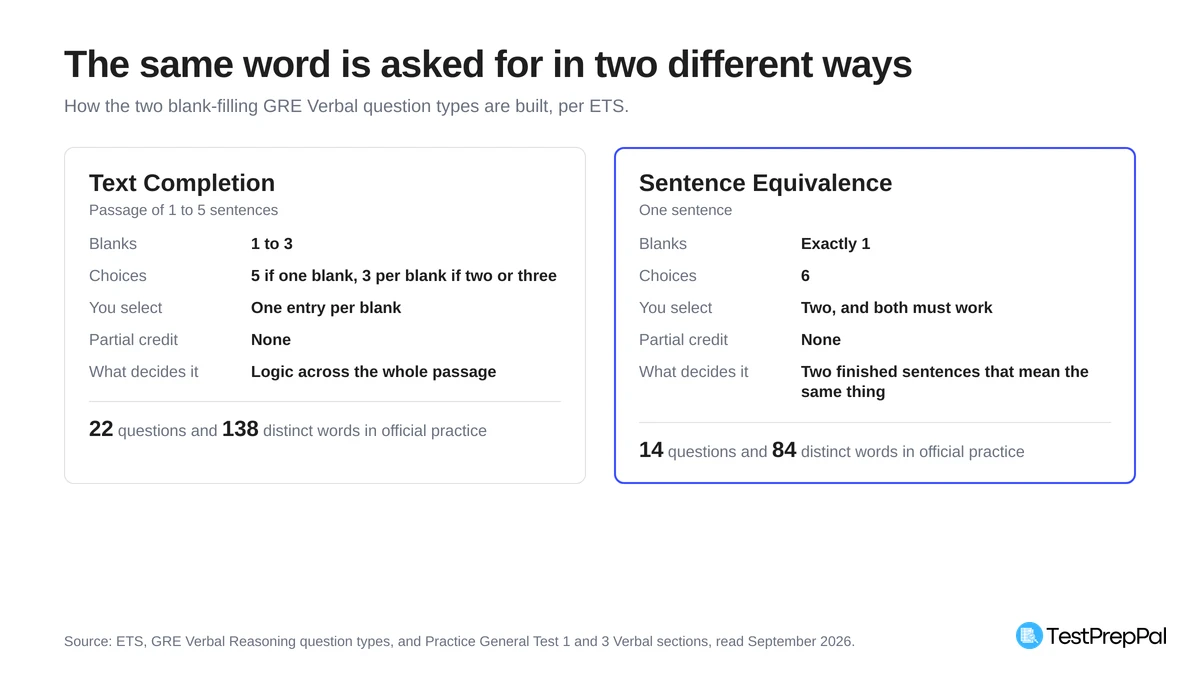 How ETS builds the two blank-filling question types. Source: ETS Verbal Reasoning question types and the official practice tests, read September 2026.
ETS describes Text Completion as a passage of one to five sentences with one to three blanks. One blank means five answer choices; two or three blanks means three choices each, chosen independently, with no credit for getting two of three right. The vocabulary load is real but the question is mostly about tracking an argument across sentences.
Sentence Equivalence is one sentence, one blank, six choices, and you pick two. ETS is explicit that the two correct choices do not have to be synonyms: what has to match is the meaning of the two completed sentences. That is why hunting for a synonym pair in the choice list is a trap, and why the official test sets so often include a decoy pair that means the same thing but does not fit the sentence.
The meaning clusters ETS builds answer sets from
Sentence Equivalence in particular forces ETS to write choice sets out of tight meaning groups. Studying those groups is a better use of an hour than studying 60 unrelated flashcards, because the groups are what the answer sets are made of. These five came straight out of the official sets above.
| Cluster | Words from the official sets | Where they appeared |
|---|---|---|
| Lying and slyness | mendacity, prevarication, duplicity, deceit, evasiveness, equivocation, cunning, craft, craftily, deviously | Sentence Equivalence |
| Help or hindrance | an obstacle to, a hindrance to, an impediment to, a brake on, a check on, a boon to, a snare for, galvanize, whet | Sentence Equivalence and Text Completion |
| Praise or attack | complimented, panned, disparaged, slighted, neglected, repudiated, criticized, contemptuous, objurgation, polemical | mostly Text Completion |
| Doubt and hedging | ambiguity, ambivalence, equivocal, credulity, inscrutable, elusive, sanguine, settled, doctrinaire | Text Completion |
| Everywhere or all-covering | universal, ubiquitous, comprehensive, inclusive, fundamental, significant | Sentence Equivalence |
The pattern is worth internalizing. If you can place a word in the right cluster and get its charge right, positive or negative, you can usually answer the question even when you could not define the word cleanly.
How to actually study these words
Start with the 72 credited answers above. They are the smallest set with any official claim on your attention, and they take an evening.
Then widen, do not deepen. Your goal for the other 163 is a one-second gut read: roughly what does this mean, and is it a good thing or a bad thing. That is all elimination requires. Our free GRE practice questions put words back in sentences, which is the only context the test ever gives you.
Do it in sentences, never in isolation. Every word above arrived attached to a sentence about regulatory agencies, Emily Dickinson, dolphins or the Wright brothers. A flashcard that shows you "beguile" alone trains a skill the GRE does not test.
Fit it into the rest of your prep rather than making it the whole plan. Verbal is one of two scored multiple-choice sections, and vocabulary is one part of Verbal; our GRE study plan generator will place it against your test date. If you want a structured course to carry the whole thing, the GRE prep course roundup compares what each one does with verbal, and our Magoosh GRE review covers the flashcard app the AI Overview keeps recommending, including what it does not do.
Last, aim the work at a number. Verbal score gains show up differently at different points on the scale, and GRE score percentiles show why a few Verbal questions matter more near the top. If you have not set a target yet, start with what counts as a good GRE score and work back, then use the rest of the GRE resources on TestPrepPal to fill the gaps.
GRE vocabulary FAQs
What vocabulary words are on the GRE?
Nobody outside ETS knows, because ETS has never published a word list. The only words it has officially put on a GRE are the ones in its own practice material, and across the two free official practice tests that is 235 distinct words and phrases. Everything longer than that is a publisher's estimate of what might show up.
What are the 3,500 essential words for the GRE?
That number comes from third-party vocabulary books, not from ETS, and no official document endorses it. The official practice tests repeat almost no vocabulary, with only 3 words out of 235 appearing in more than one question, so a very long list buys less coverage than it seems to. A shorter list studied to the point of instant recognition is worth more than a long one studied to the point of vague familiarity.
What are the top 300 words for the GRE?
There is no official top 300, and the popular lists disagree with each other because each publisher builds its own. If you want a defensible starting set, use the 72 words that ETS actually credited as correct answers in its two free practice tests, listed in bold above, then widen into the words that appeared only as wrong answers.
How many GRE vocabulary words do I need to know?
Fewer than the lists suggest, but at a shallower depth than flashcards encourage. About 69 percent of the words in official practice sets were wrong answers, which means most of your vocabulary work is spent eliminating rather than selecting. Train broad recognition and directional meaning, and put the time you save into reading complex prose, which is what the other 31 of 70 Verbal questions measure.
We may earn commissions from some links on this page, but this does not affect our reviews or your experience.