


There is no single good GRE score, because ETS scores verbal, quantitative and analytical writing on three separate scales with three separate percentile tables. Across everyone who tested between July 1, 2022 and June 30, 2025, the averages are 151.39 verbal and 157.62 quant, so one scaled score can be a strong verbal result and a below-average quant result at the same time.
That is why a target has to be a pair of section scores chosen for your field, not one combined number.
- The average GRE is 151.39 verbal, 157.62 quant and 3.46 analytical writing, which is a combined 309.
- ETS asks programs to read the three measures as separate and independent, and publishes no combined percentile.
- A 160 is the 82nd percentile in verbal and exactly the 50th in quant.
- Quant targets swing 12 points across fields of study. Verbal targets swing 4.
- A perfect 170 in quant is the 89th percentile, so no quant score reaches the 90th.
- Gaps smaller than 5 verbal points or 4 quant points sit inside ETS measurement error.
Our recommended GRE prep course:

Target Test Prep GRE
Deep quant and verbal coverage with 4,000+ practice questions. Try full access for 5 days.
No code neededPros
- 4,000+ practice questions with 2,000+ video explanations
- Strong analytics, error tracking, and custom test builder
- 320+ GRE score guarantee framework
Cons
- Verbal depth can feel secondary to quant
Set two targets, not one total
Every number below comes from the GRE Guide to the Use of Scores, 2026-27 edition, the interpretive document ETS sends to admissions offices. Its guidance to programs is direct: read verbal reasoning, quantitative reasoning and analytical writing as three separate and independent measures, because the skill level a program needs in each area is unique to that program.
The guide backs that up by what it leaves out. It publishes a percentile table for verbal, one for quant and one for writing. There is no table anywhere in it for a combined verbal plus quant total, which means the 318 and 320 thresholds that circulate online have no percentile behind them. They are section scores added together and then given a meaning ETS never assigned.
So the useful question is not "is my score good". It is "is each of my two section scores far enough above the average for the field I am applying to".
What the average GRE score actually is
The current reference group is everyone who tested in the three years ending June 30, 2025, and Table 1A of the guide reports it like this. ETS recalculates the window on a rolling basis, which is why older guides and older prep-company pages disagree with the table below.
| Measure | Score range | Mean | Standard deviation | Test takers |
|---|---|---|---|---|
| Verbal Reasoning | 130 to 170 | 151.39 | 8.43 | 788,021 |
| Quantitative Reasoning | 130 to 170 | 157.62 | 9.90 | 790,864 |
| Analytical Writing | 0.0 to 6.0 | 3.46 | 0.85 | 785,720 |
Add the two section means and the average GRE is a 309 combined. The six-point gap between the verbal and quant means is the single most useful fact on this page, because it is the reason a score that looks identical on paper lands in two different places. Our GRE score percentiles guide carries the full score-by-score table if you want to look up a specific number.
What a good GRE score is in your field
ETS also reports mean scores for seniors and recent graduates grouped by the field they intend to study, in Table 3A of the same guide. Those field averages are the honest starting point for a target, and they are nothing like each other.
The second column in each pair below is our own calculation, not an ETS recommendation. ETS publishes a standard error of score differences: 4.48 points on verbal and 3.62 on quant. A gap larger than that between two applicants is likely to reflect a real difference in ability rather than test-day noise. So the target column is the first whole score that clears the field average by more than that error.
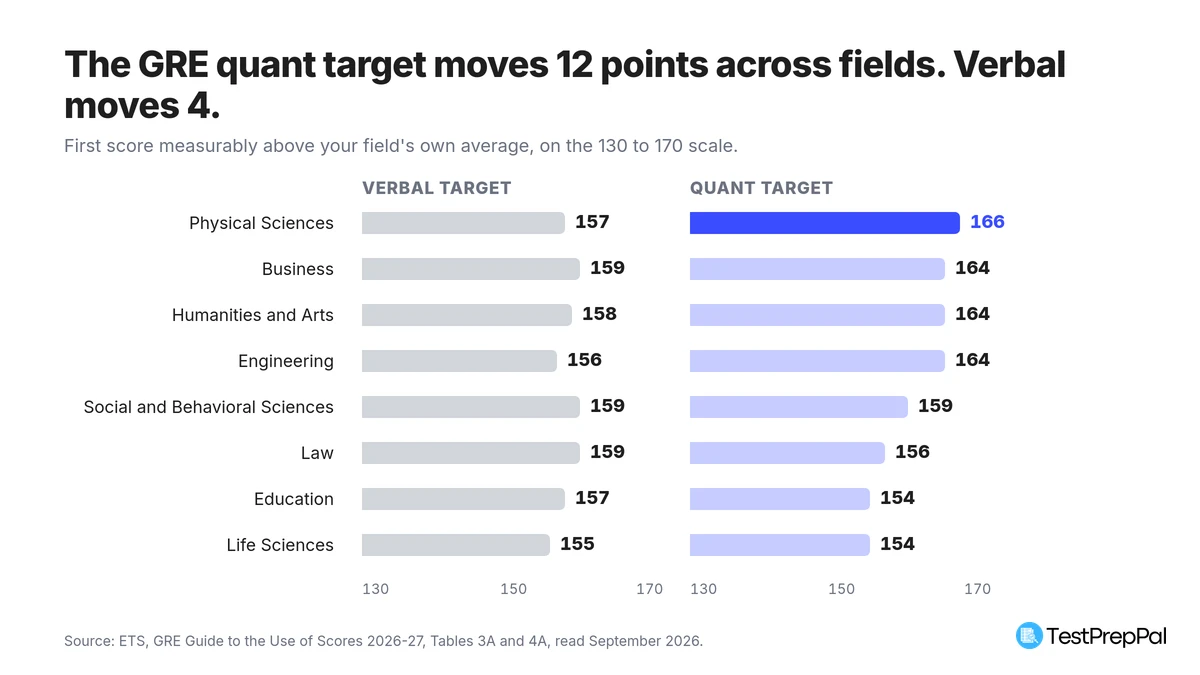 Verbal and quant targets by intended field. Source: ETS Guide to the Use of Scores 2026-27, Tables 3A and 4A.
| Intended field | Verbal average | Verbal target | Quant average | Quant target | Writing average |
|---|---|---|---|---|---|
| Business | 154 (59th) | 159 (79th) | 160 (50th) | 164 (63rd) | 3.7 |
| Education | 152 (48th) | 157 (72nd) | 150 (23rd) | 154 (34th) | 3.7 |
| Engineering | 151 (43rd) | 156 (68th) | 160 (50th) | 164 (63rd) | 3.4 |
| Humanities and Arts | 153 (54th) | 158 (76th) | 160 (50th) | 164 (63rd) | 3.4 |
| Law | 154 (59th) | 159 (79th) | 152 (29th) | 156 (39th) | 3.9 |
| Life Sciences | 150 (39th) | 155 (64th) | 150 (23rd) | 154 (34th) | 3.7 |
| Physical Sciences | 152 (48th) | 157 (72nd) | 162 (57th) | 166 (72nd) | 3.4 |
| Social and Behavioral Sciences | 154 (59th) | 159 (79th) | 155 (37th) | 159 (47th) | 3.8 |
Read across your own row and the advice changes completely. A life sciences applicant clears their field average with a 154 quant, which is the 34th percentile of all test takers. A physical sciences applicant needs a 166 for the same standing, which is the 72nd. Those two people are taking the same test and should not be chasing the same number.
Verbal behaves differently. Every field target sits between 155 and 159, a spread of four points, because no field's verbal average strays far from the overall 151.39. Quant is where your subject decides your workload.
Why 160 verbal and 160 quant are not the same result
The two percentile curves have very different shapes, and the gap between them is widest exactly where most applicants set their goals.
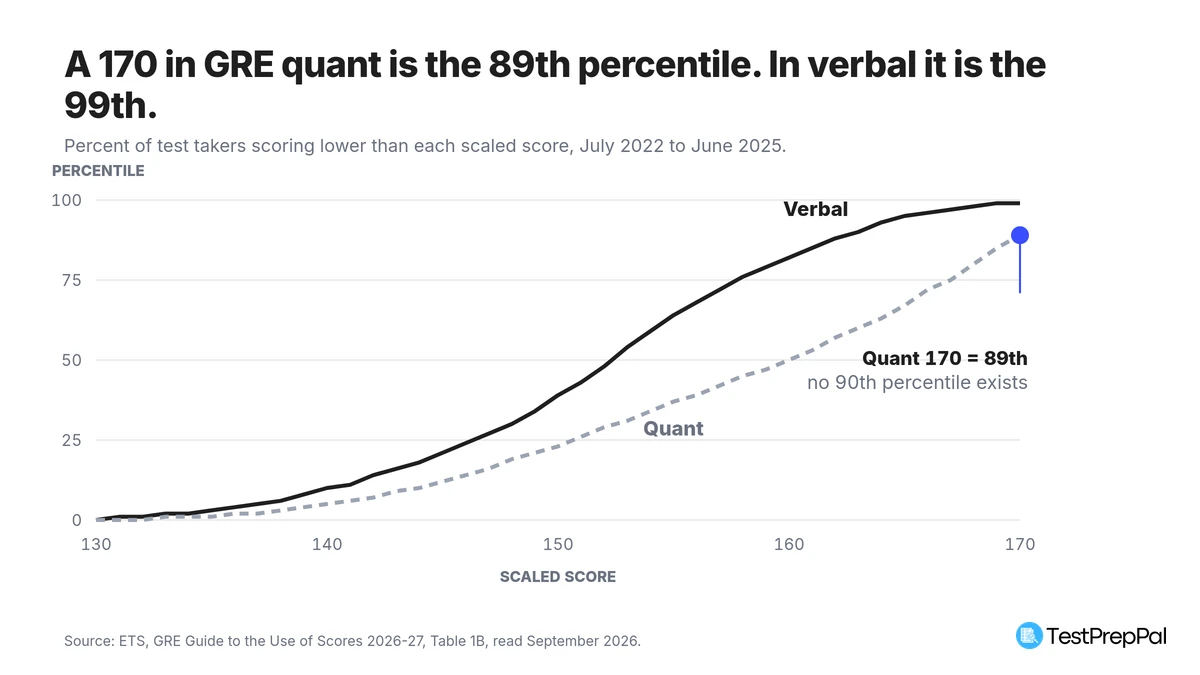 Percent of test takers scoring lower than each scaled score. Source: ETS Guide to the Use of Scores 2026-27, Table 1B.
A 160 verbal puts you above 82 percent of test takers. A 160 quant puts you above exactly 50 percent. That is the same scaled score reported as a top-fifth result and as the median. The benchmark pages that call a 158 verbal and a 159 quant equivalent, both "around the 75th percentile", are repeating a 76th percentile score and a 47th percentile score as though they were the same result. The 75th percentile is a 158 in verbal and a 167 in quant.
The reason is the population. Roughly the same number of people sit each section, but the quant distribution is pushed upward by the computing, engineering, mathematics and business applicants who make up much of the testing pool. Computer and information sciences applicants alone average a 162 quant across 68,235 test takers. You can convert any score to its percentile with our GRE score percentile calculator.
Sponsored
Target Test Prep GRE
Deep quant and verbal coverage with 4,000+ practice questions. Try full access for 5 days.
No code neededPros
- 4,000+ practice questions with 2,000+ video explanations
- Strong analytics, error tracking, and custom test builder
- 320+ GRE score guarantee framework
Cons
- Verbal depth can feel secondary to quant
There is no 90th percentile GRE quant score
Prep pages routinely tell applicants to top programs to aim for the 90th percentile in both sections. In verbal that is a 163. In quant it does not exist.
A 170 quant, the highest score the scale allows, is the 89th percentile in the current window. A 168 is the 80th and a 169 is the 85th. So the honest ceiling advice for quant is that a perfect score puts you in the top 11 percent, and nothing puts you in the top 10 percent, because ETS reports no quant score above the 89th percentile.
This matters for how you spend the last month of prep. Above a 165 in quant, each additional point is worth three to five percentile points, which is real. But the last point is capped, and the GRE hub has the format and timing details that usually cost more points than the final push for a perfect score does. One of those details is the on-screen calculator: our free GRE calculator lets you rehearse its order-of-operations behavior before it costs you a question.
Humanities applicants should not use the humanities row
The Humanities and Arts row in the table above reads a 160 quant average, the same as engineering and business. That is not a description of humanities applicants.
Table 3A groups 49,362 of that field's 57,824 test takers under "Liberal Arts and Sciences, General Studies and Humanities", a bucket with a 161 quant average that, beginning in 2025, also absorbs everyone who declined to name a major. Eighty-five percent of the broad field is that one catch-all group.
The named humanities subfields look nothing like it:
| Subfield | Verbal average | Quant average | Verbal test takers |
|---|---|---|---|
| Philosophy and Religious Studies | 159 | 156 | 785 |
| History | 157 | 151 | 1,083 |
| English Language and Literature | 155 | 153 | 1,009 |
| Foreign Languages and Linguistics | 155 | 157 | 871 |
| Liberal Arts and General Studies | 152 | 161 | 49,362 |
If you are applying to an English or history program, a 153 quant is at your field's average and a 157 verbal is not. Use the subfield row, not the broad-field row. The same warning applies inside social and behavioral sciences, where psychology averages a 149 quant against the broad field's 155, and inside physical sciences, where mathematics and statistics applicants average a 165 quant against the broad field's 162.
How far above your field average is far enough
ETS reports how reliable each measure is in Table 4A, and those numbers put a floor under any sensible target. The standard error of measurement for an individual score is 3.17 points on verbal and 2.56 on quant. For comparing two applicants, the standard error of score differences is 4.48 on verbal and 3.62 on quant.
That is the argument for stopping. If a retake would plausibly move you four or more quant points, it is worth the money and the study block. If it would move you two, you are paying to chase noise, and the same hours spent on your statement or your research experience will do more. If you do retake, the ScoreSelect option lets you pick which test dates go to each program, so a weaker first attempt does not have to travel with the new one. Check that a retake still fits your calendar first, because ETS requires 21 days between attempts and our guide to GRE test dates works out the last date that leaves room for one. ETS makes the same point to programs in the guide, asking them to support the same decision with more than one source of information.
It also tells you where to spend prep time. Compare your practice-test sections to your own field's row, find the larger gap in error-adjusted terms, and put your hours there. If you have not started yet and have no sections to compare, the free Target Test Prep GRE diagnostic returns a topic-level breakdown from 40 questions without spending one of your two official practice tests. A GRE study plan built around the weaker section beats an even split, and free GRE practice questions between full-lengths will show you whether the gap is closing. If quant is the gap, our GRE prep course roundup compares the quant-first options, and the Target Test Prep review covers the one built specifically for that. Our review methodology explains how those verdicts are reached.
One more check before you book a retake: confirm the programs you are applying to actually read the score. Plenty do not. Six of the seven PA programs that do not require the GRE we checked this October ask for no GRE at all, and two of them say outright that scores sent anyway will not be considered.
Good GRE score FAQs
Is 320 a good GRE score?
A 320 is well above the 309 average, but the split decides what it means. As a 160 verbal and a 160 quant it is the 82nd and the 50th percentile, which is strong for a humanities program and merely average for engineering. As a 150 verbal and a 170 quant it is the 39th and the 89th, which is the reverse. Check each section against your own field's row rather than the total.
Is a 300 GRE score good?
A 300 is below the 309 average, and an even 150 and 150 split puts you at the 39th percentile in verbal and the 23rd in quant. For life sciences and education programs, whose quant averages are both a 150, that quant score is roughly typical of the applicant pool. For business, engineering or physical sciences, where quant averages run 160 to 162, a 150 quant is a long way below the field.
What is the average GRE score?
Among everyone who tested between July 2022 and June 2025, the averages are 151.39 verbal, 157.62 quant and 3.46 analytical writing, which adds to a combined 309. Those figures come from 788,021 verbal and 790,864 quant test takers. ETS recalculates them on a rolling three-year basis, so a figure quoted from an older guide will be slightly different.
Is it hard to get 150 on the GRE?
No. Thirty-nine percent of test takers score below 150 in verbal, so 61 percent reach it, and 23 percent score below 150 in quant, so 77 percent reach it. A 150 is a below-average quant score in almost every field and an average one only in life sciences and education. Treat it as a floor rather than a target.
What is a top 10 percent GRE score?
In verbal a 163 is the 90th percentile, so that is the top-10-percent line. In quant there is no such score: a perfect 170 is the 89th percentile, and no reported score sits above it. A quant score in the top 10 percent of test takers does not exist on the current scale, which is worth knowing before you set a goal you cannot reach.
We may earn commissions from some links on this page, but this does not affect our reviews or your experience.