


The GRE score range is 130 to 170 on verbal reasoning, 130 to 170 on quantitative reasoning, and 0 to 6 on analytical writing. Add the two 130 to 170 scales and you get the 260 to 340 total everyone quotes, which means the analytical writing score is not inside it.
That last part is where most score pages go quiet, and it changes how you read your own report.
- Verbal and quant each run 130 to 170 in one-point steps. Analytical writing runs 0 to 6 in half-point steps.
- The 260 to 340 total is verbal plus quant only. Writing is reported next to it, never added into it.
- The middle of the range is not the average. A 300 is the 39th percentile in verbal and the 23rd in quant.
- A perfect 170 is the 99th percentile in verbal but only the 89th in quant.
- One more scaled point buys the most in verbal between 151 and 160, worth 4.3 percentile points on average.
- In quant that pattern inverts: a point is worth 3.9 percentile points near the top and 1.8 near the bottom.
Our recommended GRE prep course:

Target Test Prep GRE
Deep quant and verbal coverage with 4,000+ practice questions. Try full access for 5 days.
No code neededPros
- 4,000+ practice questions with 2,000+ video explanations
- Strong analytics, error tracking, and custom test builder
- 320+ GRE score guarantee framework
Cons
- Verbal depth can feel secondary to quant
The GRE score range is three scales, not one
ETS puts the ranges in writing in Interpreting Your GRE Scores, the 2026-27 edition: verbal reasoning and quantitative reasoning run 130 to 170 in one-point increments, and analytical writing runs 0 to 6 in half-point increments.
Three measures, three scales, three separate numbers on your report.
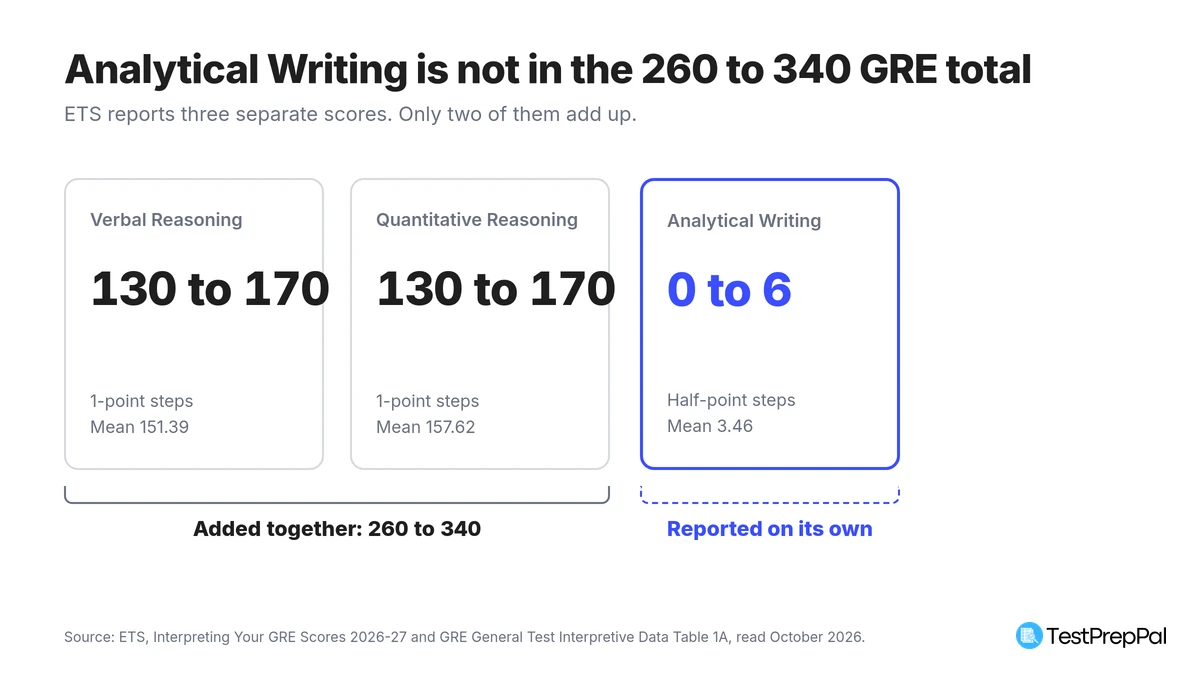 The GRE score range, as ETS reports it. Source: ETS, Interpreting Your GRE Scores 2026-27 and Interpretive Data Table 1A.
The 260 to 340 figure is arithmetic performed on two of those three numbers. The floor is 130 plus 130. The ceiling is 170 plus 170. That gives 81 possible totals, and every one of them is a verbal score and a quant score standing next to each other.
One more detail from the same document that rarely gets quoted: if you do not answer at least one question in a measure, that measure reports NS, meaning No Score. It does not report a zero. A 130 is the floor for someone who answered and got nothing right, which is a different outcome from not answering at all.
Why analytical writing sits outside the 260 to 340 total
The honest answer is that ETS never built a combined score in the first place. It asks programs to read the measures separately, and says plainly that scores from the different measures should not be directly compared, because each one is scaled on its own.
The writing score is also produced differently. Essays are scored on a 6-point holistic scale, as ETS describes on its scoring page, combining a trained reader with the e-rater scoring engine. A verbal score counts correct answers. A writing score judges an essay. Adding a judgment on a 6-point scale to a count on a 41-point scale would produce a number that means nothing.
The data backs the separation up. In the current reference group, the correlation between quant scores and analytical writing scores is .08, which is close to no relationship at all. Verbal and writing correlate at .52, a moderate link. A single total would bury both facts.
So when a program asks for a 320, it is asking about verbal plus quant. Your 4.5 writing score is read on its own, against its own percentile table.
What each end of the range is worth
The ends of the range are not symmetrical, and this is the first thing the raw numbers hide. All percentiles below come from Table 1A of the GRE General Test Interpretive Data, covering the 788,021 verbal and 790,864 quant test takers who sat the exam between July 1, 2022 and June 30, 2025.
| Measure | Range | Mean | Top of scale | Percentile at the top |
|---|---|---|---|---|
| Verbal Reasoning | 130 to 170 | 151.39 | 170 | 99th |
| Quantitative Reasoning | 130 to 170 | 157.62 | 170 | 89th |
| Analytical Writing | 0 to 6 | 3.46 | 6.0 | 99th |
A perfect quant score is the 89th percentile. That is not a typo. Enough test takers reach the top of the quant scale that the scale runs out before the percentiles do, so there is no quant score at the 90th percentile or above. Verbal has no such ceiling problem.
The means tell the same story from the middle. The average test taker scores 151.39 verbal and 157.62 quant, a six-point spread between the two scales for the same person. Our GRE score percentiles guide has the full lookup table if you want to find your own number.
Sponsored
Target Test Prep GRE
Deep quant and verbal coverage with 4,000+ practice questions. Try full access for 5 days.
No code neededPros
- 4,000+ practice questions with 2,000+ video explanations
- Strong analytics, error tracking, and custom test builder
- 320+ GRE score guarantee framework
Cons
- Verbal depth can feel secondary to quant
What one more point is worth depends on where you start
Here is the part no ranking page shows. A scaled point is not a fixed unit. Its value in percentile terms changes depending on which section you are sitting in and where on the scale you already are.
Work the deltas out of the ETS table, point by point, and the two sections move in opposite directions.
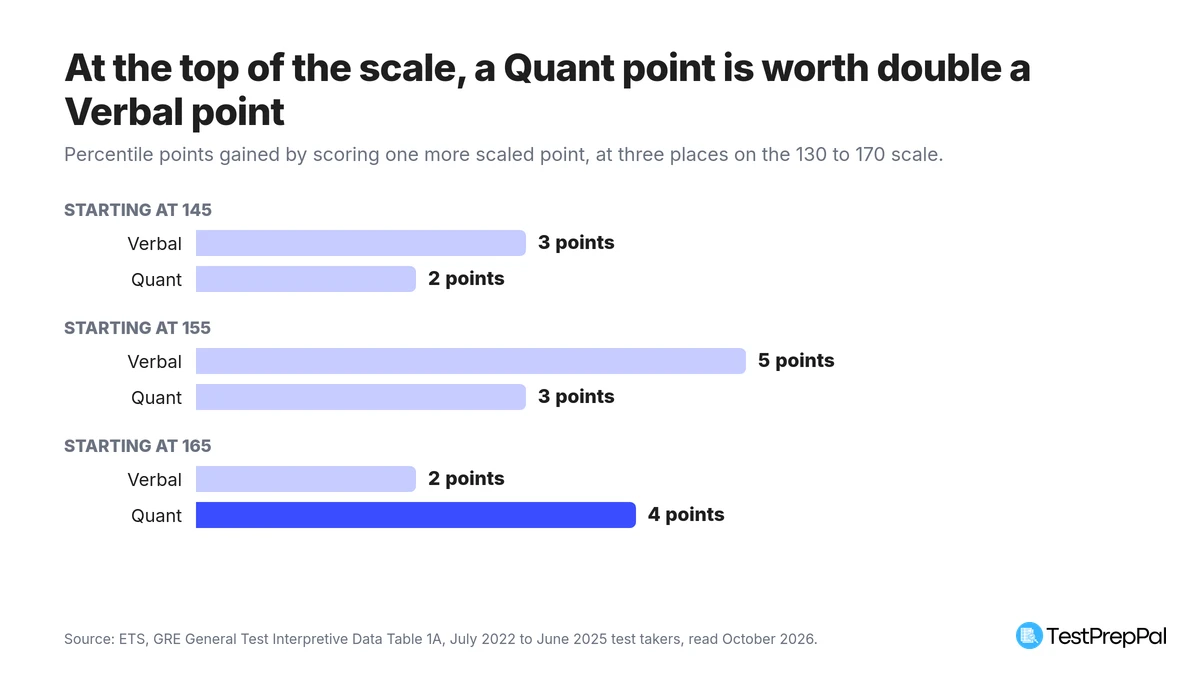 Percentile points gained by scoring one more scaled point. Source: ETS Interpretive Data Table 1A, July 2022 to June 2025 test takers.
Averaged across ten-point bands, the pattern is consistent:
| Band | Verbal, percentile points per scaled point | Quant, percentile points per scaled point |
|---|---|---|
| 141 to 150 | 2.9 | 1.8 |
| 151 to 160 | 4.3 | 2.7 |
| 161 to 170 | 1.7 | 3.9 |
Verbal pays best in the middle and flattens out at the top. Going from 152 to 153 moves you from the 48th percentile to the 54th, six percentile points for one question or two. Going from 167 to 168 moves you from the 97th to the 98th. Same single point, one sixth of the standing.
Quant runs the other way. A point at the bottom of the scale is worth less than two percentile points, but 167 to 168 moves you from the 75th percentile to the 80th, five points in one step.
The practical read: if you are sitting mid-scale in both sections, verbal points are cheaper standing. If you are already above 160 in both, quant is where the remaining movement is. Running your own numbers through the GRE score percentile calculator will show you which side of that line you are on before you commit study weeks to one section.
That is a scoring fact, not a study plan. Which section is actually easier for you to improve is a separate question, and it depends on your own weaknesses and the material in front of you. A good GRE prep course will diagnose that before you pick a target.
Where 300 and 320 fall inside the range
The middle of the 260 to 340 band is 300, and that is the number most people reach for as a benchmark. It is below average on both sections.
A 300 built as 150 verbal and 150 quant is the 39th percentile in verbal and the 23rd in quant. The two section means added together come to 309.01, so the average test taker scores about 309, nine points above the midpoint of the range. The scale is not centered on the test-taking population.
| Total | A typical split | Verbal percentile | Quant percentile |
|---|---|---|---|
| 300 | 150 and 150 | 39th | 23rd |
| 309 | 151 and 158 | 43rd | 45th |
| 320 | 160 and 160 | 82nd | 50th |
| 340 | 170 and 170 | 99th | 89th |
The 320 row is the one worth sitting with. The same scaled score, 160, is the 82nd percentile in verbal and exactly the 50th in quant. Two applicants can both report a 320 and be in completely different positions, depending on how it splits. One with 165 verbal and 155 quant is a different candidate from one with 155 verbal and 165 quant, and no total tells them apart.
This is why a target total is a weaker tool than a pair of section targets. Our guide to what counts as a good GRE score works through setting those two targets by field.
If you are still choosing when to sit the exam, the GRE test dates guide covers the scheduling windows, and the rest of our GRE resources cover prep from there.
GRE score range FAQs
Is 340 possible on the GRE?
Yes. A 340 is 170 on verbal plus 170 on quant, both at the top of the scale. The two halves are not equally rare: a 170 in verbal is the 99th percentile, while a 170 in quant is the 89th. The quant ceiling is crowded enough that a perfect score still leaves roughly one in nine test takers at your level. Our guide to the highest GRE score works out how rare a 340 is from those two numbers, and which fields produce the most perfect quant scores.
Is a 4.0 on GRE analytical writing good?
A 4.0 is the 63rd percentile, above the 3.46 mean, so it is an above-average result. It is also reported entirely separately from your 260 to 340 total, so it neither raises nor lowers that number. For context, 4.5 is the 85th percentile and 3.5 is the 40th, so the half-point steps near the middle of the writing scale move you a long way.
What is the GRE quant percentile for a 159?
A 159 in quantitative reasoning is the 47th percentile, just below the median. The same 159 in verbal is the 79th percentile. That 32-point gap between sections for one scaled score is the clearest illustration of why the two scales cannot be read interchangeably.
Is a 300 GRE score hard to get?
A 300 sits at the midpoint of the 260 to 340 range but below the average on both sections. Split evenly as 150 and 150, it is the 39th percentile in verbal and the 23rd in quant, and the combined section means come to about 309. The midpoint of the range and the middle of the test-taking population are not the same place.
We may earn commissions from some links on this page, but this does not affect our reviews or your experience.