


There is no GRE date calendar to check, because ETS sells appointments 24 hours a day, 365 days a year at more than 1,000 test centres and at home. So the question that actually decides your booking is not which dates exist, it is how late you can sit and still have scores in front of an admissions committee.
The answer is your deadline minus 10 days if you name your schools on test day, and your deadline minus 38 days if you want room for one retake and want to see the score before you send it.
- The GRE General Test has no fixed date list. Appointments run year round, at home and at test centres.
- Official scores reach your ETS account and your designated schools 8 to 10 days after the test.
- Name your four free score recipients on test day and the last safe appointment is your deadline minus 10 days.
- Order the reports later instead and ETS needs about five business days on top, which pushes the last safe date to minus 17.
- Leaving room for one retake means testing at least 31 days before the deadline, or 38 if you also want to choose recipients afterwards.
- All five permitted attempts fit inside 84 days, so the five-attempt cap bites long before the 21-day gap does.
Our recommended GRE prep course:

Target Test Prep GRE
Deep quant and verbal coverage with 4,000+ practice questions. Try full access for 5 days.
No code neededPros
- 4,000+ practice questions with 2,000+ video explanations
- Strong analytics, error tracking, and custom test builder
- 320+ GRE score guarantee framework
Cons
- Verbal depth can feel secondary to quant
There is no GRE date calendar, and that is the answer
The computer-delivered GRE General Test replaced the old fixed-date model years ago. ETS lists availability rather than dates: at-home appointments around the clock, and test-centre appointments most days of the week depending on the location. Seats are first come, first served, so a popular Saturday morning in a big city fills earlier than a Tuesday afternoon, but there is no month of the year when the test is simply unavailable.
That is why pages promising a 2026 to 2027 GRE schedule have nothing to put in the table. The ones that rank for this search either hand you the ETS booking widget or fill the space with prep products, because the dates they promise do not exist to list.
The one part of the GRE that does run on fixed dates is the Subject Tests, and those are covered further down. For the General Test, the constraint is never supply. It is the calendar behind your applications.
The last date you can still sit
Start from your earliest application deadline and count backwards. Three ETS numbers do all the work, and the order you apply them decides which of four answers you get.
The first number is the score window. Official scores appear in your ETS account 8 to 10 days after your test date, and ETS sends the official Institution Score Report to the recipients you designated on test day at that same moment. Plan on 10 rather than 8. A plan built on the fast end of a range has no margin in it.
The second number is the one almost nobody applies. If you did not name a school on test day, you order an Additional Score Report afterwards, and the GRE Information Bulletin says those reports go out approximately five business days after the order is placed. Five business days ordered on any weekday spans exactly one weekend, so it is seven calendar days. Order on a Monday and it lands the following Monday.
The third number is the retake gap, which is 21 days. That is the next section.
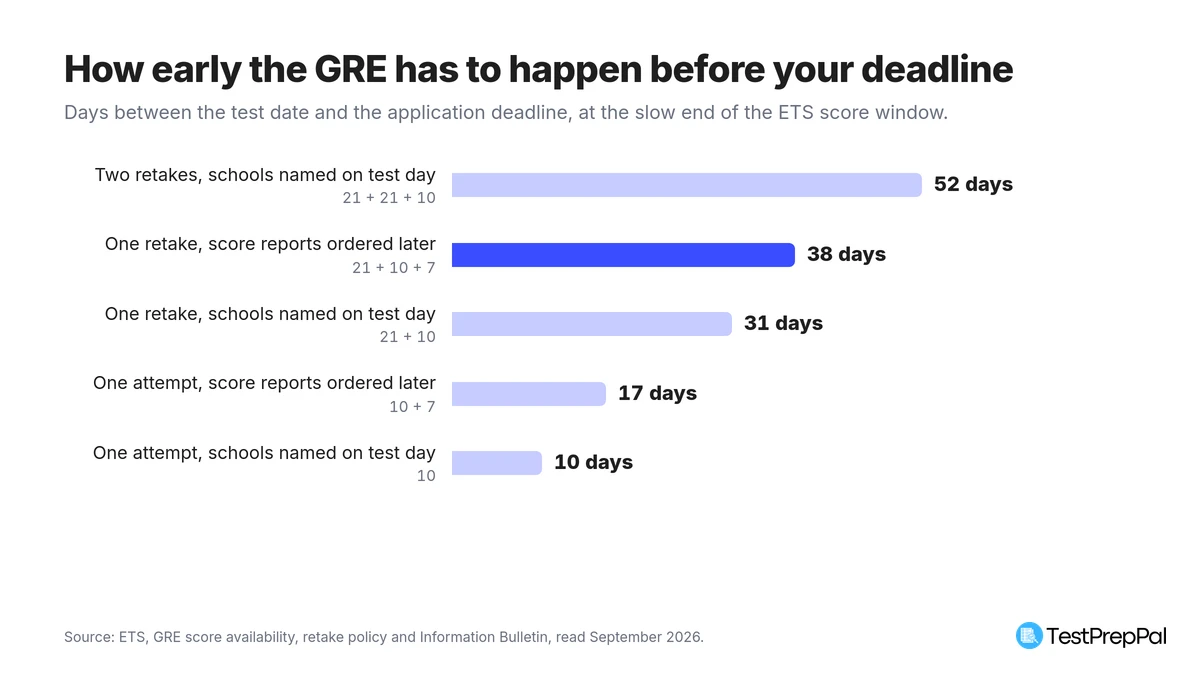 Days between the test date and the deadline, at the slow end of the ETS score window. Source: ETS score availability, retake policy and Information Bulletin.
Put together, the four rules look like this. Day 0 is your test date.
| Your plan | The arithmetic | Last safe appointment |
|---|---|---|
| One attempt, schools named on test day | 10 | Deadline minus 10 days |
| One attempt, reports ordered after you see the score | 10 + 7 | Deadline minus 17 days |
| One attempt plus one retake, schools named on test day | 21 + 10 | Deadline minus 31 days |
| One attempt plus one retake, reports ordered afterwards | 21 + 10 + 7 | Deadline minus 38 days |
| One attempt plus two retakes, schools named on test day | 21 + 21 + 10 | Deadline minus 52 days |
Two things sit outside the arithmetic and should push you earlier still. ETS notes on its scheduling page that electronic score reports go out to schools twice a week, so a report that leaves ETS on a Thursday may not be delivered the same day. And the school itself has to attach your report to your file, which is its own queue in the busiest week of its year.
Your deadline, and the date to stop booking
Graduate deadlines cluster on the same handful of dates every cycle. Here are the four rules applied to the five most common ones for autumn 2027 entry.
| Application deadline | One attempt, named on test day | One attempt, reports ordered later | With one retake | With one retake, reports later |
|---|---|---|---|---|
| December 1, 2026 | Nov 21, 2026 | Nov 14, 2026 | Oct 31, 2026 | Oct 24, 2026 |
| December 15, 2026 | Dec 5, 2026 | Nov 28, 2026 | Nov 14, 2026 | Nov 7, 2026 |
| January 1, 2027 | Dec 22, 2026 | Dec 15, 2026 | Dec 1, 2026 | Nov 24, 2026 |
| January 15, 2027 | Jan 5, 2027 | Dec 29, 2026 | Dec 15, 2026 | Dec 8, 2026 |
| February 1, 2027 | Jan 22, 2027 | Jan 15, 2027 | Jan 1, 2027 | Dec 25, 2026 |
Read your own deadline row and the booking decision stops being a guess. A January 15 deadline with a retake in the plan means the first attempt belongs in mid-December, not in January.
Three cells in that table fall inside the holiday period: December 25, December 29 and January 1. Business days stretch over those weeks, so treat those as the outer edge and add a week if you can. If your deadline row lands somewhere uncomfortable, a realistic GRE study plan built backwards from the date is more useful than a fixed twelve-week schedule that ignores it.
Before you book anything, check whether your programs need the test at all. PA applicants in particular should look first: of the seven programs we checked this October, six ask for no GRE, and the deadlines that matter there are the CASPA ones, not the ETS ones. Our list of PA schools that do not require the GRE shows how to confirm it for your own list before paying a registration fee.
Sponsored
Target Test Prep GRE
Deep quant and verbal coverage with 4,000+ practice questions. Try full access for 5 days.
No code neededPros
- 4,000+ practice questions with 2,000+ video explanations
- Strong analytics, error tracking, and custom test builder
- 320+ GRE score guarantee framework
Cons
- Verbal depth can feel secondary to quant
The retake budget runs out faster than the calendar does
The ETS registration page sets the rule: one General Test every 21 days, up to five in any continuous rolling 12-month period of 365 days, and the cap counts attempts where you cancelled your scores. Most people read that as a generous allowance. Run the arithmetic and it is not.
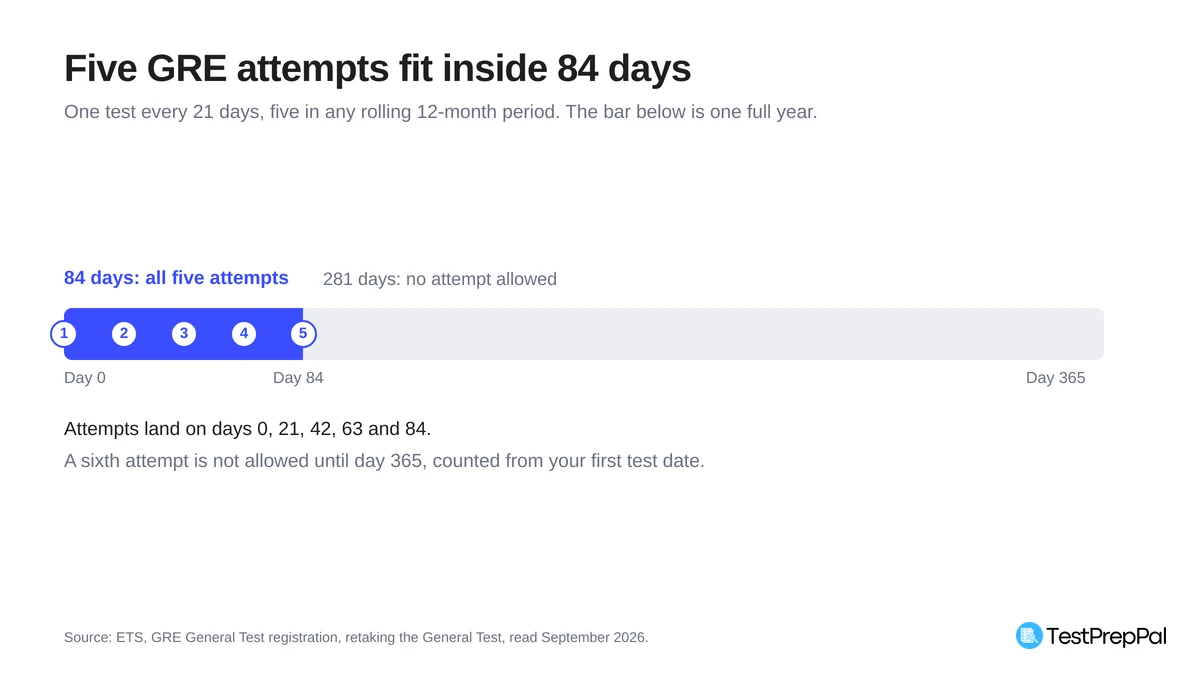 One test every 21 days, five in any rolling 12 months. Source: ETS GRE General Test registration, retaking the General Test.
Attempts at the legal minimum spacing land on days 0, 21, 42, 63 and 84. That is 12 weeks to spend the entire year's allowance, after which nothing is available until day 365 from the first attempt. Someone who panics in September and books three quick attempts has burned most of a cycle's flexibility before the deadline even arrives.
The practical reading: the 21-day rule almost never blocks you, and the five-attempt cap almost always can. Space attempts by what your practice scores are actually doing, not by what the rules permit. If two attempts have produced the same result, the third will usually produce it again, and our guide to what a good GRE score is explains why gaps inside the ETS measurement error are not worth another $249.
What changing your mind costs
Once an appointment is booked, the money and the deadlines both get real. Current ETS fees, effective August 1, 2026, are $249 for the General Test worldwide and $231.30 in Mainland China. Prep sites still quoting $220 are quoting a superseded fee.
| Change | Cost | Deadline |
|---|---|---|
| Reschedule your appointment | $55 ($53.90 in Mainland China) | Four days before test day, 10 in Mainland China |
| Change your test centre | $55 | Same as rescheduling |
| Cancel your registration | Refund of half the test fee | Four days before test day, 10 in Mainland China |
| Additional Score Report | $40 per recipient | Arrives about five business days after ordering |
The four-day rule is counted in whole days, and the Bulletin gives the example directly: the last day to move a Saturday appointment in the United States is the Tuesday before. Miss it and the entire test fee is forfeited, not just the change fee.
That four-day rule is also the reason the backward math matters before you pay. Booking a date that is too late and then rescheduling costs $55 and moves you further from the deadline. Booking early and rescheduling forwards costs the same $55 but keeps every option open.
Notice what the $40 Additional Score Report does to the second and fourth rows of the earlier table. Holding your scores back to see them first costs seven days and $40 per school, which for six programmes is $240 on top of the test. Sending on test day is free for four recipients. The trade is real, and it is worth deciding before test day rather than in the two minutes the screen gives you at the end of the exam. Our GRE score percentiles guide and the score percentile calculator will tell you in advance roughly what result would be worth sending unseen.
GRE Subject Test dates are real dates
The Subject Tests are the part of the GRE that still runs on a schedule. ETS offers them two weeks per month in September, October and April at computer-delivered centres worldwide, and at home on selected dates inside those windows. The Bulletin publishes the windows with their score reporting dates.
| Subject Test window | Scores reported |
|---|---|
| September 14 to September 27, 2026 | October 5, 2026 |
| October 19 to November 1, 2026 | November 9, 2026 |
| April 19 to May 2, 2027 | May 10, 2027 |
Those score dates are fixed rather than counted from your own test day, which changes the planning entirely. Sit on September 14 or on September 27 and the report still arrives on October 5. If your programme wants a Subject Test, the October window is the last one that clears a December 1 deadline, and after that the next opportunity is April, which is a whole cycle late. Check the requirement on the GRE exam hub before you assume you need one, because most programmes no longer ask.
GRE test date FAQs
How often are GRE exams offered?
The General Test is offered year round: at home 24 hours a day, seven days a week, and at test centres on most days of the week depending on the centre. Availability is a seat-booking question, not a calendar question. The Subject Tests are different, running for two weeks per month in September, October and April only.
Can I take the GRE twice in one month?
Not within a calendar month in most cases. ETS requires 21 days between attempts, so two tests can fall 21 days apart but not 20. Sit on the 1st and the earliest retake is the 22nd, which does fit inside a 31-day month. Sit on the 15th and the retake falls on the 5th of the following month.
How long does it take to get GRE scores?
Official scores reach your ETS account 8 to 10 days after the test date, and the schools you designated on test day receive their reports at the same time. If you did not designate anyone on test day, add about five business days for ETS to process the Additional Score Report, which is seven calendar days in practice.
How far in advance should I register for the GRE?
Far enough to sit on or before your deadline minus 10 days, or minus 38 if you want a retake and want to choose recipients afterwards. Beyond that, booking early matters for seat choice rather than availability: preferred centres, mornings and Saturdays go first. Booking a date you can reach with your prep is the real constraint, and a GRE prep course with a fixed syllabus makes that date easier to name.
Do GRE scores expire before my deadline?
No. GRE scores stay reportable for five years following the test date, so a score from a previous cycle is still usable. What does expire is your retake allowance: five attempts in any rolling 12-month period, counted from your first test date rather than from January 1.
We may earn commissions from some links on this page, but this does not affect our reviews or your experience.