


The GRE General Test takes about 1 hour and 58 minutes of testing time, across five sections with no breaks. The number you actually need for your calendar is larger: about 2 hours 28 minutes at a test centre, and 2 hours 18 to 2 hours 28 minutes at home, because check in happens before the clock starts.
That gap is the whole point of this page. ETS publishes the 1:58 on one page and the check-in rules on two others, and almost nobody adds them together.
- Testing time is 1 hour 58 minutes: a 30-minute essay, two Verbal sections (18 and 23 minutes) and two Quant sections (21 and 26 minutes).
- There are no breaks. At a test centre an unscheduled break does not stop the clock, and at home breaks are not allowed at all.
- At a test centre, ETS tells you to arrive at least 30 minutes early, which makes 2 hours 28 minutes the realistic block.
- At home, check in opens 15 minutes before your appointment and takes about 20 to 30 minutes, so testing usually starts after the time on your booking.
- You answer 54 scored questions plus one essay, which works out to about 90 seconds per Verbal question and 105 seconds per Quant question.
- The test was shortened on 22 September 2023, from about 3 hours 45 minutes. Pages quoting the old figure are describing a test that no longer exists.
Our recommended GRE prep course:

Target Test Prep GRE
Deep quant and verbal coverage with 4,000+ practice questions. Try full access for 5 days.
No code neededPros
- 4,000+ practice questions with 2,000+ video explanations
- Strong analytics, error tracking, and custom test builder
- 320+ GRE score guarantee framework
Cons
- Verbal depth can feel secondary to quant
The GRE is 1 hour and 58 minutes of testing time
Five sections, and the order is only partly fixed. ETS always puts Analytical Writing first, and the two Verbal Reasoning and two Quantitative Reasoning sections can appear in any order after it. So you will not know whether section two is Verbal or Quant until it loads.
| Section | Questions | Time |
|---|---|---|
| Analytical Writing | One "Analyze an Issue" task | 30 minutes |
| Verbal Reasoning 1 | 12 questions | 18 minutes |
| Verbal Reasoning 2 | 15 questions | 23 minutes |
| Quantitative Reasoning 1 | 12 questions | 21 minutes |
| Quantitative Reasoning 2 | 15 questions | 26 minutes |
| Total | 54 questions plus 1 essay | 118 minutes |
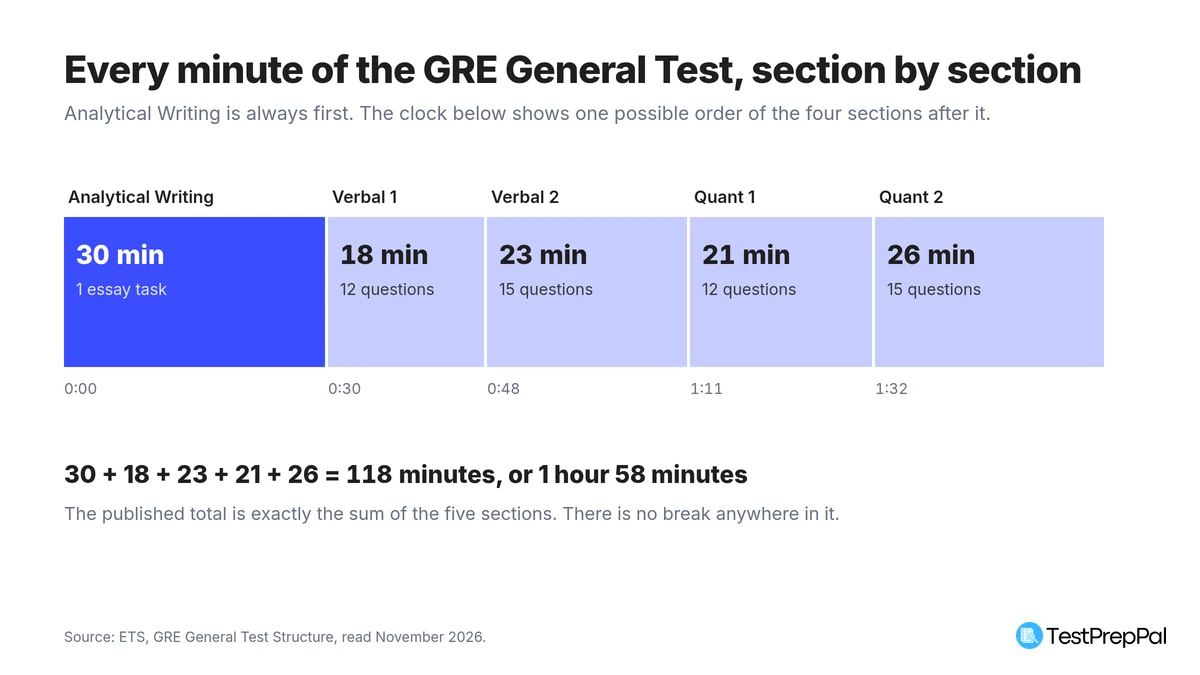 The five sections of the GRE General Test and their allotted times. Source: ETS, GRE General Test Structure.
Add the five section times and you get 30 + 18 + 23 + 21 + 26 = 118 minutes, which is exactly 1 hour 58 minutes. That matters more than it looks. The published total is not an estimate with padding in it, and it is not a seat time. It is the sum of the five timers, with nothing between them.
The second section of each measure is also the adaptive one. ETS sets the first Verbal and Quant section at average difficulty and chooses the difficulty of the second based on how you did on the first. The timing does not change either way, so a harder second section is not a longer one.
Testing time is not the time you need to block out
Here is where every other page on this query stops, and where your planning actually starts.
If you test at a centre, ETS tells you to arrive at least 30 minutes before your test time to allow for check in, and warns that arriving late can mean not being admitted with the fee forfeited. That 30 minutes is not optional padding. It is where staff take your photo, verify your ID, and may ask you to empty your pockets, raise your sleeves and pant legs, give a voice sample, remove your glasses for inspection, or be scanned with a metal detector wand. You also read and sign a confidentiality statement before you can test.
30 minutes of check in plus 118 minutes of testing is 148 minutes, or 2 hours 28 minutes. That is the floor, not the average.
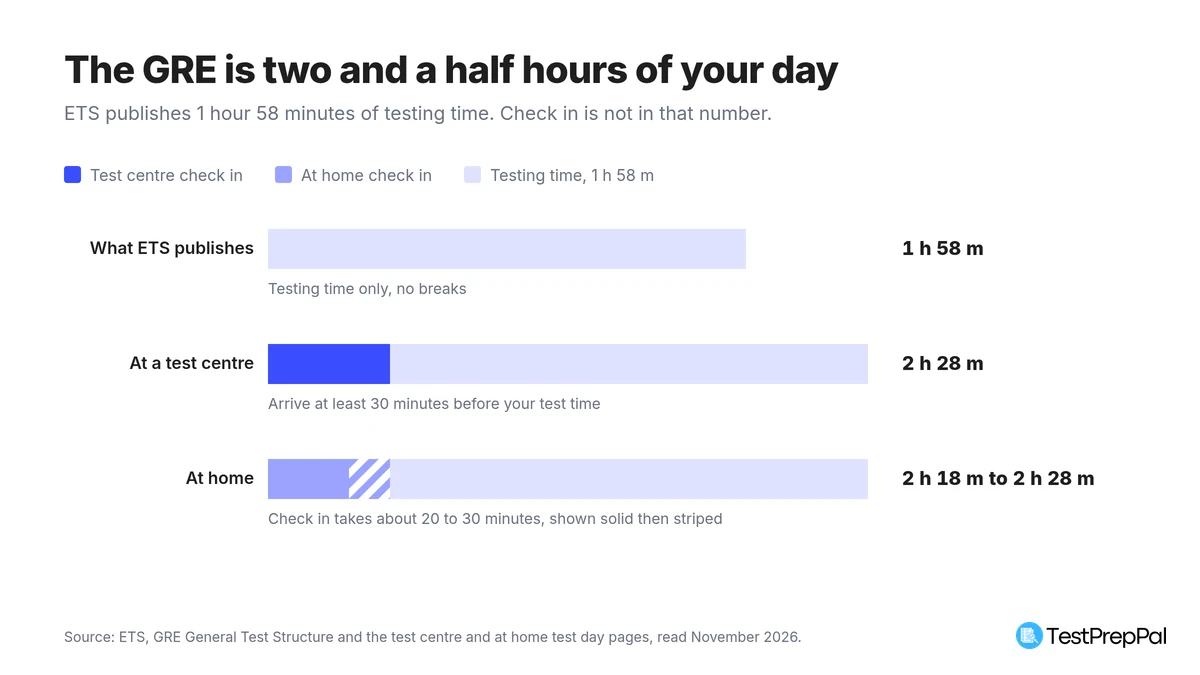 The same 118 minutes of testing in all three bars. The difference is check in. Source: ETS test structure and test day pages.
At home the shape is the same and the arithmetic is slightly kinder. ETS says to expect the at-home check-in process to take approximately 20 to 30 minutes, which puts your total at 138 to 148 minutes, or 2 hours 18 to 2 hours 28 minutes. Either way, two and a half hours is the honest number to put in a calendar.
Neither figure includes what happens after the last section. You are offered the choice to report or cancel your scores, shown your unofficial Verbal and Quant scores, and asked to name up to four score recipients and pick a ScoreSelect option. ETS does not publish a duration for those screens, so treat them as a few extra minutes rather than guessing.
Plan on two and a half hours of your day for a 1 hour 58 minute test. If you are booking a morning slot before work or a class, that is the number that decides whether the slot works.
At home, your test does not start at your appointment time
This one catches people out, and it comes straight from two ETS numbers on the same page.
The same ETS at-home test day page says check in opens 15 minutes before your scheduled test time, through the At Home Check-In link in your confirmation email, and you can connect with a proctor from 5 minutes before your scheduled time up to 15 minutes after. The check-in process itself takes about 20 to 30 minutes. Subtract the 15-minute head start and you get 5 to 15 minutes: that is roughly how far past your booked time the testing clock typically starts.
So a 9:00 a.m. at-home appointment is really an 8:45 a.m. start for you and a 9:05 to 9:15 a.m. start for the test. If someone is picking you up at 11:00, that matters.
What fills those 20 to 30 minutes is proctor work, not computer setup. You show your ID, set up a second camera, hold a mirror or phone to display your screen, give a 360-degree camera sweep of the room including your tabletop, and launch the ETS Secure Browser while the proctor reviews the rules. You may also be asked for a voice sample.
Two deadlines sit before test day and neither shows up in testing time. You have to verify your identity through the IDVaaS app at least 72 hours before your test, and ETS warns that late verification may delay your check in. You also need the Secure Browser installed and the Equipment Check passed, with every issue resolved before your appointment time. Book an at-home slot less than three days out and that 72-hour window is the first thing to sort out, well before you worry about when your scores arrive.
Sponsored
Target Test Prep GRE
Deep quant and verbal coverage with 4,000+ practice questions. Try full access for 5 days.
No code neededPros
- 4,000+ practice questions with 2,000+ video explanations
- Strong analytics, error tracking, and custom test builder
- 320+ GRE score guarantee framework
Cons
- Verbal depth can feel secondary to quant
What 118 minutes buys you per question
Divide the time by the questions and the GRE's pacing becomes concrete.
| Section | Questions | Time | Seconds per question |
|---|---|---|---|
| Verbal Reasoning 1 | 12 | 18 minutes | 90 seconds |
| Verbal Reasoning 2 | 15 | 23 minutes | 92 seconds |
| Quantitative Reasoning 1 | 12 | 21 minutes | 105 seconds |
| Quantitative Reasoning 2 | 15 | 26 minutes | 104 seconds |
The useful finding is how flat those columns are. Verbal gives you about 90 seconds a question in both sections, Quant about 105 seconds in both. The second section of each measure is longer, but it is longer in proportion to the extra questions, so your target pace never changes mid-test. One pace for Verbal, one for Quant, and the adaptive difficulty does not buy you extra seconds.
That is a clean thing to rehearse. Work through timed sets at 90 and 105 seconds a question rather than watching a section clock, and you will know within a few questions whether you are behind. Our free GRE practice questions are a reasonable place to drill that, and full-length sittings from a GRE practice test are where you find out whether the pace holds for 118 minutes with no break to reset.
One timing detail worth knowing: ETS provides an on-screen calculator for the Quantitative Reasoning sections. It is slow to use compared with mental arithmetic, so the 105 seconds includes any time you spend clicking. If you want to practise with the same constraint, our GRE calculator tool mirrors the on-screen version.
What changed in 2023, and why old timings still rank
Before 22 September 2023, the same ETS structure page records a test of about 3 hours 45 minutes across six sections, with a 10-minute break after the third. Analytical Writing had two 30-minute tasks instead of one. Each Verbal section had 20 questions and 30 minutes, each Quant section 20 questions and 35 minutes. The old structure also carried an unidentified unscored section and, in its place sometimes, an identified research section.
The shorter test cut roughly 107 minutes of testing time and 26 scored questions, and dropped one of the two essays. It is just over half the old length, which is why a 2023 Reddit thread asking whether the GRE had really been halved still ranks on page one of this search three years later. The answer is yes.
One correction worth making, because plenty of pages get it wrong. ETS's current structure table lists five sections and nothing else. The unscored and research rows appear only in its table for the pre-2023 test. The 118 minutes is the complete published picture, so do not plan for a surprise sixth section on the shorter GRE.
If you are weighing up what a shorter test means for your score, the length did not change the 130 to 170 scale, and what counts as a good GRE score is still read against the same GRE score percentiles. Fewer questions per section simply means each one carries more weight, which is an argument for pacing practice rather than for more content review. If you want a structured plan for that, start with our GRE prep course reviews or the wider GRE resource hub.
How long is the GRE FAQs
Is the GRE only 2 hours now?
Close to it. The GRE General Test has been 1 hour 58 minutes of testing time since 22 September 2023, down from about 3 hours 45 minutes. That is testing time only, though. With the 30-minute test-centre arrival rule or the 20 to 30 minute at-home check in, plan on about two and a half hours in total.
How many questions is the GRE?
54 scored questions plus one essay task. They split evenly into 27 Verbal Reasoning questions and 27 Quantitative Reasoning questions, each measure delivered as a 12-question section followed by a 15-question section. The Analytical Writing section is a single "Analyze an Issue" task.
How long is the GRE at home?
The testing time is identical at 1 hour 58 minutes. The difference is the front end: instead of arriving 30 minutes early at a centre, you start check in 15 minutes before your appointment and the proctor process takes about 20 to 30 minutes. Budget 2 hours 18 to 2 hours 28 minutes from clicking the check-in link to finishing the last section.
Are there any breaks during the GRE?
No. ETS states plainly that the testing time is 1 hour 58 minutes and there are no breaks. At a test centre you can take an unscheduled break, but the clock keeps running and you lose the time. During the at-home test, unscheduled breaks are not permitted at all.
We may earn commissions from some links on this page, but this does not affect our reviews or your experience.