


The GRE General Test asks you to prepare for four Quantitative Reasoning content areas, three Verbal Reasoning question types and one 30-minute essay. ETS publishes 28 topic lines under those four Quant areas, and this page lists every one of them, section by section.
Most pages ranking for this search are either a list of books to buy or a schedule telling you to take a practice test every two weeks. Neither tells you what is on the test. This one does, including the four things ETS states are not on it.
- Quantitative Reasoning covers four content areas: arithmetic, algebra, geometry and data analysis. ETS lists 28 topic lines across them.
- Geometry carries the longest list at 12 of those 28 lines. That is how ETS divides the subject up, not a share of the questions you will see.
- Verbal Reasoning has three question types but five answer formats, and three of the five give no credit at all for a partially correct answer.
- Analytical Writing is a single 30-minute "Analyze an Issue" task, and ETS publishes the entire topic pool your task will be drawn from.
- Trigonometry, calculus, proof construction and inferential statistics are not tested. ETS says so in plain words on its own content pages.
- The maths goes no higher than a second course in algebra, so the job is breadth and accuracy rather than advanced technique.
Our recommended GRE prep course:

Target Test Prep GRE
Deep quant and verbal coverage with 4,000+ practice questions. Try full access for 5 days.
No code neededPros
- 4,000+ practice questions with 2,000+ video explanations
- Strong analytics, error tracking, and custom test builder
- 320+ GRE score guarantee framework
Cons
- Verbal depth can feel secondary to quant
The five sections, and what each one asks of you
Start with the shape of the test, because it decides how much of each topic you can afford to study.
| Section | What it asks | Questions | Time |
|---|---|---|---|
| Analytical Writing | Build an argument on a given opinion | One "Analyze an Issue" task | 30 minutes |
| Verbal Reasoning 1 | Read passages, complete sentences | 12 questions | 18 minutes |
| Verbal Reasoning 2 | Same, harder or easier based on section 1 | 15 questions | 23 minutes |
| Quantitative Reasoning 1 | Arithmetic, algebra, geometry, data analysis | 12 questions | 21 minutes |
| Quantitative Reasoning 2 | Same, harder or easier based on section 1 | 15 questions | 26 minutes |
That is 54 scored questions plus one essay in about 1 hour 58 minutes, split evenly at 27 Verbal and 27 Quant. Analytical Writing always comes first. The two Verbal and two Quantitative sections can appear in any order after it, so you cannot plan to warm up on one measure before the other.
The second section of each measure is section-level adaptive. ETS sets the first Verbal and first Quant section at average difficulty and picks the difficulty of the second from how you did on the first. For study purposes that means there is no easy half of the test to coast through, and no topic you can skip on the grounds that it only shows up late.
If you want the timing in more depth, we have broken down how long the GRE takes including check in. This page is the other half of that question: not when you sit, but what you need to know when you do. For turning the list below into dates, use the GRE study plan generator.
Quantitative Reasoning: the 28 topics ETS publishes
ETS groups Quant into four content areas and lists what sits under each. Here is the complete list, not a selection.
Arithmetic, 3 topic lines
- Properties and types of integers: divisibility, factorization, prime numbers, remainders, odd and even integers
- Arithmetic operations, exponents and roots
- Estimation, percent, ratio, rate, absolute value, the number line, decimal representation and sequences of numbers
Algebra, 7 topic lines
- Operations with exponents
- Factoring and simplifying algebraic expressions
- Relations, functions, equations and inequalities
- Solving linear and quadratic equations and inequalities
- Solving simultaneous equations and inequalities
- Setting up equations to solve word problems
- Coordinate geometry: graphs of functions, equations and inequalities, intercepts and slopes of lines
Geometry, 12 topic lines
- Parallel and perpendicular lines
- Circles
- Triangles, including isosceles, equilateral and 30-60-90 triangles
- Quadrilaterals
- Other polygons
- Congruent and similar figures
- Three-dimensional figures
- Area
- Perimeter
- Volume
- The Pythagorean theorem
- Angle measurement in degrees
Data analysis, 6 topic lines
- Descriptive statistics: mean, median, mode, range, standard deviation, interquartile range, quartiles and percentiles
- Interpreting tables and graphs: line graphs, bar graphs, circle graphs, boxplots, scatterplots and frequency distributions
- Elementary probability, including compound and independent events
- Conditional probability
- Random variables and probability distributions, including normal distributions
- Counting methods: combinations, permutations and Venn diagrams
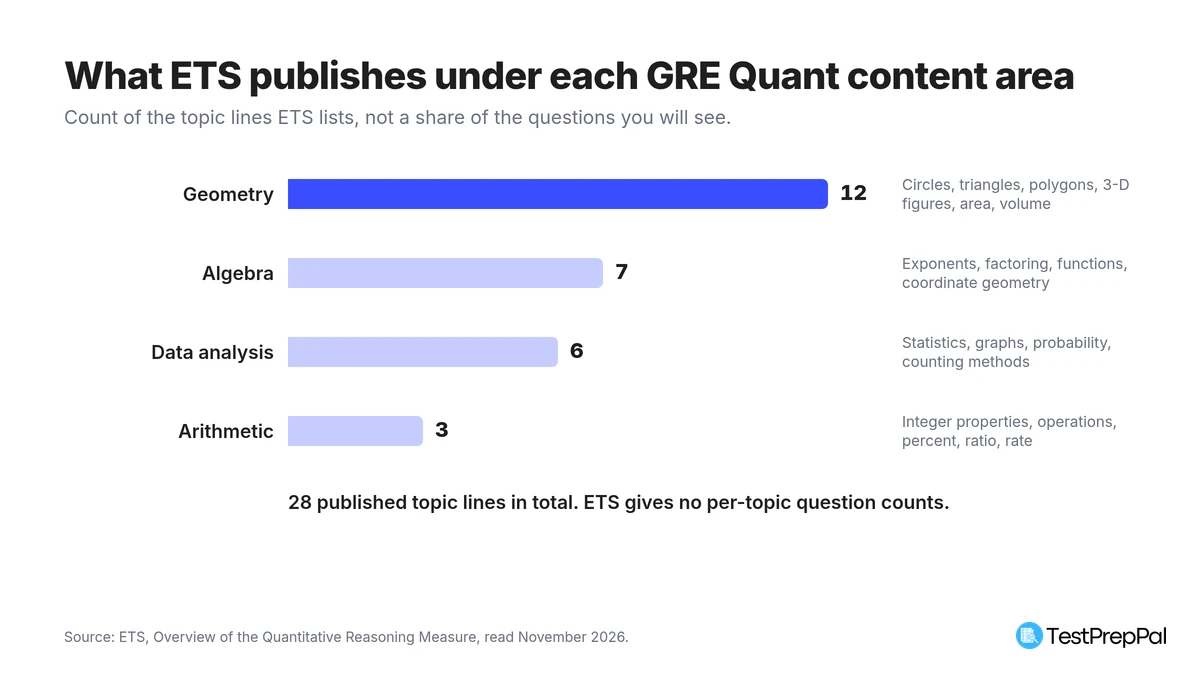 Topic lines ETS publishes under each Quant content area. Source: ETS, Overview of the Quantitative Reasoning Measure.
Add those up and you get 3 plus 7 plus 12 plus 6, or 28 topic lines. Geometry is 12 of them, which is 43 percent of the list.
Here is the part worth being careful about, because it is where a lot of study advice goes wrong. That 43 percent is a share of ETS's bullet points, not a share of the questions. ETS publishes no per-topic question counts anywhere, so the honest reading is that geometry is the area ETS breaks into the most named pieces, and nothing more. Study it because the list is long and a long list takes time to cover, not because you have been told it dominates the section.
Treat these 28 lines as a checklist with a tick next to each one. The value of a published inventory is that it ends: you can know you have covered it, which you cannot do with a list someone curated for you.
The level is fixed too. ETS says the content is high school mathematics and statistics generally no higher than a second course in algebra. So if a technique feels advanced, you have probably over-complicated the question rather than found a gap in your preparation. Drill the list with our free GRE practice questions, and get used to the on-screen calculator, which is provided for Quant and is slower than mental arithmetic, using our GRE calculator tool.
One more rule from the same page that changes how you draw diagrams. Geometric figures are not necessarily drawn to scale, so you cannot measure or eyeball a length or an angle. Coordinate systems and graphical data presentations such as bar, circle and line graphs are drawn to scale, so on those you can read and estimate by sight.
What the GRE does not test
This is the shortest section on the page and probably the most useful, because no ranking page states it.
ETS rules out four things on its own content pages:
- Trigonometry, calculus and other higher-level mathematics
- Constructing proofs, which it says plainly is not tested
- Inferential statistics
- Specific content knowledge in the essay, which tests how you argue rather than what you know
If you studied maths at university and are planning to revisit calculus before the GRE, you can delete that from your plan today. Every hour there is an hour not spent on the 28 lines that are actually on the test. That reallocation is usually worth more than any new resource, and it is a large part of why the GRE is less difficult than its reputation suggests for people who prepare against the published list.
Nine answer formats, and the three with no partial credit
Topics are only half of what to study. The other half is the shape of the answer, and there are nine distinct shapes.
Quant has four question types. Quantitative Comparison gives you two quantities and the same four choices every time, including "the relationship cannot be determined from the information given". Then there are multiple-choice questions where you select one answer, multiple-choice questions where you select one or more, and Numeric Entry questions where you type the number. Any of them can appear on its own or inside a Data Interpretation set, where several questions share one table or graph.
Verbal has five formats across its three question types, and the scoring difference between them matters.
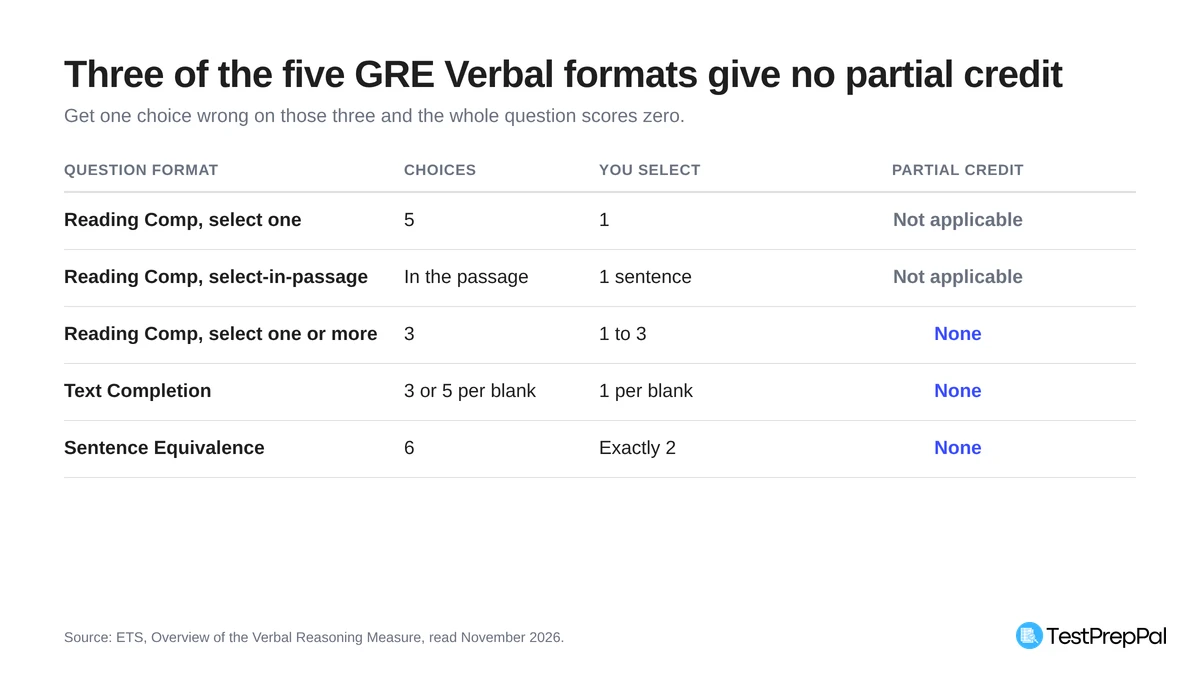 The five GRE Verbal answer formats. Source: ETS, Overview of the Verbal Reasoning Measure.
Three of those five give no credit for a partially correct answer. On a Reading Comprehension select-one-or-more question there are three choices and anywhere from one to three are correct, and you need all of them. On Text Completion, a passage of one to five sentences has one to three blanks, with three choices per blank when there are two or three blanks and five choices when there is only one, and every blank has to be right. On Sentence Equivalence you pick exactly two of six choices, and both have to be right.
That is a drilling instruction, not a trivium. A Text Completion question with three blanks is effectively three questions that score as one. Hit 80 percent per blank and you score the whole question about half the time, because 0.8 cubed is 0.512. Work them in free GRE verbal practice questions until you are checking every blank against the finished sentence before you move on.
Sponsored
Target Test Prep GRE
Deep quant and verbal coverage with 4,000+ practice questions. Try full access for 5 days.
No code neededPros
- 4,000+ practice questions with 2,000+ video explanations
- Strong analytics, error tracking, and custom test builder
- 320+ GRE score guarantee framework
Cons
- Verbal depth can feel secondary to quant
Verbal Reasoning: what to read, and what to memorise
About half of the Verbal measure is passage-based and about half asks you to complete sentences, which works out to roughly 13 or 14 passage questions across the two sections.
Passages are mostly one paragraph long, with one or two running several paragraphs, and each carries one to six questions. ETS draws them from six subject areas: physical sciences, biological sciences, social sciences, business, arts and humanities, and everyday topics. No specialised knowledge is assumed, and every question is answerable from the passage alone, so unfamiliar subject matter is a reading problem rather than a knowledge gap.
That shapes what reading practice is for. You are not building background in six fields. You are building tolerance for dense prose you did not choose, which is why ETS suggests feature journalism and general-audience trade books rather than textbooks.
Vocabulary is the one place memorisation pays, because Text Completion and Sentence Equivalence both turn on knowing what a word means in context. Our list of GRE vocabulary words worth learning is organised for that, and it is a better use of early study time than any amount of passage skimming.
Analytical Writing: one task, and the pool is published
The Analytical Writing measure is a single 30-minute "Analyze an Issue" task. You are given an opinion on an issue and instructions on how to respond, and you evaluate it and build an argument with reasons and examples.
Two facts about it change how you prepare.
First, ETS publishes the entire Issue topic pool your task will be selected from. You cannot memorise hundreds of essays, but you can read widely across the pool, notice the handful of recurring instruction types, and practise building a position quickly rather than discovering the format on test day.
Second, the ETS word processor has insert, delete, cut-and-paste and undo, and that is all. There is no spellchecker and no grammar checker. If you draft everywhere else with one running, budget a few minutes at the end for a read-through, because persistent errors do pull the score down even though an occasional one does not.
The section does not assess content knowledge, so there is no reading list to get through here. Thirty minutes of planning and writing, done a handful of times against real prompts, is worth more than anything you could read about essays.
Where to get the official material free
Start with what the test maker publishes, because it is the only material guaranteed to match the list above.
ETS offers free POWERPREP practice tests, a 100-page Math Review and a Math Conventions document, plus sample questions for each measure. The Math Review is the natural companion to the 28 topic lines: work the inventory, and when a line is unfamiliar, read that part of the review rather than buying a book for it.
Once free material runs out, the question is whether you need a structured course or just more questions. Our GRE prep course reviews compare what each one actually includes, and the GRE practice test roundup covers where the realistic full-lengths come from. If you are still deciding what score you are aiming at, the GRE score range is the place to set that target before you build a plan. Everything else we have for this test sits on the GRE hub.
GRE study guide FAQs
What do I study for the GRE?
Four Quantitative Reasoning content areas (arithmetic, algebra, geometry and data analysis), three Verbal Reasoning question types (Reading Comprehension, Text Completion and Sentence Equivalence), and one 30-minute "Analyze an Issue" essay. ETS publishes 28 topic lines under the four Quant areas, listed in full above. It also rules out trigonometry, calculus, proofs and inferential statistics, so those do not belong in your plan.
Does the GRE test trigonometry or calculus?
No. ETS states that the Quantitative Reasoning content does not include trigonometry, calculus or other higher-level mathematics, and that the ability to construct proofs is not tested either. The content is high school mathematics and statistics, generally no higher than a second course in algebra.
Is 3 weeks enough to study for the GRE?
It depends entirely on how many of the 28 Quant topic lines you already own and how strong your vocabulary is. Three weeks is realistic for someone refreshing material they once knew well, and thin for someone meeting conditional probability or counting methods for the first time. Work through the inventory above, mark the lines you cannot already do, and build the schedule from that count rather than from a generic week number.
How much maths do you need for the GRE?
No more than a second course in high school algebra, by ETS's own description. The difficulty comes from translating word problems, working accurately under about 105 seconds per question, and the breadth of the 28 published topics, rather than from the level of any single technique.
We may earn commissions from some links on this page, but this does not affect our reviews or your experience.