

Best MCAT Study Tools in 2026

by John Reed· Last Updated: Oct 17, 2026
Start with the free AAMC study tools, because the exam maker's own content outline tells you what is tested before you spend anything. After that the choice is between jobs: Sketchy MCAT teaches science visually across 336 lessons, Pixorize does the same for two subjects at a fifth of the price, and Memm drills facts into memory with 2,600 cards and review sheets.
A study tool is not a course. None of these four writes a full-length practice exam of its own, and none of them is enough on its own. They sit beside the content review you are already doing, which is why what each one covers matters more than what it costs.
- Best free starting point: AAMC Free Study Tools, the official outline and the planning guides, at no cost.
- Best visual content review: Sketchy MCAT, from $249, deepest on biology and biochemistry.
- Best on a budget: Pixorize MCAT, 203 mnemonic images for $70 a year, biology and psychology only.
- Best for memorisation: Memm MCAT, cards plus interactive review sheets, priced by the month.
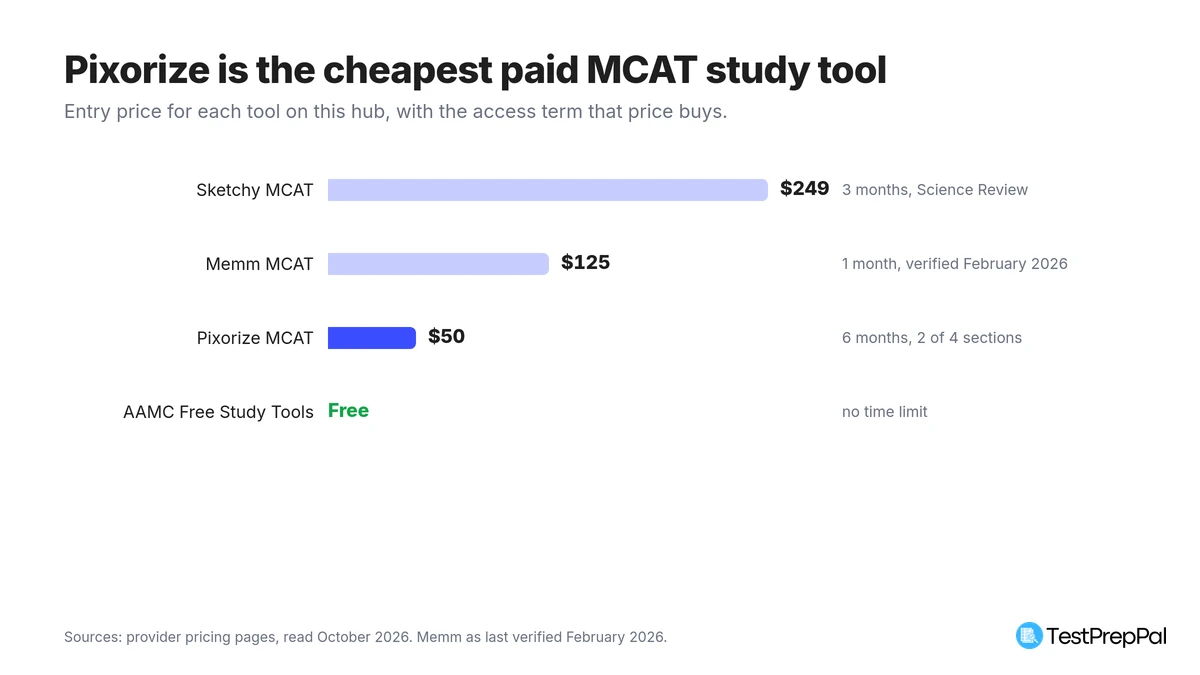 Entry price and the access term each one buys. AAMC, Pixorize and Sketchy read October 2026, Memm as last verified in February 2026.
MCAT Study Tools Comparison
| AAMC Free Study Tools | Pixorize MCAT | Sketchy MCAT | Memm MCAT | |
|---|---|---|---|---|
| Price | Free | $50 to $70 | $249 to $649 | From $125 a month, verified February 2026 |
| What it is | Official outline and planners | Visual mnemonic images | Visual mnemonic lessons | Flashcards and review sheets |
| Content volume | Outline, planner, Khan collection | 203 images, 21.3 hours of video | 336 lessons, 9 courses | 2,600+ cards |
| Practice questions | 120 free, plus 3,000 Khan review questions | None | 900+ quiz questions | None |
| Full-length exams | Paid separately | None | AAMC exams, top tier only | None |
| CARS material | Yes, diagnostic tool | None | Top tier only | None |
| Chemistry and physics | Yes, in the outline | None | Yes, 85 lessons | Cards only |
| Free trial | Free throughout | Try it Free, no length stated | 7 days | 7 days |
| Best for | Planning your prep | Biochemistry on a budget | Science that will not stick | Memorising facts fast |
Which MCAT Study Tool Should You Use?
You have not started yet: read the AAMC free study tools first. The content outline is the document every other product is a summary of, and it is free. Build the plan around it with our MCAT study schedule guide.
Biology and biochemistry will not stick: Sketchy MCAT puts 172 of its 336 lessons into those subjects, including 29 lessons on the nervous and musculoskeletal systems alone. It is the deepest visual teaching of the two subjects the exam leans on hardest.
Your budget is the constraint: Pixorize MCAT is $70 for a year, about a fifth of Sketchy's cheapest per-month rate, and its amino acid, endocrine and immunology playlists are the densest visual teaching of those topics on this hub. It covers two of the four scored sections and nothing else, so it is a supplement rather than a content plan.
You know the material but cannot recall it: Memm is the narrower tool. It does not teach, it drills, and a month of it is the fastest way to turn a content pass into retention.
Psychology and sociology is your weak section: Pixorize is the cheapest way to put visual teaching against it, with 54 of its 203 images there, though only 8 of those are sociology. Sketchy gives the section 49 lessons, the smallest share of its library against one of the biggest sections, and Memm's cards cover it without teaching it. Use the AAMC material and our free psych and soc practice questions to work out how far behind you are.
CARS is your weak section: no study tool fixes CARS. Sketchy locks its passage walkthroughs inside the $549 tier, and the MCAT CARS practice tools are the category built for it.
AAMC Free Study Tools
The association that writes the exam publishes a set of free planning and study resources: the content outline as a PDF and as a course, study plan guidance, the Khan Academy MCAT Collection of 1,100 videos and 3,000 review questions, and the Fee Assistance Program that can unlock paid AAMC products for students who qualify. The outline course also carries 120 free practice questions from the retired Official Guide.
It costs nothing, it is the only first-party description of what is tested, and it is the right first stop. Read our AAMC free study tools review for what each resource does.
Sketchy MCAT
Sketchy builds illustrated scenes where every object encodes a fact, the same method that made its microbiology and pharmacology libraries standard in medical school. For the MCAT it publishes nine courses: 336 lessons across 41 units, with a chapter and lesson count printed on every unit before you buy.
The library is not evenly spread. Systems biology has 71 lessons and biochemistry 65, while psychology and sociology gets 49 and the CARS course is 10 strategy lessons plus a locked 42 lesson passage set available only in the $549 MCAT Prep Essentials tier. Science Review, the cheaper tier, runs $249 for 3 months to $349 for 12.
Buy it for the science, plan separately for the rest. Our Sketchy MCAT review has the full count by course, the pricing, and what the score guarantee actually requires.
Pixorize MCAT
Pixorize sells the same idea as Sketchy at a fraction of the price, and for a fraction of the exam. Its MCAT library is 203 interactive mnemonic images in two subject areas: 149 across biology and biochemistry, 54 across psychology and sociology. There is no general chemistry, organic chemistry or physics playlist, and no CARS material of any kind, which leaves about 41 percent of the scored questions untouched.
What it does cover, it covers deeply. Amino Acids runs to 20 images, Immunology another 20, Endocrine and Hormones 18, and 198 of the 203 images carry a video, 21.3 hours in total. At $70 for a year that is about 34 cents an image, the cheapest paid content on this hub.
Two cautions. Only 8 of the 54 psychology and sociology images are sociological, against an AAMC sociology target of 30 percent of that section. And no MCAT image carries a date later than December 2021, while the company's medical library kept growing into 2025. Our Pixorize MCAT review has the count by playlist, the pricing and what the frozen library means for the subjects it does cover.
Memm MCAT
Memm is a spaced repetition platform built on 2,600 high-yield cards tied to interactive review sheets, so each fact is drilled with its context rather than in isolation. It is sold by the month, and the signup flow is the only place the plan prices appear, so check the total at checkout: every plan carries a 7 day money-back guarantee. Our review last verified the entry plan at $125 a month in February 2026.
It is the narrowest tool of the three. There are no practice questions, no full lengths and no video teaching, so it belongs beside a course rather than instead of one. The Memm MCAT review covers the sheets, the cards and how it compares with Anki.
Study Tools Are Not the Whole Plan
Every tool here is a content layer. You still need questions under timed conditions, and that is a different purchase: see our MCAT question bank roundup and MCAT practice tests for the exams that actually predict a score. If you would rather buy one thing that covers everything, compare MCAT prep courses instead.
If flashcards are what you are really after, the free community decks in our MCAT Anki deck roundup do much of what Memm does for nothing. How we score every resource is set out in our review methodology.
We may earn commissions from some links on this page, but this does not affect our reviews or your experience.


