


Pixorize MCAT Review
by Pixorize
A 203 image visual mnemonic library for MCAT biology, biochemistry, psychology and sociology
✓Pros
- ✓At $70 for a year across 203 images, about 34 cents an image, it is the cheapest paid content product on our MCAT study tools hub and well under the $249 Sketchy entry plan
- ✓The entire library is published image by image before you pay, so you can check the coverage against your own weak topics instead of trusting a lesson count
- ✓198 of the 203 images carry a video and the set runs 21.3 hours, with the densest playlists on amino acids, immunology and the endocrine system
- ✓MCAT access is sold on its own, so you are not buying into the much larger USMLE subscription to reach it
✗Cons
- ✗There is no general chemistry, organic chemistry, physics or CARS playlist at all, which leaves roughly 94 of the 230 scored questions with nothing in the library
- ✗No MCAT image in the published list carries a date later than 6 December 2021, while the Medicine and USMLE library kept growing through July 2025
- ✗The two sociology playlists hold 8 of the 54 psychology and sociology images, 15 percent, against an AAMC sociology target of 30 percent of that section
- ✗The terms page sets out no refund policy and no score guarantee, so the subscription is not reversible once bought
Highlights
- ✓203 interactive mnemonic images across two subject libraries
- ✓21.3 hours of mnemonic video, on 198 of the 203 images
- ✓17 biology and biochemistry playlists, from amino acids and metabolism to renal and reproductive systems
- ✓13 psychology and sociology playlists covering development, memory, personality and social structure
Price
$50 - $70
What Students Are Saying
Sign in to leave a review

Expert Rating
Pixorize MCAT is worth $70 if amino acids, hormones and developmental psychology are what you keep forgetting, and it is worth nothing at all if your problem is physics, chemistry or CARS. Pixorize publishes its whole library before you buy, so we counted it: 203 images, all of them in two subject areas, with no playlist anywhere for general chemistry, organic chemistry, physics or reading.
That is an unusual shape for an MCAT product, and it makes sense once you know the company sells mostly to medical students. The MCAT line is the smallest of three, and it has not grown in nearly five years.
Summary Table
| Feature | Pixorize MCAT |
|---|---|
| Price | $50 for 6 months, $70 for 1 year |
| Images in the library | 203 |
| Subject libraries | 2: biology and biochemistry, psychology and sociology |
| Playlists | 30 |
| Video | 21.3 hours, on 198 of the 203 images |
| General chemistry, organic chemistry, physics | None |
| CARS | None |
| Newest item in the library | December 2021 |
| Practice questions | None |
| Full-length exams | None |
| Guarantee | None stated |
| Delivery | Self-paced interactive images with mnemonic videos |
 The Pixorize home page, captured from pixorize.com in October 2026. The logo names the product line a visitor lands on first.
Pixorize MCAT Overview
Pixorize teaches by hiding facts inside a picture. Each item in the library is a single illustrated scene where every object stands for something, usually by sound, and clicking an object tells you what it encodes. Most scenes come with a video that walks through the story. The method is the same one Sketchy uses, and both companies built it for medical school before adapting it for premeds.
The company sells three lines: Medicine and USMLE, Nursing and NCLEX, and MCAT. They are separate products with separate libraries and separate prices, and buying one gives you none of the others. The MCAT line is organised into two libraries:
- Biology and Biochemistry: 17 playlists, 149 images
- Psychology and Sociology: 13 playlists, 54 images
That is the entire product. There are no practice questions, no full-length exams, no study planner and no written content beyond the notes attached to each image.
Pixorize MCAT Review For 2026
What the 203 images actually cover
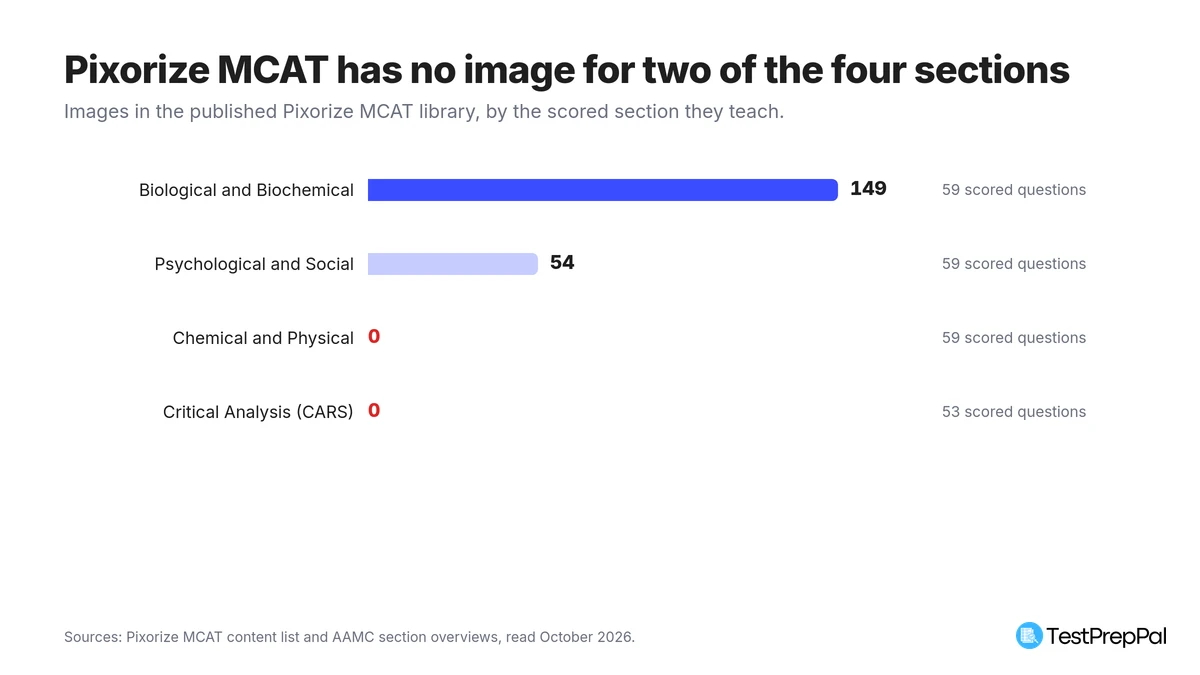 Pixorize MCAT images by the scored section they teach. Sources: the Pixorize MCAT content list and the AAMC section overviews, October 2026.
The biology library is the reason to buy this. Its largest playlists are Amino Acids at 20 images, Immunology at 20, Endocrine and Hormones at 18, Digestive at 16 and Renal at 12. Those are the arbitrary, list-shaped topics where a mnemonic earns its keep, and 20 images on amino acids alone is more dedicated visual teaching of that topic than anything else on this hub.
Six of the 17 biology playlists are really biochemistry: Amino Acids, Lipids, Metabolism, Protein Structure, Nucleic Acids and RNA, 52 images between them. The AAMC sets first-semester biochemistry at 25 percent of the Biological and Biochemical Foundations section, a section of 59 questions in 95 minutes, so about a third of the library sits against roughly 15 questions a test. That is a lot of teaching for a narrow target, which is exactly what you want if biochemistry is your weak spot and waste if it is not.
The psychology side is thinner and less even. Thirteen playlists cover emotion, personality, Piaget, Kohlberg, Freud, intelligence, memory, conditioning and psychoactive drugs, which is a reasonable map of introductory psychology. Sociology is where it thins out. Only two playlists are sociological, Status and Social Stratification at 3 images and Social Structure at 5, so 8 of the 54 psychology and sociology images, about 15 percent. The AAMC sets introductory sociology at 30 percent of that section. The coverage is half the weight the exam gives it, and if psych and soc is your weak section you can measure your own gap with our free psych and soc practice questions before spending anything.
Where the library stops
There is no general chemistry playlist, no organic chemistry playlist and no physics playlist. There is no CARS material of any kind.
The Chemical and Physical Foundations section is 59 questions, and the AAMC weights it general chemistry 30 percent, first-semester biochemistry 25 percent, introductory physics 25 percent, organic chemistry 15 percent and introductory biology 5 percent. Only the biochemistry quarter of that section is touched by anything Pixorize sells, and only indirectly, through images written for the biology section. The other 70 percent, roughly 41 questions a test, has nothing. Add the 53 CARS questions and about 94 of the 230 scored questions on the exam, 41 percent, sit in material this product does not teach. The AAMC notes that all of its percentages are approximated to the nearest 5 percent and vary between test forms, so treat 41 percent as the right order of magnitude rather than a precise figure.
This is not a flaw so much as a boundary, and Pixorize does not pretend otherwise: the product pages promise images for the MCAT, not a course. The problem is that nothing on the site tells you the boundary before you subscribe, and "MCAT Complete" is a name that implies the opposite. You have to open the content list and count, which is what we did.
Two of the four scored sections have no Pixorize image at all. Whatever else you buy, you will be buying chemistry, physics and CARS material somewhere else.
The library has not grown since 2021
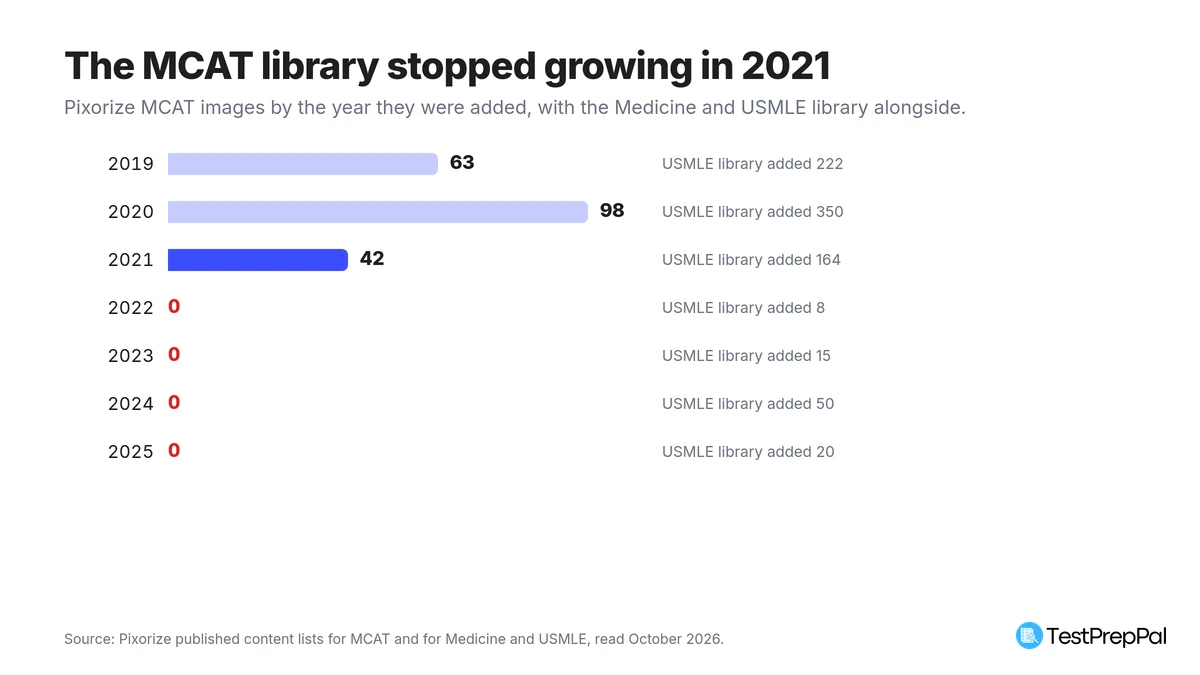 Items added to each Pixorize library by year. Source: the published Pixorize content lists, read October 2026.
Every item in the published list carries the date it was created. The MCAT library runs from 24 July 2019 to 6 December 2021: 63 items dated 2019, 98 dated 2020, 42 dated 2021, and nothing after that.
The company has not gone quiet. The Medicine and USMLE library holds 916 images across pharmacology, biochemistry, microbiology, neuroanatomy and immunology, and its newest item is dated 17 July 2025, with 50 items added in 2024 and 20 in 2025. One library kept growing for nearly four more years than the other.
Hold that against the wording on the subscription card, which says the plan "covers all new and existing Pixorize MCAT content for the remainder of the subscription". That is literally true and practically empty: on the evidence of the library's own dates, there has been no new MCAT content to cover since 2021.
How much this matters depends on the subject. Amino acid structures and the Krebs cycle have not changed since 2021, and most of this library is that kind of content, which is the honest defence of a frozen library. Psychology and sociology ages faster, and a product that stopped in 2021 was never going to grow into the sections it skipped.
Pricing
Two options, both read from the Pixorize subscribe page on 17 October 2026, where MCAT Complete sits under its own tab:
| Plan | Term | Price | Per month |
|---|---|---|---|
| MCAT Complete | 6 months | $50 | $8.33 |
| MCAT Complete | 1 year | $70 | $5.83 |
Both are one-off terms rather than recurring billing, and the year costs $20 more than the half year, so the longer term is the obvious buy unless you test within six months.
At $70 across 203 images the library works out at about 34 cents an image, or $5.83 a month. For contrast, the cheapest Sketchy MCAT configuration is $349 for 12 months, about $29.08 a month, and our Memm review last verified that product at $125 a month in February 2026. Pixorize is roughly a fifth of Sketchy's per-month rate and an order of magnitude under Memm. On price alone it is the easiest recommendation on this hub.
The MCAT line is also the cheapest thing Pixorize sells. Medicine and USMLE Complete is $249 a year, the single-subject USMLE plans are $150 a year each, and Nursing and NCLEX Complete is $100. The MCAT library being smaller and older is reflected in what it costs, which is fairer than most test prep pricing.
Two things to know before you pay. The terms page sets out no refund policy, no free-trial length and no score guarantee, so treat the purchase as final. And the site offers a "Try it Free" route on every page, which is the sensible first step: open the content list, find the playlists for your own weak topics, and see whether 203 images aimed at two subjects is worth $70 to you.
Who Pixorize MCAT Is Best For
Students who have already met the material and cannot retain the arbitrary parts. Amino acid side chains, hormone axes, immune cell types and renal transport are the topics this library is densest on, and they are the ones that defeat rote memorisation.
Students buying a supplement, not a spine. At $5.83 a month this does not have to be the main purchase. It sits well beside an MCAT prep course or a question bank, and it is cheap enough that using half the library still pays for itself.
Students who want to check coverage before paying. Publishing every image with its playlist, before purchase, is rare, and it is the reason this review could count anything at all. If you want a tool for one named weakness, you can confirm the material exists first.
It is a poor first and only resource. There are no practice questions, no full-length exams and nothing for two of the four scored sections. Fit it into a wider plan with our MCAT study schedule guide rather than treating it as a content pass.
When You Might Look Elsewhere
If you want visual teaching across the sciences, Sketchy MCAT is the direct alternative and the broader product: 336 lessons, including chemistry, physics and a CARS course, for $249 to $649. It costs several times more and covers several times more.
If your budget is zero, start with the AAMC free study tools. The content outline is the only first-party statement of what is tested, and reading it is how you work out whether Pixorize covers your weak topics at all. The free community decks in our MCAT Anki deck roundup also do the drilling Pixorize does not.
If CARS is your weak section, nothing here helps and no mnemonic will. The MCAT CARS practice tools are the category built for it. For the rest of the category, compare everything side by side in our MCAT study tools roundup, and see our review methodology for how we score.
Final Verdict
Pixorize MCAT earns 3.1 out of 5. The craft is real, the biochemistry and endocrine playlists are dense and genuinely useful, 21.3 hours of video for $70 is the best price per hour on this hub, and publishing the full library before purchase is a standard of transparency we wish every provider met. It loses points for covering two of four sections, for giving sociology half the weight the AAMC does, and for a library whose newest item is nearly five years old while the company's medical library kept growing to 2025.
Buy the $70 annual plan if biochemistry, endocrine physiology or introductory psychology is a named weakness, and budget separately for chemistry, physics and CARS. Skip it if you are looking for one product to carry your content review.
Pixorize MCAT FAQs
How much does Pixorize MCAT cost?
MCAT Complete is $50 for 6 months or $70 for 1 year, bought as a one-off term rather than a recurring subscription. The MCAT plan is sold separately from the Medicine and USMLE plans, so you do not need the $249 medical subscription to get it. Prices were read from the Pixorize subscribe page on 17 October 2026.
Does Pixorize cover all the MCAT sections?
No. The library is 203 images in two subject areas, biology and biochemistry and psychology and sociology. There is no general chemistry, organic chemistry or physics content, and no CARS content at all, which leaves roughly 41 percent of the scored questions untouched. Plan to cover the Chemical and Physical Foundations section and CARS with something else.
Is Pixorize the same as Sketchy?
No, though they use the same method. Both build illustrated scenes where objects encode facts, but they are separate companies with separate libraries. Sketchy MCAT lists 336 lessons across nine courses including chemistry, physics and CARS, and starts at $249. Pixorize MCAT is 203 images across two subjects and starts at $50.
Is Pixorize MCAT still updated?
Not on the evidence of its own content list. Every item carries a creation date, and no MCAT image is dated later than 6 December 2021. The Medicine and USMLE library, by contrast, has items dated through July 2025. Most of the MCAT content is stable science that does not need revising, but you are buying a library that stopped growing, not one in development.
Does Pixorize MCAT include practice questions?
No. There are no practice questions, no quizzes and no full-length exams anywhere in the MCAT product. It is a content and memorisation tool only, so you will need a separate question bank and separate practice tests to study under timed conditions.
We may earn commissions from some links on this page, but this does not affect our reviews or your experience.
Our Verdict
The cheapest serious content product on this hub, and the narrowest. For $70 a year you get 203 mnemonic images and 21.3 hours of video covering biology, biochemistry, psychology and sociology, which is real value if those are the subjects that will not stick. It has no general chemistry, organic chemistry, physics or CARS material at all, its sociology coverage is half the share the AAMC asks for, and no image in the MCAT library carries a date later than December 2021. Buy it as a cheap supplement for two subjects, never as your content resource for the exam.