


Sketchy MCAT Review
by Sketchy
Visual mnemonic lessons for MCAT content review
✓Pros
- ✓336 lessons across 9 courses, with every unit's chapter and lesson count published before you buy
- ✓16 lessons on data and research design, the two AAMC inquiry skills worth 10 percent each in every science section
- ✓71 systems biology and 65 biochemistry lessons, the deepest visual coverage of the two heaviest science subjects
- ✓7 day free trial with no credit card
- ✓Prep Essentials bundles the AAMC official prep material and a score guarantee
✗Cons
- ✗Only 49 psychology and sociology lessons for a section worth 59 questions, and just 5 under the unit named Sociology
- ✗CARS is 10 strategy lessons plus a locked 42 lesson passage set, and only in the $549 tier
- ✗The +10 or 510 guarantee needs more than 350 of the 378 lessons watched and an official score from before you bought
- ✗Three provider pages give three library sizes (380+, 370+, 378 counted) and two values for the same AAMC bundle
Highlights
- ✓9 courses: biochemistry, cell biology, systems biology, general chemistry, physics, organic chemistry, psychology and sociology, science strategy, CARS
- ✓41 units and 114 chapters, 336 listed lessons
- ✓Quiz questions with explanations
- ✓7 day free trial
- ✓Prep Essentials only: CARS course and 42 lesson passage walkthroughs
- ✓Prep Essentials only: AAMC official prep material released up to June 2025
- ✓Prep Essentials only: study planning guide PDF
- ✓Prep Essentials only: +10 or 510 score guarantee
Price
$249 - $649
What Students Are Saying
Sign in to leave a review

Expert Rating
Sketchy MCAT is worth the money if your problem is that science content will not stick, and it is a poor buy if your problem is the rest of the MCAT. We counted every lesson the nine course pages list: 336 across 41 units, and 172 of them are biology and biochemistry.
The company that made micro and pharm memorable for medical students has built the same thing for premeds, and the parts it has built well are very good. The parts it has not built are the ones its own "everything on the MCAT" wording covers up.
Summary Table
| Feature | Sketchy MCAT |
|---|---|
| Price | $249 to $649 |
| Science Review | $249 (3 months), $299 (6 months), $349 (12 months) |
| MCAT Prep Essentials | $549 (3 months), $599 (6 months), $649 (12 months) |
| Courses | 9 |
| Units and chapters | 41 units, 114 chapters |
| Lessons listed | 336, plus a locked 42 lesson CARS passage set |
| Quiz questions | 900+ according to the help centre |
| CARS | Prep Essentials only |
| AAMC material | Prep Essentials only, everything released up to June 2025 |
| Free trial | 7 days, no credit card |
| Guarantee | +10 or 510, Prep Essentials only |
| Delivery | Self-paced video lessons |
 The Sketchy MCAT landing page, captured from sketchy.com in October 2026.
Sketchy MCAT Overview
Sketchy teaches by putting facts inside a picture. Each lesson is an illustrated scene where every object encodes something, so recalling the scene pulls the facts back with it. It is the same method behind SketchyMicro and SketchyPharm for Step 1, rebuilt for premedical science.
The MCAT program is a separate product line from the medical one, with its own prices and its own library. Nine courses are listed in the curriculum explorer:
- Biochemistry, Cell Biology and Systems Biology
- General Chemistry, Physics and Organic Chemistry
- Psychology and Sociology
- Science Strategy
- CARS
Every course page states how many units, chapters and lessons it contains, which is more than most study tools publish before you pay. That is what made the count below possible.
Sketchy MCAT Review For 2026
What the 336 lessons actually cover
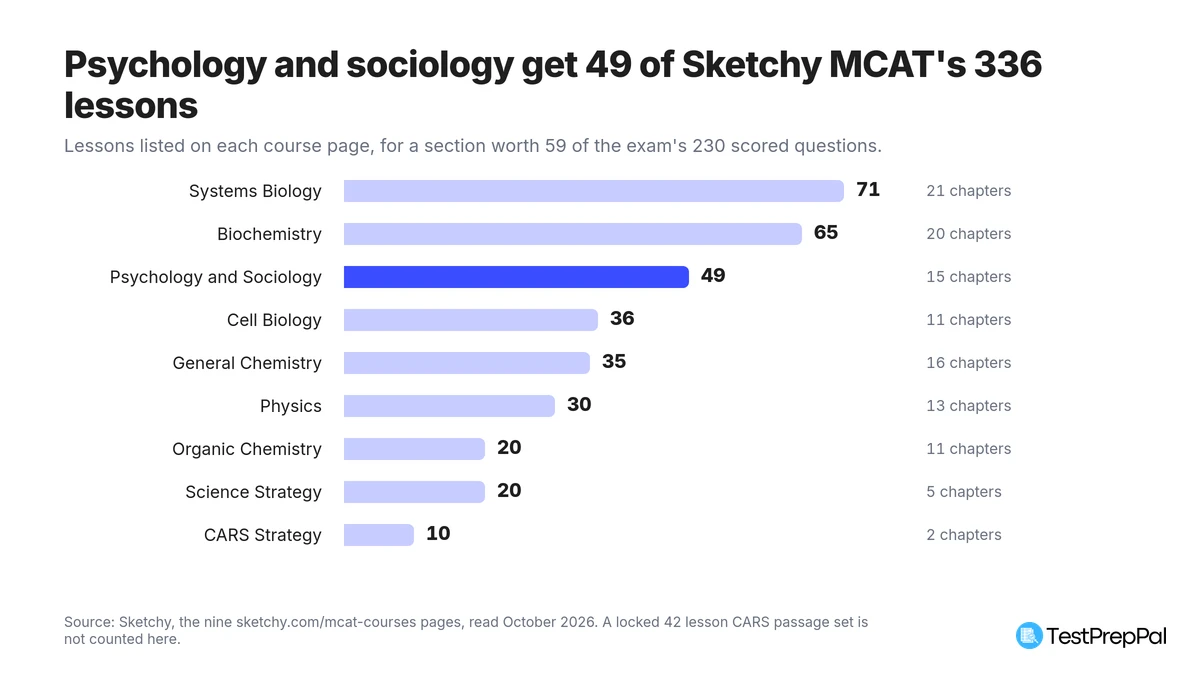 Lessons per course, counted from the nine Sketchy MCAT course pages in October 2026.
The depth is in biology. Systems Biology is the largest course at 71 lessons, and almost half of it is one unit: nervous and musculoskeletal systems runs 5 chapters and 29 lessons. Biochemistry follows at 65, with 20 lessons on carbohydrates alone. Add Cell Biology at 36 and you have 172 lessons, slightly more than half of the 336 listed, aimed at one quarter of the exam.
That is not a criticism by itself. Those are the subjects where a mnemonic earns its keep, and 29 lessons on the nervous and musculoskeletal systems is more structured visual teaching than any competitor on this hub offers. If neuroanatomy and metabolism are what defeat you, this is the product built for you.
The physical sciences are leaner but proportionate. General Chemistry has 35 lessons across 7 units, Physics has 30, and Organic Chemistry has 20 in just 3 units. Organic looking small is fine: the AAMC sets organic chemistry at 15 percent of the Chemical and Physical Foundations section, and 20 of 85 physical science lessons is above that share. If you want to drill what those lessons teach, our MCAT organic chemistry reactions guide and the free organic chemistry practice questions are the next step.
Physics has one genuinely thin spot. Atomic and nuclear physics is 1 chapter and 1 lesson, the smallest unit in the library.
Where the coverage stops
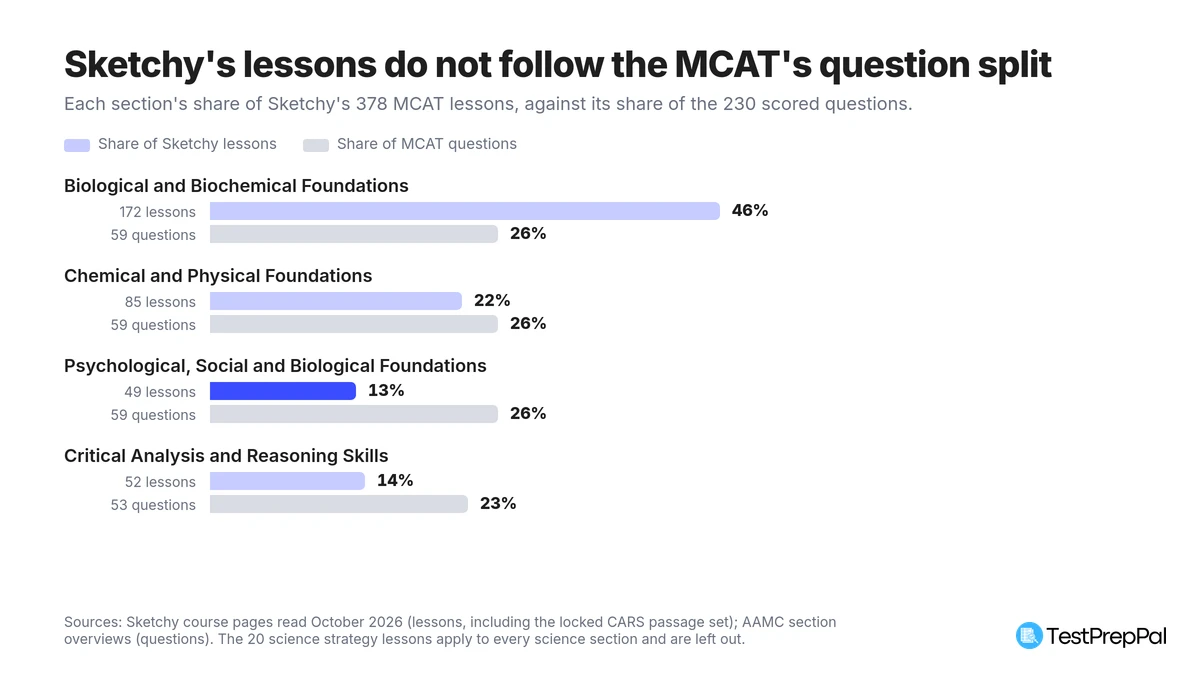 Share of Sketchy lessons against share of scored questions, by section. Sources: Sketchy course pages and AAMC section overviews, October 2026.
The four scored sections are close to equal in size. Chemical and Physical Foundations is 59 questions in 95 minutes, Biological and Biochemical Foundations is another 59, Psychological, Social and Biological Foundations is another 59, and CARS is 53 in 90 minutes. That is 230 scored questions, and no section is more than 26 percent of them. Sketchy's library is not distributed that way.
Psychology and sociology is the gap that matters. The whole section gets 49 lessons, 13 percent of the 378 for 26 percent of the questions. Inside that course, the unit named Sociology is 1 chapter and 5 lessons, the smallest in the course. The AAMC sets introductory sociology at 30 percent of that section, roughly 18 questions a test. Some social content does sit in the 15 lesson personality and social psychology unit, so 5 is not the whole story, but it is still the thinnest coverage in the product sitting against a section tied for the largest question count. Plan to cover that section elsewhere, and use our free psych and soc practice questions to find out how big your own gap is before you spend anything.
CARS needs reading carefully. The CARS course lists one unit, 2 chapters and 10 strategy lessons. A second set called Passage Walkthroughs, 6 units and 42 lessons, appears on the same page behind a padlock, with the note that Sketchy cannot show it publicly because it breaks down passages copyrighted by the AAMC. So a Prep Essentials subscriber does get 52 CARS lessons, not 10. Two things still hold: you cannot see any of that 42 before buying, and none of it comes with Science Review at all. For a section you cannot study by memorising anything, that is an odd place to put the paywall, and dedicated passage practice such as Jack Westin remains a separate decision.
The part nobody mentions: science strategy
The Science Strategy course is 20 lessons, and 16 of them sit in a unit called Data and Research Design.
That unit is better value than its size suggests. The AAMC weights reasoning about the design and execution of research at 10 percent of each science section, and data-based statistical reasoning at another 10 percent. One fifth of every science section tests how you read an experiment rather than what you remember about it, and 16 lessons aimed squarely at that is the most under-sold thing in this product. No roundup we found on the first page of results for "sketchy mcat" mentions the course exists.
Pricing
Six prices, two tiers, three terms each. Everything below was read from the Sketchy MCAT pricing cards on 5 October 2026.
| Plan | 3 months | 6 months | 12 months |
|---|---|---|---|
| Science Review | $249 | $299 | $349 |
| MCAT Prep Essentials | $549 | $599 | $649 |
Per month, Science Review is $83.00, $49.83 and $29.08. Prep Essentials is $183.00, $99.83 and $54.08. The longer terms are much cheaper per month, and the 12 month Science Review plan at $29.08 is the only configuration that comes in under Memm, whose entry plan our review last verified at $125 a month in February 2026.
Science Review is sold as "7 courses covering all the sciences on the MCAT" plus quiz questions with explanations. Prep Essentials adds the CARS course, the AAMC official prep material, a study planning PDF and the score guarantee. A 7 day free trial runs with no credit card, and Klarna splits any plan into 4 interest-free payments. A site-wide 20 percent code was running on the day of this review, so check the banner before paying list price.
Three numbers on Sketchy's own pages do not agree, and it is worth knowing which to trust:
- Library size. The product page says "380+ cartoon-based lessons", the help centre says "370+". Counting the course pages gives 336 listed plus the 42 locked, so 378. Both marketing figures are rounded from the same real number.
- Questions. The product page says "2,500+ practice questions", the help centre says "900+ carefully curated quiz questions". The likeliest reading is that the larger figure folds in the bundled AAMC questions, but neither page says so.
- The AAMC bundle. The pricing card calls it "a $390 value". The guarantee terms deduct $273 for the same materials when they calculate a refund.
The AAMC material in Prep Essentials is everything released up to June 2025, which the help centre lists as Practice Exams 1 to 4, the Section Bank, the online flashcards, the Official Guide questions, the CARS diagnostic tool and the biology, chemistry, physics and CARS question packs. The pricing card says "6 AAMC MCAT Official Prep Practice Exams" while the help centre lists four. If the full-length count is what decides your purchase, ask support in writing first. Our guide to how many MCAT practice tests you actually need explains why four scored AAMC exams is usually enough.
What the score guarantee really asks for
The "+10 or 510" guarantee sounds generous and is narrower than it reads. It applies to Prep Essentials only, bought direct, and you must already hold an official MCAT score from before your subscription started.
To qualify for the refund you must, by test day, have:
- watched more than 350 unique Sketchy lessons
- answered more than 700 unique quiz questions
- completed more than 2,000 unique AAMC questions, including at least 4 scored full lengths
Hold that first number against the library. More than 350 of the 378 lessons that exist is about 93 percent of everything Sketchy has made, including all 42 locked CARS passages. The question bar is more than 700 of a stated 900+, about 78 percent. Half of all of it has to be finished at least two weeks before your test date.
The refund is also not the price you paid. Sketchy deducts $273 for the AAMC materials, so a 12 month Prep Essentials buyer who meets every condition and misses the target gets $376 back of $649. The claim has to be emailed within 60 days of the subscription expiring.
One detail to watch if you are near the line: the page headline says "Score under 500" for the 10 point promise and "Score 500 or above" for the 510 promise, while the numbered terms underneath say "500 or lower" and "500 or higher". A prior score of exactly 500 lands in both branches depending on which sentence you read. Get it confirmed in writing before you rely on it.
Treat the guarantee as a discipline device, not as insurance. If watching 93 percent of a library and finishing 2,000 AAMC questions is realistic for you, you were likely to improve anyway.
Who Sketchy MCAT Is Best For
Visual learners who have met the material once and cannot hold it. The method works best on dense, arbitrary content, and 136 lessons across systems biology and biochemistry is where that pays.
Students with a long runway. At $29.08 a month for 12 months of Science Review it is cheaper than most content resources, and the volume of lessons needs months rather than weeks. Fit it into a plan using our MCAT study schedule guide, and keep it as the content layer rather than the whole plan.
Anyone already using Anki. A sketch gives the scene, cards give the repetition, and the AnKing MCAT deck handles the drilling that Sketchy's 900+ quiz questions will not cover on their own.
It is a poor first and only resource. Sketchy writes no full-length exams of its own, so the only ones you get are the AAMC exams bundled into the top tier and Science Review has none at all. The psychology and sociology coverage is thin, and CARS is gated. If you want one purchase that covers the whole exam, an MCAT prep course is the category to look at, not a study tool.
When You Might Look Elsewhere
If you want memorisation rather than teaching, Memm is the direct alternative on this hub: 2,600 cards and review sheets, sold by the month, far less product and a lower entry price. If your budget is zero, the AAMC free study tools include the content outline that tells you exactly what is tested, which is the document to read before buying any of this.
If psychology and sociology is your weak section, buy something else for it. Nothing in Sketchy's 49 lessons is wrong, there is just not enough of it, and a dedicated deck plus the AAMC material is a better use of the money.
If CARS is your weak section, Sketchy cannot be your answer at all unless you buy the $549 tier, and even then it is one strategy unit plus passage walkthroughs you cannot preview. Our MCAT CARS practice roundup covers the tools built for that job. How we score every resource is set out in our review methodology.
Final Verdict
Sketchy MCAT earns 4.1 out of 5. The craft is real, the science coverage is deep where the exam is hardest to memorise, and publishing a chapter and lesson count on every unit is a standard of transparency we wish more study tools met. It loses points for the distance between "everything on the MCAT" and a library that puts 46 percent of its lessons against 26 percent of the questions, for a CARS set you cannot see before buying, and for three different figures on three of its own pages.
Buy the 12 month Science Review plan at $349 if biology and biochemistry are what you cannot hold in your head, and plan separately for psychology, sociology and CARS. Skip Prep Essentials unless you want the AAMC bundle, and buy that from the AAMC yourself if you do not want the guarantee.
Sketchy MCAT FAQs
How much does Sketchy MCAT cost?
Science Review is $249 for 3 months, $299 for 6 months or $349 for 12 months. MCAT Prep Essentials, which adds the CARS course, the AAMC material and the score guarantee, is $549, $599 or $649 for the same terms. A 7 day free trial needs no credit card, and promotional codes appear on the site regularly.
Is Sketchy MCAT the same as Sketchy Medical?
No. They are separate product lines with separate libraries and separate prices. Sketchy Medical is built around microbiology and pharmacology for Step 1, neither of which is an MCAT subject. Sketchy MCAT is 9 courses of premedical science, strategy and CARS, and buying one does not give you the other.
How many lessons does Sketchy MCAT have?
The nine course pages list 336 lessons across 41 units and 114 chapters, and a locked set of 42 CARS passage walkthroughs brings the real total to 378. Sketchy's own pages round this to "380+" on the product page and "370+" in the help centre.
Does Sketchy MCAT cover CARS?
Only in the $549 MCAT Prep Essentials tier. That tier includes a 10 lesson CARS strategy unit and a 42 lesson set of passage walkthroughs that is hidden on the public site because it uses AAMC passages. The cheaper Science Review plan includes no CARS material at all.
Is the Sketchy MCAT score guarantee worth counting on?
Only if you intend to finish the whole program. It requires more than 350 of the 378 lessons watched, more than 700 quiz questions, more than 2,000 AAMC questions including 4 scored full lengths, and an official MCAT score taken before you subscribed. The refund is also the price paid minus $273 for the AAMC materials.
We may earn commissions from some links on this page, but this does not affect our reviews or your experience.
Our Verdict
The strongest visual content review for the two heaviest science subjects, with 71 systems biology and 65 biochemistry lessons and an unusually honest published lesson count for every unit. It is thinner than its own marketing suggests on the other half of the exam: 49 lessons for psychology and sociology, 5 of them under the unit named Sociology, and a CARS course that is 10 strategy lessons plus a locked passage set in the $549 tier only. Buy it to learn science visually, not to cover the MCAT.