

Best GMAT Flashcards in 2026

by John Reed· Last Updated: Nov 26, 2026
The best GMAT flashcards for most students are Magoosh's free GMAT math cards. They cost nothing, need no account, and hold 418 cards across 12 decks, including 221 full practice problems with worked explanations.
Flashcards do one narrow job well on the GMAT: they make formulas, number rules and other facts automatic, so your time on test day goes to reasoning. They do not teach Verbal Reasoning or Data Insights, which are 43 of the 64 questions on the current exam. Both sections test reasoning, and practice questions teach them better than any card.
The other catch is age. The GMAT is now the GMAT Focus Edition, with three sections: Quantitative Reasoning, Verbal Reasoning and Data Insights. Several decks still carry geometry, Sentence Correction or vocabulary built for the older exam, and we flag that below for each one.
Here are the main takeaways:
- Magoosh GMAT Math Flashcards: Best for free Quant review you can start in seconds. 418 cards, 51 of them geometry, which GMAC's Quant description does not name.
- Target Test Prep GMAT Flashcards: Best for students already on a TTP plan who keep an error log. Not sold alone, so the cheapest way in is $249 for one month of Self-Study.
- GMAT Official Flashcards (GMAC): Best for students already buying an Official Guide. They come inside the Online Question Bank, from $26.99, with no published card count.
- Quizlet GMAT Flashcards: Best for building your own deck from your mistakes. Free to study, but community sets are unchecked and many were made for the old exam.
- Varsity Tutors GMAT Flashcards: Best for free Data Insights and Verbal cards alongside quizzes. Free with an account, labelled by the three current sections, with no published card count.
GMAT flashcards summary table
| Resource | Cost | Sections covered | What you get | Best for |
|---|---|---|---|---|
| Magoosh | Free, no account needed | Quant only | 418 cards: 197 concept cards in 6 decks, 221 mixed practice problems in 6 decks | Free Quant drills on web or phone |
| Target Test Prep | From $249 (Self-Study, 1 month) | Quant and Verbal | 700 or 1,200+ cards (TTP publishes both), unlimited custom cards | TTP students with an error log |
| GMAC Official | From $26.99, inside an Official Guide | Not published | Digital cards and practice games inside the Online Question Bank, 12 months | Official Guide buyers |
| Quizlet | Free, Plus $35.99 a year | Varies by set | User-made sets, spaced repetition on the website | Your own error-log deck |
| Varsity Tutors | Free with an account | Quant, Verbal and Data Insights | Focus-labelled cards, lessons and quizzes on one hub | Free cards for all three sections |
Which GMAT flashcards are right for you?
- If you want free Quant cards written by a prep company, use Magoosh's GMAT math flashcards.
- If you already pay for Target Test Prep, use the TTP GMAT flashcards and turn your missed questions into custom cards.
- If you are buying an Official Guide anyway, open the GMAT Official flashcards inside its question bank.
- If you want a free place to keep your own cards, use Quizlet and skip most of the public sets.
- If you want free cards for Data Insights and Verbal, try the Varsity Tutors GMAT flashcards.
The GMAT flashcards we reviewed
1. Magoosh GMAT Math Flashcards
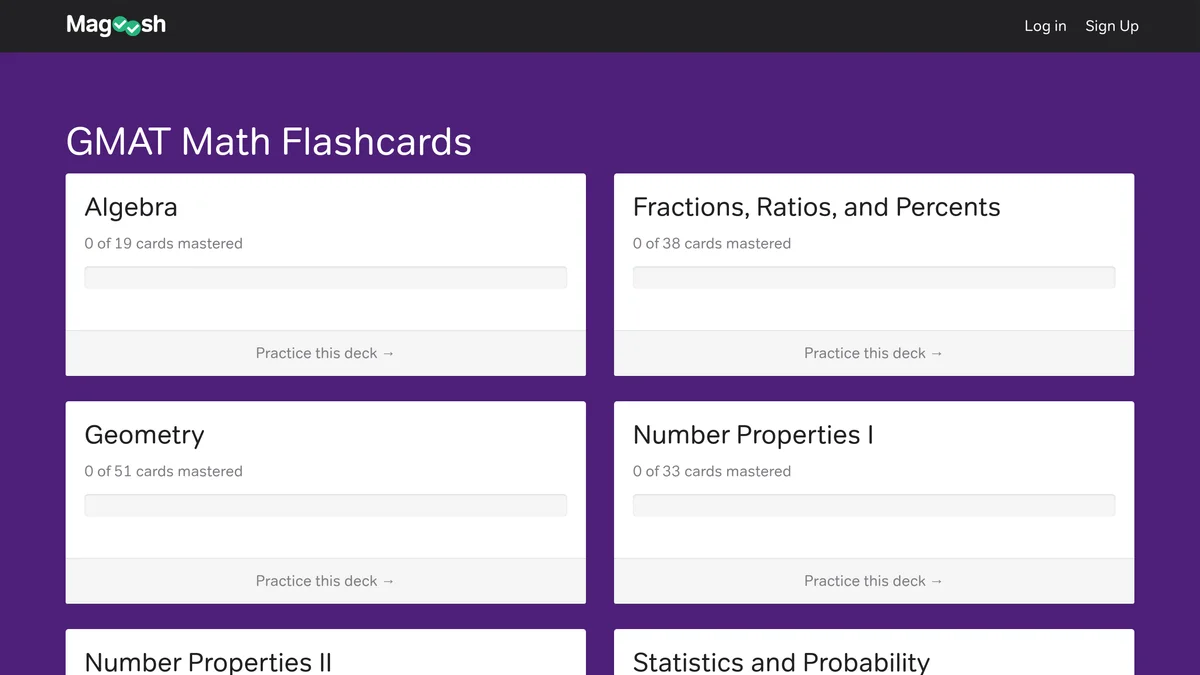
Magoosh's GMAT math flashcards are a free web and mobile deck of Quant cards from Mike McGarry and Magoosh's GMAT team, and we rate them 4.0 out of 5.
What you get:
a) Six concept decks, 197 cards: Algebra (19), Fractions, Ratios, and Percents (38), Geometry (51), Number Properties I (33), Number Properties II (32), and Statistics and Probability (24).
b) Six mixed practice decks, 221 cards: Full GMAT-style problems with worked solutions on the back. These are practice questions in a flashcard shell, and they are the strongest part of the set.
c) Missed-card repetition: Cards you get wrong come back more often.
d) Web, iOS and Android apps: No trial, no card limit and no account wall. A free account only syncs your progress.
Best for: Anyone who wants free Quant practice today, and anyone weighing a paid Magoosh product who wants a free sample of its explanation style.
Limitation: The deck carries content the current exam does not name. Geometry is the largest concept deck at 51 cards, 26 percent of the concept cards, while GMAC describes Quantitative Reasoning as "arithmetic and elementary algebra". There is no Verbal or Data Insights deck. Magoosh's separate GMAT idiom deck was built for Sentence Correction, which the current Verbal section no longer includes.
2. Target Test Prep GMAT Flashcards
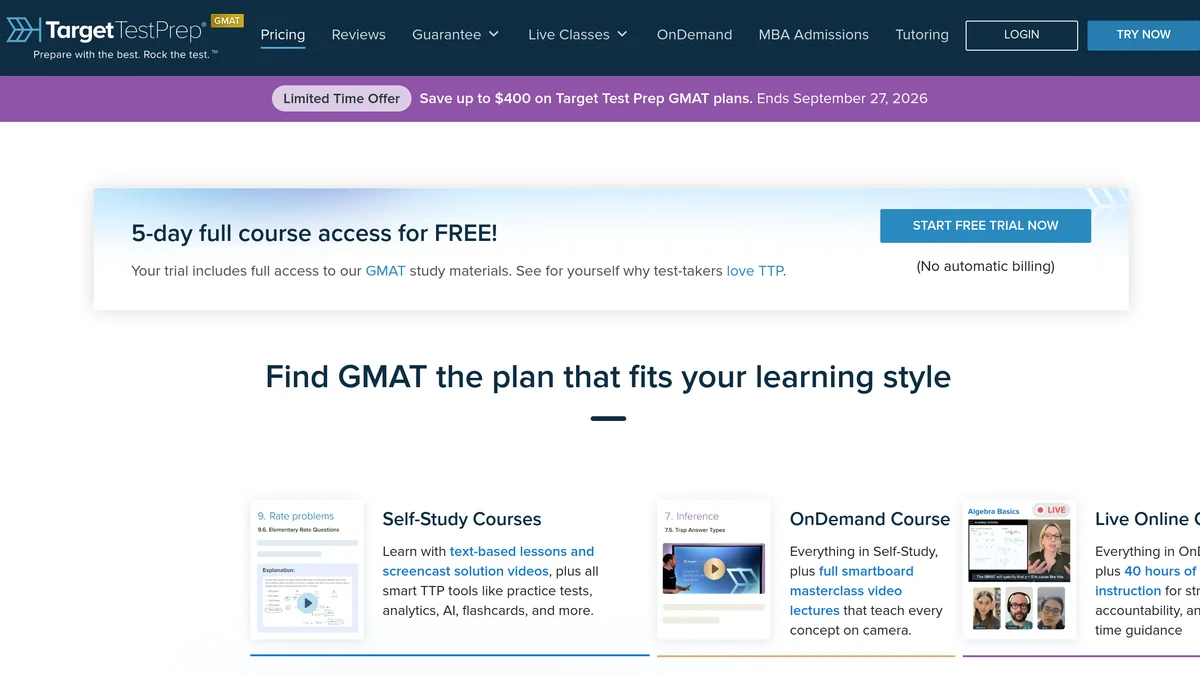
Target Test Prep's GMAT flashcards are a Quant and Verbal deck built into every TTP GMAT plan, and we rate them 3.8 out of 5.
What you get:
a) A pre-made Quant and Verbal deck: 700 cards according to TTP's course home page, 1,200+ according to its plans page. Plan for 700 until you see the deck yourself.
b) Unlimited custom cards: Written by hand or generated with AI, in the same account as TTP's error tracker.
c) A "still to learn" filter: Cards you have shown you know drop out of rotation. TTP does not claim this is spaced repetition with published intervals.
d) The rest of the course: 1,500+ lessons, 4,000+ practice questions, a custom test builder, error tracking and analytics.
e) A 5-day free trial: Full Self-Study access with no automatic billing, which is the only way to see the deck before paying.
Best for: Students already on a TTP plan, and anyone who keeps an error log and wants missed questions turned into cards without copying them out.
Limitation: The cards are never sold alone. The cheapest plan is $249 for one month of Self-Study, the deck names no Data Insights cards, and access ends when your plan ends. If you do buy, the 6-month Self-Study plan at $1,099 works out at $183.17 a month, the lowest monthly rate TTP publishes.
3. GMAT Official Flashcards (GMAC)
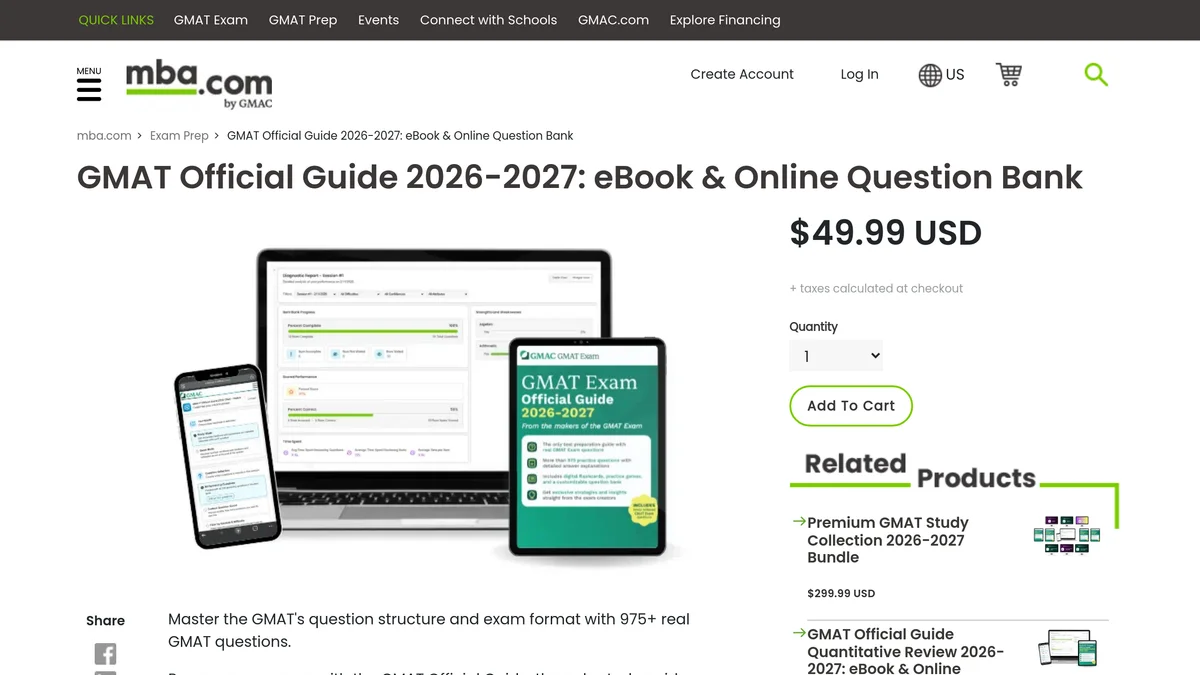
The GMAT Official flashcards are digital cards inside the Online Question Bank that comes with any new Official Guide 2026-2027 title, and we rate them 3.4 out of 5.
What you get:
a) The only cards from the test maker: Written by GMAC, the organisation that writes the GMAT.
b) Practice games: Named on the 2026-2027 cover and nowhere else in GMAC's materials.
c) The question bank around them: The main Official Guide's bank holds 975+ real GMAT questions, with diagnostic evaluations, timed practice and progress tracking.
d) Twelve months of access: Through your mba.com account. GMAC's product page starts the clock at activation, its terms of use at purchase.
Best for: Students already buying an Official Guide, who get the cards at no extra cost in the account they will use daily.
Limitation: GMAC publishes no card count, no subject list and no preview, and its own product copy no longer mentions the cards. The cheapest route is a $26.99 section review eBook, but GMAC has never said whether a section review's bank carries the same cards as the $49.99 main guide. Used guides usually arrive with a redeemed code, so no cards.
4. Quizlet GMAT Flashcards
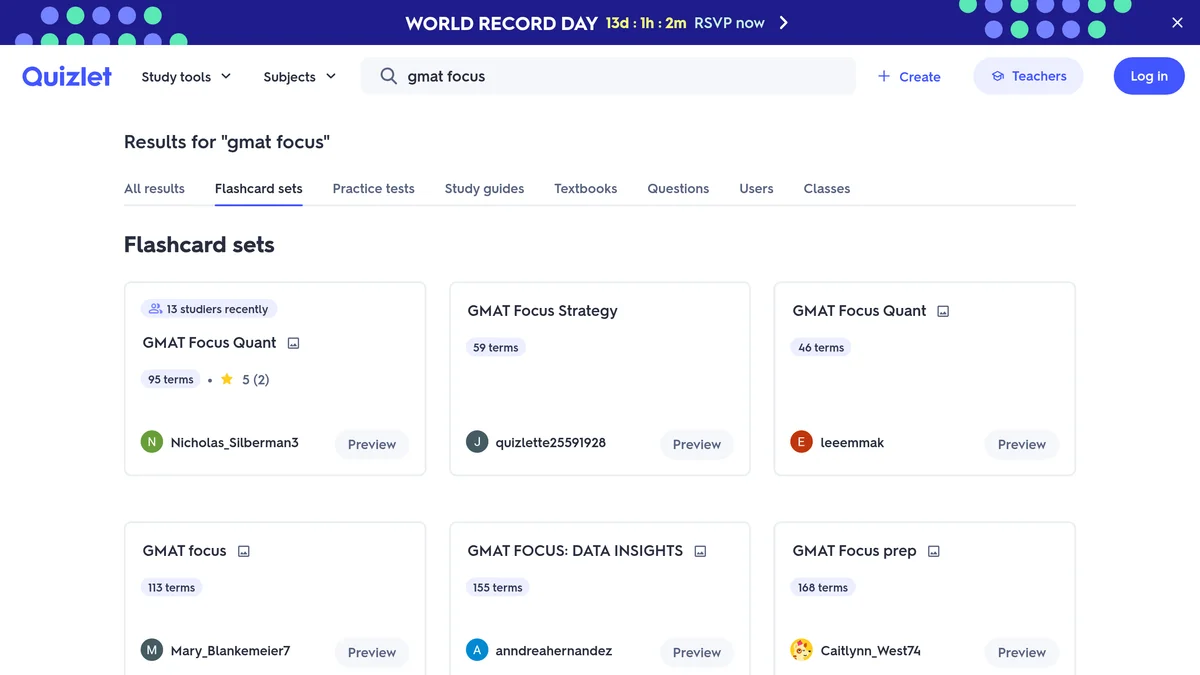
Quizlet's GMAT flashcards are free sets made by other users on a general flashcard platform, and we rate them 3.1 out of 5.
What you get:
a) Every public GMAT set: From a few cards to 2,000 terms, free to study in Flashcards mode.
b) Spaced repetition: You rate each card Repeat, Hard, Okay or Easy, and Quizlet schedules the next review. It works on the website only, not in the apps.
c) Your own sets: The best use of Quizlet is turning your error log into a deck you have checked yourself.
d) A useful Data Insights primer: The 155 term "GMAT FOCUS: DATA INSIGHTS" set walks through all five question types.
e) Optional paid plans: Quizlet Plus at $35.99 a year or Plus Unlimited at $44.99 a year. Neither adds GMAT content.
Best for: Students who want to build their own deck, and students on a zero budget reviewing formulas they have already checked.
Limitation: Nobody checks the cards, and much of the content targets the old exam. The largest GMAT set on page one of search is a 2,000 word vocabulary list, Sentence Correction sets still turn up in search, and even the most-studied GMAT Focus Quant set has wrong division rules and leftover geometry. Free accounts get limited Learn rounds and one Test per set.
5. Varsity Tutors GMAT Flashcards
The Varsity Tutors GMAT flashcards are part of Varsity's free GMAT practice hub, which pairs flashcards with lessons and quizzes.
What you get:
a) Cards labelled for the GMAT Focus Edition: Organised by the current three sections.
b) Separate Quant, Verbal and Data Insights practice: By comparison, Magoosh is Quant only and TTP names Quant and Verbal cards only.
c) Lessons and quizzes on the same hub: You can drill cards and then quiz yourself without switching sites.
d) Progress tracking across devices: Access is free with an account.
Best for: Students who want free cards for all three current sections in one place.
Limitation: Varsity publishes no card count and no author credentials, and the hub doubles as a lead page for its paid tutoring. It is weaker as a standalone study plan than Magoosh or TTP. We have not published a full expert review of this deck.
How to use these together
- Start by checking what the exam actually tests. Our guide to the current GMAT sections explains the three-section format, and the free GMAT practice test shows where you stand.
- Run Magoosh's five non-geometry concept decks (146 cards) in spare minutes. Work the mixed practice decks at a desk with scratch paper, and leave the geometry deck until last.
- Keep an error log from day one. Turn each missed question from your GMAT question bank into a card in Quizlet, or in TTP's custom builder if you have a plan.
- Use Varsity Tutors' Data Insights cards for terms and question types, then practise the section itself. Our free GMAT Quant practice questions do the same for math.
- If you buy the GMAT Official Guide, redeem the code the week you start, and treat its cards as a bonus to its official questions.
- Fit card time into a full schedule with the GMAT study plan generator, and read how to study for the GMAT for how retrieval practice fits around problem sets.
Every other GMAT resource we cover is on the GMAT hub, and our review methodology explains how the ratings above are set.
GMAT flashcards FAQs
What are the best free GMAT flashcards?
Magoosh's GMAT math flashcards are the best free deck we have reviewed. They hold 418 cards across 12 decks, including 221 practice problems with worked explanations, and need no account. They cover Quant only, so pair them with practice questions for Verbal and Data Insights.
Are GMAT flashcards up to date for the GMAT Focus Edition?
Not all of them. The current GMAT tests Quantitative Reasoning, Verbal Reasoning and Data Insights, scored from 205 to 805. Magoosh's largest concept deck is geometry, which GMAC's Quant description does not name, and many Quizlet sets still drill Sentence Correction or long vocabulary lists made for the older exam.
Can I buy the official GMAT flashcards on their own?
No. GMAC sells no flashcard product. The cards sit inside the Online Question Bank that comes with any new Official Guide book or eBook, starting at $26.99, and access lasts twelve months.
Are flashcards enough to study for the GMAT?
No. Flashcards help with facts that must be automatic, mostly in Quant. Verbal Reasoning and Data Insights test reasoning, which practice questions teach better than any card, and those two sections make up 43 of the 64 questions.
How many flashcards does Target Test Prep have for the GMAT?
TTP publishes two figures for the same deck: 700 cards on its course home page and 1,200+ on its plans page. Plan for 700 until you see the deck in the 5-day free trial. You can add an unlimited number of your own cards on top.
We may earn commissions from some links on this page, but this does not affect our reviews or your experience.


