

Magoosh GMAT Math Flashcards Review
by Magoosh
400+ free expert-written GMAT math cards on web, iOS, and Android.
✓Pros
- ✓Completely free, with no account wall to start
- ✓418 cards written by Magoosh's GMAT instructors
- ✓221 of those cards are full practice problems, not just concept prompts
- ✓Web, iOS, and Android, so you can review in spare minutes
- ✓Surfaces the cards you miss most often
✗Cons
- ✗Geometry is the largest concept deck at 51 cards, and GMAC's Quant description names only arithmetic and elementary algebra
- ✗Math only: there is no Verbal or Data Insights deck here
- ✗Magoosh's separate idiom deck is leftover Sentence Correction content
- ✗Explanations can run long for a flashcard format
Highlights
- ✓418 cards across 12 decks, all free
- ✓197 concept cards in 6 topic decks
- ✓221 mixed practice problems with worked explanations
- ✓Web app plus iOS and Android apps
- ✓Missed-card targeting, no account needed to start
Price
✓Free
What Students Are Saying
Sign in to leave a review

Expert Rating
Magoosh's GMAT math flashcards are free, there is no account wall, and there are 418 of them across 12 decks. That makes them the largest free GMAT math deck you can start using in the next thirty seconds, and for most candidates they are worth the thirty seconds.
The catch is in the mix, and it takes counting to see. We opened Magoosh's deck index on 25 September 2026 and added up every card. Six concept decks hold 197 cards. Six mixed practice decks hold 221. The single biggest concept deck is Geometry, at 51 cards, and GMAC's own exam content page describes Quantitative Reasoning as "arithmetic and elementary algebra" and names no geometry at all.
Summary Table
| Feature | Magoosh GMAT Math Flashcards |
|---|---|
| Price | Free |
| Account required | No. An account only saves your progress |
| Total cards | 418 across 12 decks, counted 25 September 2026 |
| Concept cards | 197 in 6 topic decks |
| Mixed practice cards | 221 in 6 decks, full problems with explanations |
| Largest deck | Geometry, 51 cards |
| Sections covered | Quantitative Reasoning only. No Verbal, no Data Insights |
| Format | Web, plus iOS and Android apps |
| Written by | Mike McGarry and Magoosh's GMAT team |
| Repetition | Missed cards resurface more often |
| Guarantee | None, and none needed |
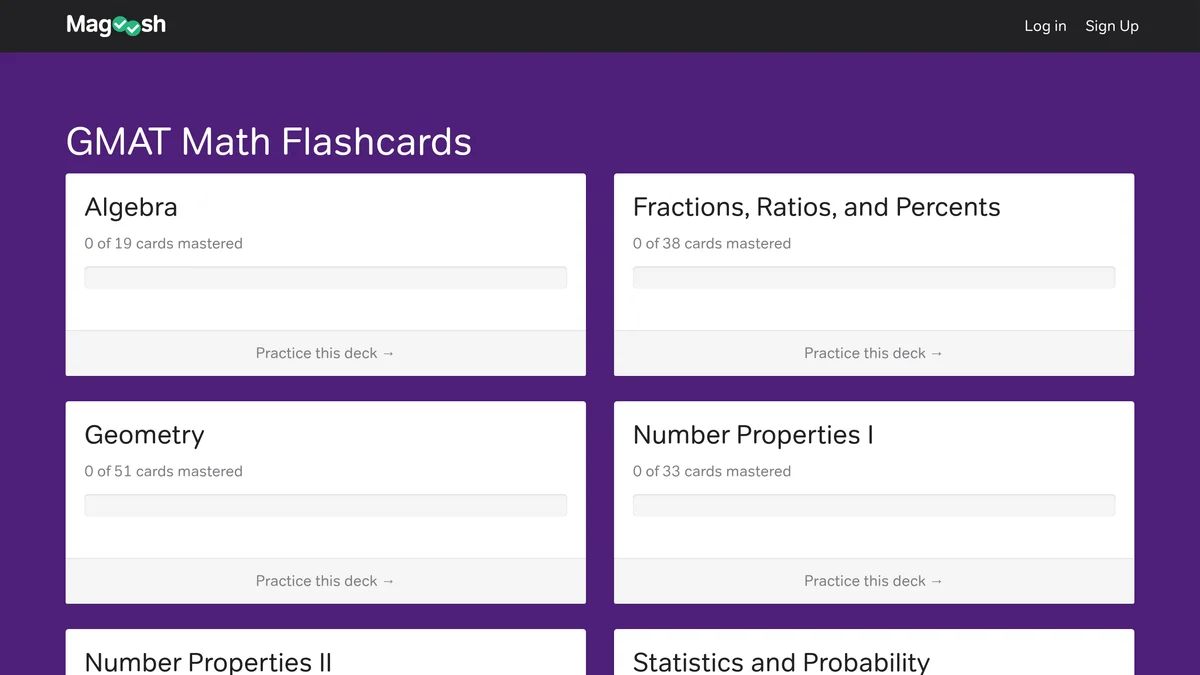 The deck index at gmat.magoosh.com, captured September 2026. Magoosh publishes a card count on every deck, which is how the numbers in this review were counted.
Sponsored
Target Test Prep GMAT
One of the most complete GMAT prep platforms we've reviewed. Try full access for 5 days.
No code neededPros
- Very large GMAT content and practice library
- Strong analytics, error tracking, and custom test tooling
- 130-point score improvement guarantee
Cons
- Higher tiers become expensive quickly
Magoosh GMAT Math Flashcards Overview
This is a browser app and a pair of mobile apps holding one product: Magoosh's GMAT math cards. You press "Start Studying", a card appears, you decide whether you knew it, and the ones you miss come back sooner. There is no trial, no upsell gate and no card limit. The sign-up link exists to save progress across devices, nothing more.
Magoosh's page credits Mike McGarry and its GMAT team with selecting "400+ of the most common and challenging math concepts on the GMAT". The real number is 418, and it splits into two products that happen to share a menu.
What you get:
- Six concept decks, 197 cards: Algebra (19), Fractions, Ratios, and Percents (38), Geometry (51), Number Properties I (33), Number Properties II (32), Statistics and Probability (24)
- Six mixed practice decks, 221 cards: Mixed Practice I through VI, at 36, 37, 37, 37, 38 and 36 cards
- A missed-card algorithm that resurfaces what you got wrong
- Web, iPhone and Android apps, with progress synced to a free account
- A feedback link on every card that emails Magoosh's support address directly
What you do not get: any Verbal Reasoning content, any Data Insights content, and any indication on the deck index that a quarter of the concept cards cover material GMAC no longer names.
Magoosh GMAT Flashcards Review For 2026
A quarter of the concept cards are geometry, and the current GMAT does not name it
This is the finding that should change how you use the set, and it is the one thing no other review of this deck tells you.
Magoosh's product page says the cards "review all the topics covered on the GMAT". Its deck index tells a more precise story, because Magoosh publishes a count on every deck. Geometry is the largest at 51 cards. That is 26 percent of the 197 concept cards, more than Algebra and Statistics and Probability combined.
Now read GMAC's description of the section those cards are for. Quantitative Reasoning "measures your algebraic and arithmetic foundational knowledge", it is "composed of 21 Problem Solving questions", and those questions "require some knowledge of arithmetic and elementary algebra". Geometry does not appear. Neither does Data Sufficiency, which GMAC moved into Data Insights along with Multi-Source Reasoning, Table Analysis, Graphics Interpretation and Two-Part Analysis.
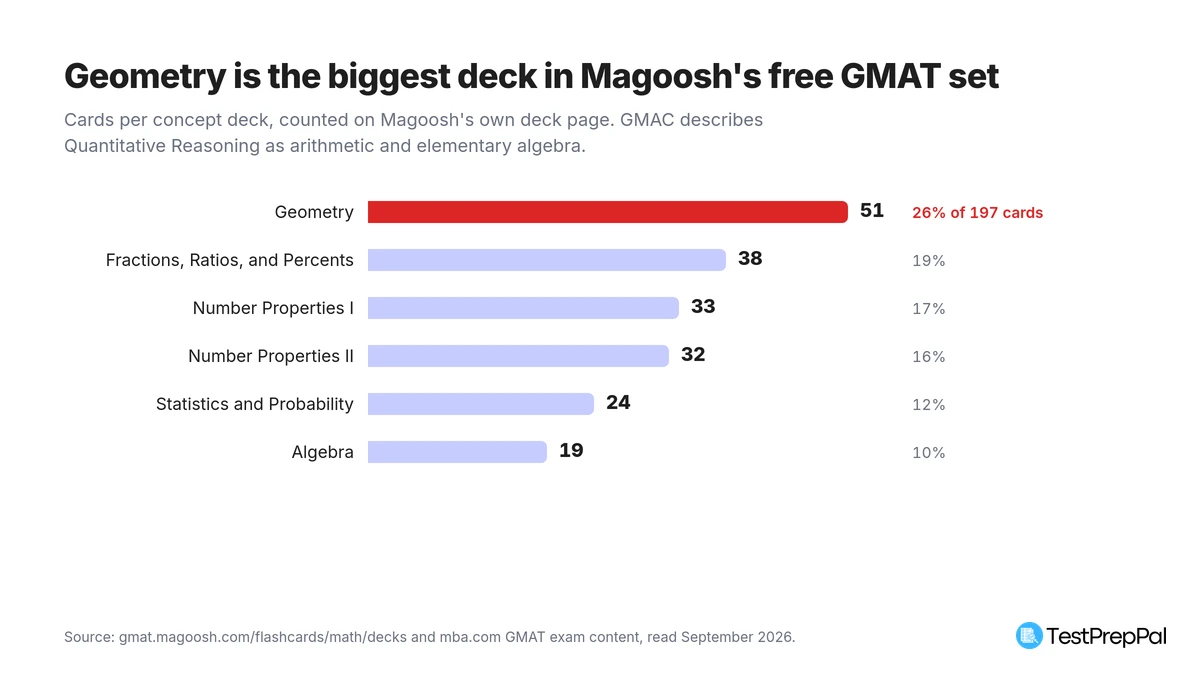 Magoosh's concept decks by card count, counted from its deck index on 25 September 2026.
Be careful about how far you take this. GMAC publishes a section description, not a full content outline, so "not named" is not the same as "cannot appear". Ratios, rates and coordinate work sit close enough to arithmetic and algebra that some of what Magoosh files under geometry is still useful. But 51 cards of circle theorems and triangle area formulas is a lot of card time for content the test maker declines to mention, and the deck index gives you no warning.
The mixed practice decks are not flashcards, and that is the best thing here
Open Mixed Practice I and you do not get a concept prompt. You get a full GMAT-style problem: "What is the smallest positive integer that is not a factor of (20!)?" Flip it and you get a worked solution that reasons through 3 times 7 giving 21, 2 times 11 giving 22, and lands on 23 as the first prime the factorial misses.
That is a practice question with an explanation, sitting in a flashcard shell. There are 221 of them, more than the 197 concept cards, and they are the part of this set worth the most.
The reason is that flashcards and practice questions train different things. Cards make retrieval automatic. Questions train the decision about which fact to retrieve, which is the harder half of a 21-question section with no calculator. Most free decks only give you the first. Magoosh gives you both and does not distinguish between them anywhere in its interface, so plenty of students never notice.
It also changes the honest comparison. Magoosh's GMAT question bank is a paid product. These 221 problems are free, they come with the same house explanations, and they are a real sample of what the paid material reads like. If you are weighing Magoosh's GMAT prep course, drill Mixed Practice I before you spend anything.
The format fights the content on longer cards
The explanation quoted above runs four sentences of chained arithmetic. On a phone, that is a scroll. It is a good explanation, but it is a paragraph, and a paragraph is not what the flip of a card is for.
This is the recurring weakness across the set. Magoosh wrote the explanations to teach, which is right, then put them somewhere designed for one-second recall. The concept decks handle it better because the fronts are short. The mixed practice decks, which are the better material, are where it bites.
The practical fix is to treat the two halves differently. Run concept decks in spare minutes, the way flashcards are meant to work. Sit down with mixed practice at a desk with scratch paper, work the problem before you flip, and read the explanation as you would read a solutions manual. Our GMAT study guide makes the same case about spacing retrieval practice against problem sets.
Pricing
There is one price, and it is nothing.
| What | Price | Access | Account |
|---|---|---|---|
| Magoosh GMAT Math Flashcards, web | Free | Unlimited | Optional |
| Magoosh GMAT Math Flashcards, iOS | Free | Unlimited | Optional |
| Magoosh GMAT Math Flashcards, Android | Free | Unlimited | Optional |
Verified on Magoosh's flashcard page on 25 September 2026. There is no paid tier of the flashcards, no card limit and no expiry, which makes the per-month math that matters on every other product in this category meaningless here.
One thing to check before you assume free means no cost. Magoosh publishes a separate GMAT idiom deck, built for Sentence Correction. GMAC's exam content page lists Verbal Reasoning as Reading Comprehension and Critical Reasoning only, with no Sentence Correction. Those idiom cards are not part of this product and are not worth your study time.
Who Magoosh GMAT Flashcards Are Best For
- Anyone who wants free GMAT quant practice today, because there is no signup, no card cap and no trial clock, and 418 cards is more than most paid decks
- Students with dead time, since the iOS and Android apps make a bus ride worth 15 cards
- Candidates rebuilding arithmetic fluency, who should run Fractions, Ratios, and Percents and both Number Properties decks and skip the rest for now
- Anyone considering paying Magoosh anything, because the mixed practice decks are a free, honest sample of the explanation style you would be buying
- Self-studiers who already have a question bank and want retrieval practice that does not eat their stock of unseen official questions
They are not for anyone who needs Verbal or Data Insights help, which is 43 of the 64 scored questions on the exam. This deck speaks to the other 21.
When You Might Look Elsewhere
- If you want cards written by the test maker, the GMAT Official Flashcards come inside the Official Guide's question bank from $26.99, though GMAC will not tell you how many there are
- If you want a structured library with analytics, Target Test Prep GMAT Flashcards come attached to a full course, starting at $299
- If you want to build your own decks, Quizlet and Varsity Tutors are both free, with the usual warning that community sets vary wildly in quality and currency
- If what you actually need is Verbal or Data Insights, no flashcard set on the market covers them well; start from the GMAT flashcards category and then look at a GMAT question bank instead
- If you want to know where you stand before you drill anything, run our free GMAT quant practice questions and let the result pick your decks
Final Verdict
Magoosh's GMAT math flashcards are the best free thing in this category, and they are better than their own marketing suggests. The 221 mixed practice problems with worked explanations are genuinely good study material that Magoosh gives away and barely mentions. Nothing else free comes with that.
We rate them 4.0 out of 5. The deduction is for the mix, not the writing. A set that puts 51 geometry cards at the top of a menu, with no note about what the current Quantitative Reasoning section actually measures, asks a student to do the auditing that the provider should have done.
How we assess and score products is on our review methodology page, the rest of the category is on our GMAT flashcards list, and everything else about the exam starts at the GMAT hub.
Magoosh GMAT Flashcards FAQs
Are Magoosh's GMAT Flashcards Really Free?
Yes, with no conditions we could find on 25 September 2026. There is no trial period, no card limit and no payment step, and you can study the full set in a browser without creating an account. The sign-up link exists only to save your progress across devices, which matters if you want to switch between the web app and the phone apps.
How Many Magoosh GMAT Flashcards Are There?
There are 418, which is more than the "400+" Magoosh advertises. We counted them from the per-deck totals Magoosh publishes on its deck index: 197 cards across six concept decks and 221 across six mixed practice decks. The largest single deck is Geometry at 51 cards and the smallest is Algebra at 19.
Do Magoosh's GMAT Flashcards Cover The Current Exam?
Partly. They cover Quantitative Reasoning only, which is 21 of the 64 scored questions, and there is no Verbal Reasoning or Data Insights deck. Within the math, 51 of the 197 concept cards are geometry, while GMAC describes Quantitative Reasoning as arithmetic and elementary algebra and does not name geometry. Pick decks deliberately rather than shuffling the whole set.
Should I Use The Mixed Practice Decks Or The Concept Decks?
Both, but differently. The concept decks are short-prompt recall and work well in spare minutes on a phone. The mixed practice decks are full GMAT-style problems with worked explanations, so sit with them at a desk, solve before you flip, and read the explanation properly. The mixed decks are the stronger material of the two.
Are Magoosh's Free Flashcards Better Than The Official GMAT Ones?
They are more useful and far better documented. GMAC has never published a card count, a subject list or a preview for its official flashcards, and you cannot buy them separately from an Official Guide. Magoosh publishes a count on every deck and lets you read every card for free. The official cards' only real edge is that GMAC writes the exam.
We may earn commissions from some links on this page, but this does not affect our reviews or your experience.
Our Verdict
The best free GMAT math deck available, and the one most likely to waste your time if you drill it front to back. The 221 mixed practice cards are full exam-style problems with worked explanations, which is more than most paid decks give you. But 51 of the 197 concept cards are geometry, and GMAC describes Quantitative Reasoning as arithmetic and elementary algebra. Use the deck picker, not the shuffle.