
Best GMAT Question Banks in 2026

by John Reed· Last Updated: Sep 26, 2026
Question banks are where GMAT scores are actually built. Full-length mocks tell you where you stand; banks are what move you. But the headline numbers vendors advertise are close to meaningless on their own, because 50,000 community-contributed questions and 4,000 professionally curated ones are not the same product.
We compared the seven banks most GMAT students consider, verified every price live in August 2026, and worked out what you actually pay per question.
Here's the bottom line:
- GMAC Official Guide Question Bank: Best for real retired GMAT questions, and the cheapest official practice available.
- Target Test Prep: Best for Quant, with more instructor-led video solutions than any rival bank and the best error tracking in prep.
- e-GMAT Scholaranium: Best curated volume at 7,500 questions, and the strongest Verbal.
- GMAT Club: Best free option, with 50,000+ questions and 8 free adaptive questions a day forever.
- Manhattan Prep Qbank: Best value at $39 for 1,000+ problems.
- Magoosh: Best for video explanations, with one for every single question.
- Manhattan Review: Best no-signup free bank, with 412 questions and no account of any kind.
- Only GMAC's bank contains real retired GMAT questions: everything else is original material written to imitate the exam.
- Cost per question varies by a factor of ten: Manhattan Prep is about 4 cents, GMAC about 5 cents, and Target Test Prep about 24 cents.
- GMAT Club's 50,000+ is a community aggregate, not a curated bank: it is not comparable to e-GMAT's 7,500 or TTP's 4,000.
- Target Test Prep includes no full-length practice tests by design, and directs students to GMAC's official mocks instead.
- Manhattan Review's 412 free questions are real: its on-page counter says 348 because 17 of those items are reading passages holding 81 questions between them.
GMAT Question Banks Comparison Table
| GMAC | Target Test Prep | e-GMAT | GMAT Club | Manhattan Prep | Magoosh | Manhattan Review | |
|---|---|---|---|---|---|---|---|
| Price | $49.99–$114.99 | $299–$1,099 | $249–$499 | Free–$29.99/mo | $39 | $199–$449 | Free |
| Questions | 975+ (2,100+ bundle) | 4,000+ | 7,500 | 50,000+ | 1,000+ | 800+ | 412 (312 current) |
| Cost Per Question | ~$0.05 | ~$0.24 | ~$0.07 | Free–low | ~$0.04 | $0.25–$0.44 | $0 |
| Real Retired Questions? | Yes | No | No | No | No | No | No |
| Video Explanations? | No | 1,200+ to 2,200+ | Yes | Community | No | Every question | No |
| Curated? | Yes | Yes | Yes | Community | Yes | Yes | Yes |
| Best For | Official practice | Quant | Verbal + volume | Free volume | Value | Video learners | No-signup practice |
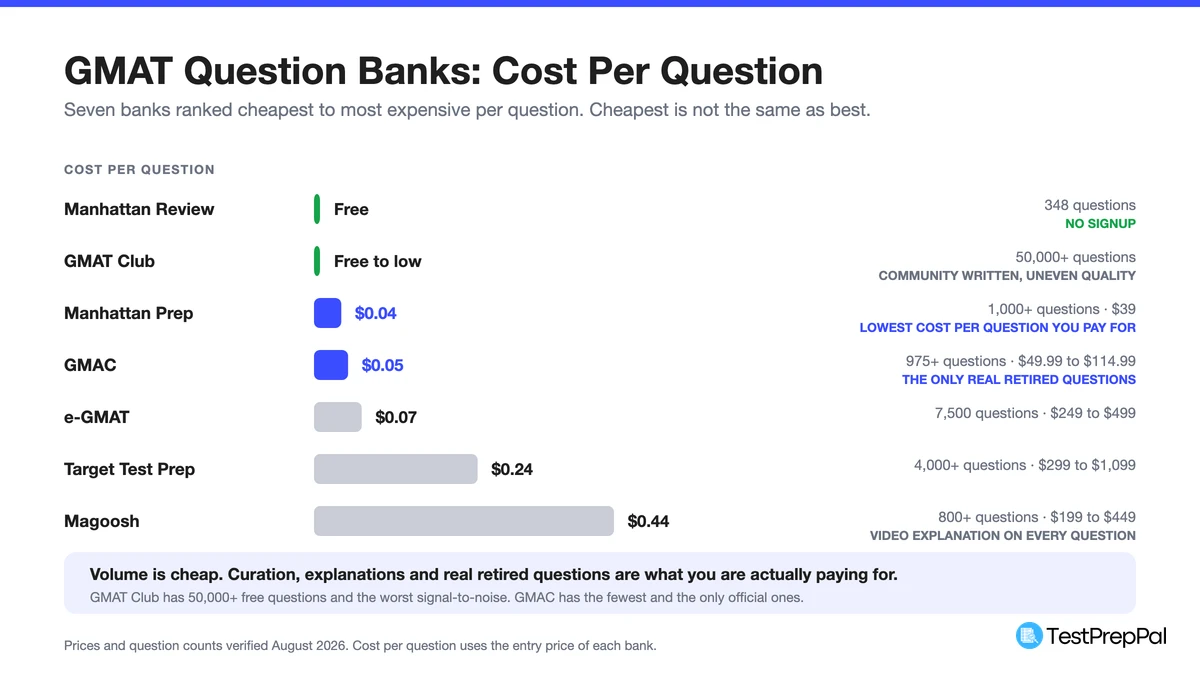 Cost per question, cheapest first. Question count and question quality are close to unrelated.
The 7 Best GMAT Question Banks, In-Depth Reviews
1. GMAC GMAT Official Guide Online Question Bank
GMAC's own bank is non-negotiable. It is the only source of real retired GMAT questions, and no amount of third-party quality substitutes for practising on the genuine article.
The base Official Guide 2026-2027 eBook and Online Question Bank costs $49.99 for 975+ questions including 100+ new items. The four-book bundle at $114.99 raises that to 2,100+ questions across the main guide plus the Quantitative Review, Verbal Review, and Data Insights Review titles, with 250+ questions available only in the online bank. The same four guides in print cost $69.70 and carry their own bank codes, which our full review works through. A separate Official Practice Questions Bundle at $79.99 adds 300+ more that do not overlap with the guides.
That non-overlap matters and is confirmed by tutors who have worked through all of them: the main Official Guide, the Review guides, and the Practice Questions bundle are distinct pools. You can buy all of them without paying twice for the same material.
One price note that GMAC's own store does not volunteer: the bank is a one-time-use code attached to a copy of the guide, and the publisher lists the same 2026-2027 title from $30.00, which our Official Guide question bank review prices against the $49.99 store edition.
The drawbacks are real but manageable. Answer explanations are frequently criticised as convoluted, the difficulty ceiling is limited so top scorers exhaust the genuinely hard material quickly, and the Wiley-hosted interface is clunky. It is also not adaptive and gives no predicted score. Use it as your source of truth, and use a better-explained bank alongside it.
2. Target Test Prep GMAT Question Bank
Target Test Prep pairs 4,000+ questions with 1,500+ lessons and more instructor-led video solutions than any rival bank ships. How many is unsettled: TTP's own pricing page publishes 2,200+, 2,000+ and 1,200+ in three different places, which puts video coverage somewhere between 30 and 55 percent of the bank. Its Quant reputation is the strongest in the category, and deservedly so.
The feature students single out is the error tracker, which logs not just which questions you missed but why, and how often you repeat each error type. Most banks tell you your accuracy; TTP tells you your failure pattern. Combined with fully customisable practice sets and chapter reinforcement tests, it is the most structured way to work through weak areas.
Pricing is Self-Study at $299 per month, $949 for 4 months, or $1,099 for 6 months, with OnDemand at $1,599 and LiveTeach at $2,199.
Two things to know. At roughly 24 cents per question it is by far the most expensive bank here. And TTP includes no full-length practice tests at all. That is a deliberate design choice, because they direct students to GMAC's official mocks for score prediction. Budget for those separately; see our GMAT practice tests comparison.
3. e-GMAT Scholaranium
Scholaranium is the largest curated bank in GMAT prep at 7,500 questions, and it is bundled with e-GMAT's course plans at $249 for 2 months, $379 for 4 months, or $499 for 6 months. Those plans also include 5 SIGma-X full-length adaptive mocks and 90 sectional tests.
Its distinguishing feature is ability-level reporting. Rather than only tracking accuracy, Scholaranium estimates your proficiency per sub-section and surfaces which specific areas are capping your score. For students who have plateaued and cannot work out why, that diagnostic layer is worth more than raw question volume.
e-GMAT's Verbal instruction is widely rated the strongest in the category, which makes it the natural counterweight to Target Test Prep's Quant focus. If Verbal is your bottleneck, start here, and work out which half of the section is costing you first: our GMAT Critical Reasoning guide covers the three question families and the order to drill them in.
The trade-offs: it is not sold standalone, so you buy the course to reach the bank, access starts at just 2 months, and the sheer volume of analytics can overwhelm students who simply want to drill.
4. GMAT Club Forum Question Bank & Adaptive Quiz
GMAT Club hosts more GMAT questions than anywhere else on the internet: 50,000+ contributed and curated by the community over two decades. Browsing the forum bank is free and unmetered, and every question carries community and expert explanations. Bunuel's Quant solutions in particular are a genuine institution and routinely clearer than official ones.
The structured Adaptive Quiz layers filtering, an error log, and an analytics dashboard on top. There is a permanently free tier of 8 questions per day with no credit card required. Paid plans are $19.99 per month for Linear or $29.99 per month for Adaptive, and, unusually, can be redeemed with GMAT Club Rewards points earned by contributing to the forum rather than with money.
The important caveat is that 50,000+ is a community aggregate, not a curated bank. Quality varies question to question in a way it does not at e-GMAT or TTP, so do not read that number as ten times better than Scholaranium's 7,500. Verbal and Data Insights coverage also lags Quant, score prediction is widely considered inaccurate, and questions cannot be reviewed once a free period ends.
5. Manhattan Prep GMAT Qbank
The Manhattan Prep Qbank, now branded Manhattan Prep powered by Kaplan, is the best pure value in GMAT prep: 1,000+ problems for $39 with 6 months of access, which works out to about 4 cents per question.
It covers all eight GMAT Focus question types, including the Data Insights formats that most banks skimp on: Tables, Graphs, Multi-Source Reasoning, and Two-Part Analysis. Every question and explanation is written by Manhattan Prep's 99th-percentile instructors, and explanation quality has long been the brand's strongest asset, with reviewers regularly rating them above GMAC's own.
A free tier lets you try the bank before paying anything, but check what loads: Kaplan's own GMAT pages describe the free Qbank as 100 problems across all eight question types on one page and as 350+ Foundations of Math problems on another, and both link to the same sign-up. Our Manhattan Prep Qbank review sets out all three descriptions.
Know what it is: a drill bank with no lessons, no full-length CATs, and no adaptivity. The interface is dated, and hard Quant items skew toward laborious multi-step problems rather than clever ones. As a cheap supplement to official material, it is hard to beat.
6. Magoosh GMAT Question Bank
Magoosh bundles 800+ questions with 200+ video lessons, and its defining feature is that every single question carries both a video and a written explanation. No competitor matches that at this price.
Its Quant lessons earn consistent praise for teaching where formulas come from rather than asking you to memorise them, and its score predictor has a good reputation for accuracy. Plans run $249 for 6 months and $349 for 12 months, with an up-to-70-point score guarantee and a 7-day refund window. A 30-day plan at $199 also exists, though the pricing page does not list it.
The problems are volume and balance. At 800+ questions this is the smallest paid bank here and the most expensive per question, at 25 cents on the 30-day plan and 44 cents on the 12-month one. Verbal draws consistent criticism above the 650 level, some Sentence Correction material is dated against current official questions, and Data Insights coverage is thin relative to the current exam. Good for video learners early in prep; not enough on its own for a 700+ target.
7. Manhattan Review Free GMAT Practice Questions
Manhattan Review's free bank asks for no account, no email, and no payment, which is genuinely rare. It covers Problem Solving, Reading Comprehension, Critical Reasoning, and all five Data Insights formats including Data Sufficiency.
Its real strength is explanation depth. Alongside the correct answer it explains each wrong option and names the specific error, and it shows the percentage of other test takers who picked each choice, which is peer benchmarking that most free banks lack.
Now the number, because the page publishes two. The site advertises 412 free questions while its own practice counter reads 348, and it never reconciles them. Counting every section settles it: the 17 Reading Comprehension items are passages holding 81 questions between them, so 348 listed items minus 17 passages plus 81 questions is exactly 412. Of those, 100 are Sentence Correction items retired from the GMAT Focus exam and clearly labelled as old format, which leaves 312 questions in current format. Our Manhattan Review question bank review counts it section by section. There is no progress tracking, error log, or timer.
Manhattan Review also gives away a separate 300-question Quantitative Question Bank as a PDF, which pairs with its GMAT Math Essentials book and is the better free option of the two if you want graded difficulty bands.
One practical note: Manhattan Review is not Manhattan Prep. They are unrelated companies with confusingly similar names, and the Qbank reviewed above belongs to Manhattan Prep.
How to Choose a GMAT Question Bank
Start from what is actually limiting your score:
- Everyone, without exception: GMAC's Official Guide bank. Real retired questions are the foundation; the rest is volume around them.
- Quant is your bottleneck: Target Test Prep, for the video solutions and error tracker.
- Verbal is your bottleneck: e-GMAT Scholaranium.
- Budget is tight: Manhattan Prep's Qbank at $39, plus GMAT Club's free tier.
- Spending nothing: GMAT Club's 8 free questions a day, Manhattan Review's 412, and Manhattan Prep's free 100.
A realistic combination for most students is the GMAC bundle at $114.99 plus one strong third-party bank. That covers official material for accuracy and third-party material for volume and explanation quality, which is the pairing that actually moves scores.
Before you buy, our free GMAT study plan generator will map your weeks to your test date, and the free GMAT Quant practice questions give you an honest read on Problem Solving at no cost. If you want instruction rather than just questions, see our GMAT prep course comparison.
GMAT Question Bank FAQs
What is the best GMAT question bank?
GMAC's Official Guide Online Question Bank, because it is the only bank containing real retired GMAT questions. For a third-party bank alongside it, Target Test Prep is the strongest for Quant and e-GMAT Scholaranium for Verbal. On value alone, the Manhattan Prep Qbank at $39 for 1,000+ problems is the best deal in GMAT prep.
Is there a free GMAT question bank?
Yes, and some are substantial. GMAT Club offers 8 adaptive questions per day free forever with no credit card, and its 50,000+ forum question bank is free to browse. Manhattan Prep advertises a free Qbank that its own pages size at either 100 problems across all eight question types or 350+ Foundations of Math problems, Manhattan Review offers 412 free questions with no signup, and GMAC's free Starter Kit includes 70+ official questions plus two full-length exams.
How many practice questions do I need for the GMAT?
Most students who improve significantly work through 2,000 to 4,000 questions over two to three months. Volume alone is not the point though. Reviewing every miss carefully and tracking recurring error patterns matters more than raw count, which is why banks with strong explanations and error tracking tend to produce better results than larger but thinly explained ones.
Does Target Test Prep include practice tests?
No, and this is deliberate. Target Test Prep provides chapter reinforcement tests and fully customisable practice sets, but no full-length exams, because it directs students to GMAC's official practice exams for score prediction. If you use TTP, budget separately for official mocks.
Are GMAT Club questions good quality?
They are useful but variable. GMAT Club's 50,000+ questions are community-contributed rather than professionally curated, so quality ranges from excellent to poor. The community explanations, especially Bunuel's Quant solutions, are frequently better than official ones. Treat it as a huge free supplement rather than a structured curriculum, and do not compare its 50,000+ directly against a curated bank like e-GMAT's 7,500.
Should I buy the GMAT Official Guide bundle or the single book?
The bundle at $114.99 gives 2,100+ questions across four titles versus 975+ for the $49.99 single guide, which is better value per question and includes 250+ questions available only online. Since the guides do not overlap with each other, the bundle is the sensible choice if you are studying for more than about six weeks. The single guide is enough for a short retake preparation. Before you buy either, note that the four guides in print are $69.70 with the same bank access attached, which our GMAT Official Guide review compares against the digital price.
We may earn commissions from some links on this page, but this does not affect our reviews or your experience.


