


GMAT Critical Reasoning questions come in three families: ones that ask you to attack or improve an argument, ones that ask you to describe how the argument is built, and ones that ask you to draw a conclusion from it. GMAC's Critical Reasoning explainer on mba.com says more than 75 percent of the questions are the first family, which tells you exactly where to spend your first month.
That weighting is the part almost every prep page leaves out. The usual article hands you an alphabetical list of eight or ten question types with no sense of which ones you will actually meet.
- Three families cover every Critical Reasoning question: attack the argument, describe the reasoning, or draw the conclusion.
- More than 75 percent are the attack family, so strengthen, weaken and assumption questions come first in your study order.
- GMAC does not publish a count per subtype. Any page quoting "assumption is 18 percent of CR" invented that number.
- The Verbal section is 23 questions in 45 minutes, which averages 1 minute 57 seconds per question.
- Verbal now holds only Reading Comprehension and Critical Reasoning. Sentence Correction is gone.

Target Test Prep GMAT
One of the most complete GMAT prep platforms we've reviewed. Try full access for 5 days.
No code neededPros
- Very large GMAT content and practice library
- Strong analytics, error tracking, and custom test tooling
- 130-point score improvement guarantee
Cons
- Higher tiers become expensive quickly
What Critical Reasoning is on the current GMAT
Critical Reasoning is one of two question types in the Verbal Reasoning section. GMAC's exam content page states that the section is composed of Reading Comprehension and Critical Reasoning questions only. Sentence Correction, which older guides still cover at length, is not on the exam.
Each Critical Reasoning item gives you a short reading passage, usually fewer than 100 words, and five answer options. You do not need any outside knowledge of the topic. Everything you need is in the passage, which is why the questions can put a bike lane, a vaccine and a quarterly earnings report on the same test.
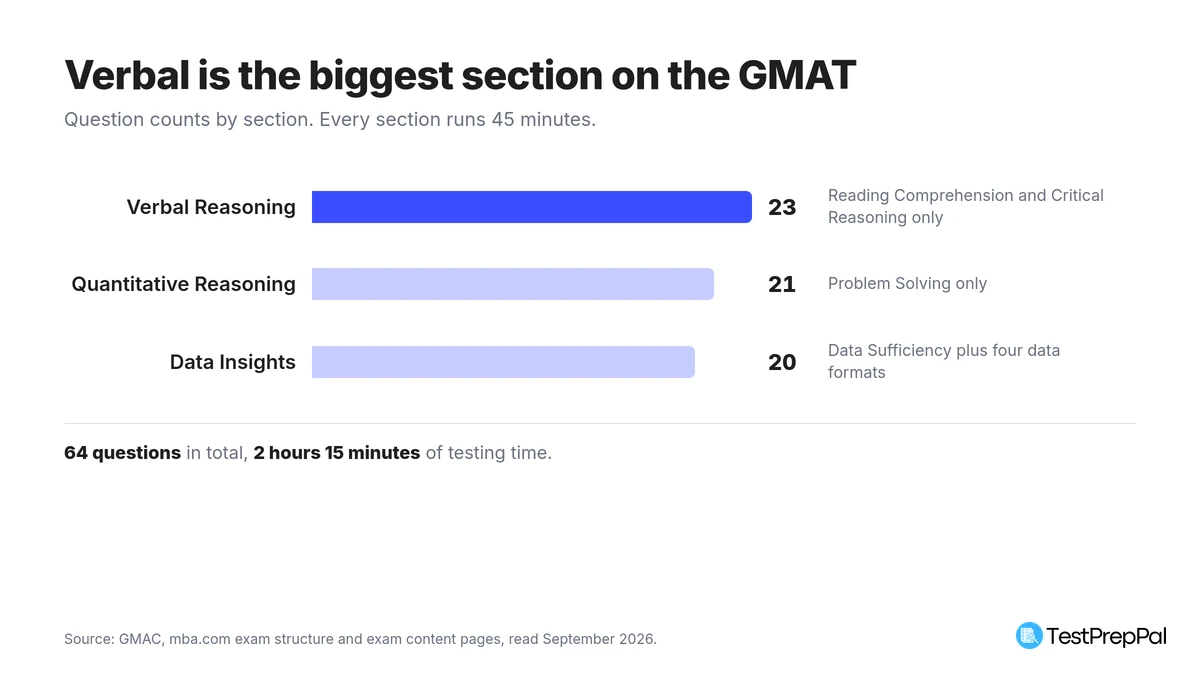 Published GMAT structure. Source: GMAC, read September 2026.
Two things follow from that chart. Verbal is the largest of the three sections, and it is split across only two question types, so Critical Reasoning carries more of your Verbal score than any single question type carries in Quant or Data Insights. GMAC publishes the section totals on its exam structure page but does not publish how the 23 Verbal questions divide between reading and reasoning, so treat any exact Critical Reasoning count you see elsewhere as an estimate.
Critical Reasoning also shows up outside Verbal. GMAC notes that Two-Part Analysis questions in Data Insights now commonly use the same setup: an argument or a plan, then a task that asks you to strengthen it in one column and weaken it in the other. Training this skill pays in two sections, not one. If you are still sizing up the exam as a whole, our guide to how hard the GMAT is covers the rest of the format, and the GMAT hub collects the scoring and registration pages.
The three families, in the order they are worth learning
GMAC groups the whole question type into three families. Study them in this order, because the order matches how often they appear.
| Family | What the question asks | Names you will see | How often |
|---|---|---|---|
| 1. Attack or improve the argument | Find the answer that exposes or repairs a flaw in the passage | Strengthen, weaken, assumption, useful to evaluate, explain the paradox | More than 75 percent |
| 2. Describe the reasoning | Say what role a statement plays or how the argument is built | Method of reasoning, usually the boldfaced questions | The remainder, with family 3 |
| 3. Draw the conclusion | Take the passage as fact and pick a conclusion it supports | Inference, conclusion | The remainder, with family 2 |
Here is the honest caveat, and it matters for how you plan. GMAC gives the weighting for family 1 and nothing finer. There is no official table anywhere on mba.com that says what share of Critical Reasoning questions are assumption questions, or weaken questions, or boldface. Pages that quote those splits to the percentage point are quoting a prep company's tally of its own materials, not the exam.
So the practical read is simple. Family 1 is three quarters or more of what you face, and its five subtypes all reward the same core skill: finding the gap between the premises and the conclusion. Families 2 and 3 share the rest and need a different approach, which is the next section.
A four-step method that works on all three
The method below follows the sequence GMAC's explainer lays out. It is deliberately boring and repeatable, which is the point under time pressure.
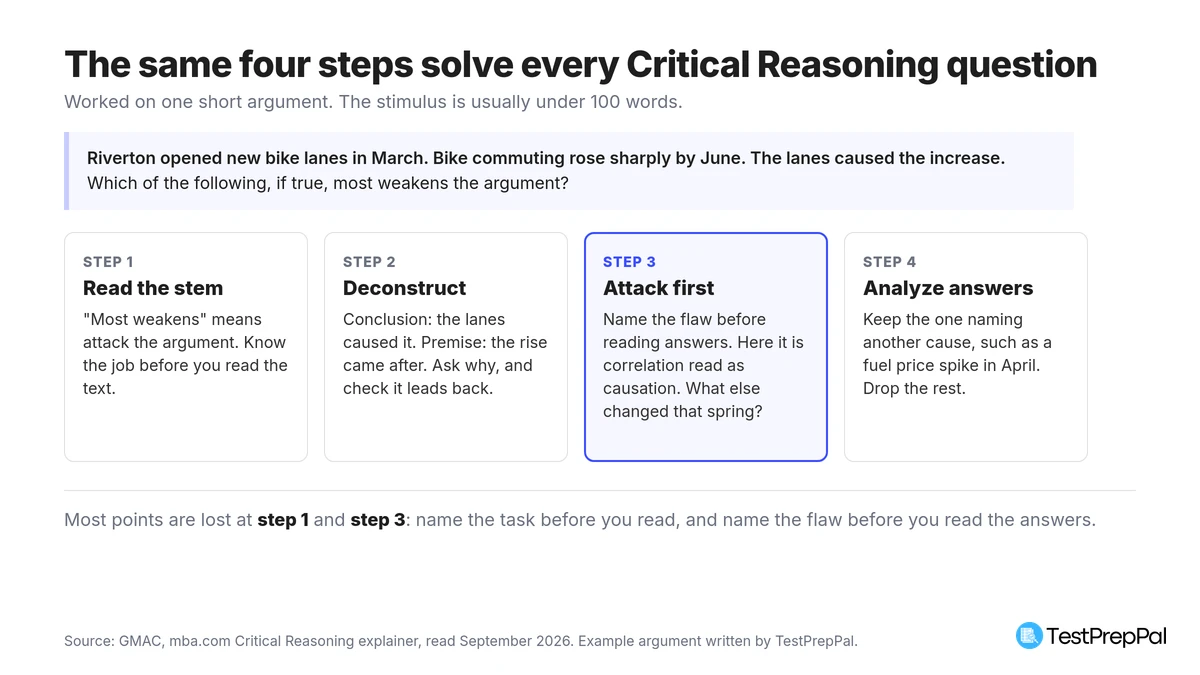 The four steps worked on an original example argument. Method source: GMAC, read September 2026.
Step 1: read the question stem first. The three families need completely different mindsets, so you need to know your job before you read the passage. GMAC's own example of how easy this is to get wrong: "Which of the following most supports the argument above?" is a strengthen question, while "Which of the following is most supported by the argument above?" is an inference question. Nine words apart, opposite tasks.
Step 2: deconstruct the argument. Find the conclusion, then ask "why?" and check that the answer leads you back to the premises in the passage. If it does not, you have the wrong sentence as your conclusion. Do not look at the answer choices yet.
Step 3: attack and anticipate, but only for family 1. Name the flaw yourself before you read a single answer. This is the step strong scorers do and weak scorers skip, and it is also the step that does not transfer. GMAC is explicit that anticipation is for family 1 only. On boldface questions you deconstruct and then eliminate; on inference questions you cannot predict what valid conclusion the writers chose, so you work the answers one by one.
Step 4: analyze the answers with the traps in mind. Wrong answers on Critical Reasoning are built to be attractive. Reading them before step 3 is what lets them set your thinking.
The common flaws GMAC names are worth memorizing as a checklist: correlation mistaken for causation, unjustified generalization, numerical data flaws such as using absolute numbers where percentages belong, assuming past trends continue, and ignoring the baseline you started from.
Sponsored
Target Test Prep GMAT
One of the most complete GMAT prep platforms we've reviewed. Try full access for 5 days.
No code neededPros
- Very large GMAT content and practice library
- Strong analytics, error tracking, and custom test tooling
- 130-point score improvement guarantee
Cons
- Higher tiers become expensive quickly
The trap behind each question type
Knowing the type is half the work. The other half is knowing how that type gets you. These four mechanisms are the ones GMAC names, and each maps onto a predictable mistake.
| Trap | How it works | Where it bites |
|---|---|---|
| Wordplay | Negation and abstract phrasing designed to be misread | Assumption questions, where the correct answer is often phrased negatively |
| Misdirection | Vivid detail pulls your attention off the dull sentence that matters | Weaken and strengthen, where the flaw is usually in the boring premise |
| Mental inertia | A familiar topic where the right answer contradicts what you assume | Any family 1 question on a subject you have opinions about |
| Word shifts | A term quietly changes between the premise and the conclusion | Assumption and weaken, where the shift is the gap itself |
Word shifts deserve their own drill. If a passage argues from "wholesale price" and an answer talks about "the price paid by consumers", those are not the same thing, and the swap is usually the whole question. Treat every synonym in a Critical Reasoning passage as a suspect.
For assumption questions specifically, the negation technique cuts through the wordplay. Take the answer choice, read it affirmatively instead of negatively, and see whether the argument collapses. If it collapses, that answer was a necessary assumption and it is your pick.
How much time you actually get
Here is the arithmetic nobody shows you. The Verbal section is 45 minutes for 23 questions. That is 2,700 seconds divided by 23, or 117 seconds per question.
You average 1 minute 57 seconds per Verbal question. Reading Comprehension passages eat more than that, so Critical Reasoning items need to land closer to 1 minute 45 seconds to keep the section on schedule.
That budget is why step 1 pays for itself. Reading the passage without knowing your task means reading it twice, and you do not have 2 minutes to spend twice.
One feature buys back a little room. GMAC's published structure lets you bookmark questions as you go and, once you finish the section, change up to three answers on the review screen. Three is the hard limit, so bookmark generously but spend those edits on questions where you narrowed it to two choices, not on ones you never understood.
What to practise, and where the official questions are
Official questions are the only ones written by the people who write the exam, and Critical Reasoning is the question type where that gap shows most. Prep company items tend to have cleaner flaws and less manipulative answer choices, which trains the wrong instincts.
GMAC publishes very little for free. Its sample questions page carries two Critical Reasoning items, and both are weaken questions. A third worked item sits inside the explainer linked at the top of this page, and that one is an assumption question. All three belong to family 1, which is consistent with the more than 75 percent figure, though three questions is far too small a sample to prove anything on its own. Use them to learn the format, not to estimate frequencies.
For volume you need the paid official material. The GMAT Official Guide question bank is the largest pool of retired official questions, and the official practice tests put Critical Reasoning back under section timing, which is where the pacing above gets real. We score every resource against a published review methodology so you can see what each one was tested on.
If your verbal work needs structure rather than more questions, a full course is the honest answer, and our GMAT prep course reviews compare what each one covers. Target Test Prep is the one we rate highest for candidates who want a guided sequence rather than a question dump. When you are ready to slot this into a schedule, our GMAT study guide sets out the weekly structure, and you can warm up the quantitative side with our free GMAT Quant practice questions.
Whatever you drill with, keep an error log with one column that most students miss: which family the question was, and which step of the method you skipped. After 50 questions that column tells you more than your percentage correct does.
Critical Reasoning FAQs
Does the GMAT still have Critical Reasoning?
Yes. Critical Reasoning is one of the two question types in the Verbal Reasoning section, alongside Reading Comprehension. Sentence Correction was removed, so Critical Reasoning now carries a larger share of your Verbal score than it used to. Similar reasoning also appears in Two-Part Analysis questions in the Data Insights section.
How many Critical Reasoning questions are on the GMAT?
GMAC publishes that the Verbal section has 23 questions and does not publish how those split between Reading Comprehension and Critical Reasoning. Any specific count you see is somebody's estimate from practice materials, not an official figure. Plan on Critical Reasoning being a substantial share of the 23 and train it accordingly.
Which Critical Reasoning question type should I study first?
Start with the family that asks you to attack or improve an argument: strengthen, weaken and assumption questions. GMAC states that more than 75 percent of Critical Reasoning questions come from that family. Boldface and inference questions are worth learning, but they are the smaller share and they need a different approach, so they are better as a second pass.
How long should a Critical Reasoning question take?
The Verbal section averages 1 minute 57 seconds per question across all 23 items. Because Reading Comprehension passages run long, aim to finish most Critical Reasoning questions in about 1 minute 45 seconds. If you are still deconstructing the argument at the two minute mark, pick your best remaining option, bookmark it, and move on.
We may earn commissions from some links on this page, but this does not affect our reviews or your experience.