


Sentence Correction is not on the GMAT. GMAC's exam content page describes the Verbal Reasoning section as 23 Reading Comprehension and Critical Reasoning questions, and the question type now survives on the Executive Assessment, whose 14-question Verbal section still lists it.
That split is why this page exists. If you are taking the GMAT, every Sentence Correction chapter you own is dead weight. If you are taking the Executive Assessment, almost every page ranking for this question was written for the wrong exam.
- The GMAT Verbal section is 23 questions, Reading Comprehension and Critical Reasoning only. Sentence Correction is not among them.
- The Executive Assessment still tests it: 14 Verbal questions in 30 minutes, covering Reading Comprehension, Critical Reasoning and Sentence Correction.
- GMAC does not publish how those 14 questions split by type, so any page quoting an exact Sentence Correction count on the EA invented it.
- mba.com itself still hosts a 2021 article calling Sentence Correction one of three GMAT Verbal question types, which is how the confusion stays alive.
- EA Verbal gives you 2 minutes 9 seconds per question against the GMAT's 1 minute 57 seconds, so the extra question type comes with about 11 extra seconds.
Target Test Prep GMAT
One of the most complete GMAT prep platforms we've reviewed. Try full access for 5 days.
No code neededPros
- Very large GMAT content and practice library
- Strong analytics, error tracking, and custom test tooling
- 130-point score improvement guarantee
Cons
- Higher tiers become expensive quickly
What the GMAT Verbal section actually contains
GMAC's exam content page is unambiguous. Verbal Reasoning is "composed of 23 Reading Comprehension and Critical Reasoning questions". There is no third question type, no underlined sentences, and no grammar testing anywhere else on the exam either. Quantitative Reasoning is problem solving, and Data Insights handles data sufficiency and multi-source questions.
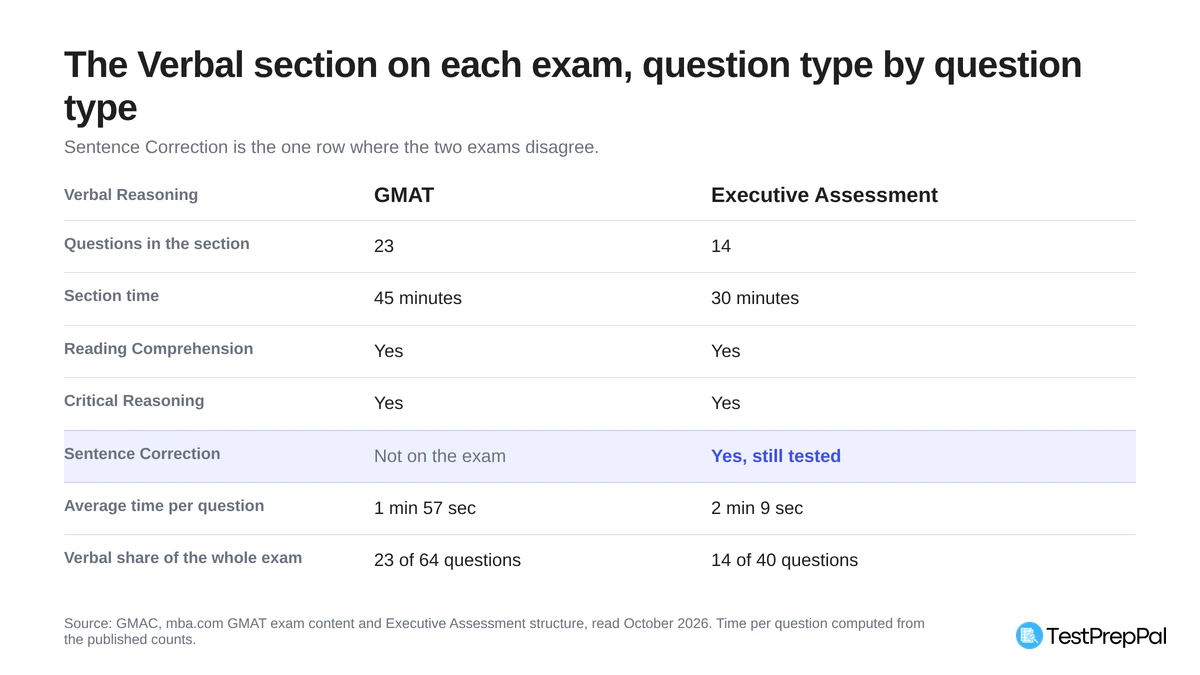 GMAT and Executive Assessment Verbal sections compared. Source: GMAC, read October 2026.
The arithmetic in the bottom rows is worth a second. GMAT Verbal is 45 minutes for 23 questions, which is 2,700 seconds divided by 23, or 1 minute 57 seconds each. EA Verbal is 30 minutes for 14 questions, which works out to 2 minutes 9 seconds each. The Executive Assessment asks you to handle one more question type and gives you about 11 more seconds per question to do it.
Verbal carries almost the same weight on both exams. It is 23 of 64 scored questions on the GMAT and 14 of 40 on the EA, which is 36 percent and 35 percent. The section matters equally. It just contains different things.
Why so many pages still teach it as GMAT content
Search for this topic today and most of what you get is a Sentence Correction tutorial written for an exam that no longer asks the question. That is not only prep companies being slow. GMAC's own site is part of it.
The mba.com page that ranks third for this query is an expert tips article on Sentence Correction, dated August 10, 2021 and written by Chris Kane of Menlo Coaching as an mba.com featured contributor. Its page description still reads "Sentence Correction is one of the three question types you'll encounter in the GMAT Verbal Reasoning section." The article is a good one. It is also four years older than the exam it describes, and nothing on it says so.
The same pattern repeats off GMAC's site with less excuse. Manhattan Review's Sentence Correction page, ranking second, opens by calling Sentence Correction one of three GMAT Verbal question types and tells you to expect it to be "roughly 40%" of the section. That page sits on a site whose own navigation links to a GMAT Focus Edition explainer about the 2023 changes.
Before you trust any GMAT Verbal advice, find the date on the page. If it predates the Focus Edition and nobody has touched it since, its section counts are describing a retired exam, and that includes pages hosted on mba.com.
The practical test is quicker than reading the article. Open GMAC's exam content page, count the question types it names for Verbal, and compare. Two types means current. Three means stale. We apply the same check to every resource we rate, which is set out in our review methodology.
Where Sentence Correction still counts
The Executive Assessment is GMAC's shorter exam, built for working professionals and accepted by full-time, part-time, Executive MBA and Masters programs. Its structure page gives the whole shape: 40 questions in 90 minutes, across three equally weighted sections scored 0 to 20 each, for a total between 100 and 200.
| Section | Questions | Time | Question types |
|---|---|---|---|
| Integrated Reasoning | 12 | 30 minutes | Multi-Source Reasoning, Graphics Interpretation, Two-Part Analysis, Table Analysis |
| Verbal Reasoning | 14 | 30 minutes | Reading Comprehension, Critical Reasoning, Sentence Correction |
| Quantitative Reasoning | 14 | 30 minutes | Data Sufficiency, Problem Solving |
Two things in that table are worth noticing if you know the current GMAT. Data Sufficiency is still in the EA Quant section, where the GMAT moved it into Data Insights. And Integrated Reasoning is still its own section rather than the broader Data Insights section. The Executive Assessment keeps a structure the GMAT no longer uses.
What GMAC does not give you is the split inside those 14 Verbal questions. There is no published count of how many are Sentence Correction, how many are Critical Reasoning, and how many are Reading Comprehension. Pages that tell you to expect exactly five or exactly six are quoting somebody's tally of practice material, not GMAC. Plan for all three types and let the practice assessments tell you the mix you personally see.
Sponsored
Target Test Prep GMAT
One of the most complete GMAT prep platforms we've reviewed. Try full access for 5 days.
No code neededPros
- Very large GMAT content and practice library
- Strong analytics, error tracking, and custom test tooling
- 130-point score improvement guarantee
Cons
- Higher tiers become expensive quickly
What Sentence Correction tests, if you are the EA taker
The format is one sentence with part of it underlined, followed by five options. Option A always repeats the original wording, so "no change" is a real answer and not a cop-out. Your job is to pick the version that is clear, logical and free of errors.
The GMAC-hosted article above is still useful here, because the question type it describes did not change, only the exam it sits on. It names three habits worth copying:
- Scan the answer choices before you read the sentence closely. If the options differ on verb number or on where a modifier sits, you now know what to look for on the first read instead of hunting in a vacuum.
- Eliminate, never select by ear. Hard questions usually put something that sounds odd in the correct answer. There are concrete reasons the other four are wrong, and finding those reasons is the whole method.
- Read the differences between the two choices you have left. The reason one of them is wrong is often invisible until it sits beside the other one.
The worked example on that page makes the point better than any rule list. The original sentence contains no grammar error at all. It is wrong because "no less than a technical breakthrough is necessary" is redundant: if a breakthrough is necessary, then nothing less than it will do. The correct answer is the short one. As the author puts it, the hardest Sentence Correction questions test meaning, redundancy and word choice, not subject-verb agreement.
This is why memorising idiom lists is a poor use of EA study time. The grammar you need is ordinary. The skill you need is comparing five near-identical sentences and noticing what each one changes, which is much closer to Critical Reasoning than to a grammar test.
Official EA practice, and what it costs
Sentence Correction is the one place where using current official material really matters, because prep company items tend to have cleaner errors than the real thing. GMAC's Executive Assessment prep store lists the options, and the tiers are not obvious at a glance.
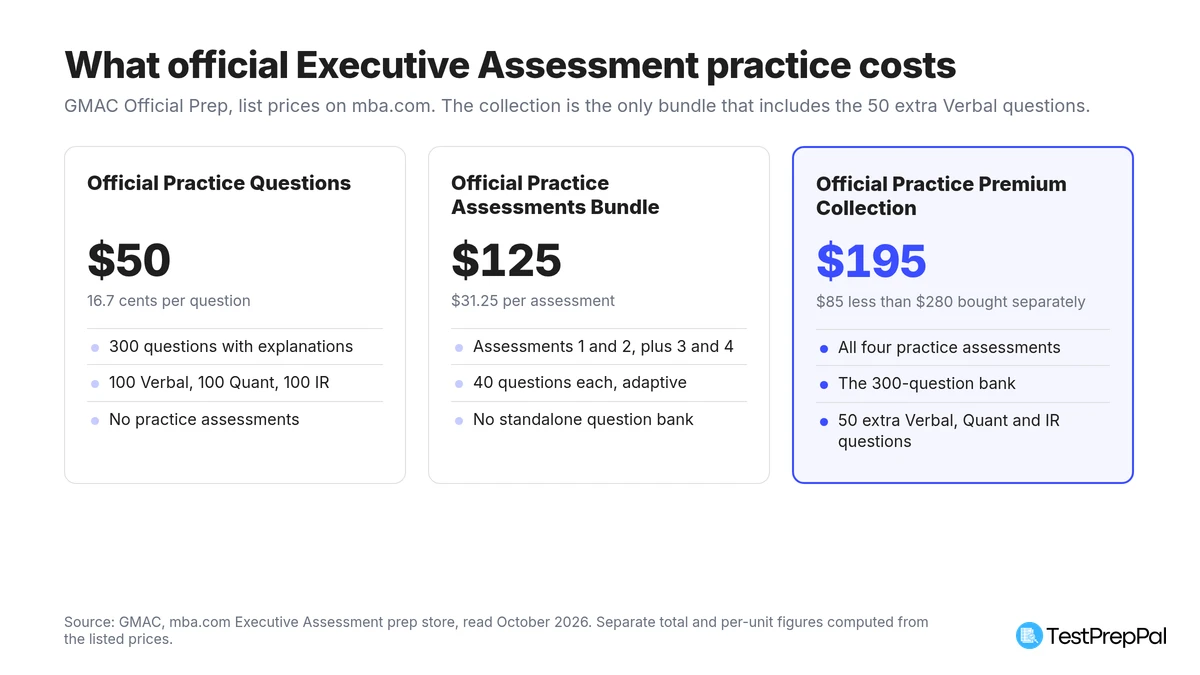 Executive Assessment Official Prep list prices. Source: GMAC, read October 2026.
The 300-question bank at US$50 splits evenly across the three sections, so it holds 100 Verbal questions, which is 16.7 cents per question. The 50-question Verbal add-on costs US$30 on its own, or 60 cents per question, about 3.6 times the price of the base bank. Buy the base bank first.
The Premium Collection at US$195 is the only bundle that carries the three add-on sets. Priced separately, its six pieces come to US$280: US$70 and US$70 for the two assessment pairs, US$50 for the question bank, and US$30 each for the Verbal, Quant and Integrated Reasoning add-ons. The collection saves US$85, or 30 percent. GMAC also keeps a free prep resources page for the EA, which is the sensible place to start before you spend anything.
One honest caveat on all of it. GMAC says the Executive Assessment is designed so candidates can feel prepared in under four weeks. That is the exam's selling point to working executives, and it is also a reason not to over-buy. Four practice assessments plus 150 Verbal questions is a lot of material for a four-week plan.
If you are taking the GMAT, what to do with your Sentence Correction material
Stop studying it. There is no partial credit, no hidden grammar question in Data Insights, and no scenario in which a Sentence Correction drill moves your GMAT score. Any hour you spend on it is an hour not spent on the two question types that are actually scored.
Redirect the time into Critical Reasoning first. It now carries a larger share of your Verbal score than it used to, and the argument skills transfer into Two-Part Analysis questions in Data Insights, so the same study pays twice. Our Critical Reasoning guide covers the three question families and the order worth learning them in.
For your materials, the fix is a date check rather than a shopping trip. A book written for the previous GMAT devotes a chapter to a question type you will not see, and some of those editions are still on shelves. Our GMAT prep book reviews record the edition and publication date of every set, which is the quickest way to tell what you are holding. If you want a guided sequence rather than a pile of books, our GMAT prep course reviews compare what each one covers, and Target Test Prep is the one we rate highest for structure.
Then rebuild the plan around the real section weights. Our GMAT study guide sets out a weekly structure, our page on what counts as a good GMAT score gives you the target to aim the plan at, and the GMAT hub collects the scoring, registration and format pages. If you want to test the quantitative side for free before committing to anything, start with our free GMAT Quant practice questions.
GMAT Sentence Correction FAQs
Is Sentence Correction removed from the GMAT?
Yes. GMAC's exam content page lists the Verbal Reasoning section as 23 Reading Comprehension and Critical Reasoning questions, with no Sentence Correction. The change came in with the Focus Edition, which is the only GMAT that mba.com now offers. Grammar is not tested anywhere else on the exam either.
Is there Sentence Correction in the GMAT Focus Edition?
No. The Focus Edition is simply the GMAT now, and its Verbal section holds two question types. If a page tells you the GMAT Verbal section has three question types, check its publication date before you trust anything else on it.
How many Sentence Correction questions are on the Executive Assessment?
GMAC does not publish that number. The EA Verbal section is 14 questions in 30 minutes and covers Reading Comprehension, Critical Reasoning and Sentence Correction, but the split between the three is not stated anywhere on mba.com. Treat any exact count you see elsewhere as an estimate from practice material.
How do you solve a Sentence Correction question?
Scan the five options first to see what they disagree about, then read the sentence knowing what to check. Eliminate options for concrete reasons rather than picking the one that sounds best, since the correct answer on hard questions often sounds unusual. When two options are left, the difference between them is almost always the point of the question, and redundancy or an unclear meaning is a more common fault than a broken grammar rule.
We may earn commissions from some links on this page, but this does not affect our reviews or your experience.