


A good GMAT score is 655 or higher. That is the 90th percentile on the current 205 to 805 scale, and the average total score is 554.94, according to GMAC's official score table on mba.com.
The harder part is that most advice you will read about GMAT scores was written for a scale that no longer exists. If someone told you to aim for a 700, that target is on the retired scale, and it is worth a 645 to 655 today. This page prices every band against GMAC's own numbers so you can stop converting in your head.
- A 655 is the 90th percentile and the point where "good" reasonably starts.
- The average total score is 554.94, which lands at the 47th percentile.
- Current scores end in 5 (205 to 805). Old scores end in 0 (200 to 800). That is how you tell which scale a number is on.
- The old 700 target maps to a 645 or a 655, and those two are 4 percentile points apart.
- A 735 is the lowest current score in the top 1 percent.

Target Test Prep GMAT
One of the most complete GMAT prep platforms we've reviewed. Try full access for 5 days.
No code neededPros
- Very large GMAT content and practice library
- Strong analytics, error tracking, and custom test tooling
- 130-point score improvement guarantee
Cons
- Higher tiers become expensive quickly
What counts as a good GMAT score right now
GMAC reports a total score from 205 to 805, built from Quantitative Reasoning, Verbal Reasoning and Data Insights, with the three sections weighted equally. Alongside your score you get a percentile ranking, which is the percentage of test takers you outscored.
Here is the official percentile table, as GMAC publishes it. The data period runs 2021 to 2026 and covers 509,182 tests, with a standard deviation of 94.24.
| Total score | Percentile ranking | What that means |
|---|---|---|
| 755 and up | 100% | Rounded up. The unrounded figure for a 755 is 99.8% |
| 705 | 98% | Top 2 percent of test takers |
| 655 | 90% | Top 10 percent |
| 605 | 69% | Better than two thirds of the field |
| 555 | 47% | Just below average |
| 505 | 27% | Bottom third |
| 455 | 16% | |
| 405 | 8% | |
| 355 | 4% |
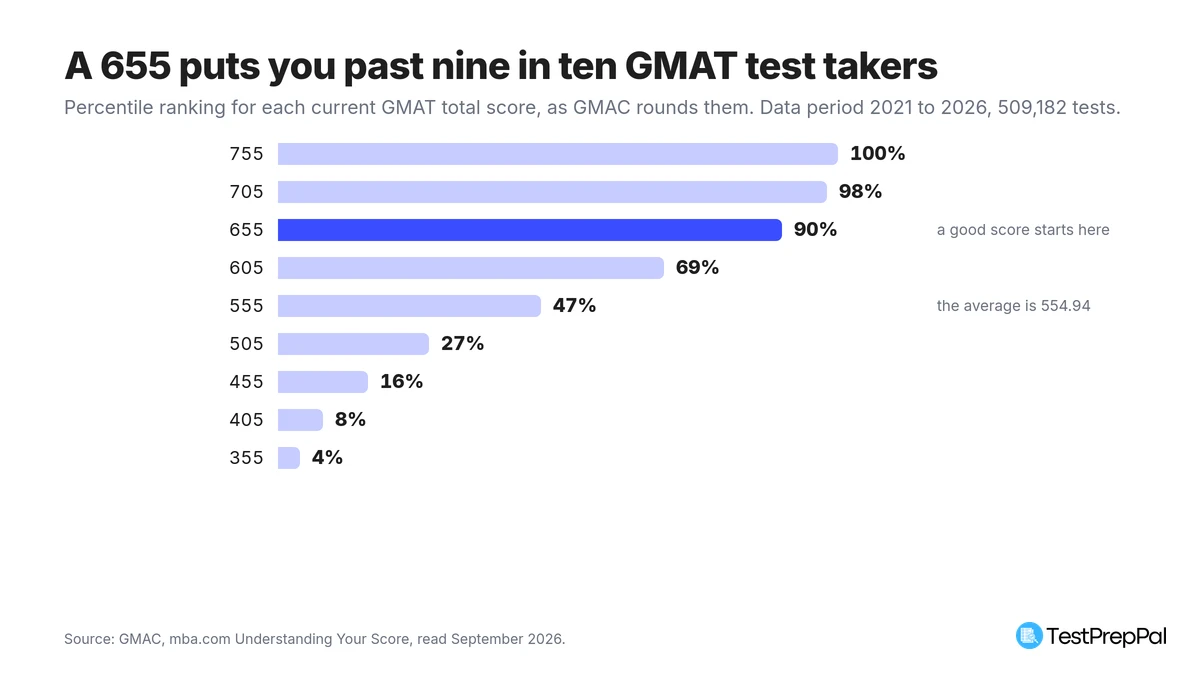 Percentile ranking by current GMAT total score. Source: GMAC, mba.com, read September 2026.
So "good" is not one number, but the 655 line is the most defensible place to draw it. At 655 you are ahead of nine out of ten people who sat the exam, and you clear the average by 100 points.
One more thing the table shows: the field is packed in the middle. Going from a 605 to a 655 is five ten-point steps, and it moves you 20.2 percentile points, from 69.4 to 89.6 on GMAC's unrounded figures. The same 50 points above a 705 moves you 2.3 percentile points, from 97.5 to 99.8. If you are sitting in the 600s, your study time is worth more than it will ever be again. Our guide to how hard the GMAT really is covers why that middle band is so crowded.
Is your number even on the current scale?
This is the fastest check, and almost nobody writes it down. Current total scores run 205 to 805 in ten-point steps, so every valid current score ends in a 5. The retired scale ran 200 to 800 in ten-point steps, so every old score ends in a 0. You can read both columns side by side in GMAC's official concordance table.
If the score you are chasing ends in 0, it is an old score and you are aiming at the wrong number. A 700, a 720 and a 620 are all retired scores. A 655 or a 615 is current.
This matters because forum posts, school pages and older blog articles quote both scales without labelling either. When you see a target that ends in 0, convert it before you plan around it. Our GMAT score conversion tool does the lookup both ways, and the GMAT percentile calculator will tell you where any current score sits on the curve.
What happened to the 700 target
GMAC's own guidance says that a 645 is the equivalent of an old 700. That is true, and it is also only half of the row.
The concordance table gives an old 700 two current matches, not one. A 645 sits at 85.6 percent. A 655 sits at 89.6 percent. Both are legitimate readings of a 700, because the old scale bunched more people into each score. So the choice is yours: 645 matches the bottom of the old 700's band, and 655 matches the top.
If you are applying against schools that used to publish 700 averages, aim for the 655. Four percentile points is the difference between the top 14 percent and the top 10 percent of the field, and it costs you one ten-point step.
| Classic GMAT | Current GMAT | Percentile |
|---|---|---|
| 800 | 805 | 100.0% |
| 750 | 695 to 715 | 96.9 to 98.6% |
| 700 | 645 to 655 | 85.6 to 89.6% |
| 650 | 595 to 615 | 66.3 to 75.4% |
| 600 | 555 to 565 | 47.4 to 50.4% |
| 550 | 515 to 525 | 31.6 to 34.0% |
| 500 | 485 to 495 | 21.7 to 25.4% |
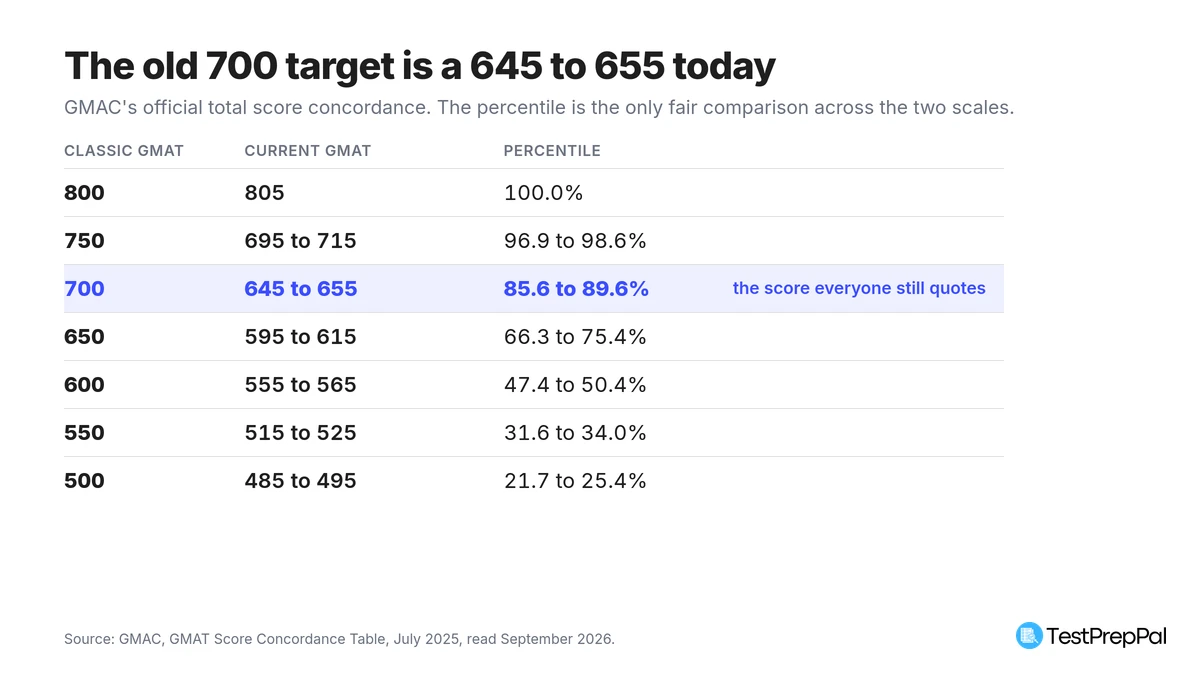 Total score concordance at the scores people actually quote. Source: GMAC, July 2025 concordance table, read September 2026.
GMAC is blunt about why the percentile column is the one to read: comparing raw scores across the two editions "is not appropriate, accurate, or a meaningful comparison of performance". The exams are built on different scales. Percentiles are the common currency.
The top row is the one people argue about, since GMAC maps both an old 800 and an old 790 onto a single current 805. We unpack what that ceiling is worth in the highest GMAT score.
Sponsored
Target Test Prep GMAT
One of the most complete GMAT prep platforms we've reviewed. Try full access for 5 days.
No code neededPros
- Very large GMAT content and practice library
- Strong analytics, error tracking, and custom test tooling
- 130-point score improvement guarantee
Cons
- Higher tiers become expensive quickly
What business schools actually admit
GMAC publishes what leading programs report, and the numbers are less intimidating than the forums suggest. Top schools tend to expect something around the 77th percentile, and many report class averages above the 80th.
The floors are the interesting part. GMAC's roundup of score ranges at leading schools notes that Northwestern Kellogg admitted students in 2025 with scores as low as 515, which GMAC places at the 32nd percentile. IESE admitted a 545, London Business School a 555, and the Indian School of Business a 575. Stanford GSB, whose latest class profile shows a lowest accepted score of 615, states that it has no minimum score at all. For context, almost two thirds of the 2025 entering class at Harvard Business School sat the GMAT.
Watch the scales in that same guidance, though. It also says most US schools expect at least a 620 and that many average 670 or more, paired with the 77th to 79th and the 80th percentile. Those two numbers end in 0. On the current table, the 78th percentile is a 625 and the 81st is a 635. Anchor on the percentile GMAC quotes, not on the three digits, and you will target the right score.
Put plainly: a 655 clears the stated expectation at most US programs with room to spare, a 625 meets it, and admissions data shows people getting in below both. The score is one input. If you want to see how we weigh any claim a prep provider or a school makes, our review methodology sets it out.
How far is "good" from average?
The average total score is 554.94. Reach a 655 and you have gained 100.06 points and 42.2 percentile points, from 47.4 percent to 89.6 percent. That is the whole job, stated in one line.
Two details are worth knowing before you plan around the average:
- The average and the middle of the field are not the same score. A 555 is the 47.4th percentile, while the 50th percentile falls at 565. The distribution leans slightly high, so the average test taker is one step below the median score.
- Not every published average agrees. One of the ten pages ranking for this question today still lists the average as 546. GMAC's live table says 554.94 for the 2021 to 2026 period. Use GMAC's figure and check the date on anyone else's.
A 100-point gain is realistic with real study time, and it is where a structured course earns its price. Our GMAT prep course roundup compares what each one costs against what it actually includes, and the Target Test Prep review covers what its Quant-focused plans include and what they cost. If you are still deciding whether the GMAT is the right exam at all, start at the GMAT hub.
What is a good GMAT score FAQs
How good is a 750 GMAT?
A 750 is not a valid current score, so it is always an old-scale number. GMAC's concordance puts an old 750 at a current 695 to 715, which is the 96.9th to 98.6th percentile. It was an excellent score then and the equivalent is an excellent score now, comfortably inside the top 5 percent of test takers.
What is a top 1 percent GMAT score?
A 735. On GMAC's unrounded percentile figures, a 735 sits at 99.4 percent, so it clears the top 1 percent, while the next score down, a 725, sits at 98.9 percent and just misses it. That is our calculation from the official concordance percentiles, not a figure GMAC labels as such.
Is a 545 GMAT score good?
A 545 sits at 41.7 percent, so you outscored about 42 percent of test takers and finished about 10 points below the average of 554.94. It is under what most US programs say they expect, though GMAC's own data shows schools admitting students in the 515 to 575 range. Treat it as a retake candidate rather than a dead end, especially since the 550 to 650 stretch is where points move your percentile fastest.
Is 435 a bad GMAT score?
A 435 sits at 12.1 percent, which means about 88 percent of test takers scored higher. It is well below what any competitive MBA program expects, and it is worth retaking rather than explaining away. The good news is that scores in this range usually reflect fixable gaps in fundamentals and pacing, not a ceiling, and the climb from here moves your percentile quickly.
We may earn commissions from some links on this page, but this does not affect our reviews or your experience.