


The highest GMAT score is 805. That is the top of the 205 to 805 total score scale, and GMAC's official percentile table on mba.com gives it a percentile ranking of 100 percent.
The number most people still reach for is 800, and that was correct until the scale changed. An 800 is a real score that real people hold, it is just on a scale GMAC no longer sells. This page covers what the 805 is, what GMAC's own data says it is worth, and the two things about it that almost every other page gets wrong.
- The maximum total is 805. The old maximum was 800, and both are still live scores.
- Totals run 205 to 805 in 10-point steps, so there are 61 possible scores and every one ends in a 5.
- GMAC's published table ranks an 805 at 100 percent, not at the 99th percentile.
- A 755 gets the same 100 percent ranking, so the official table cannot separate the top 50 points.
- Three sections score 60 to 90 each and count equally, but GMAC publishes no formula from section scores to the total.

Target Test Prep GMAT
One of the most complete GMAT prep platforms we've reviewed. Try full access for 5 days.
No code neededPros
- Very large GMAT content and practice library
- Strong analytics, error tracking, and custom test tooling
- 130-point score improvement guarantee
Cons
- Higher tiers become expensive quickly
What the highest GMAT score actually is
Your GMAT total score runs from 205 to 805. It is built from three sections, Quantitative Reasoning, Verbal Reasoning and Data Insights, and GMAC weights all three equally in the total.
The scale moves in 10-point steps. That gives 61 possible total scores, counting both ends, and it is why every valid total ends in a 5. There is no 800 on this exam, no 804 and no 806. The rung below 805 is 795.
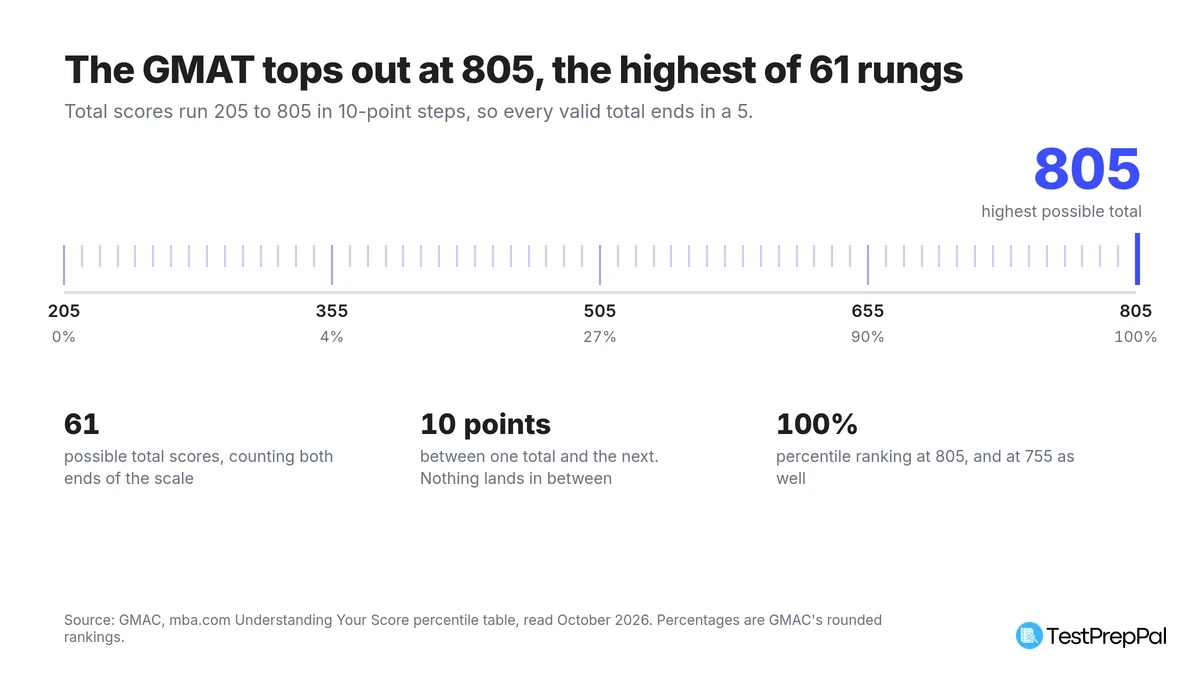 Every valid GMAT total score, 205 to 805. Source: GMAC, mba.com, read October 2026.
Here is the top of GMAC's published percentile table, the rows that matter when you are looking at the ceiling.
| Total score | Percentile ranking |
|---|---|
| 805 | 100% |
| 755 | 100% |
| 705 | 98% |
| 655 | 90% |
| 605 | 69% |
The table is drawn from 509,182 tests over the 2021 to 2026 period, with a mean total of 554.94 and a standard deviation of 94.24. An 805 is 250.06 points above that mean, or about 2.65 standard deviations.
Is an 805 really the 99th percentile?
No, and this is the most repeated error about the top of the scale. Google's AI Overview for this question currently says an 805 "places a test-taker in the 99th percentile" while citing the mba.com page that says 100 percent.
GMAC's table ranks an 805 at 100 percent. It also ranks a 755 at 100 percent. Those are the published, rounded figures, and they mean that the official percentile column cannot tell the two scores apart.
That is a 50-point blind spot, five rungs wide, at the very top of the scale. GMAC rounds there because the number of test takers above a 755 is small enough that the distinction stops being meaningful. If you want to see where any lower score sits, our GMAT percentile calculator runs the same official table score by score.
Which section scores add up to an 805
Each section is scored 60 to 90, and each contributes equally to the total. The three differ in shape more than in weight:
| Section | Questions | Time | Note |
|---|---|---|---|
| Quantitative Reasoning | 21 | 45 minutes | Problem Solving only |
| Verbal Reasoning | 23 | 45 minutes | Reading Comprehension and Critical Reasoning |
| Data Insights | 20 | 45 minutes | On-screen calculator available |
Those section ranges and formats come from GMAC's exam scores page, which also sets out what each section score is based on: how many questions you answered, whether the answers were right, and the difficulty and other parameters of the questions you saw.
Now the part other pages skip. Each section has 31 possible scores, from 60 to 90, so the three sections give 31 x 31 x 31 = 29,791 possible combinations. Exactly one of them, a 90 in all three, is the maximum on every section.
Which of those 29,791 combinations produce an 805 is not a published fact. GMAC gives the section ranges and the equal weighting, and it stops there: there is no official lookup from three section scores to a total. Any page that lists "the section combinations that give you an 805" built that list from an estimate, not from GMAC. Our GMAT score calculator estimates a total from section scores too, and it says so on the page rather than presenting the output as official.
Sponsored
Target Test Prep GMAT
One of the most complete GMAT prep platforms we've reviewed. Try full access for 5 days.
No code neededPros
- Very large GMAT content and practice library
- Strong analytics, error tracking, and custom test tooling
- 130-point score improvement guarantee
Cons
- Higher tiers become expensive quickly
How an 805 compares with the old 800
The retired exam, which GMAC calls the GMAT 10th Edition, scored 200 to 800 in 10-point steps, so every one of its totals ended in a 0. Its total came from two sections, Quantitative and Verbal. The current total adds Data Insights and counts all three equally.
GMAC is blunt about comparing the two directly. Its guidance says that because of the differences in scale and distribution, comparing total scores across the editions "is not appropriate, accurate, or a meaningful comparison of performance". The right bridge is percentile, and GMAC publishes a Total Score concordance table to do it, last updated July 2025.
At the top of that table, two legacy scores land on the same current one: an 800 maps to an 805, and so does a 790. Nothing maps above an 805, because it is the last rung on one scale and 800 is the last rung on the other.
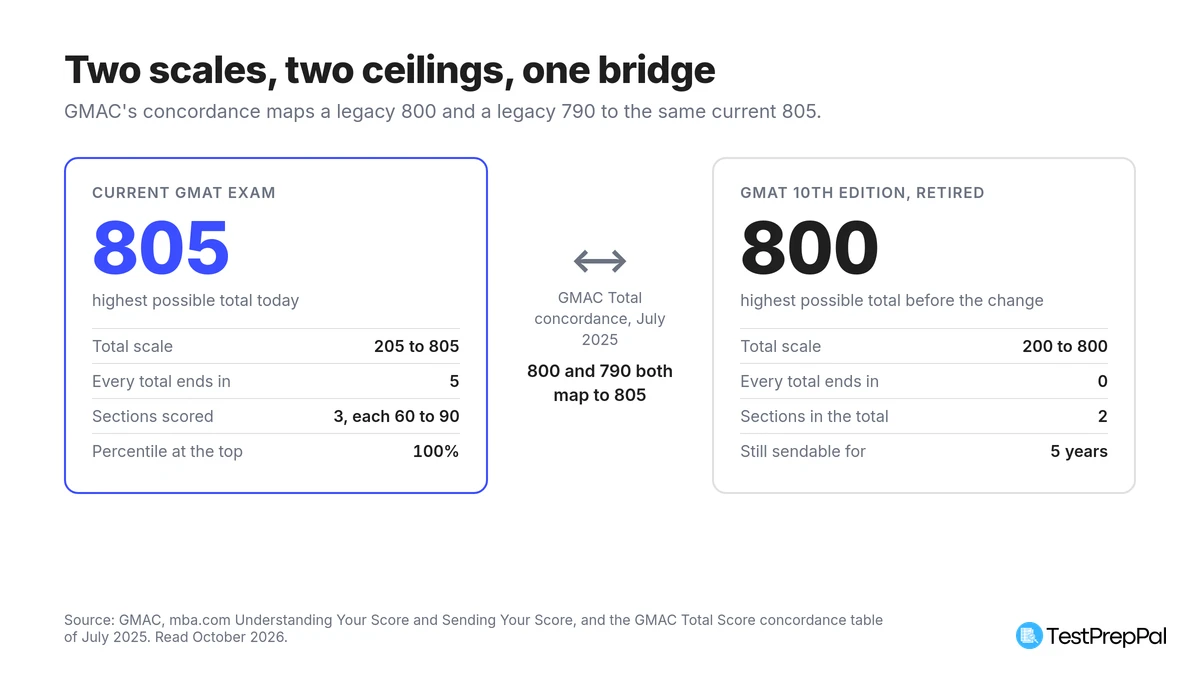 The two ceilings and the concordance that connects them. Source: GMAC, read October 2026.
Any GMAT total tells you which scale it is on. Current scores end in 5, legacy scores end in 0. A 780 is always an old score. A 785 is always a current one.
That rule settles most arguments about whether someone's number is impressive. If you are holding a score on either scale and want the equivalent, our GMAT score conversion tool runs the official concordance in both directions.
The part of a perfect score with no old equivalent
GMAC publishes three concordance tables: Total Score, Quantitative Reasoning and Verbal Reasoning. There is no Data Insights table, and there cannot be one, because the section did not exist on the 10th Edition.
Data Insights is one of the three equally weighted inputs to an 805. So roughly a third of a perfect current score has no counterpart on the old exam by GMAC's own publishing. That is the honest answer to "what is an 805 in old money": the total converts, the Quant and Verbal pieces convert, and the third piece has nothing to convert to.
It also explains why a perfect-scorer's story from the legacy era does not transfer cleanly. A 2011 test taker with an 800 never sat a Data Insights section. For what the current exam demands section by section, see our guide to how hard the GMAT is.
Is chasing the highest GMAT score worth it?
Look again at the 50-point blind spot. On GMAC's published table, a 755 and an 805 carry the same 100 percent ranking, so the last five rungs of the scale buy you no difference in the percentile an admissions reader sees.
The scores themselves last a while. GMAC lets you send an official score report as long as the score is no more than five years old, and scores between five and 10 years old can be requested if you have not taken a GMAT in the past five years. That five-year window is also why legacy 800s are still in circulation rather than being history.
A more useful target than the ceiling is the band where points move your ranking fastest, which our guide to what counts as a good GMAT score prices out against the same official table. If you are earlier than that and still mapping out the exam, start at the GMAT hub.
Highest GMAT score FAQs
Is an 800 GMAT score possible?
Not on the current exam. Totals run 205 to 805 in 10-point steps and every valid score ends in a 5, so 800 is not a score the current test can produce. It was the maximum on the retired 10th Edition, and GMAC's concordance maps that 800 to an 805 today.
What does GMAC say an 805 is worth in percentile terms?
100 percent, which is the top row of its published total score percentile table. The same table gives a 755 the same 100 percent, so GMAC's rounded figures do not distinguish between them. Anything more precise than that at the top of the scale is someone's estimate rather than a GMAC number.
Do you have to answer every question correctly to score 805?
GMAC does not publish the threshold. What it does say is that each section score depends on how many questions you answered, whether they were correct, and the difficulty and other parameters of those questions, so correctness alone is not the whole input. Nobody outside GMAC can tell you the exact number of misses an 805 survives.
Does an 805 expire?
The score itself does not disappear, but normal score reporting runs for five years from the test date. After that you can request that scores between five and 10 years old be sent, provided you have not taken a GMAT exam in the past five years.
We may earn commissions from some links on this page, but this does not affect our reviews or your experience.