


The GMAT has three sections: Quantitative Reasoning, Verbal Reasoning and Data Insights. GMAC's exam structure page puts 64 questions across them in 2 hours 15 minutes, 45 minutes per section, and all three are weighted equally in your Total Score.
That last clause is the one that matters, and it is the one every format page states and then drops. Equal weighting is not a detail about scoring. It changes which section is worth your next study hour.
- Three sections, 45 minutes each: Quantitative Reasoning (21 questions), Verbal Reasoning (23) and Data Insights (20).
- 64 questions in 2 hours 15 minutes, plus one optional 10-minute break you can take after the first or the second section.
- Each section contributes exactly one third of the 205 to 805 Total Score, whatever its question count.
- On the old 200 to 800 GMAT, the total came from Quantitative and Verbal alone, so Data Insights material counted for nothing in it. Today it carries 200 points of that range.
- You can bookmark questions as you go and change up to three answers per section, but only if time is left in that section.

Target Test Prep GMAT
One of the most complete GMAT prep platforms we've reviewed. Try full access for 5 days.
No code neededPros
- Very large GMAT content and practice library
- Strong analytics, error tracking, and custom test tooling
- 130-point score improvement guarantee
Cons
- Higher tiers become expensive quickly
The three GMAT sections at a glance
Here is the whole structure in one table. Every figure comes from GMAC's exam structure page and its exam content page.
| Section | Questions | Time | Question types | Calculator | Share of Total Score |
|---|---|---|---|---|---|
| Quantitative Reasoning | 21 | 45 min | Problem Solving | No | One third |
| Verbal Reasoning | 23 | 45 min | Reading Comprehension, Critical Reasoning | Not applicable | One third |
| Data Insights | 20 | 45 min | Data Sufficiency, Multi-Source Reasoning, Table Analysis, Graphics Interpretation, Two-Part Analysis | Yes, on screen | One third |
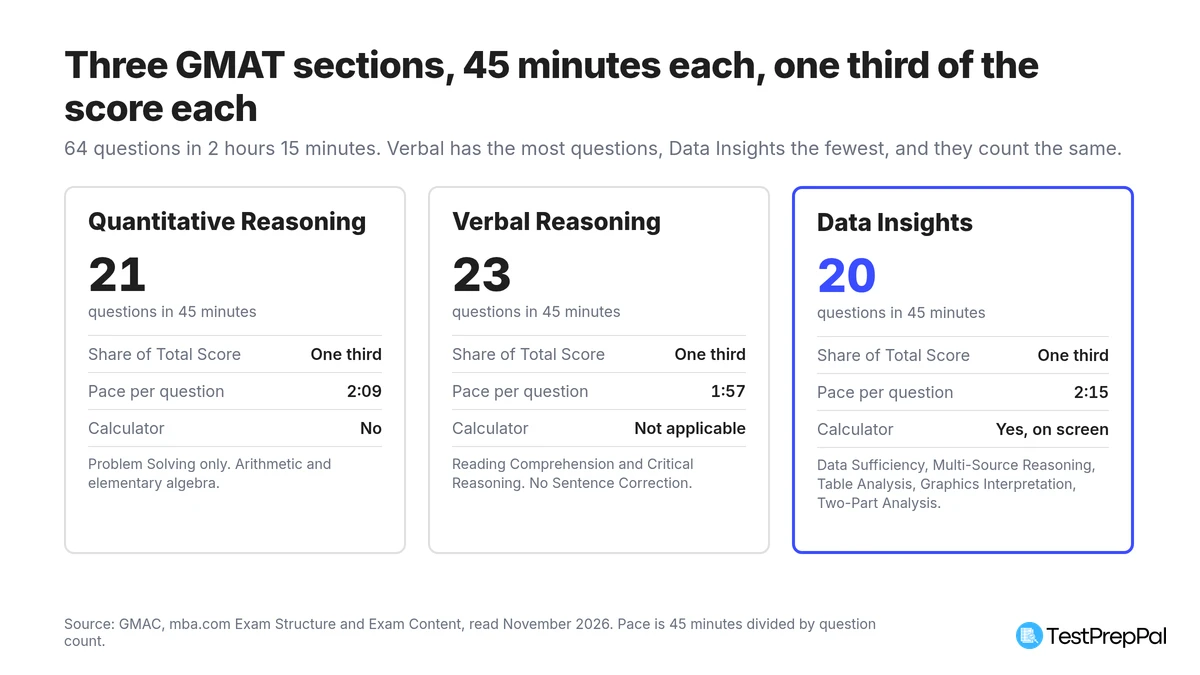 The published GMAT structure, with the pace each section sets. Source: GMAC, read November 2026.
Notice the mismatch in that chart. Verbal is 23 of the 64 questions, or 35.9 percent of them. Data Insights is 20 of 64, or 31.3 percent. Both are exactly one third of your score. Work the arithmetic through and each Data Insights question carries 15 percent more of your Total Score than each Verbal question does, because 23 divided by 20 is 1.15. Against Quant, a Data Insights question is worth 5 percent more.
That is a small edge on its own. The bigger change is what the sections are built from.
Equal weighting is the part that breaks an old study plan
If you learned this exam from a book, a tutor or a friend who sat it before 2024, you learned a four-section exam. GMAC still publishes that structure on its page about the GMAT Exam (10th Edition), because those scores stay valid through January 2029.
| 10th Edition section | Questions | Time | Section score | In the 200 to 800 total? |
|---|---|---|---|---|
| Analytical Writing Assessment | 1 essay topic | 30 min | 0 to 6 | No |
| Integrated Reasoning | 12 | 30 min | 1 to 8 | No |
| Quantitative | 37 | 75 min | 6 to 51 | Yes |
| Verbal | 41 | 75 min | 6 to 51 | Yes |
GMAC's wording is blunt: "The GMAT Total score (200-800) was based on performance on the Quantitative and Verbal sections." Integrated Reasoning and the essay were reported separately and sat outside the number everyone quoted.
Add up what that meant. Those two sections took 60 of the exam's 210 minutes. More than a quarter of a three-and-a-half-hour test produced no part of the headline score, which is exactly why so many candidates treated Integrated Reasoning as the section to coast through. On the current exam, none of the 135 minutes sit outside the total.
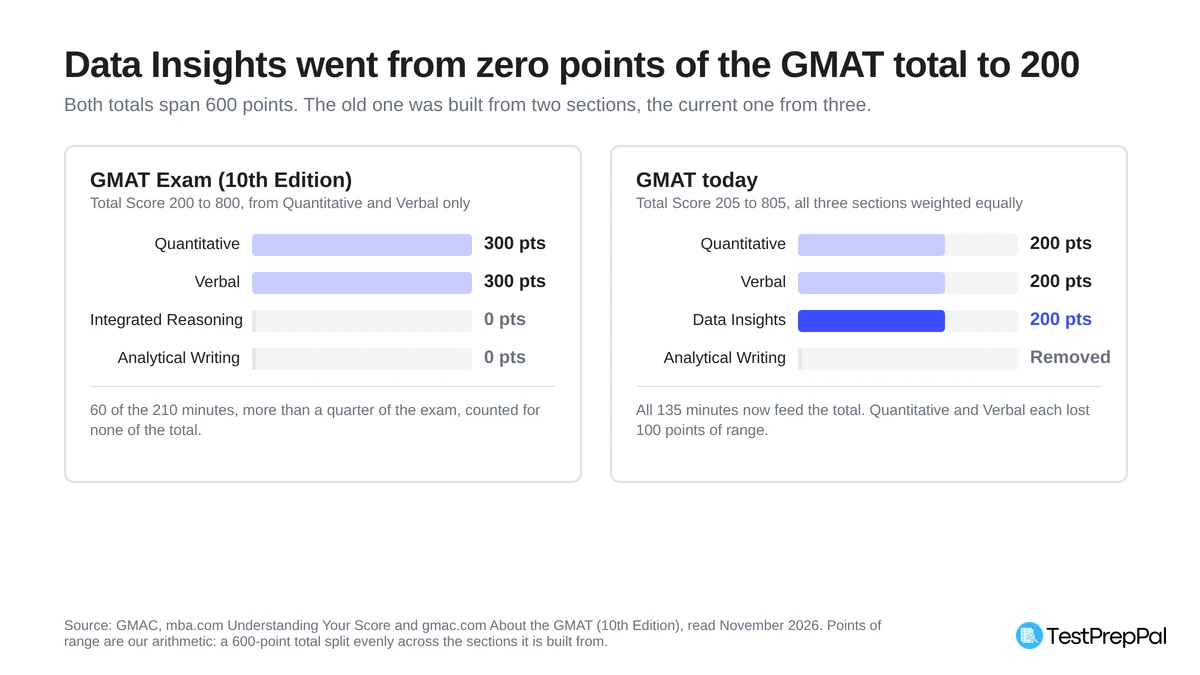 Where each section's influence on the Total Score sits, then and now. Points of range are our arithmetic on the two published scales.
Here is that comparison in score terms, which is the part no other format page runs. Both totals span 600 points: 800 minus 200, and 805 minus 205. The old total was split between two sections, so each of Quantitative and Verbal accounted for 300 points of that span. The current total is split three ways, so each section accounts for 200.
Data Insights went from 0 points of the GMAT total to 200. Quantitative and Verbal each went from 300 to 200, losing a third of their former influence on your score.
So the old advice to carry a weak section on the strength of two strong ones no longer holds, because there are only three to carry it with and one of them is the section most people have never trained. If Data Insights is your weakest, it is now worth the same marginal point as Quant, and you have 20 questions in which to earn those points rather than 37.
What each section actually asks you to do
Quantitative Reasoning
Twenty-one Problem Solving questions in 45 minutes. GMAC says these need arithmetic and elementary algebra only, and that answering them correctly "relies on logic and analytical skills, not the underlying math skills". There is no calculator.
The notable absence is Data Sufficiency. It was a Quant question type on the old exam and it now lives in Data Insights, so a Quant section today is one question format from start to finish. If you are gauging the difficulty of this against other exams, our GMAT versus GRE comparison lines up the quant demands of both.
Verbal Reasoning
Twenty-three questions in 45 minutes, drawn from two question types: Reading Comprehension and Critical Reasoning. Critical Reasoning items give you a short passage, usually fewer than 100 words, and five options; our guide to GMAT Critical Reasoning covers the three question families and which one dominates.
Sentence Correction is not on the exam. It was a Verbal question type on the 10th Edition and GMAC removed it, which is why grammar drills from an older book are time you will not get back. The question type still appears on one GMAC assessment, and we cover where Sentence Correction went separately.
Data Insights
Twenty questions in 45 minutes, and the only section with an on-screen calculator. GMAC describes it as measuring data literacy: how sources of information "relate to one another and can be leveraged to make informed decisions". Five formats appear here.
- Data Sufficiency. Decide at what point you have enough data to solve a problem, without solving it.
- Multi-Source Reasoning. Several tabs of text, tables or graphics, with questions that often turn on a discrepancy between them.
- Table Analysis. A sortable table, and a question about what meets a stated condition.
- Graphics Interpretation. A scatter plot, bar chart, pie chart or distribution curve, read for relationships.
- Two-Part Analysis. One scenario, two columns of answers, often a trade-off or a pair of simultaneous conditions.
Four of those five were the old Integrated Reasoning formats. Data Sufficiency joined them from Quant. That is the whole of what changed in content terms, and it is why prep material labelled "Integrated Reasoning" is still usable while material labelled "IR is not part of your score" is actively wrong.
Sponsored
Target Test Prep GMAT
One of the most complete GMAT prep platforms we've reviewed. Try full access for 5 days.
No code neededPros
- Very large GMAT content and practice library
- Strong analytics, error tracking, and custom test tooling
- 130-point score improvement guarantee
Cons
- Higher tiers become expensive quickly
The clock, the section order and the three edits you get
Divide each 45-minute section by its question count and the pace comes out uneven. Quant gives you 2 minutes 9 seconds a question, Verbal 1 minute 57, and Data Insights exactly 2 minutes 15. Verbal is the tightest clock on the exam, and it is the section where a single Reading Comprehension passage can eat four questions' worth of time.
You choose the section order. GMAC lets you answer the three sections in any order, which is six possible arrangements, and you take your optional 10-minute break either after the first section or after the second. There is no fixed sequence to prepare for, so practise in the order you intend to sit.
The Question Review and Edit tool is the feature most worth rehearsing, and it comes with limits that are easy to misread.
- You answer every question in the order given on the first pass. Bookmark as you go.
- At the end of a section you reach a review screen listing the questions and flagging your bookmarks.
- You may review as many as you like and change up to three answers.
- If time has run out in that section, you skip the review screen entirely.
Three edits is a hard ceiling, so bookmark freely and spend the edits on questions where you narrowed the field to two options. A question you never understood is not worth one of the three. Our GMAT study guide sets out how to build this into timed practice, and the official practice tests are where you can rehearse the review screen under real section timing.
Scores come back fast. GMAC says the detailed Official Score Report arrives within 3 to 5 days, though it notes this can occasionally take up to 20.
What your old GMAT score means on this structure
Because the sections changed, the scale changed too, and GMAC is firm that comparing raw scores between the two editions "is not appropriate, accurate, or a meaningful comparison of performance". Compare percentiles instead.
There is a quick test for which scale a number is on. Current Total Scores run from 205 in 10-point steps, so every valid current score ends in 5. Legacy scores ran from 200, so every legacy score ends in 0. A 710 is always an old number; a 655 is always a current one.
GMAC's own concordance table, built on test takers from July 2021 to June 2026, maps the scores people still quote.
| Old GMAT total | Current equivalent | Percentile |
|---|---|---|
| 800 | 805 | 100.0% |
| 750 | 695 to 715 | 96.9 to 98.6% |
| 700 | 645 to 655 | 85.6 to 89.6% |
| 650 | 595 to 615 | 66.3 to 75.4% |
| 600 | 555 to 565 | 47.4 to 50.4% |
The old 700 target is a 645 to 655 today, four percentile points apart across one 10-point step. The difference now is how you get there: two sections used to carry it and three have to carry it. Our score conversion tool runs the full table both ways, and our guide to what counts as a good GMAT score puts those numbers next to what schools actually admit.
If you are deciding where the next month of study goes, the honest answer for most people starting from an older plan is the section that used to be free. Our GMAT prep course reviews score every option on how well it covers Data Insights, using a published review methodology, and the GMAT hub collects the registration, cost and scoring pages.
GMAT sections FAQs
How many questions are in each section of the GMAT?
Quantitative Reasoning has 21 questions, Verbal Reasoning has 23 and Data Insights has 20, for 64 in total. Each section is 45 minutes long, so the whole exam runs 2 hours 15 minutes plus one optional 10-minute break. The question counts differ but each section contributes the same one third of your Total Score.
Are all three GMAT sections weighted equally?
Yes. GMAC states that the contribution of each section score to the Total Score is equally weighted across sections. This is a change from the previous edition, where the 200 to 800 total came from the Quantitative and Verbal sections only and Integrated Reasoning was reported separately. A weak Data Insights section now moves your total in a way it never used to.
Is Sentence Correction still a GMAT section?
No, and it was never a section in its own right. Sentence Correction was one of three Verbal question types on the GMAT Exam (10th Edition), alongside Reading Comprehension and Critical Reasoning. The current Verbal Reasoning section uses only the other two, so grammar rules for Sentence Correction are not tested on the GMAT today.
Can you choose the order of the GMAT sections?
Yes. You can answer Quantitative Reasoning, Verbal Reasoning and Data Insights in any order, which gives six possible sequences, and you choose whether to take your optional 10-minute break after the first section or after the second. Pick an order in practice and keep it, since the choice is only useful if you have rehearsed it.
We may earn commissions from some links on this page, but this does not affect our reviews or your experience.