

Best MCAT Mobile Apps in 2026

by John Reed· Last Updated: Nov 26, 2026
For most iPhone users the best MCAT app is Blueprint MCAT Prep: a free download built around question bank sessions, review of your misses, and performance analytics. On Android, start with Varsity Tutors: MCAT Prep, where the diagnostics, flashcards and quizzes are all free.
MCAT apps are good at one thing: short daily sessions that keep recall alive between longer study blocks. A commute or a break between classes is enough for a question set or a run of flashcards.
They are not a full prep plan. None of the five apps here replaces full-length practice exams or deep content review, and three of them hold back some content for paid accounts.
Here are the main takeaways:
- Blueprint MCAT Prep: Best for question-first practice on iOS. Free to download, with Qbank sessions, review flows and analytics.
- MedSchoolCoach MCAT Prep App: Best for one app on both iOS and Android. Combines flashcards, question drills and bite-size videos.
- Magoosh MCAT Prep: Best for guided lesson-style review on iOS. Free download with lessons, practice questions and progress tracking on a freemium model.
- Varsity Tutors: MCAT Prep: Best for free practice on Android. Diagnostic tests, flashcards and quizzes, with the core study functions free.
- Gold Standard MCAT Flashcards: Best for free physics and chemistry recall. 455 science cards with no account, but the iOS app was last updated in December 2017.
MCAT mobile apps summary table
| Resource | Cost | Platform | What you get | Best for |
|---|---|---|---|---|
| Blueprint MCAT Prep | Free download (account-based, freemium) | iOS | Qbank sessions, review flows, analytics | Question-first mobile practice |
| MedSchoolCoach MCAT Prep App | Standalone app access (freemium model) | iOS and Android | Flashcards, question drills, bite-size videos | Daily active recall on either platform |
| Magoosh MCAT Prep | Free download (freemium) | iOS | Lessons, question practice, progress tracking | Guided mobile structure |
| Varsity Tutors: MCAT Prep | Free | Android | Diagnostics, flashcards, quizzes | Quick daily practice at no cost |
| Gold Standard MCAT Flashcards | Free, no in-app purchase | iOS and Android | 455 cards in 3 sets, 44 videos on iOS | Extra physics and chemistry reps |
Which MCAT mobile app is right for you?
- If you need question practice with analytics on an iPhone, use Blueprint MCAT Prep.
- If you need the same app on iOS and Android, use the MedSchoolCoach MCAT Prep App.
- If you need lessons and structure more than raw questions, use Magoosh MCAT Prep.
- If you need a free Android app with nothing to upgrade, use Varsity Tutors: MCAT Prep.
- If you need short video lessons and science cards with no account at all, use Gold Standard MCAT Flashcards on an iPhone.
The MCAT mobile apps we reviewed
1. Blueprint MCAT Prep
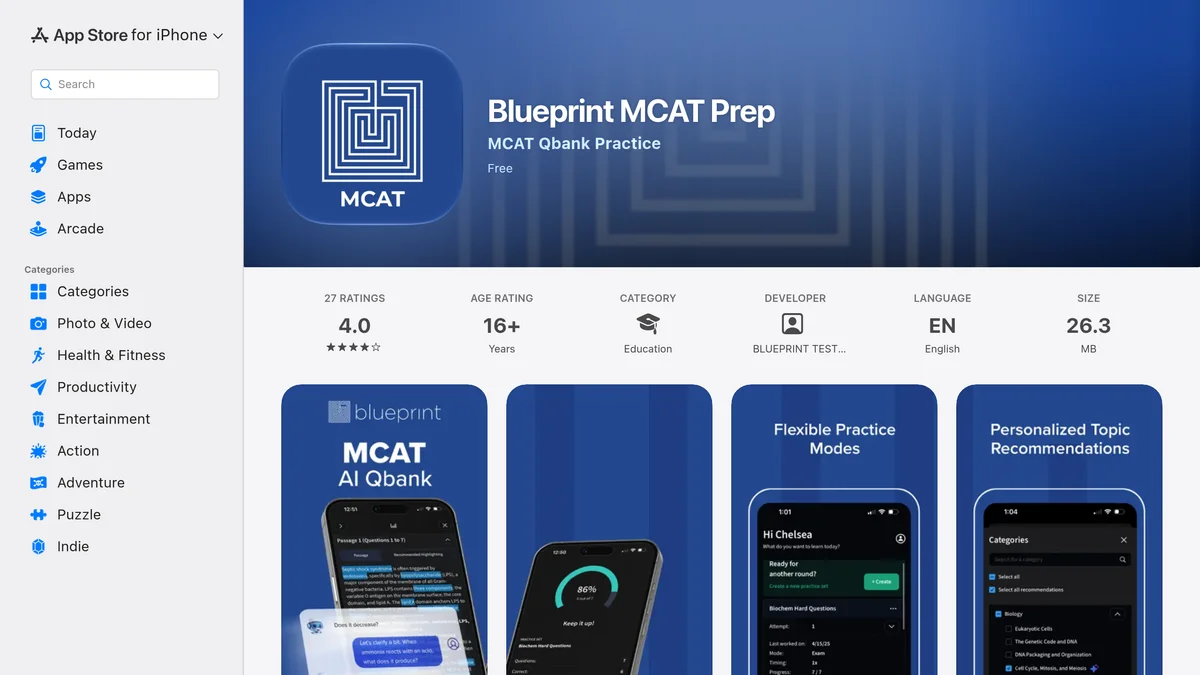
Blueprint MCAT Prep is a free iOS app from a company already known for MCAT courses, diagnostics and tutoring. The app centers on active practice and tracking how you perform.
What you get:
a) Mobile question bank sessions: Run short question sets without sitting at a desktop.
b) Review workflow: The app supports going back through your misses, which encourages deliberate review over passive scrolling.
c) Performance tracking: Analytics let you monitor trends across sessions.
d) A link to the wider Blueprint products: The app works standalone and connects to Blueprint's other MCAT prep if you use it.
Best for: iOS users who already know their content gaps and want to tighten execution through repeated questions.
Limitation: Access is account-based and freemium, so additional features may require a paid Blueprint plan. Our review lists it as an iOS app, so Android users should look at MedSchoolCoach or Varsity Tutors.
2. MedSchoolCoach MCAT Prep App
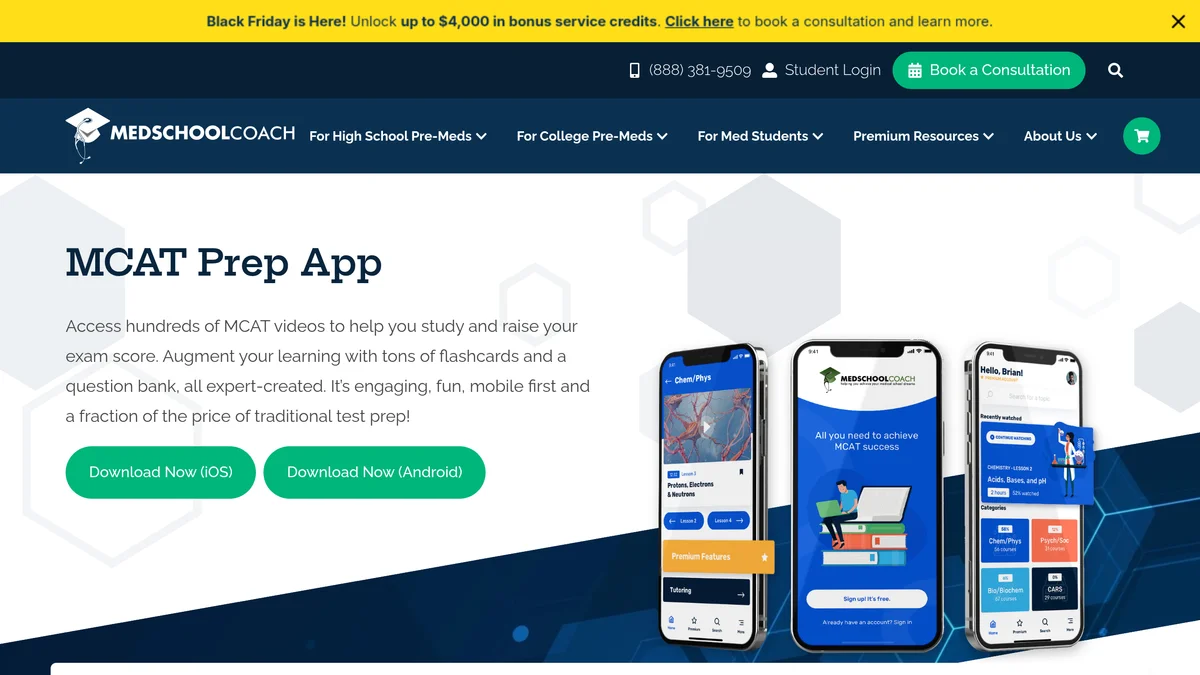
The MedSchoolCoach MCAT Prep App is a mobile-first study app on both iOS and Android, built for short, frequent sessions. You can use it without buying MedSchoolCoach tutoring.
What you get:
a) Flashcards: MCAT cards for active recall practice.
b) Question drills: Question-based sets that reinforce concepts.
c) Short videos: Bite-size instructional content for quick review loops.
d) Both major platforms: You are not locked to one phone ecosystem.
Best for: Students balancing coursework or work shifts who want flashcards, drills and short lessons in a single app.
Limitation: It runs on a freemium and paid-feature mix that depends on account level. Breadth is more limited than a full prep program, and there is no full-length exam simulation.
3. Magoosh MCAT Prep
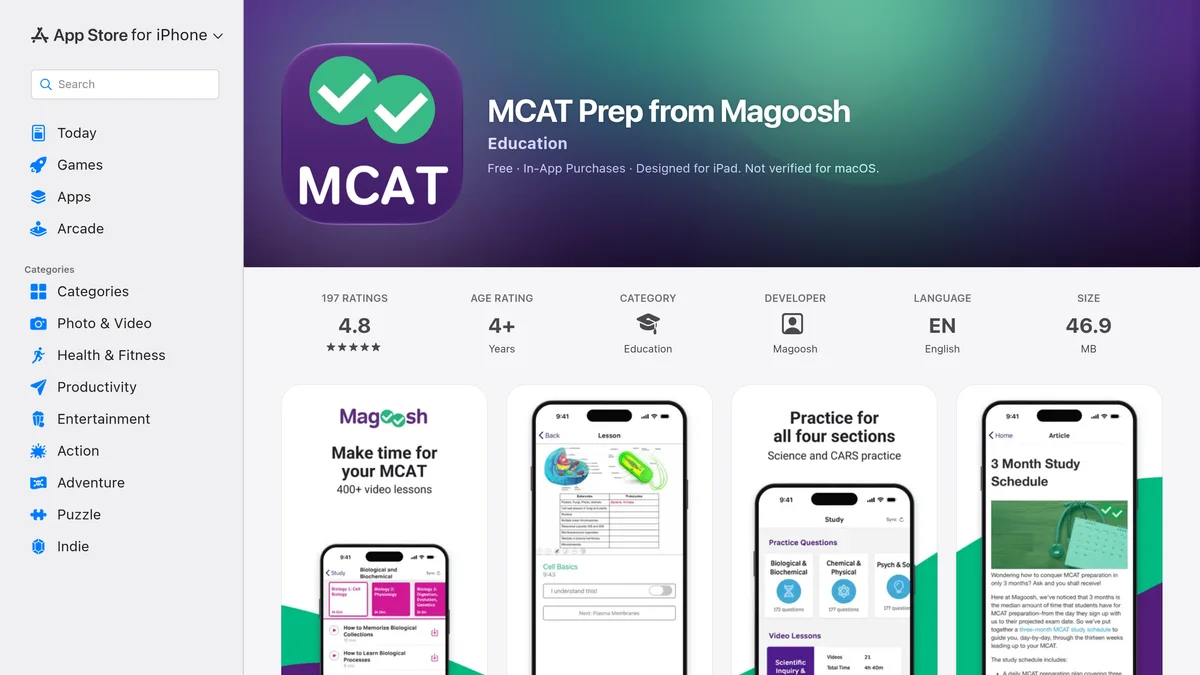
Magoosh MCAT Prep is a free iOS download that gives you a structured review environment on your phone. You start with free access and decide later whether premium content is worth paying for.
What you get:
a) Lesson and concept review: A mobile lesson workflow. Next to Blueprint, Magoosh leans more toward lesson-style review than question bank practice.
b) Practice questions: Question sessions that reinforce the content you review.
c) Progress indicators: In-app tracking to keep you consistent.
d) Immediate starter access: The free install opens content right away, so you can test the fit before any purchase.
Best for: iOS users who want a guided experience from an established provider, and students testing app-based prep before a larger purchase.
Limitation: Freemium gating. Students who want full content depth may need a paid Magoosh plan, and the app does not offer strong full-length exam simulation.
4. Varsity Tutors: MCAT Prep
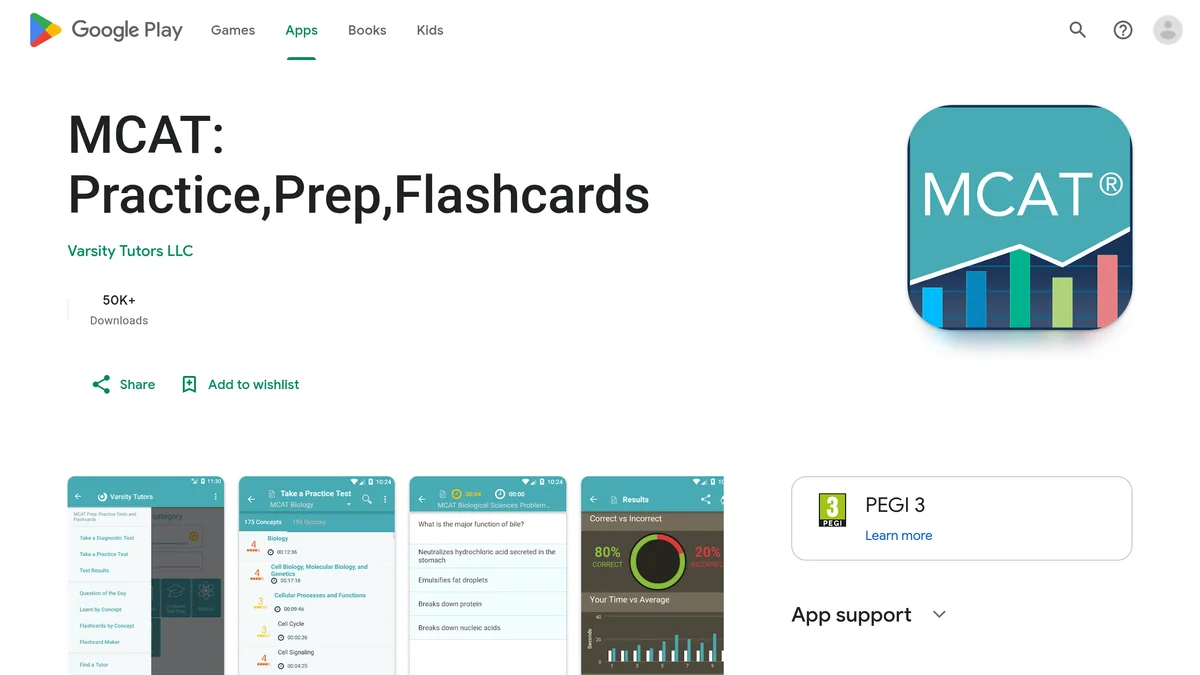
Varsity Tutors: MCAT Prep is a free Android app for short MCAT drills. You do not need to buy a course or tutoring to use it.
What you get:
a) Diagnostic tests: Establish early baselines by subject.
b) Flashcard sets: High-yield concept review in card form.
c) Quiz-based drills: Short question practice across MCAT topics.
d) Free core functions: The app download and the core study functions are free. Varsity's tutoring services are separate and optional.
Best for: Early-stage test takers on Android who want to build a daily study habit without spending anything.
Limitation: It is lightweight. Question depth and exam-level strategy guidance are limited compared with complete prep, and our review lists it as an Android app.
5. Gold Standard MCAT Flashcards
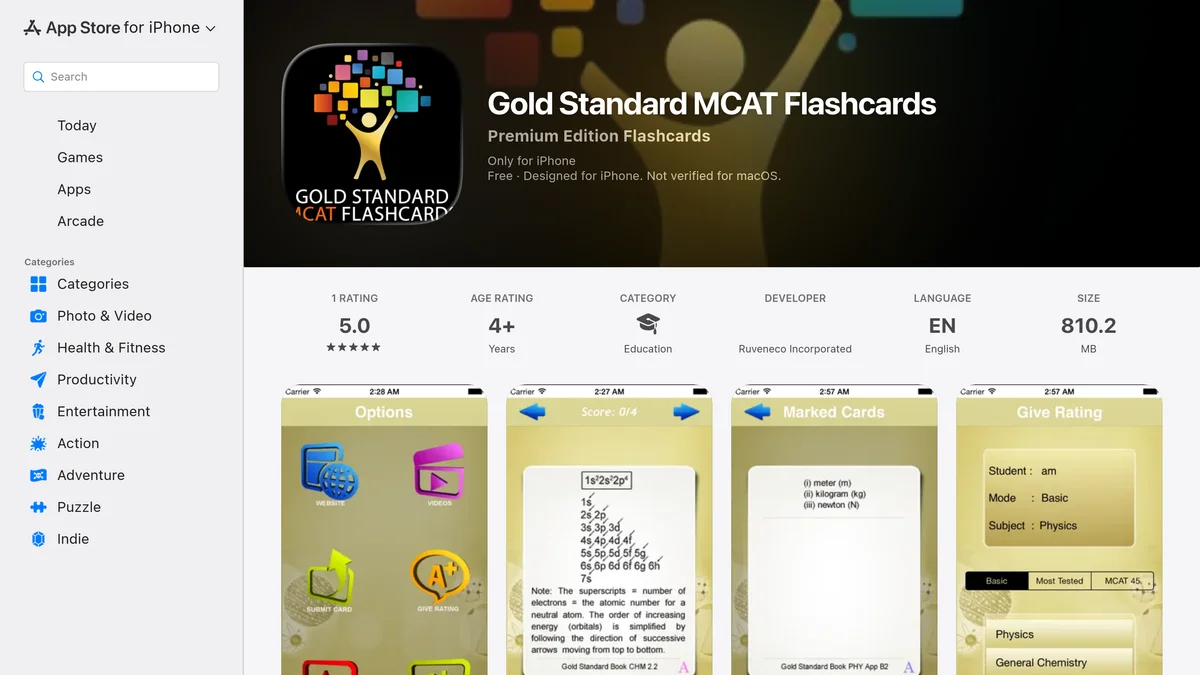
Gold Standard MCAT Flashcards is a free fixed deck of 455 science questions for iOS and Android, drawn from the same material as the Gold Standard textbook. It has one tier with no in-app purchase, no subscription and no account.
What you get:
a) 455 cards in three sets: Basic, Most Tested and MCAT 45, covering biology, physics, general chemistry and organic chemistry.
b) Diagrams on the answers: Many cards carry diagrams and illustrations on the answer side.
c) Score tracking: The app keeps your score and lets you flag cards to revisit.
d) 44 bundled videos on iOS: Almost four hours of short lessons inside the iPhone build. The Google Play description does not mention them.
Best for: Students who want free physics and chemistry recall on a phone, or who learn well from short video.
Limitation: The iOS version dates from 20 December 2017 and the Android version from 6 January 2016. There are no psychology, sociology or CARS cards, which leaves out two of the four scored sections, and there is no spaced repetition.
How to use these together
- Set your study plan before you install anything. An app fills gaps in a schedule; it does not create one. Use our MCAT study schedule guide or the MCAT study plan generator.
- Pick one daily app for your phone. Blueprint or Magoosh on iOS, Varsity Tutors on Android, MedSchoolCoach on either. Use it for short sessions between longer blocks.
- Do your main question work on a full question bank. The apps reinforce; a dedicated MCAT question bank gives you the volume.
- Use a maintained deck for memorization. The free decks on our MCAT flashcards page are a better primary tool than Gold Standard's cards. Add Gold Standard only for extra physics and chemistry reps.
- Schedule full-length exams separately. No app here simulates test day, so plan your MCAT practice tests on a desktop.
- Cover CARS with passages. See our MCAT CARS practice list for timed passage sources.
On a tight budget, the free MCAT resources page lists what else costs nothing. Every category we review for the exam is on the MCAT hub.
MCAT mobile apps FAQs
Is there a free MCAT app?
Yes. Varsity Tutors: MCAT Prep is free on Android, including its diagnostics, flashcards and quizzes. Gold Standard MCAT Flashcards is free on iOS and Android with no in-app purchases. Blueprint and Magoosh are free to download on iOS, but both are freemium, so some features may need a paid plan.
What is the best MCAT app for Android?
Of the five we reviewed, three are listed for Android: Varsity Tutors, MedSchoolCoach and Gold Standard. Varsity Tutors is the simplest free choice for daily drills. MedSchoolCoach adds short videos and question drills on a freemium model. Gold Standard's Android build was last updated in January 2016.
Can you study for the MCAT with only an app?
For most students, no. Every one of our reviews reaches the same conclusion: mobile apps work for reinforcement and daily recall, but they do not replace full-length exams, deeper content review and section strategy work. Treat an app as one layer of a larger plan.
Do MCAT apps cover all four sections?
Not always. Gold Standard MCAT Flashcards covers biology, physics, general chemistry and organic chemistry only, with nothing for the psychology and sociology section or CARS. Check the subject list of any app before you rely on it.
Is the Gold Standard MCAT Flashcards app still worth installing?
Only as a free supplement. It gives you 455 science cards and, on iPhone, 44 videos at no cost and with no account. But its third card set is still named after the 45-point score scale used by the exam last administered in September 2014, and it has no spaced repetition.
We may earn commissions from some links on this page, but this does not affect our reviews or your experience.


