


Not quite anyone, but the bar is lower than most people assume. The AAMC lets you register if you are planning to apply to a health professions school, and that is the whole test: no degree, no prerequisite courses, no minimum GPA, no sponsoring institution. What the AAMC does limit, strictly, is how many times you can sit it: three in a testing year, four across two consecutive testing years, and seven in your lifetime.
There is a catch that the ranking pages for this question miss. The AAMC publishes its eligibility rule in two places, and the two do not say the same thing. The stricter version is the binding one, and it is the version you certify you have read when you register.
- Eligibility is about intent, not credentials. If you plan to apply to an M.D., D.O., D.P.M., D.V.M. or any other program that accepts MCAT scores, you can register.
- You sign a statement at registration confirming that intention. There is no document to upload and nothing to prove.
- If you have ever been enrolled in a health professions program, or you want to sit the exam for any other reason, you need special permission first.
- Request it through Service Requests in the MCAT Registration System, not by email, and allow about five business days.
- Attempts are capped at 3 per testing year, 4 across two consecutive years, and 7 lifetime counting from the April 2015 dates.
- Voids, no-shows, late arrivals and ID mismatches all burn an attempt. Only an approved Emergency Refund Request gives one back.
Who is allowed to sit the MCAT
The MCAT FAQs put it plainly: you are eligible if you are planning to apply to a health professions school. The AAMC names M.D.-granting programs, D.O.-granting programs, podiatric medicine (D.P.M.), veterinary medicine (D.V.M.), and any other health-related program that accepts MCAT results to satisfy a test score admissions requirement.
That last clause does a lot of work. It means the list is not closed. If a program accepts MCAT scores, applying to it makes you eligible.
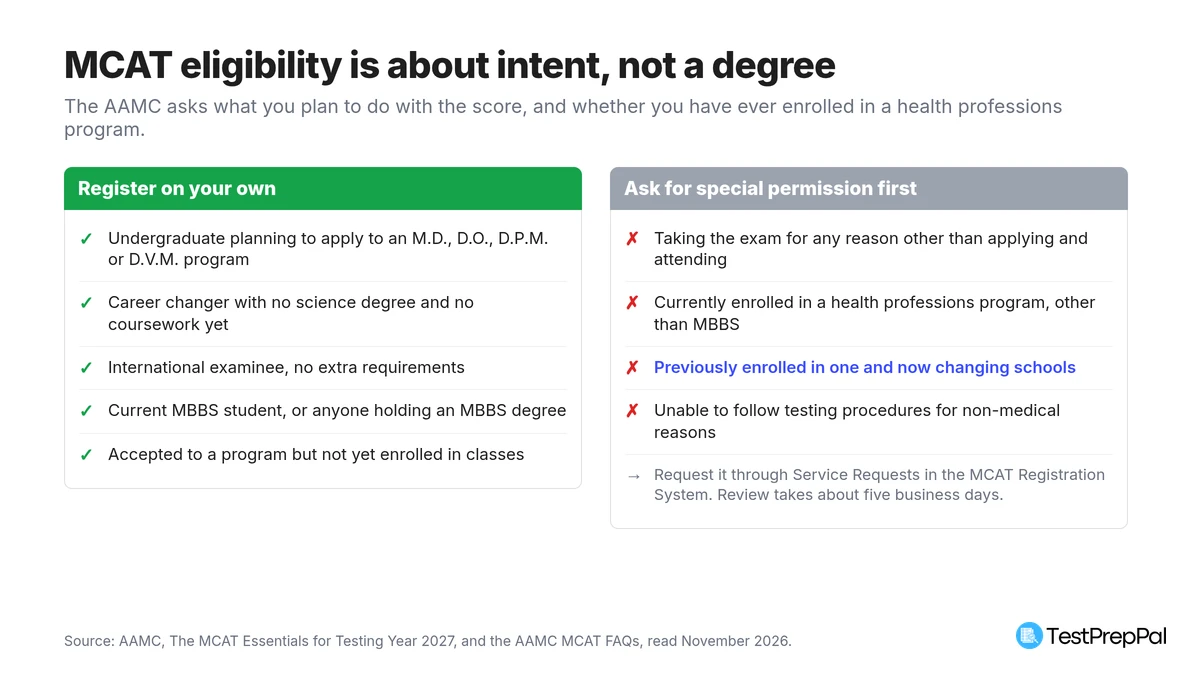 Who registers directly and who has to ask first. Source: AAMC MCAT FAQs and the MCAT Essentials for Testing Year 2027.
At registration you agree to a statement verifying your intention to apply. Nobody asks for a transcript. Nobody checks that you have taken organic chemistry. The AAMC confirms there are no required courses or prerequisites, although the exam tests content from introductory biology, general and organic chemistry, physics, and first-semester biochemistry, psychology and sociology. Eligibility and readiness are different questions, and the MCAT section breakdown is the better guide to the second one.
International examinees face no additional requirements at all. If you are currently in, or hold a degree from, an MBBS program or its equivalent, you can register without seeking special permission. That is an explicit carve-out, and it is the one case where being enrolled in a medical program does not trigger the extra step.
The AAMC's two official pages do not say the same thing
This is where the general advice on this question goes wrong, because almost all of it is a restatement of the FAQ.
The FAQ says you need special permission if you are not planning to apply to a health professions school, or if you are a currently enrolled medical student other than an MBBS student. It tells you to email the MCAT program office with your reasons.
The MCAT Essentials for Testing Year 2027, which is the policy document you certify you have read at registration and again on test day, is both broader and more specific:
| MCAT FAQs | MCAT Essentials (binding) | |
|---|---|---|
| Base rule | Planning to apply to a health professions school | Preparing to apply and not currently or previously enrolled in a health professions program |
| Who needs permission | Non-applicants, current med students | Non-applicants, current or former enrollees changing schools, anyone who cannot follow testing procedures for non-medical reasons |
| How to ask | Email the MCAT program office | "Submit another service request" in the MCAT Registration System |
| Turnaround | Five business days, deadlines never extended | Five business days typical |
Three differences matter in practice.
First, the Essentials covers people who were previously enrolled, not just current students. If you started a health professions program, left, and now want to apply elsewhere, the FAQ reads as though you are in the clear and the Essentials says you are not.
Second, there is a carve-out worth knowing: if you have been accepted into a health professions program but have not yet enrolled in classes, you do not need special permission. Acceptance alone does not close the door.
Third, the request channel differs. Use the Service Requests route in the registration system and complete the Personal Information tab first, which the Essentials says prevents processing delays. If you are working through MCAT registration for the first time, that tab is part of the normal flow anyway.
Do nurses, vets and the merely curious take the MCAT?
Three versions of this question come up constantly, so here are three direct answers.
Nurses. Nursing licensure runs through the NCLEX, not the MCAT, so a nurse qualifying as an RN never touches this exam. A nurse applying to medical school does, and is eligible on exactly the same terms as a 20-year-old undergraduate. Clinical experience neither helps nor hinders eligibility.
Veterinary applicants. Yes, and they are named in the AAMC's own list. Most U.S. veterinary programs prefer the GRE, so check what your schools actually want before you book a seat. If they accept MCAT scores, you are eligible.
People who just want to try it. No, not without permission. Sitting the exam out of curiosity, to benchmark yourself, or to see what it is like is explicitly "any reason other than applying to and attending an eligible health professions program," and that requires special permission. It is also an expensive hobby: the full cost of taking the MCAT starts at $360 before you change a single thing about your booking.
How many times can you take the MCAT?
Three limits apply at the same time, and you have to satisfy all three:
| Limit | Maximum |
|---|---|
| Appointments held at once | 1 |
| Attempts in a single testing year | 3 |
| Attempts across two consecutive testing years | 4 |
| Attempts in a lifetime | 7 |
The lifetime count begins with the April 2015 test dates, so anything before that does not count against you.
The two-year cap is the one that actually shapes a retake plan, and it is the one people overlook. Hitting the per-year maximum twice in a row is not allowed, because 3 plus 3 is 6 and the two-year ceiling is 4.
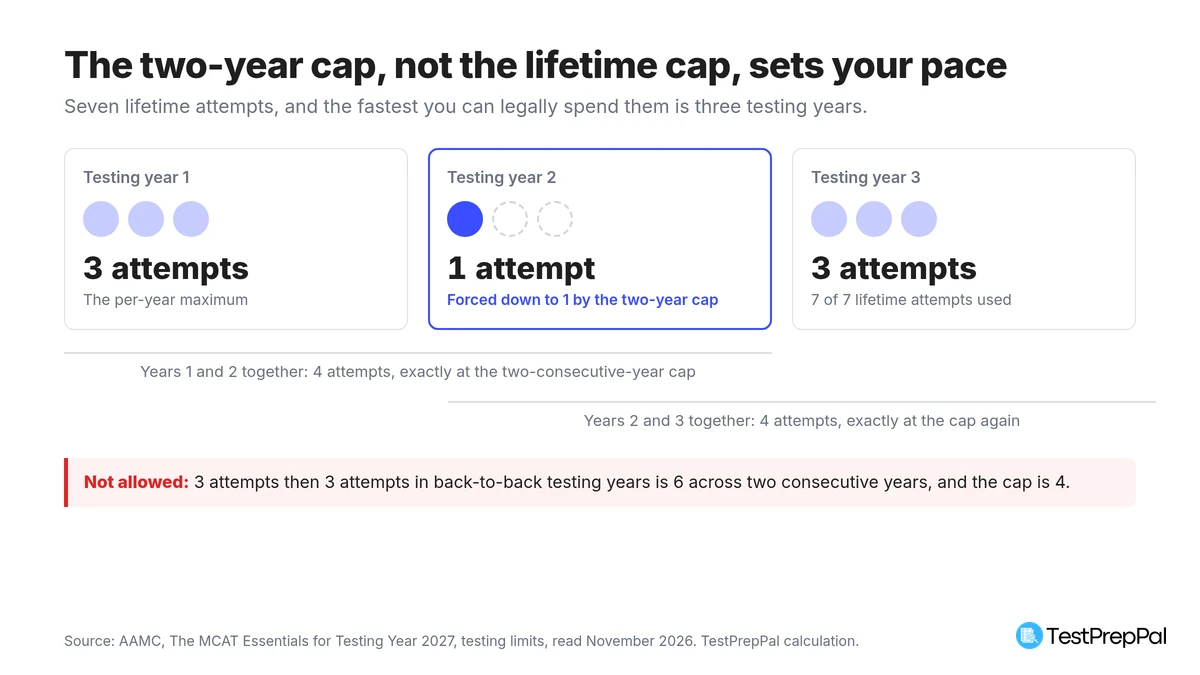 Why seven lifetime attempts take at least three testing years to use. Source: MCAT Essentials for Testing Year 2027, TestPrepPal calculation.
So the fastest legal way to spend all seven attempts is three testing years: three, then one, then three. Each adjacent pair sums to exactly four.
Seat availability is never the constraint here. The 2027 U.S. calendar lists 35 test dates between January 15 and September 11, 2027. You may use three of them. That is 8.6 percent of the calendar, and the rule, not the booking system, is what caps you.
Whether you should use an attempt at all is a different calculation, and the MCAT retake calculator works through the score improvement that makes a second sitting worth it. Timing matters too: the MCAT score release calendar maps each test date onto the day schools see the result, which is what decides whether a retake fits inside your application cycle.
What actually counts as an attempt
An attempt is not the same thing as a score. There are six documented ways to spend one, and only one of them produces a number you can send to schools.
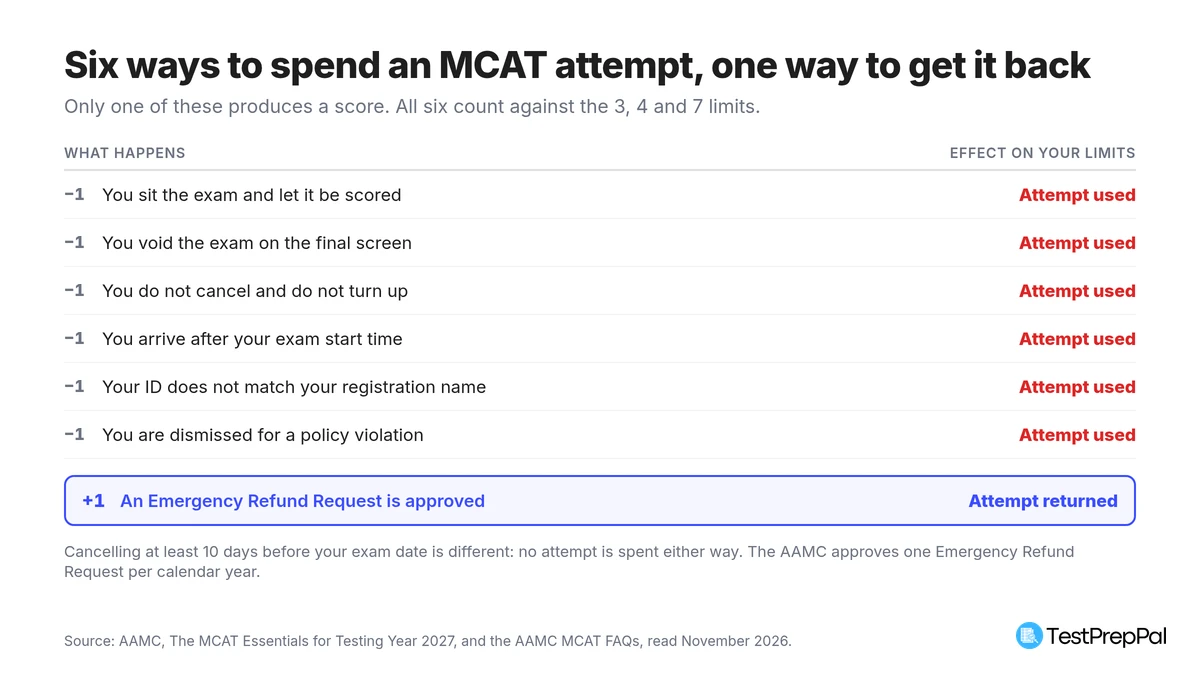 Six ways to lose an attempt, one way to recover it. Source: MCAT Essentials for Testing Year 2027 and the AAMC MCAT FAQs.
Voiding counts. On test day you get one chance, on the final screen, to score or void. Telling the test administrator you want to void is not sufficient, the choice is irreversible, and the void still consumes an attempt. Even leaving early because you are ill requires clicking through the exam in order to void it.
No-shows count, regardless of the reason. If you do not cancel and do not sit, you lose the attempt and pay the full registration fee again to rebook. You may also have to wait up to 24 hours before the system lets you schedule anything new.
Arriving late is a no-show. So is an ID whose first and last names do not match your registration exactly, and so is being dismissed for a policy violation. All three leave you with one fewer attempt and no refund. The MCAT registration walkthrough covers the name-matching rule in detail, because it is the cheapest mistake to avoid and the most expensive to make.
Cancelling properly does not count. Cancel at least 10 days before your appointment, through the registration system or by calling Pearson, and no attempt is spent. Watch for the confirmation email: if it does not arrive within 24 hours, the cancellation did not go through.
One route gives an attempt back. If a qualifying emergency stops you attending, an approved Emergency Refund Request puts the exam into no-show status, refunds part of the fee after your exam date, and returns the testing attempt. The AAMC approves one per calendar year, decides within two weeks of receiving your documentation, and the request is not reversible once submitted. It is the only documented way to recover an attempt, and it is worth knowing about before you need it.
The limits can be appealed, once
Seven is not quite as final as it sounds.
The Essentials PDF says the AAMC may consider appeals of the testing limits and may ask for supporting documentation. Below the lifetime limit, it will consider one request for an additional attempt per test year. Once you have reached seven, it will consider exactly one request for an additional attempt and will not consider any further appeals after that.
So the practical ceiling is eight sittings, not seven, with the eighth granted at the AAMC's sole discretion. Treat it as a genuine last resort rather than a planning assumption. If you are close to the limit, the honest question is what would change on the next attempt, and a free diagnostic from the MCAT free resources list answers that more cheaply than an appeal does.
For everything else about sitting the exam, the MCAT hub collects the format, scoring and prep comparisons in one place, and what counts as a good MCAT score is the better next question once eligibility is settled.
MCAT eligibility FAQs
Can you take the MCAT without going to college?
Yes. The AAMC sets no degree requirement and no prerequisite courses for registration, so enrollment status is irrelevant to eligibility. The content is drawn from introductory college science, psychology and sociology courses, so most candidates have taken them, but that is a readiness question rather than a rule. You still have to intend to apply to a health professions school.
Can a medical student take the MCAT?
Only with special permission, and that applies whether you are currently enrolled or were previously enrolled and are now trying to change schools. The one exception is MBBS: current MBBS students and MBBS degree holders register normally. Request permission through Service Requests in the MCAT Registration System and allow five business days.
Do nurses take the MCAT?
Only if they are applying to a program that accepts MCAT scores, such as an M.D. or D.O. program. Nursing licensure in the United States runs through the NCLEX, which is a different exam with a different purpose, and neither one substitutes for the other. A nurse applying to medical school is eligible on exactly the same terms as any other applicant.
Does a voided MCAT count against your limit?
Yes. The AAMC states that voids and no-shows count toward your testing limits, so a voided exam uses one of your three annual and seven lifetime attempts even though no score is ever produced. The decision to void is made on screen at the end of the exam and cannot be reversed afterwards.
What happens if you register without special permission when you needed it?
The AAMC lists the possible consequences as an investigation, cancellation of your testing appointment, cancellation of your scores, and a ban from taking the MCAT for a designated period or permanently. The exam itself is also over seven hours end to end, so this is not a day you want to spend on an appointment that gets voided afterwards. If you are unsure whether the rule applies to you, ask before you book.
We may earn commissions from some links on this page, but this does not affect our reviews or your experience.