

Best LSAT Flashcards in 2026

by John Reed· Last Updated: Nov 26, 2026
Most students should start with Magoosh LSAT Flashcards: 190 expert-written cards, free on the web, iOS and Android, with a review system that shows your hardest cards more often. If you would rather build a deck around your own mistakes, Quizlet is the pick, because it is the only option here that lets you create and edit cards.
All four options on this page can be used for free. They differ in what they drill: reasoning concepts, vocabulary, or whatever a community member decided to type into a set.
Flashcards have a narrow job on this exam. They are good for memorizing terminology, conditional logic indicators, flaw types and question stem identifiers. The LSAT is mainly a skills test, so cards should sit beside timed practice, not replace it.
Here are the main takeaways:
-
Magoosh LSAT Flashcards: Best for learning core LSAT terminology on your phone. It has 190 cards across three topic areas, and the web version needs no account.
-
Quizlet LSAT Flashcards: Best for volume and custom decks. You get four study modes (Flashcards, Learn, Test and Match) on a free tier with ads, and Quizlet Plus is $35.99 a year.
-
Manhattan Review LSAT Vocabulary Flashcards: Best for reading fluency, especially for non-native English speakers. It has 500 cards in Essential and Advanced tiers, with no signup.
-
Blueprint LSAT Flashcards: Best for printable, offline study. It is a free PDF pack covering Logical Reasoning and Reading Comprehension, and it needs an email signup.
LSAT flashcards summary table
| Resource | Cost | Format | Cards | What it covers | Best for |
|---|---|---|---|---|---|
| Magoosh LSAT Flashcards | Free, no account on web | Web, iOS and Android | 190 | LSAT Basics, Logic Games, Transitional Language | Foundational terms on mobile |
| Quizlet LSAT Flashcards | Free with ads. Quizlet Plus is $35.99/year | Web, iOS and Android | Varies by set | Community sets on flaw types, conditional logic, question stems and more | Custom decks and varied study modes |
| Manhattan Review LSAT Vocabulary Flashcards | Free, no signup | Web only | 500 | Vocabulary in Essential and Advanced tiers | Passage vocabulary |
| Blueprint LSAT Flashcards | Free with email signup | Downloadable PDF | Fixed PDF pack | Logical Reasoning and Reading Comprehension concepts | Printed, offline review |
Which LSAT flashcards are right for you?
- If you are new to the LSAT and need the basic terminology, use Magoosh LSAT Flashcards.
- If you want to make cards from the questions you miss, use Quizlet.
- If unfamiliar words slow you down in passages, use the Manhattan Review vocabulary flashcards.
- If you study better on paper, use the Blueprint LSAT Flashcards.
- If you want expert-written cards and do not want to vet anything yourself, choose Magoosh or Blueprint over Quizlet.
The LSAT flashcards we reviewed
1. Magoosh LSAT Flashcards
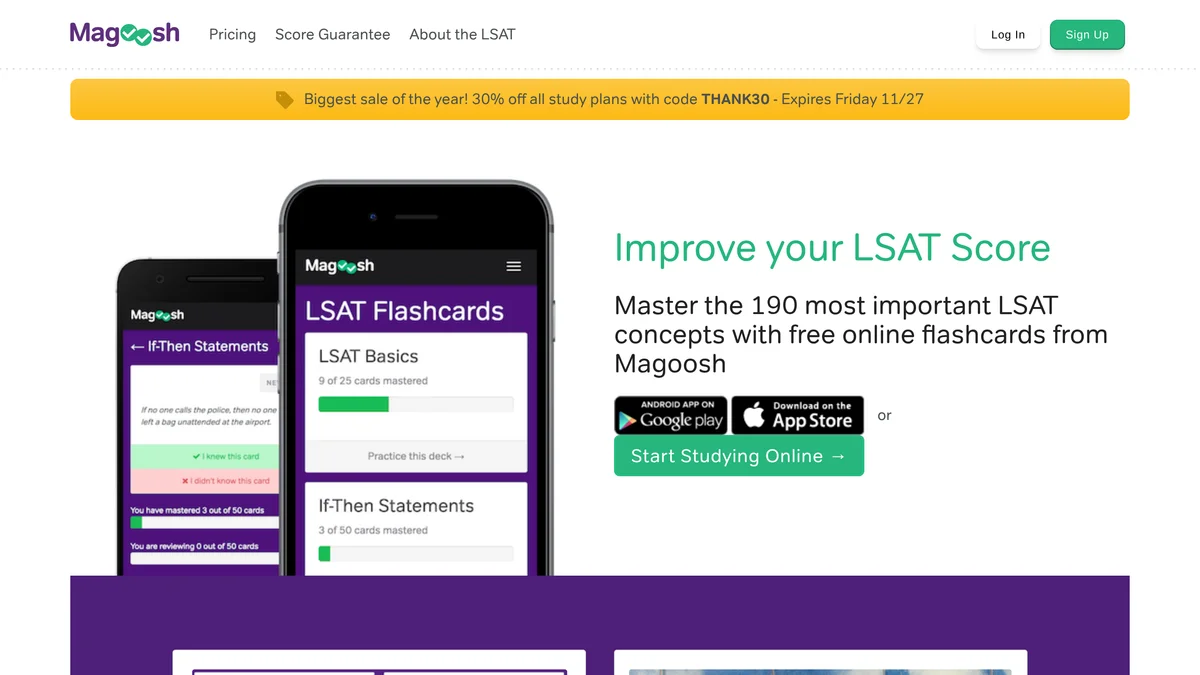
Magoosh LSAT Flashcards are a free deck of 190 cards, written by Magoosh's LSAT content team, that teaches the terminology of the exam.
What you get:
a) 190 cards in three topic areas: LSAT Basics, Logic Games and Transitional Language. The last covers signal words such as "nevertheless" and "moreover" that run through Logical Reasoning and Reading Comprehension passages.
b) Smart review: The app tracks which cards you find difficult and shows them more often. It is a basic form of spaced repetition that needs no setup.
c) Free apps: The deck is free on iOS and Android as well as on the web.
d) No account on the web: You can open the web version and start.
Best for: Students new to the LSAT who want to learn the core terms quickly, and anyone who wants a short review session on a phone.
Limitation: The cards teach concepts, not skills. There are no real LSAT questions or passage drills in the deck, and you cannot add or edit cards. One of the three topic areas is Logic Games, which is no longer a scored part of the test, as our guide to the current LSAT sections explains. The app is standalone and does not connect to Magoosh's other LSAT tools.
2. Quizlet LSAT Flashcards
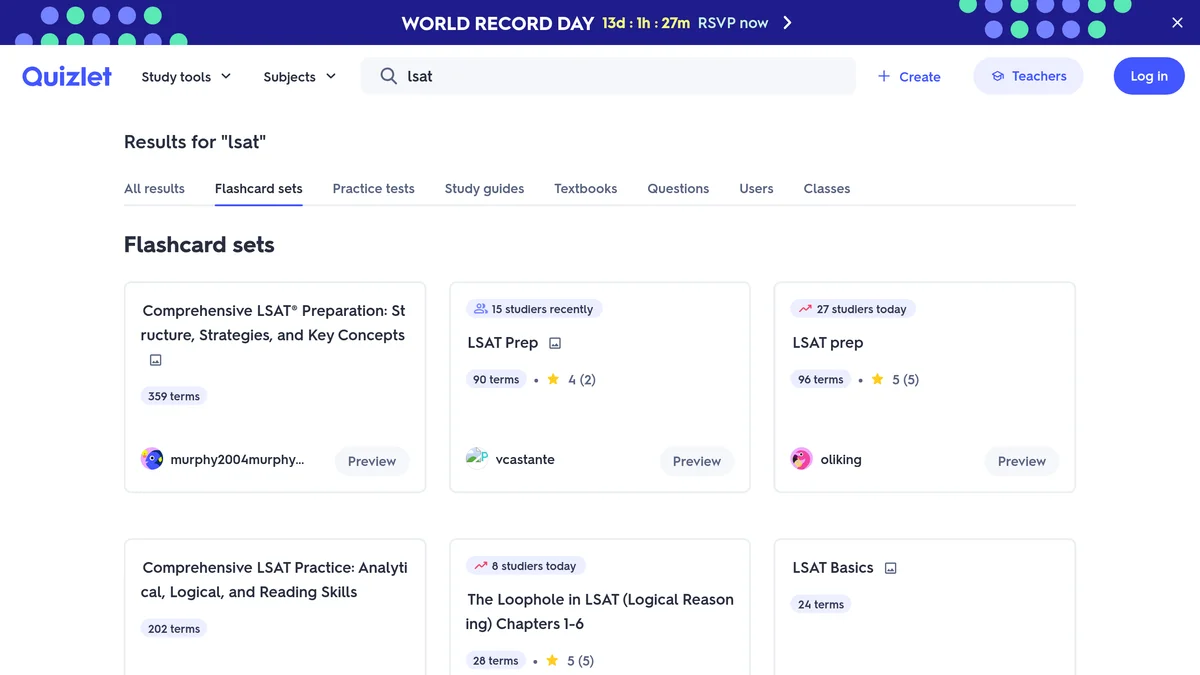
Quizlet is a general flashcard platform where anyone can create and share study sets, and its LSAT section is the largest library of LSAT flashcards we reviewed.
What you get:
a) A large library of community sets: Popular sets cover Logical Reasoning question types, common flaw categories, conditional logic indicators, sufficient versus necessary conditions and Reading Comprehension strategies.
b) Four study modes: Flashcards, Learn, Test and Match. Learn mode adapts to your performance and shows the cards you struggle with more often. Test mode builds randomized quizzes with multiple choice, true/false and written answers.
c) Custom sets: You can create your own sets for free and combine several sets into one study folder. The fixed decks from Magoosh and Blueprint cannot be edited.
d) Web and mobile access: Quizlet works on the web, iOS and Android.
e) A free tier that covers most needs: It includes full access to community sets and all basic study modes, with ads. Quizlet Plus, at $35.99 a year, removes ads and adds AI-enhanced study features.
Best for: Self-directed students who want to build a personal deck from their weak areas and are willing to check a set before trusting it.
Limitation: There is no quality control. Some sets are written carefully by LSAT tutors, and others contain errors, outdated information or badly worded cards. Sample a few cards from any set before you commit to it. The free tier shows ads, and Learn mode is not as sophisticated as a dedicated spaced repetition tool.
3. Manhattan Review LSAT Vocabulary Flashcards
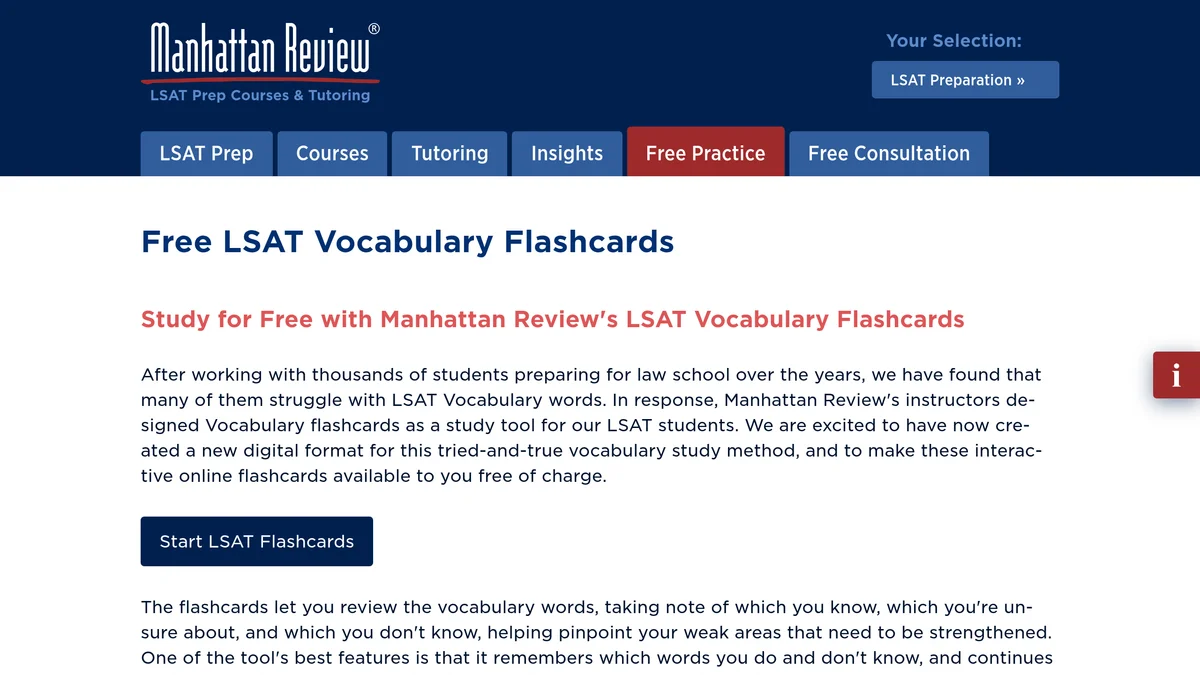
The Manhattan Review LSAT Vocabulary Flashcards are a free set of 500 digital flashcards focused entirely on vocabulary that appears in LSAT passages.
What you get:
a) 500 vocabulary cards: Our review calls it the largest free LSAT flashcard set by card count.
b) Two difficulty tiers: Essential covers foundational words that appear often in LSAT passages. Advanced covers less common words from harder Reading Comprehension and Logical Reasoning content.
c) Definitions with usage context: Each card gives a word with its definition and context, and some include example sentences.
d) Color-coded progress tracking: The interface shows how well you know each word.
e) No signup: There is no account, email or payment. You can start on the website immediately.
Best for: Students who find LSAT passage language hard going, and non-native English speakers preparing for the exam.
Limitation: Vocabulary is never tested directly on the LSAT. Knowing more words reduces friction when you read, but these cards teach nothing about conditional logic, argument structure or flaw types. The set is web only, with no dedicated mobile app.
4. Blueprint LSAT Flashcards
The Blueprint LSAT Flashcards are a free downloadable PDF pack written by Blueprint Prep instructors who scored at or above the 98th percentile.
What you get:
a) Logical Reasoning cards: They cover argument structure, common flaw types and strategies for specific question types.
b) Reading Comprehension cards: They focus on passage analysis and on identifying author tone, main points and structural elements.
c) A printable format: Each card has a concept on the front and an explanation or strategy on the back. You can print the pack and study with no app or internet connection.
d) A wider free suite: Blueprint also offers free cheat sheets, practice questions, blog posts and sample course lessons. We cover the Blueprint LSAT Cheat Sheets separately.
Best for: Students who prefer paper cards and want expert-written content on the two scored section types.
Limitation: A static PDF has no spaced repetition, no progress tracking and no way to edit cards. You must give your email to download it, which means you will get Blueprint marketing emails.
How to use these together
- Learn the language first. Run through the LSAT Basics and Transitional Language cards in Magoosh during your first weeks. Check how long to study for the LSAT so cards do not eat your whole schedule.
- Take a baseline. Sit an LSAT diagnostic test before you decide what else to memorize. It shows whether your problem is terminology, vocabulary or reasoning.
- Add vocabulary only if you need it. If passage wording is slowing you down, work through the Essential tier of the Manhattan Review deck, and pair it with our Reading Comprehension tips.
- Build a deck from your mistakes. After each set of free LSAT practice questions or each full LSAT practice test, add the concepts you missed to your own Quizlet set.
- Keep a printed reference nearby. Use the Blueprint flashcards or one of the LSAT cheat sheets at your desk while you review Logical Reasoning.
Flashcards are one small part of a plan. The rest of our free LSAT resources and the LSAT hub cover practice tests, courses and video lessons.
LSAT flashcards FAQs
Are flashcards useful for the LSAT?
They are useful for a limited set of things: LSAT terminology, conditional logic indicators, flaw types and question stem identifiers. The LSAT is mainly a skills test, so flashcards should supplement practice with real questions and not replace it.
What are the best free LSAT flashcards?
For most beginners it is Magoosh, with 190 expert-written cards and free apps on iOS and Android. Manhattan Review is the better choice for vocabulary, with 500 cards and no signup. Blueprint is the choice for printable cards, and Quizlet is the choice for building your own.
Do vocabulary flashcards help on the LSAT?
Only indirectly. Vocabulary is not tested directly on the LSAT, but knowing a word on sight lets you focus on the reasoning in a passage. Students who find passage language difficult, including non-native English speakers, benefit the most.
Is Quizlet free for LSAT prep?
Yes. The free tier gives full access to community LSAT sets and all basic study modes, and it shows ads. Quizlet Plus costs $35.99 a year and removes the ads.
Do any free LSAT flashcards use spaced repetition?
Two come close. The Magoosh app shows difficult cards more often, and Quizlet's Learn mode adapts to your performance in a similar way. Blueprint's PDF pack has no such feature.
We may earn commissions from some links on this page, but this does not affect our reviews or your experience.


