


The LSAT has four 35-minute multiple-choice sections, three of which are scored. Since August 2024 those scored three are two Logical Reasoning sections and one Reading Comprehension section, so Logical Reasoning now carries 70 of your 105 scored minutes.
That is the part most section lists leave out. They tell you what the sections are. They do not tell you that the weighting changed underneath them, and that study advice written for the old format now points a third of your effort at two thirds of the test.
- The multiple-choice LSAT is four 35-minute sections: three scored, one unscored.
- The scored three are two Logical Reasoning sections and one Reading Comprehension section. Logic Games is gone.
- Logical Reasoning went from 35 of 105 scored minutes to 70, exactly doubling its share.
- LSAC publishes the scored totals, 50 Logical Reasoning questions and 27 Reading Comprehension questions, but not a fixed count for the section on your form.
- LSAT Argumentative Writing is separate, unscored, and taken online on its own day.
What are the four sections of the LSAT?
Per LSAC's types of LSAT questions page, the multiple-choice portion is four 35-minute sections. Three count toward your score. One does not, and it exists so LSAC can validate questions for future tests.
| Section type | On test day | Scored | Length |
|---|---|---|---|
| Logical Reasoning | Two sections | Yes | 35 minutes each |
| Reading Comprehension | One section | Yes | 35 minutes |
| Unscored pretest section | One section, either type | No | 35 minutes |
Between Section 2 and Section 3 you get a 10-minute intermission. It is worth knowing one detail about it: Section 3 does not begin until the full 10 minutes expires. You cannot return early and bank the time, so plan to use it rather than rush back.
That puts test day at 140 minutes of testing plus the 10-minute intermission, or 150 minutes from the first question to the last.
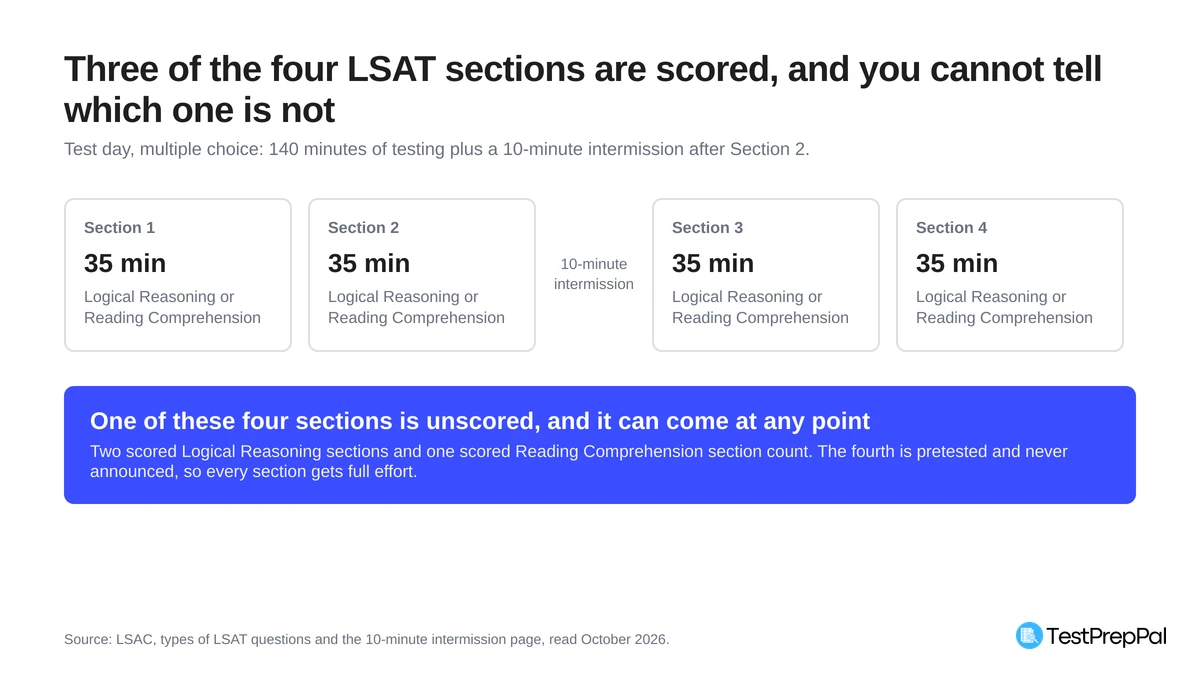 The multiple-choice LSAT on test day. Source: LSAC test format pages, read October 2026.
Why the LSAT has two Logical Reasoning sections now
The second Logical Reasoning section is not an addition. It is a replacement.
LSAC announced the change in October 2023, in a post on the August 2024 format. The background is a 2019 settlement with two blind individuals who argued that the Analytical Reasoning section, known to everyone as Logic Games, disadvantaged blind test takers because they could not draw or use diagrams. LSAC committed to researching alternatives, and concluded that a second Logical Reasoning section was the best way to keep assessing deductive reasoning without the diagramming problem.
Logic Games sunset after the June 2024 test. From the August 2024 test onward, the scored sections have been two Logical Reasoning and one Reading Comprehension.
If you are studying from a book or a course syllabus that still allocates time to Logic Games, that material is testing you on a section that no longer exists.
Logical Reasoning is now two thirds of your scored test
Here is the arithmetic nobody runs for you.
Under the old format, the three scored sections were one Logical Reasoning, one Reading Comprehension and one Logic Games, at 35 minutes each. Logical Reasoning was 35 of 105 scored minutes, or 33 percent.
Under the current format, the three scored sections are two Logical Reasoning and one Reading Comprehension. Logical Reasoning is 70 of 105 scored minutes, or 67 percent.
The scored total did not move. It was 105 minutes before and it is 105 minutes now. All of the gain came out of Logic Games, which means Logical Reasoning exactly doubled its share of the scored test.
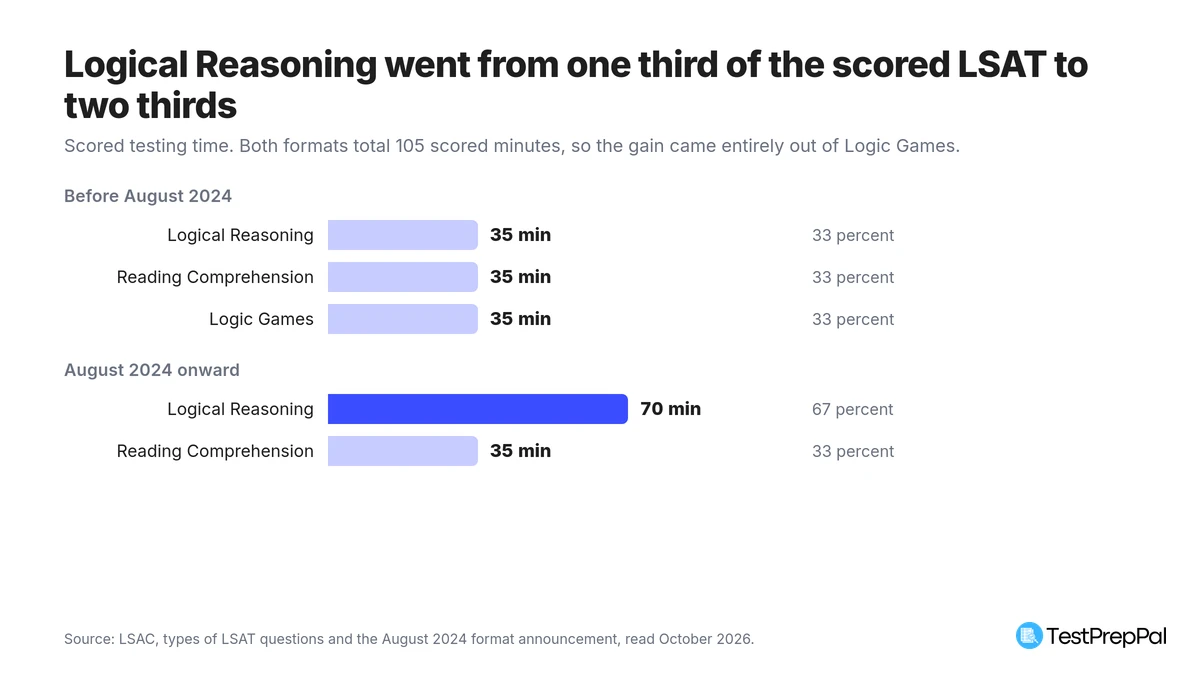 Scored testing time, before and after August 2024. Source: LSAC format pages, read October 2026.
Two of every three scored minutes on the LSAT are Logical Reasoning. If your study plan splits time evenly across question types, you are underweighting the section that decides most of your score.
Our guide to Logical Reasoning tactics goes into what actually moves accuracy on those two sections.
How many questions are on each LSAT section?
This is where most pages state a number LSAC does not publish.
For Reading Comprehension, LSAC is specific. The Reading Comprehension page says the section contains four sets of reading questions, each set consisting of reading material followed by five to eight questions. A section includes either three or four single passages, and either one comparative reading set or none.
Four sets of five to eight questions gives a scored Reading Comprehension section of 20 to 32 questions. That is a range, not a fixed number, and it is LSAC's own range.
For Logical Reasoning, the Logical Reasoning page describes the format but not a count: each question presents a short passage followed by one question, or rarely two.
The scored totals, though, LSAC does publish, on a page most people never reach. Its explanation of the August 2027 format change states that the current test and the new one both carry 27 scored Reading Comprehension questions and 50 scored Logical Reasoning questions. So 77 scored questions, and Reading Comprehension is 35 percent of them. Our LSAT Reading Comprehension tips work out what that means per passage set.
What LSAC still does not fix is the count on the section in front of you. A prep site quoting "about 25 Logical Reasoning questions" is giving you an observed average from released tests, and your form may differ.
What LSAC does fix is the clock. Every section is 35 minutes, whatever the count. That is why pacing practice beats memorizing a question total, and why working through free LSAT practice questions under a timer is more useful than counting items.
Which section is unscored, and can you tell?
No, and that is deliberate.
LSAC states that the unscored section can be any one of the question types, Reading Comprehension or Logical Reasoning, and that it can occur at any point in the test. There is no marker, no announcement, and no reliable pattern.
This has a practical consequence. If you see a third Logical Reasoning section, you cannot conclude that one of them is the pretest and coast. One of the Logical Reasoning sections you sit might be unscored, or the Reading Comprehension section might be, or the extra one might be the real one. Treat all four as scored, because three of them are and you do not get to pick which.
The upside is that an unusually hard section is not evidence of anything. Pretest questions are being calibrated, so a section that felt brutal may simply be the one that does not count.
Where LSAT Argumentative Writing fits
Argumentative Writing is the second part of the LSAT, and it is not one of the four sections.
It is unscored. It is administered online with secure proctoring software on your own computer, not at a Prometric test center, and you can take it as early as eight days before your multiple-choice test. You get 50 minutes in total: 15 minutes of prewriting analysis and 35 minutes of essay writing.
You are given a debatable issue and three or four perspectives, and you write an argumentative essay taking a position while addressing the other perspectives. There is no right position. Law schools read it for reasoning, clarity, organization, language use and mechanics.
Unscored does not mean unread. It goes to every school you apply to. Treat it as a writing sample that admissions officers will see, and get it done before test day so it is not hanging over you. Our LSAT Argumentative Writing guide budgets both halves of the 50 minutes and shows what the planning time has to produce before the essay clock starts.
Did removing Logic Games change scores?
Barely, and LSAC published the numbers.
Before the change, LSAC analyzed 218,243 test sessions both ways: scored with Analytical Reasoning included, and scored with a second Logical Reasoning section in its place. The mean score was 150.82 with Logic Games and 150.83 without. The median was 151 in both. The difference in the mean is one hundredth of a point.
LSAC also reported that the correlation with first-year law school grades changed by less than one hundredth of a point, so the revised format predicts law school performance about as well as the old one did.
For individual test takers there is more variation than a mean suggests, and LSAC noted that most individual sessions shifted by a point or less. If you are judging your target against older score data, the format change is not a reason to adjust it. Our breakdown of the LSAT score range covers what the 120 to 180 scale means in practice, and how hard the LSAT is covers where the difficulty actually comes from.
How to split your study time for the current format
Match study time to scored weight, not to the number of question types.
The old three-way split made sense when the scored test was three different sections. It does not now. Carried over literally, giving Logical Reasoning, Reading Comprehension and Logic Games a third each, it points a third of your effort at two thirds of the test. Drop the Logic Games third and split what is left evenly, which is what most people actually do, and Logical Reasoning still only gets half.
A weighting that matches the test looks closer to two thirds Logical Reasoning and one third Reading Comprehension, adjusted for where your accuracy is weakest. If Reading Comprehension is your bottleneck, weight it up. The point is to start from the real weighting rather than from a habit the test outgrew.
Two things follow from this that are easy to miss:
- Logical Reasoning stamina matters more than it used to. You will sit at least two of those sections, possibly three with the pretest, and accuracy on the second one is a different skill from accuracy on the first.
- A single bad Reading Comprehension section is harder to absorb, because there is only one scored section carrying that third.
If you are building a plan from scratch, the best way to study for the LSAT walks through sequencing, and LSAT test dates covers how far out to start. If you want structure rather than a self-built plan, our LSAT prep course reviews compare what the main options actually teach, and the LSAT hub collects the rest of our coverage.
LSAT sections FAQs
What are the four sections of the LSAT?
Two scored Logical Reasoning sections, one scored Reading Comprehension section, and one unscored section that is either Logical Reasoning or Reading Comprehension. Each runs 35 minutes. The unscored section can appear at any position, and you are not told which one it is.
What is the hardest section of the LSAT?
LSAC does not publish difficulty data by section, so there is no official answer. What is measurable is weight: Logical Reasoning is two thirds of your scored testing time, so errors there cost the most. Students who found Logic Games hardest under the old format often find the current test easier, since the section they struggled with no longer exists.
How many Logical Reasoning questions are there?
LSAC does not publish a fixed count. Each question follows a short passage and asks one question, or rarely two, and each section runs 35 minutes. Released tests have typically run in the mid-twenties per section, but treat that as a planning estimate rather than a specification.
How long is the LSAT in total?
The multiple-choice portion is 140 minutes of testing, four sections of 35 minutes, plus a 10-minute intermission after Section 2, for 150 minutes on test day. Argumentative Writing adds 50 minutes and is taken separately online, as early as eight days before.
We may earn commissions from some links on this page, but this does not affect our reviews or your experience.