


The multiple-choice LSAT takes 150 minutes from the first question to the last: four 35-minute sections and one 10-minute break. Block out three hours anyway, because LSAC tells you to arrive at the test center 30 minutes before your scheduled testing time, and the unscored LSAT Argumentative Writing essay adds another 50 minutes on a different day.
Almost every page answering this question stops at 150 minutes. That is the number on the clock inside the test, not the number you need to plan a morning around.
- The multiple-choice LSAT is four 35-minute sections plus a 10-minute intermission: 150 minutes of test time.
- LSAC tells in-center test takers to arrive 30 minutes early, so the realistic block is 180 minutes.
- Only three of the four sections are scored, so 105 of the 140 testing minutes count toward your score.
- LSAT Argumentative Writing is a separate 50-minute session you take online, up to eight days before test day.
- From the August 2027 test the multiple-choice portion runs 162 minutes, 12 minutes longer than it does now.
How long is the LSAT on test day?
LSAC's types of LSAT questions page sets the format: the multiple-choice portion is four 35-minute sections. A 10-minute intermission falls between Section 2 and Section 3. That is 140 minutes of testing plus 10 minutes of break, or 150 minutes total.
The part the 150 leaves out is the front of the morning. For the 2026-2027 cycle LSAC has moved the vast majority of test takers into Prometric test centers, and its test day instructions say to arrive 30 minutes before your scheduled testing time. Prometric staff then walk you through check-in, assign you a locker for everything you brought, and run a security check once you are at your station.
| What happens | Minutes | Clock |
|---|---|---|
| Arrive, check in, store belongings, security check | 30 | 0 to 30 |
| Section 1 | 35 | 30 to 65 |
| Section 2 | 35 | 65 to 100 |
| Intermission | 10 | 100 to 110 |
| Section 3 | 35 | 110 to 145 |
| Section 4 | 35 | 145 to 180 |
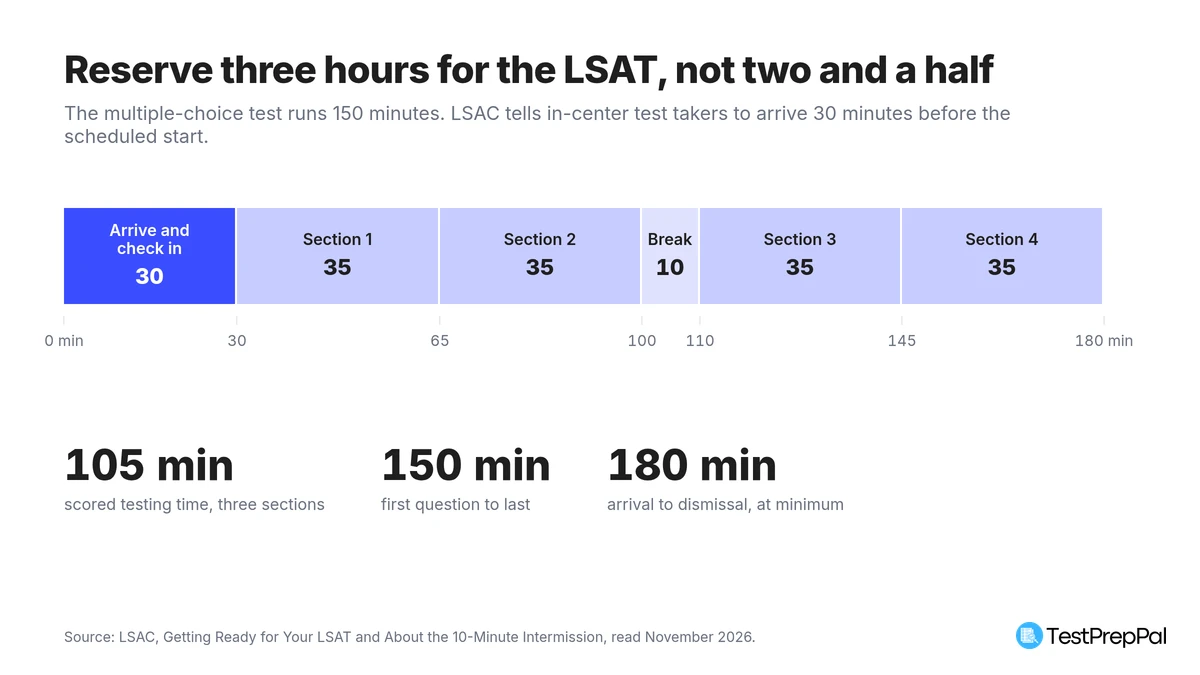 LSAT test day, from arrival to dismissal. Source: LSAC test day and intermission pages, read November 2026.
Treat 180 minutes as a floor rather than an estimate. LSAC publishes the 30-minute arrival instruction but puts no duration on check-in itself, on the locker assignment, or on the security check at your station, and none of those run on your test clock. If you are driving to an unfamiliar center, add the parking too.
Reserve three hours for the multiple-choice LSAT, not two and a half. The 150-minute figure starts at your first question, and LSAC asks you to be in the building 30 minutes before that.
Only 105 of those 140 minutes are scored
Three of the four sections count. The fourth does not. LSAC uses it to validate new questions for future tests, and it can be either a Reading Comprehension or a Logical Reasoning section, appearing at any point in the test.
That makes the arithmetic uncomfortable:
- Scored testing time: 3 sections x 35 minutes = 105 minutes
- Unscored testing time: 1 section x 35 minutes = 35 minutes
- Share of testing time that never reaches your score report: 35 of 140, or 25 percent
A quarter of the time you spend answering questions is not measured. You cannot tell which quarter it is while you sit there, which is the point: the validation section only works if everyone treats every section as real. The practical consequence is that your stamina has to cover 140 minutes of full effort to produce 105 minutes of scored work.
If you want the section-by-section detail, including which question types carry the score now that Logic Games is gone, our guide to the LSAT sections breaks down the scored weighting.
The 10-minute intermission is not yours to shorten
The break sits between Section 2 and Section 3, and it is exactly 10 minutes whether you want it or not. LSAC states that Section 3 does not begin until the full 10 minutes expires, and that every test taker on the standard intermission is required to take all 10. You cannot return early and bank the time.
There is a second detail worth planning for. When you come back, the proctor re-secures your testing environment and rechecks your computer settings before Section 3 starts, and may ask to see your ID again. That handoff is not part of the 10 minutes and not part of Section 3, so the real gap between your last Section 2 question and your first Section 3 question is a little longer than the posted break.
Use the 10 minutes. Stand up, use the restroom, eat something. You cannot use a phone, you cannot work on scratch paper, and you cannot discuss the test, but you can move. Two sections of Logical Reasoning after a cold start is a different experience from two after you have stretched. If you want to rehearse the pacing before test day, our free LSAT practice questions run in the same question formats you will see.
Argumentative Writing adds 50 minutes on a different day
The LSAT is not all multiple-choice. LSAT Argumentative Writing is a separate, unscored essay task, and the same LSAC format page gives you 50 minutes for it: 15 minutes of prewriting analysis followed by 35 minutes of essay writing.
It is not part of test day at all. It is administered remotely for every test taker, which means it is not available at a Prometric center, and you can take it as early as eight days before your multiple-choice test. Most people should. Your score is not released until the writing sample is on file, so leaving it until after test day only delays you.
Added up, the full LSAT is roughly 230 minutes of your life across two sittings: 180 at the test center and 50 at your own desk. Our LSAT Argumentative Writing guide budgets both phases of that 50 minutes in detail.
The LSAT gets 12 minutes longer in August 2027
If you are testing in August 2027 or later, the length changes. LSAC has announced that from that administration the LSAT moves to embedded pretesting: the standalone unscored section disappears, and unscored questions are mixed into the three scored sections instead.
Everyone will take the same three sections in the same order, Reading Comprehension first, then two Logical Reasoning sections.
| Section | Time | Scored questions | Total questions |
|---|---|---|---|
| Reading Comprehension | 52 minutes | 27 | 40 |
| Break | 10 minutes | ||
| Logical Reasoning 1 | 45 minutes | 25 | 32 |
| Break | 10 minutes | ||
| Logical Reasoning 2 | 45 minutes | 25 | 32 |
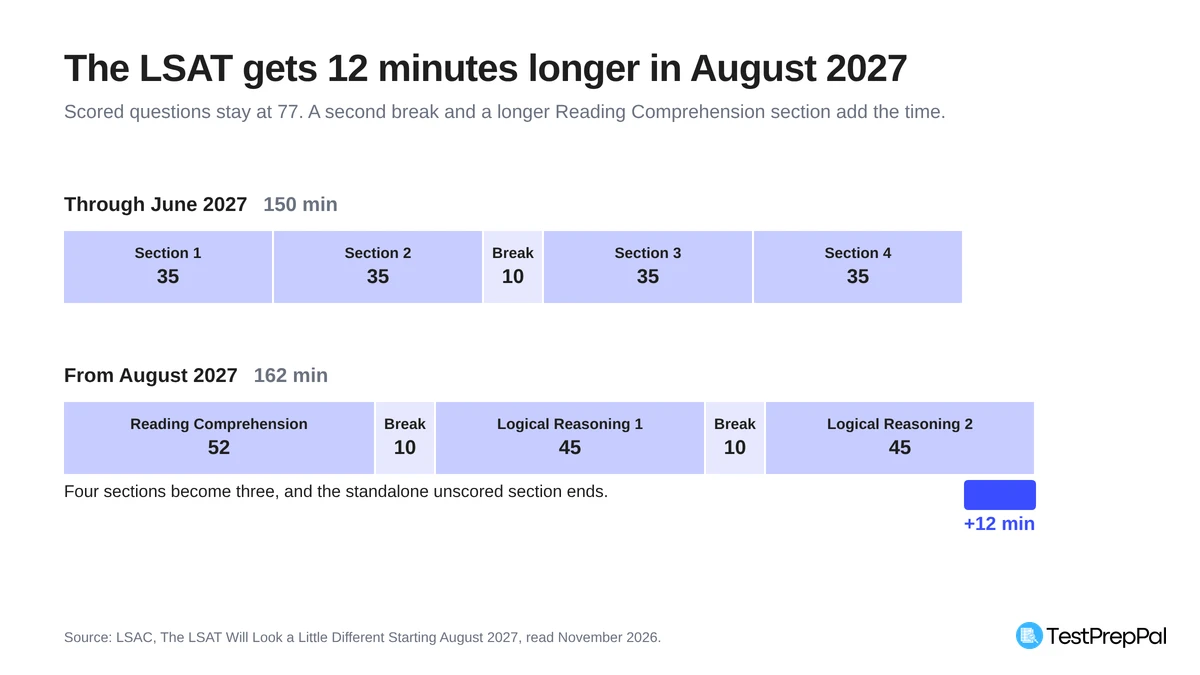 The current and August 2027 LSAT, to scale. Source: LSAC format announcement, read November 2026.
Run the numbers and the test gets longer, not shorter:
- Testing time: 52 + 45 + 45 = 142 minutes, against 140 today, so 2 minutes more
- Break time: two 10-minute breaks instead of one, so 10 minutes more
- Total: 162 minutes against 150, so 12 minutes more
Add the 30-minute arrival and an August 2027 test day runs 192 minutes at the center.
What does not change is the score. LSAC keeps the scored counts identical at 27 Reading Comprehension questions and 50 Logical Reasoning questions, holds the average time per question steady, and says scores stay comparable across cycles. Practice tests in the new format arrive on LawHub in February 2027, so anyone testing through June 2027 should keep preparing in the current four-section format. Check your administration on our LSAT test dates page before you decide which format to drill.
What the timing means for your prep
Three hours of concentration is the thing to train, not just the question types. A practice session that stops after two sections tells you nothing about how Section 4 feels.
Two habits help. Take at least a few full-length practice tests in one sitting, with a timed 10-minute break in the right place, so that the fatigue curve is familiar. And schedule a start time that matches when you actually think clearly, because Prometric appointments are first come, first served within your scheduling window and the good slots go early.
How many weeks of that preparation you need is a separate question, and we answer it with the study-hour data in how long to study for the LSAT. For what the resulting score has to be, see what counts as a good LSAT score, and for course options built around full-length timed practice, our LSAT prep course reviews compare what each one includes. Everything else we publish for the exam sits on the LSAT hub.
LSAT length FAQs
How long is the LSAT in total?
The multiple-choice portion is 150 minutes: four 35-minute sections and a 10-minute intermission. Because LSAC asks in-center test takers to arrive 30 minutes before their scheduled time, plan for about 180 minutes at the test center. LSAT Argumentative Writing adds 50 minutes on a separate day, which brings the full commitment to roughly 230 minutes.
Is the LSAT all multiple-choice?
No. The multiple-choice portion is the scored part, but every test taker also completes LSAT Argumentative Writing, an unscored 50-minute essay task. It is taken online with remote proctoring rather than at a test center, and your score is not released until it is on file.
How many sections are on the LSAT?
Four, each 35 minutes long. Three are scored and one is not: LSAC uses the unscored section to validate questions for future tests. It can be either Reading Comprehension or Logical Reasoning, and it can appear anywhere in the test, so you will not know which one it was. From the August 2027 administration the test drops to three sections with the unscored questions embedded inside them.
How long is LSAT Argumentative Writing?
Fifty minutes, split into 15 minutes of prewriting analysis and 35 minutes of essay writing. You can complete it as early as eight days before your multiple-choice test, and doing it early is the safer choice because scores are held until the sample is submitted. It is administered remotely for everyone, so it is never part of your time at the test center.
How much does the LSAT cost?
Cost is a separate question from length, and it has several parts rather than one number. Our breakdown of what the LSAT costs covers the 2026-2027 registration fee, the Credential Assembly Service charges most applicants also pay, the date-change and withdrawal rules, and how fee waivers change the total.
We may earn commissions from some links on this page, but this does not affect our reviews or your experience.