


LSAT Argumentative Writing gives most test takers 50 minutes, split into 15 minutes of prewriting analysis and 35 minutes of essay writing, per LSAC. Treat those as two separate budgets with a deliverable each: the planning time has to end with a typed thesis sentence and a paragraph map, and the writing time has room for five paragraphs and one reread.
Almost every tips article you will find is about the essay. The planning time is where the points are lost, because nobody tells you what it is supposed to produce.
- Most test takers get 50 minutes total: 15 for prewriting analysis, 35 for the essay. Approved extra time adjusts both.
- The prompt gives you a debatable issue and three or four short perspectives. You take a position and answer some of them.
- The section is unscored, but LSAC will not release your score to you or to schools until an approved writing sample is on file.
- Physical scratch paper is banned. Your notes are typed into a digital scratch paper panel inside the test.
- You get one attempt. LSAC resets a sample only for a technical failure, so the room setup is part of the test.
What the 15 minutes have to hand over
LSAC describes the prompt as a debatable issue plus three or four perspectives, each a few sentences long, representing competing beliefs and values. It also says the preparatory period exists so you can organise your thinking with guided prewriting analysis questions and take notes in the digital notetaking tool.
That is a work period, not a warm-up. Here is a budget that fits inside 15 minutes.
| Job | Minutes | What exists when it is done |
|---|---|---|
| Read the issue and every perspective, once, straight through | 5 | You can state the question in your own words |
| Answer the guided prewriting questions | 3 | Each perspective has a one-line gloss |
| Pick a side and type the thesis sentence in full | 2 | One sentence you will paste into the essay |
| Type the paragraph map, one line per paragraph | 5 | Four labelled lines, each naming its perspective |
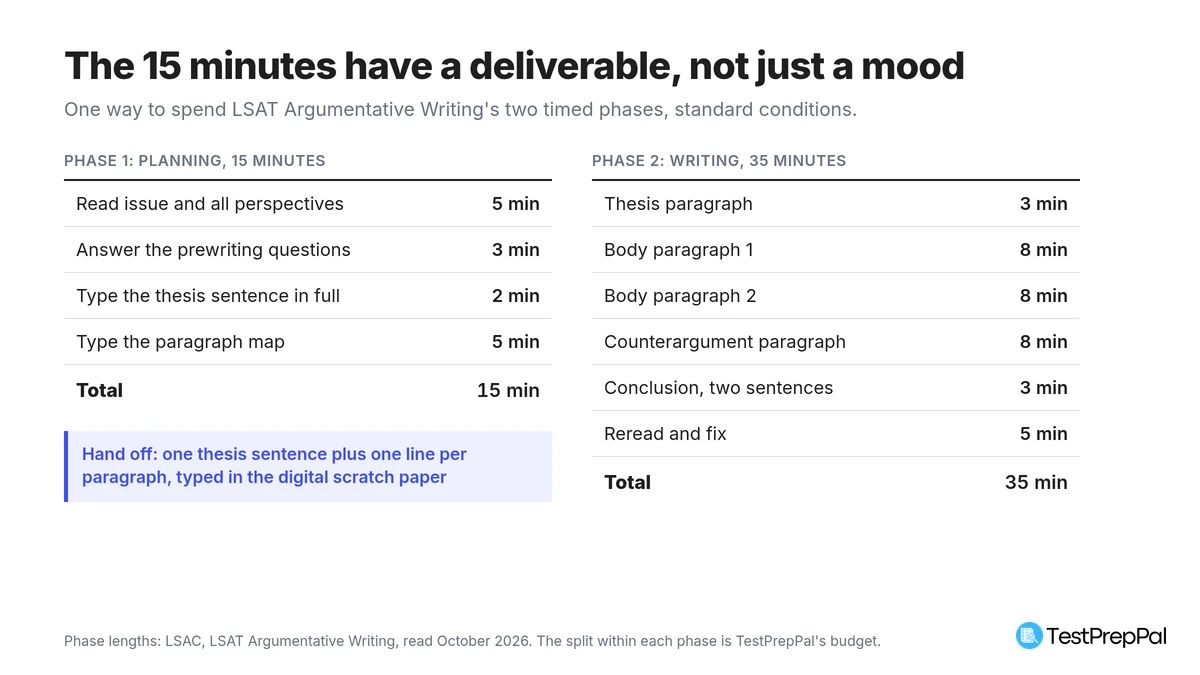 A 50-minute budget with a deliverable at each mark. Phase lengths from LSAC, read October 2026.
The thesis sentence matters more than it sounds. Writing it during the planning time means that when the essay clock starts you are copying a finished sentence instead of inventing one, and the first two minutes of writing are usually the two minutes people lose.
The paragraph map is the other half. One line per paragraph, each line naming which perspective it leans on and whether you are agreeing with it or answering it. Four lines is enough.
What 35 minutes of writing actually fits
There is no word limit and no space limit on LSAT Argumentative Writing, so the constraint is minutes, not length. LSAC's own advice is to stop worrying about length and write something cogent and well argued.
Thirty-five minutes supports about five paragraphs if you want any time to reread.
| Paragraph | Minutes | Job |
|---|---|---|
| Thesis | 3 | Paste the sentence you already wrote, add one line of preview |
| Body 1 | 8 | Your strongest reason, anchored to one perspective |
| Body 2 | 8 | A second reason, anchored to a different perspective |
| Counterargument | 8 | Name an opposing perspective and say why yours is stronger |
| Conclusion | 3 | Two sentences, no new evidence |
| Reread | 5 | Fix the sentences the spell-check underlined |
If you are 20 minutes in and still on the first body paragraph, cut the second one and go straight to the counterargument. An essay that takes a position and answers an objection reads as complete. An essay that stops in the middle of a second supporting reason does not.
The reasoning here is the same reasoning the multiple-choice test rewards, so the practice transfers. If you can identify a conclusion and the support under it, which is most of what our LSAT Logical Reasoning tips drill, you already know how to build one.
Your notes are typed, and the toolbar is thin
Physical scratch paper and writing implements are not permitted during a standard administration. Instead the interface gives you a digital scratch paper panel where you type notes, per LSAC's writing FAQs.
The rest of the toolbar is short:
- Highlighting and underlining, for marking the prompt
- Incremental text size and a line-spacing control
- The digital scratch paper panel
Misspellings get underlined by the browser's spell-check, but no alternative spellings are offered. You can see that a word is wrong and you are on your own fixing it. That is why the 5-minute reread is in the budget rather than being optional.
One practical consequence of typed notes: anything you want in the essay has to be typed twice unless you plan for it. Keep the paragraph map in short labels, not full sentences, and keep only the thesis as a full sentence.
You get one attempt. LSAC will not reset your writing sample so you can take it again unless there was a technical problem with your submission.
Take it the day it opens, not the week after your test
LSAT Argumentative Writing is included in your LSAT registration at no extra charge, which our guide to what the LSAT costs breaks down in full. It becomes available in your account eight days before your administration begins, per the same LSAC writing FAQs, and you can take it any time after that.
Most people leave it until after the multiple-choice test. That is the expensive choice, and both numbers behind the arithmetic are LSAC's. Samples are often processed within a week, but LSAC tells you to allow up to three weeks before yours can appear in a CAS Report.
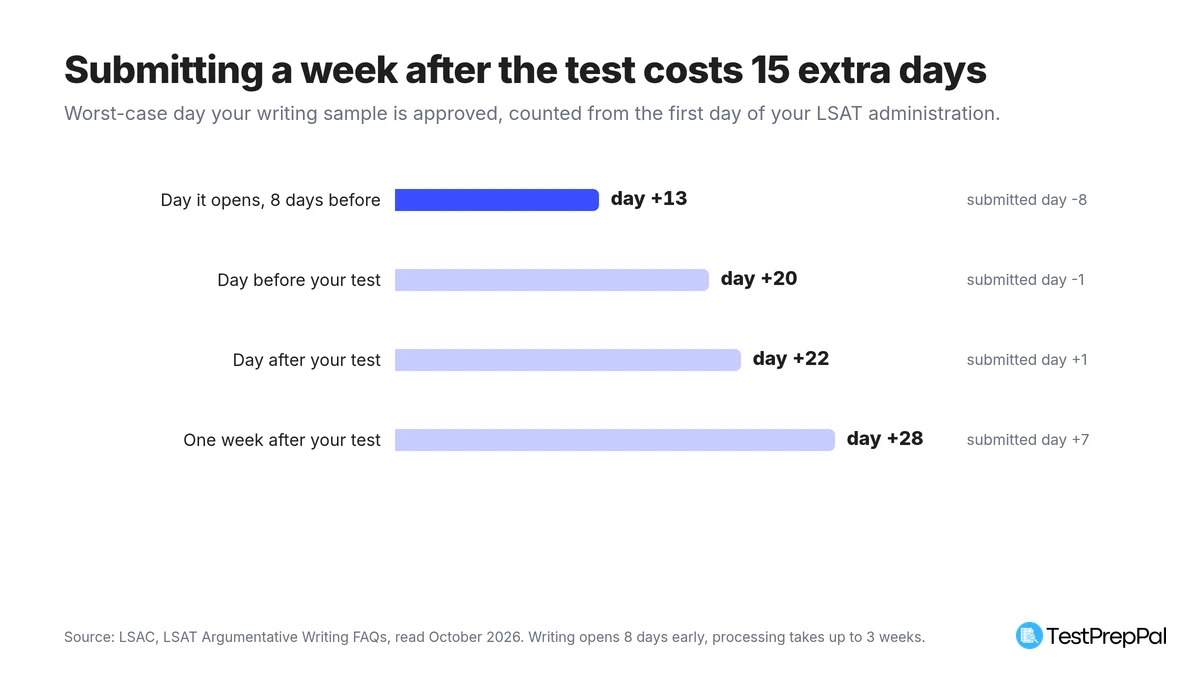 Counting from the first day of your LSAT administration, with LSAC's three-week worst case applied to four submission dates.
Submit on the first day it opens, eight days before your test, and the three-week worst case lands 13 days after your test. Submit a week after your test instead and the same worst case lands 28 days after. That is 15 days of difference, and until the sample is approved you cannot see your own score or release it to schools.
Work the writing date into your calendar alongside the LSAT test dates rather than treating it as an errand for afterwards. If you are building a schedule from scratch, our LSAT study plan generator will put the date in the plan.
If you are not applying this cycle, you still have a deadline: LSAC gives you a maximum of one year to complete the writing sample.
You get one attempt, so the setup is part of the test
The proctoring rules are where sessions die, and they are stricter than the usual summary suggests. LSAC's tips for avoiding a flagged session are blunt about the big one: any actively running application will result in a cancellation, whether or not you use it during the test. That includes grammar-checking extensions such as Grammarly and Microsoft Editor.
The rest of the hard requirements, from LSAC's getting ready page:
- A quiet, well-lit, private work area inside a fully enclosed room. Glass walls and glass doors do not count as enclosed.
- Windows or Mac, with only one connected monitor. Mobile devices, Chrome OS and Linux are not supported.
- The latest version of Google Chrome. Firefox, Safari and Edge will not launch it.
- Administrative rights on the computer, so you can install the proctoring software.
- Virtual backgrounds and webcam filters disabled, including blur.
- A full 360-degree room scan, including the top of your desk and the floor under it.
- No watch and no fitness tracker, anywhere in the room.
A cancellation is not one thing, and the difference matters:
| What happened | What follows |
|---|---|
| Unacceptable ID, incomplete room scan, and similar rule violations | Eligibility is reset and you retake the writing |
| A test security violation, such as a prohibited electronic device | Possible referral to the Misconduct and Irregularities Subcommittee |
| A technical failure during your session | LSAC resets the sample and you get a different prompt |
In most cases a cancelled sample is not reported to law schools. A misconduct finding is, to every school you have applied to or later apply to.
Two small rules that catch people out: the essay submits itself automatically when time expires, so running out of time does not void anything, and taking a photo or screenshot of your completed essay or the completion screen is prohibited while you are still in the session.
How to practise without burning the real prompt
LawHub carries one official LSAT Argumentative Writing practice prompt free, and LawHub Advantage adds more. Our review of LSAC's own LawHub prep covers what the paid tier includes beyond the writing prompts, and the LSAT free resources page lists what you can use without paying.
Use the free prompt for the interface, not for the essay. Load it once, run the 15 minutes properly, and stop at the end of the planning time to look at what you typed. If there is no thesis sentence and no paragraph map on the screen, the budget is not working yet, and that is a cheap thing to discover in practice.
After that, you do not need the official interface to rehearse. Any op-ed with two or three opposing viewpoints will do. Set a timer for 15 minutes, produce the thesis sentence and the four-line map, then set 35 and write.
Most commercial LSAT prep courses spend very little time here, which is reasonable given the section is unscored. Budget an hour of your own, once, and you have covered it.
LSAT Argumentative Writing FAQs
How long does LSAT Argumentative Writing take?
Most test takers get 50 minutes in total: 15 minutes for prewriting analysis and 35 minutes for essay writing. LSAC restated that split in an October 2026 post, so it has not changed. Test takers with approved accommodations for extra time have both allocations adjusted.
Does LSAT Argumentative Writing matter if it is unscored?
It is not scored, and it does not touch your number on the LSAT score range. It matters in two other ways. Your score is not released to you or to law schools until an approved sample is on file, and LSAC says most schools require the sample as part of the admission decision, with each school setting its own policy on how it is used.
How can I practise argumentative writing for the LSAT?
Take the free official practice prompt on LawHub once to learn the interface and the typed scratch paper. After that, practise the two phases separately on any article that presents competing viewpoints: 15 minutes to produce a thesis sentence and a paragraph map, 35 minutes to write five paragraphs. The skill being tested is building and defending an argument, not writing speed.
Can I retake LSAT Argumentative Writing if the essay goes badly?
Not for a weak essay. LSAC resets a writing sample only when there is a technical problem with the submission, and then you receive a different prompt. Certain rule violations, such as an unacceptable ID image or an incomplete room scan, also reset your eligibility to retake it, but a security violation can instead be referred for investigation.
Where does the writing section sit in the rest of the test?
It is separate from the multiple-choice portion and is taken online on its own, which is why it does not appear among the four LSAT sections you sit on test day. Everything else about registering and preparing is on our LSAT hub.
We may earn commissions from some links on this page, but this does not affect our reviews or your experience.