


The LSAT score range runs from 120 to 180, which is 61 possible scores, and there is no passing mark anywhere on it. Three scored sections are added into one raw score, that raw score is converted to the 120 to 180 scale, and the scale number is the only thing a law school sees.
- The range is fixed at 120 to 180. A 120 is the lowest score LSAC awards, not a zero, and 180 is the ceiling.
- Your raw score is just the count of correct answers across three scored sections. The fourth section does not count, and you cannot tell which one it is.
- On LSAC's current table, 154 is the first score with at least half of all scores below it, so the real midpoint is 154 and not the 152 you will see quoted.
- A 170 is the 94.48th percentile, which puts 5.52 percent of test takers at or above it.
- One extra correct answer is worth about 2.5 percentile points in the low 150s and about 0.28 of a point between 175 and 180.
What the 120 to 180 LSAT score range actually is
LSAC's LSAT Scoring page, read on October 5, 2026, sets out four mechanics that between them explain the whole scale:
- Your raw score is the number of questions you answered correctly.
- Every question is weighted exactly the same. Which ones you got right does not matter, only how many.
- There is no deduction for incorrect answers, so a blank and a wrong answer cost you the same thing. Guess on everything.
- The raw score is converted to a scale that runs 120 to 180, and LSAC does this so that scores earned on different test dates can be compared.
That last point is the one that explains why the range exists at all. Two test takers who sit different administrations face different questions of slightly different difficulty. Converting both raw scores onto one fixed 61-point scale is how LSAC makes a 164 in June mean the same thing as a 164 in October.
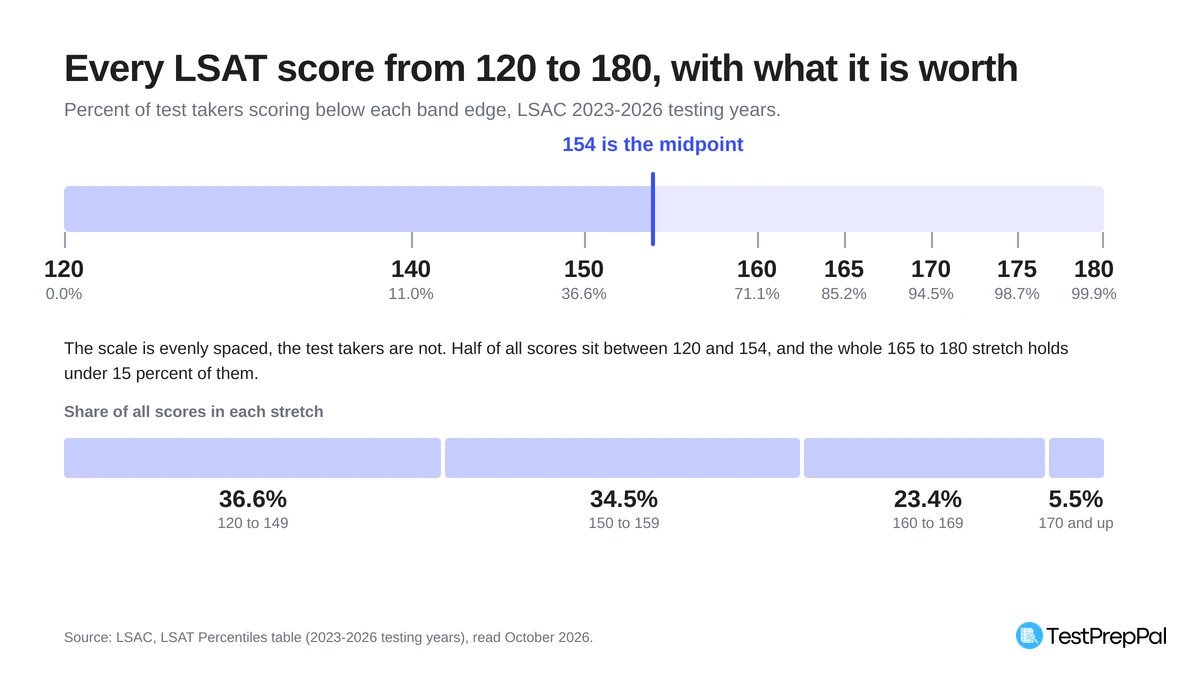 The 120 to 180 scale is evenly spaced, but test takers are not spread evenly across it. Source: LSAC LSAT Percentiles table, 2023-2026 testing years.
Two things follow from that picture. Over 36 percent of all scores land in the 120 to 149 stretch, and everything from 170 up is 5.52 percent of scores. The top sixth of the scale holds about one twentieth of the people.
How three scored sections become one scaled score
The multiple-choice LSAT is four 35-minute sections, and LSAC's question types page confirms that only three of them are scored. The fourth is unscored, and LSAC uses it to validate questions for future tests.
Two details about that unscored section matter on test day:
- It can be either question type, Reading Comprehension or Logical Reasoning.
- It can appear at any point in the test.
So there is no section you can safely coast through. You will not know which one did not count until it is far too late to act on it, which is the practical reason your raw score is built from three sections but your effort has to cover four.
The conversion itself is not a curve, whatever the forums call it. Nothing is graded relative to the people who sat your test date. LSAC equates each form against the scale before anyone takes it, which is why a test with harder questions needs fewer correct answers for the same scaled score. If you want to see how that plays out across the whole scale, our LSAT score converter runs the conversion in both directions.
What each band of the range costs in correct answers
LSAC does not publish conversion tables for current tests, so the raw-correct figures below are our estimate, from the typical curve behind our score converter, normalised to 75 scored questions. The percentile column is LSAC's own, from the LSAT Percentiles table covering the 2023-2024, 2024-2025 and 2025-2026 testing years.
| Score | Raw correct (of 75) | Percent below | Scores at or above |
|---|---|---|---|
| 140 | 27 | 11.00% | 89.00% |
| 145 | 32 | 21.48% | 78.52% |
| 150 | 39 | 36.56% | 63.44% |
| 154 | 45 | 50.43% | 49.57% |
| 155 | 46 | 54.03% | 45.97% |
| 160 | 53 | 71.06% | 28.94% |
| 165 | 60 | 85.17% | 14.83% |
| 170 | 66 | 94.48% | 5.52% |
| 175 | 71 | 98.72% | 1.28% |
| 180 | 75 | 99.85% | 0.15% |
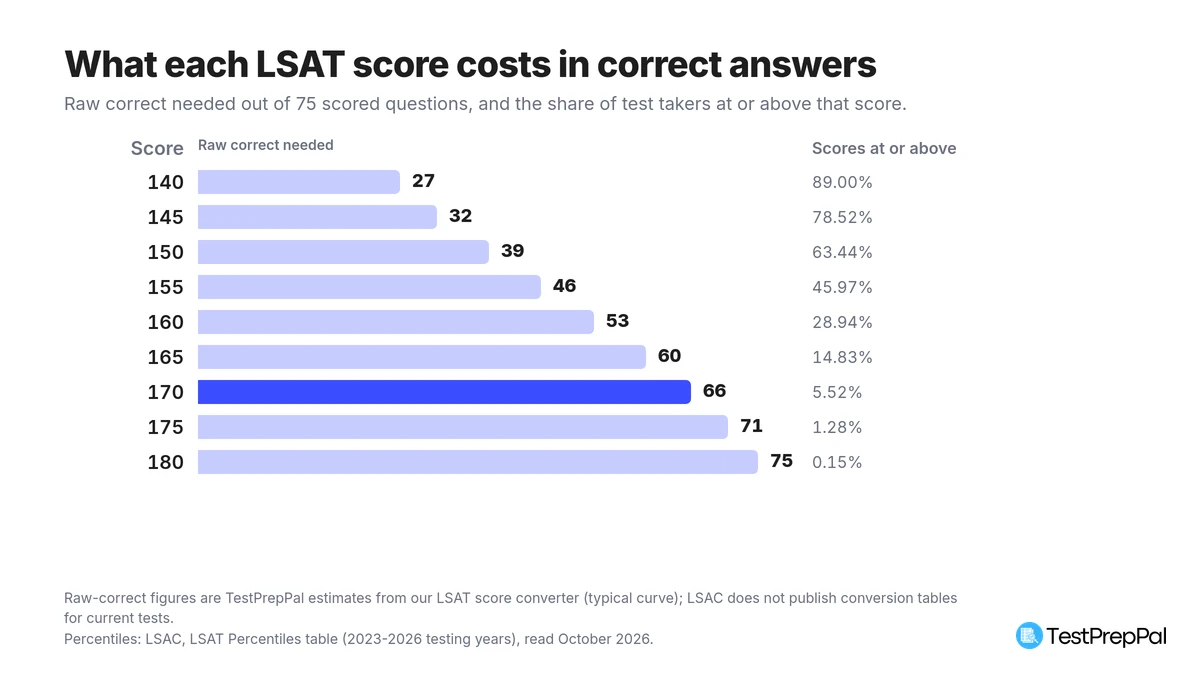 Raw-correct figures are TestPrepPal estimates; percentiles are LSAC's 2023-2026 table.
Read across any row and the scale stops feeling abstract. A 160, which is the score most people have in mind when they say they want to do well, is 53 right out of 75. That leaves 22 questions you can miss and still land above 71 percent of the field.
Why one extra correct answer is worth less at the top of the range
Here is the part no band table shows. Because the percentiles bunch up near the top of the scale, an extra correct answer does very different work depending on where you already are.
| Band | Extra correct needed | Percentile gained | Percentile per correct answer |
|---|---|---|---|
| 145 to 150 | 7 | 15.08 | 2.15 |
| 150 to 155 | 7 | 17.47 | 2.50 |
| 155 to 160 | 7 | 17.03 | 2.43 |
| 160 to 165 | 7 | 14.11 | 2.02 |
| 165 to 170 | 6 | 9.31 | 1.55 |
| 170 to 175 | 5 | 4.24 | 0.85 |
| 175 to 180 | 4 | 1.13 | 0.28 |
Climbing from 150 to 155 takes seven more correct answers and moves you 17.47 percentile points. Climbing from 175 to 180 takes only four more correct answers, which is the easier ask in raw terms, and moves you 1.13 points.
One extra correct answer is worth about 2.5 percentile points in the low 150s and about 0.28 of a point between 175 and 180. Measured in where you stand nationally, a question you fix in the 150s does roughly nine times the work of one you fix in the high 170s.
That is not an argument against aiming high. It is an argument about where your next 20 hours go. If you are sitting at 152 on practice tests, the questions you are currently missing are the most valuable ones you will ever fix, and a structured LSAT study plan is worth more to you than it is to someone grinding from 176 to 178. Take a timed diagnostic first so you know which end of this table you are actually on, then read off how long you will need from the size of that gap.
The other LSAT score range: your score band
"LSAT score range" has a second, official meaning, and it is the one most pages miss. Your score report does not go to law schools as a bare number. LSAC sends a score band with it.
LSAC's score bands page explains why. An LSAT score is an estimate of your proficiency, and no test estimates perfectly. The band is a range slightly above and slightly below the score you received, built from a statistic called the standard error of measurement. LSAC's own framing is that your actual proficiency is unlikely to be more than a few points higher or lower than the number you got.
LSAC does not publish a single numeric width for the band on that page, so treat any blog that gives you an exact plus-or-minus figure with suspicion. The useful takeaway is directional: a 161 and a 163 are not cleanly different scores in measurement terms, even though applicants treat them as though they are.
Your report also carries a percentile rank, which LSAC defines as the percentage of test takers who scored lower than you during the previous three testing years. Those percentiles are refreshed every year by the end of July, so the same scaled score can be worth a slightly different percentile from one summer to the next.
Where the common band percentiles go wrong
Search this topic and you will get the same four rounded bands everywhere, usually with percentiles attached. Checked against the current LSAC table, several of those numbers are off:
- The median is widely given as "around 152 to 153". On the current table, 153 has 46.93 percent below it and 154 has 50.43 percent. 154 is the first score with at least half the field below it.
- The 150 to 159 band is usually given as the 38th to 70th percentile. It is 36.56 to 67.93.
- The 160 to 169 band is usually given as the 73rd to 94th percentile. It is 71.06 to 93.03.
- The 170 and up band is usually called the top 5 percent. It is the top 5.52 percent.
The gaps are small individually, but they all run the same direction: the circulating figures flatter scores in the middle of the range by a point or two of percentile. Some of the raw-score conversion charts still ranking for this keyword are worse, because they come from the three-section LSAT-Flex that is no longer administered, or pair a current scale with a percentile chart from a window that closed years ago.
For the full score-by-score breakdown, our LSAT score percentiles guide has all 61 rows. If what you actually want to know is whether your number is good enough for your list, that is a different question and what counts as a good LSAT score answers it against school medians rather than the national table.
How to use the range without obsessing over it
The scale tells you where you stand nationally. It does not tell you whether you get in, because schools compare you to their own entering class, not to the 120 to 180 distribution.
Three practical uses:
- Set a target from your school list, then convert it. Find the median LSAT at the schools you want, then use the table above to see how many correct answers that is. A target of 164 is about 59 right out of 75, which is a concrete practice goal in a way that "164" is not.
- Measure progress in questions, not points. Scaled scores move in lumps. Raw correct moves every practice test, and it is the number you can actually act on.
- Use official material. Practice tests from other sources approximate the conversion. LSAC's own are the reference point, and our review of LSAC's official practice tests covers what is in the free tier. If you want structure on top of that, the LSAT prep course roundup compares what each option gives you for the money, and everything else for the exam sits on our LSAT hub.
LSAT score range FAQs
How rare is a 172 on the LSAT?
On LSAC's 2023-2026 percentile table, 96.72 percent of scores fall below a 172. That puts 3.28 percent of test takers at or above it, or roughly 1 in 30. On our converter's typical curve, a 172 is about 68 correct out of 75, so it means missing around seven questions across three scored sections.
What is the lowest LSAT score you can get?
120 is the lowest score on the scale, and it is awarded rather than being a zero. LSAC's table shows 0.00 percent of scores below 120 for the obvious reason that nothing can be lower. You receive a 120 if your raw score falls at or under the bottom of the conversion range for your test form.
How many questions can you get wrong and still score 170?
On our typical curve, a 170 is about 66 correct out of 75 scored questions, so roughly nine wrong. That figure moves by a question or two in either direction depending on the form, because LSAC equates each test separately and publishes no conversion table for current administrations. Treat any single "you can miss N questions" number as an estimate, not a rule.
Does the LSAT have a passing score?
No. There is no pass or fail anywhere on the 120 to 180 range. Your report carries the scaled score, a percentile rank against the previous three testing years, and a score band reflecting measurement error. Law schools decide what is competitive for them, and those thresholds differ by school and shift year to year.
Why did my percentile change when my score did not?
Because LSAC recalculates percentiles every year by the end of July, using the previous three testing years. The scaled score is fixed once you earn it, but the percentile attached to it is a statement about the current applicant pool. A 163 earned two years ago can sit at a different percentile today without anything about your performance having changed.
We may earn commissions from some links on this page, but this does not affect our reviews or your experience.