


A cold LSAT diagnostic tells you where you are starting, and almost nothing about where you finish. The number worth knowing is what improvement is worth from your starting point: on LSAC's current table, ten scaled points moves a 150 diagnostic up 34.50 percentile points, while the same ten points from a 170 moves you 5.37.
That gap is the whole argument against reading a diagnostic as a verdict. Low starting scores sit in the steepest part of the curve, where points are worth the most.
- A diagnostic is a full-length official practice test taken before you study, so the score reflects an untrained reading of a test with its own rules.
- The LSAT's multiple-choice portion is four 35-minute sections, of which three are scored and one is unscored.
- There are only two question types left, Reading Comprehension and Logical Reasoning. Logic Games are gone, so any diagnostic that includes them is an old test.
- A 147 sits at the 27.06th percentile and a 154 is the first score above the median, at 50.43 percent.
- Ten points is worth 34.50 percentile points from a 150 start and 5.37 from a 170 start, about six times the difference.
- Your diagnostic predicts your starting position, not your ceiling, and it cannot tell you how fast you learn the format.
What an LSAT diagnostic test actually is
A diagnostic is a full-length LSAT you take before any studying, under test conditions, to set a baseline. It is not a separate product and not a different exam. It is an ordinary practice test used at a particular moment.
The structure matters, because a diagnostic taken on the wrong material produces a meaningless number. LSAC's types of LSAT questions page, read on October 3, 2026, sets out the current test:
- The multiple-choice portion is four sections of 35 minutes each.
- Three of those sections are scored. One is unscored, and LSAC uses it to validate new questions.
- The unscored section can be either question type, and it can appear at any point in the test.
- The only two question types are Reading Comprehension and Logical Reasoning.
- LSAT Argumentative Writing is unscored, administered separately online, and runs 50 minutes in total: 15 minutes of prewriting analysis and 35 minutes of essay writing.
Two consequences follow. You cannot tell which section is unscored while you sit the test, so there is no section to coast through. And because Logic Games no longer appear, any older practice test that contains them will hand you a score built partly on a section that does not exist. Check the material before you trust the number.
LSAC's official practice tests run through LawHub and simulate the four-section test with the real interface, including answer elimination and passage highlighting. If you want the diagnostic to mean something, that is the environment to take it in.
For a lighter first look before committing a full afternoon, our free LSAT practice questions cover both scored question types with explanations.
Is a 147 diagnostic bad? What the current table says
This is the question students actually ask, so here is the direct answer. LSAC's LSAT percentiles table covers the 2023-2024, 2024-2025 and 2025-2026 testing years, and reports the percentage of scores falling below each scaled score.
| Scaled score | Percent of scores below it | What that means |
|---|---|---|
| 147 | 27.06% | Roughly a quarter of scores fall below it |
| 150 | 36.56% | Still below the middle of the pack |
| 153 | 46.93% | Just under the median |
| 154 | 50.43% | The first score above the median |
| 156 | 57.62% | Already above the middle |
So a 147 is not a good scored result, and pretending otherwise helps nobody. As a cold diagnostic it is a different thing entirely: it is the score of someone who has not yet learned the format, taken on a test whose question types reward training more than instinct.
A cold 156 is a genuinely strong start, because 57.62 percent of real scores sit below it before you have studied at all. A cold 154 means you are starting at the median. What none of these numbers do is set a limit. For what these scores are worth once they are final, rather than cold, see our guide to what counts as a good LSAT score.
What ten points is worth from where you start
Here is the part no diagnostic guide publishes. Because the LSAT's score distribution bunches in the middle, the same ten-point improvement is worth wildly different amounts depending on where you begin. Subtracting LSAC's own percentile figures gives the value of those ten points at each starting band.
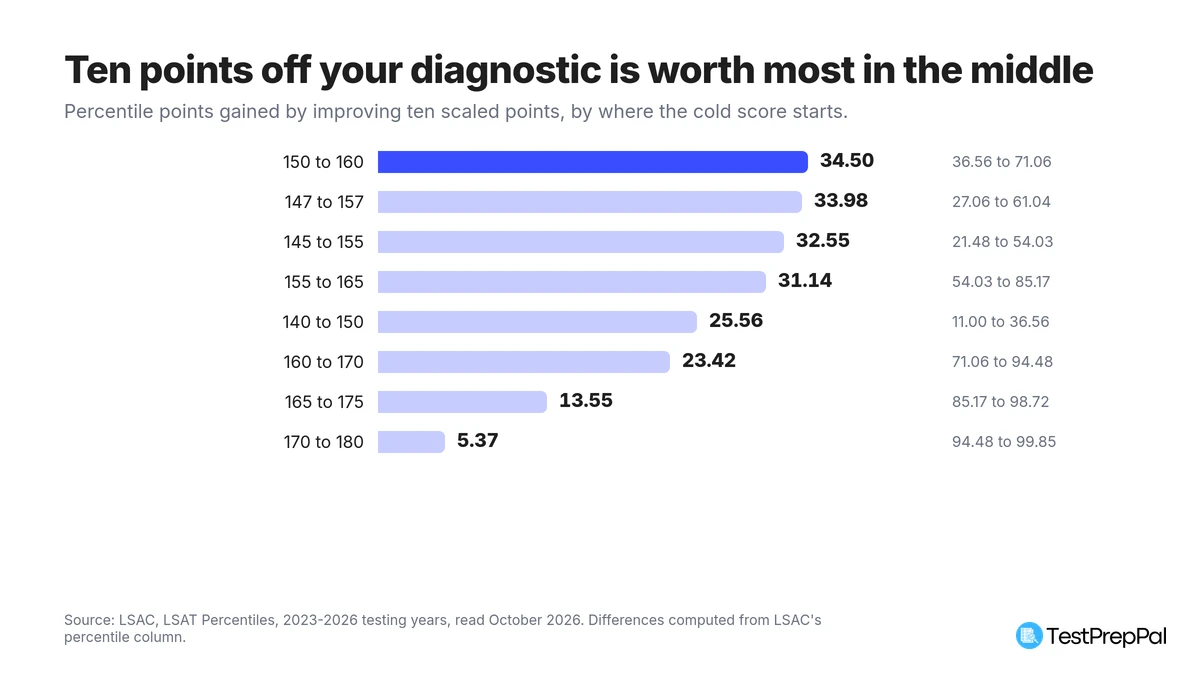 Percentile points gained by improving ten scaled points, by diagnostic starting score. Source: LSAC percentile table, 2023-2026 testing years.
| Diagnostic | Ten points later | Percentile points gained |
|---|---|---|
| 150 | 160 | 34.50 |
| 147 | 157 | 33.98 |
| 145 | 155 | 32.55 |
| 155 | 165 | 31.14 |
| 140 | 150 | 25.56 |
| 160 | 170 | 23.42 |
| 165 | 175 | 13.55 |
| 170 | 180 | 5.37 |
The peak sits at a 150 start, worth 34.50 percentile points. The floor is a 170 start, worth 5.37. That is a ratio of about 6.4 to 1 for identical effort measured in scaled points.
A 147 diagnostic plus ten points lands at 157, which clears the median with room to spare: 61.04 percent of scores fall below a 157, against 50.43 percent below a 154. The lower your cold score, the more each point you gain is worth.
This is also why comparing your improvement to someone else's is close to useless. A student going from 165 to 172 has done something hard that barely moves their percentile. A student going from 145 to 155 has moved 32.55 percentile points. The second number looks less impressive and means more.
Where a cold score sits on the 120 to 180 curve
The scale runs from 120 to 180, and scores cluster heavily in the middle. Seeing the shape explains why the table above behaves the way it does.
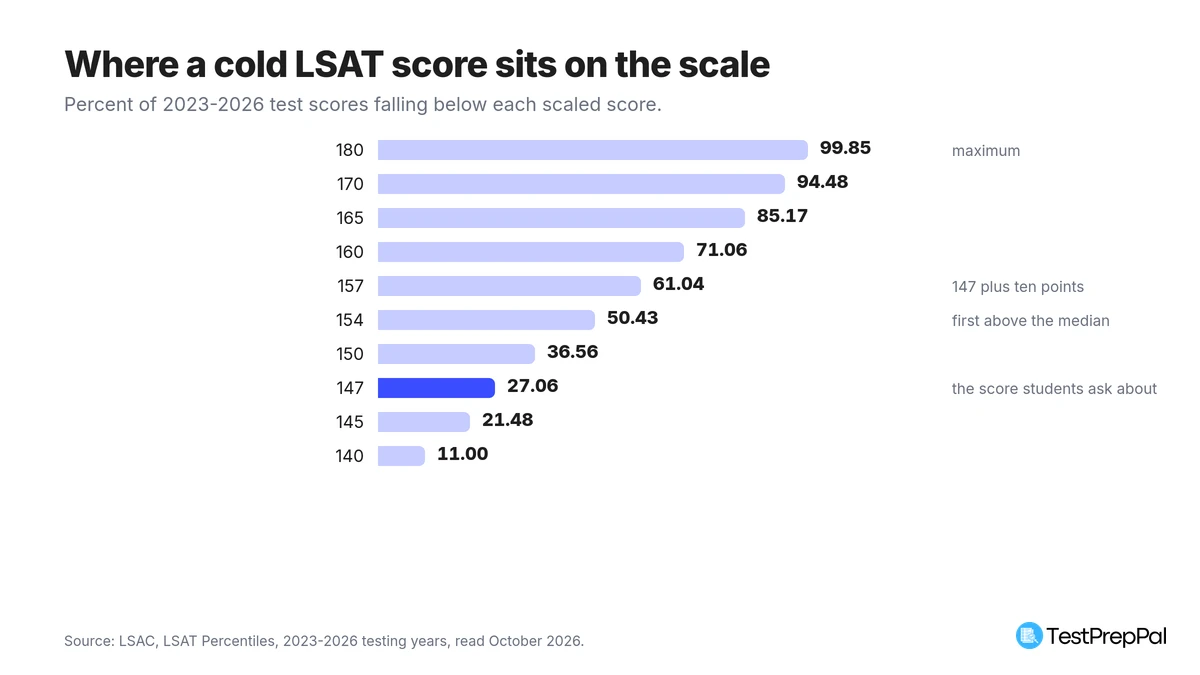 Percent of 2023-2026 LSAT scores falling below each scaled score. Source: LSAC percentile table.
Notice how tightly the bars bunch between 150 and 160, and how far apart they spread at the top. Between a 150 and a 160 you pass 34.50 percent of all test takers. Between a 170 and a 180 you pass 5.37 percent, because there is almost nobody left.
LSAC's scoring page explains the mechanism underneath: your raw score is simply the number of questions you answered correctly, every question is weighted the same, and there is no deduction for a wrong answer. That makes guessing on every unanswered question strictly correct, including on a diagnostic. A diagnostic where you left items blank understates your baseline. Our LSAT score converter turns a raw count into a scaled score if your practice test did not do the conversion for you.
For the full percentile breakdown across the scale, see our LSAT score percentiles page.
What a diagnostic does not predict
A cold score is a measurement of an untrained attempt. It carries real information and a lot of noise, and it is worth being specific about which is which.
It does not predict your ceiling. The LSAT tests a small set of learnable skills applied under time pressure, which is why score movement is normal rather than exceptional.
It does not tell you how fast you improve. Two students with the same 149 diagnostic can end up 15 points apart, and nothing in that first score distinguishes them.
It does not account for the unscored section. Because the unscored section can be either question type and can appear anywhere, part of your effort on test day goes into questions that never count. That is true on the real exam too, so it does not bias the comparison, but it does mean your score is built on three sections rather than four.
It is also worth correcting a figure that circulates widely. Summaries of this topic often state that the average LSAT score is "around 150". On LSAC's current table, 150 has 36.56 percent of scores below it, so it sits well under the middle. The first score above the median is 154. If you are using 150 as the bar to clear, you are aiming below average without knowing it.
How to take a diagnostic so the number means something
A diagnostic is only as good as the conditions you take it in. Four things decide whether the score is usable:
- Take it cold, but take it informed. Do not study content first. Do read the instructions and know the section structure, because burning ten minutes working out the format is not a measurement of your reasoning.
- Use a current official test. Material containing Logic Games predates the current exam and will not give you a comparable number.
- Time every section strictly at 35 minutes and take all four in one sitting. A diagnostic taken across three evenings measures something other than the LSAT.
- Answer every question. There is no penalty for a wrong answer, so a blank is a guaranteed zero where a guess is not.
Once you have a baseline you trust, the next decision is how long you need. Our guide to how long to study for the LSAT works through the timelines, and the LSAT study plan generator builds a week-by-week schedule around your target. If the cold score was rougher than you expected, how hard the LSAT is sets out what the test is actually measuring. Everything else we publish on the exam sits on the LSAT hub.
LSAT diagnostic test FAQs
What is a diagnostic LSAT test?
It is a full-length official LSAT practice test taken before you begin studying, under timed conditions, to establish your baseline score. It uses the same format as the real exam: four 35-minute multiple-choice sections, three of which are scored. Nothing about it is a separate or special product, and the score does not go to law schools.
Is a 147 LSAT diagnostic bad?
As a final score, a 147 is below average: 27.06 percent of scores from the 2023-2026 testing years fall below it. As a cold diagnostic it is an ordinary starting point and sits in the most valuable part of the curve. Ten points of improvement from a 147 reaches a 157, which clears the median, and that same ten points gains you 33.98 percentile points.
Is 156 a good LSAT diagnostic?
Yes, as a starting point it is strong. A 156 has 57.62 percent of real scores below it, so you are already above the middle of the pack before studying. Be aware that improvement from a 156 is worth slightly less per point than from the low 150s, because the distribution starts thinning above the median.
Is a 154 LSAT diagnostic good?
A 154 is the first score above the median on LSAC's current table, with 50.43 percent of scores below it. As a cold diagnostic that is a solid position, and it means a target in the 160s is a realistic goal rather than a stretch. A ten-point gain from a 154 reaches a 164, which has 82.75 percent of scores below it.
We may earn commissions from some links on this page, but this does not affect our reviews or your experience.