


Blueprint LSAT Free Practice Exam Review
by Blueprint
Free full-length LSAT practice exam with section analytics
✓Pros
- ✓Full-length timed LSAT exam at no cost and with no credit card
- ✓Question-type and section analytics sit on the free tier, not behind the paid plan
- ✓Comes with a start-to-finish study plan and 8 modules from the paid Self-Paced Course
- ✓Sensible first move before content review, because it sets a baseline you can measure against
✗Cons
- ✗Blueprint does not publish how long the free trial stays open on any page that sells it
- ✗Not an official released LSAC PrepTest; the 59 official LawHub exams sit behind the paid plan
- ✗The plan it previews runs 219 dollars for a first month once the separate 120 dollar LawHub Advantage fee is counted
Highlights
- ✓One full-length, real-time LSAT practice exam
- ✓Advanced exam analytics on your results
- ✓Start-to-finish customized LSAT study schedule
- ✓8 learning modules from the LSAT Self-Paced Course
Price
✓Free
What Students Are Saying
Sign in to leave a review

Expert Rating
Blueprint's free LSAT practice exam costs nothing and asks for no credit card, and it is a full-length timed test with section analytics attached. That makes it the cheapest honest way to find out where you stand before you spend a dollar on prep.
The thing to watch is not the exam. It is the plan the exam is a door to. Blueprint's LSAT Self-Paced Course runs $99 or $149 a month, and both tiers carry a separate $120 LSAC LawHub Advantage fee that is a footnote on a different page.
Summary Table
| Feature | Blueprint LSAT Free Practice Exam |
|---|---|
| Price | Free, no credit card |
| Format | One full-length, real-time LSAT practice exam |
| Also in the same free account | Advanced exam analytics, a start-to-finish study schedule, 8 learning modules |
| Official released PrepTest? | No. Blueprint does not claim it is one |
| Access period | Blueprint publishes no length for the LSAT trial |
| What the next tier costs | $219 first month on Starter, $269 on Pro, LawHub fee included |
| Guarantee | None on the free exam |
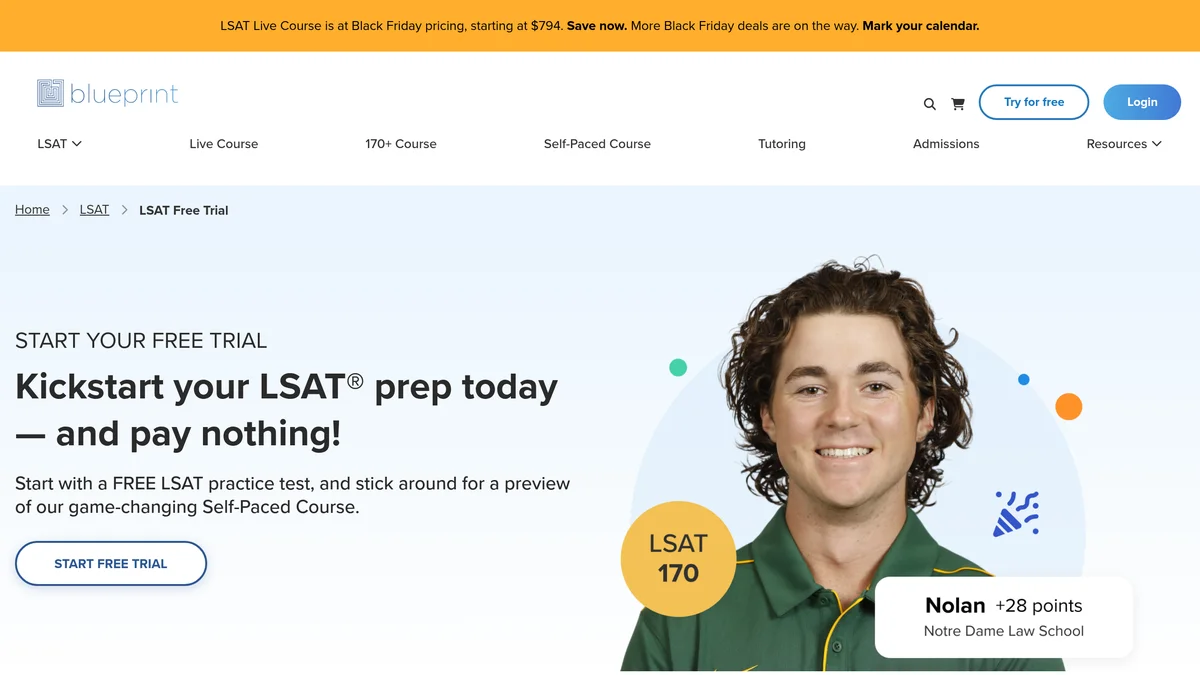 The Blueprint LSAT free trial page on blueprintprep.com, captured November 2026.
Blueprint LSAT Free Practice Exam Overview
Blueprint lists the exam as its own entry in the LSAT Resources menu on every LSAT page, under the name Free LSAT Practice Exam, and the link goes to the LSAT free trial page. That page leads with the test rather than the course: "Start with a FREE LSAT practice test, and stick around for a preview of our game-changing Self-Paced Course."
Four things come with the account, and Blueprint's free LSAT resources page describes each in a line:
- One full-length practice exam, described as "full-length, real-time practice"
- Advanced exam analytics, which Blueprint frames as finding your weaknesses
- A customized LSAT study schedule, start to finish
- 8 learning modules, lifted from the paid LSAT Self-Paced Course
The signup form asks for a name and a phone number and states that no credit card is required. That matters more than it sounds. Most free LSAT diagnostics either want payment details up front or hand back a raw number with no breakdown. This one does neither.
Blueprint LSAT Free Practice Exam Review For 2026
Is this an official LSAT PrepTest?
No, and Blueprint never says it is. The company is careful with the wording: the free-trial page calls it "a diagnostic LSAT exam that looks and feels just like the real thing", which is simulation language, not official-form language.
Where the official exams sit is the clearer tell. On the Self-Paced Course page, the Starter plan line reads "Access all 59 official LawHub exams, including 16 full-length exams with Blueprint analytics and explanations". Those are a paid-plan feature with a separate fee, not part of the free trial. Blueprint's own score-guarantee terms also refer to "Practice Exam 1", which is a Blueprint numbered form rather than a released LSAC test.
The analytics are the real product
A cold score on its own is close to useless. You already know you have not studied. What tells you something is the distribution: which of the two question types you are losing points in, which subtypes inside Logical Reasoning you miss, and whether you ran out of time or ran out of knowledge.
Blueprint puts that layer on the free tier, alongside the exam itself. For a first diagnostic, a breakdown you can act on is worth more than the provenance of the questions, because you are not trying to predict a score yet. You are trying to find out what to study. If you would rather sit an official form, LSAC's own practice tests are the place to do it, and checking what your LawHub tier reports back is worth a minute before you choose.
The 8 modules are a sampler, not a course
The modules are preview lessons from the Self-Paced Course, so they are chosen to show the teaching style rather than to cover the test. Treat them as a trial of the instruction, not as content review. For the full picture of what the paid product does, our Blueprint LSAT prep course review walks through the Qbank, the LawHub integration and the live office hours.
Pricing
The exam is free. The question students actually need answered is what happens after, and the sticker price on Blueprint's pricing cards is not the number you pay in month one.
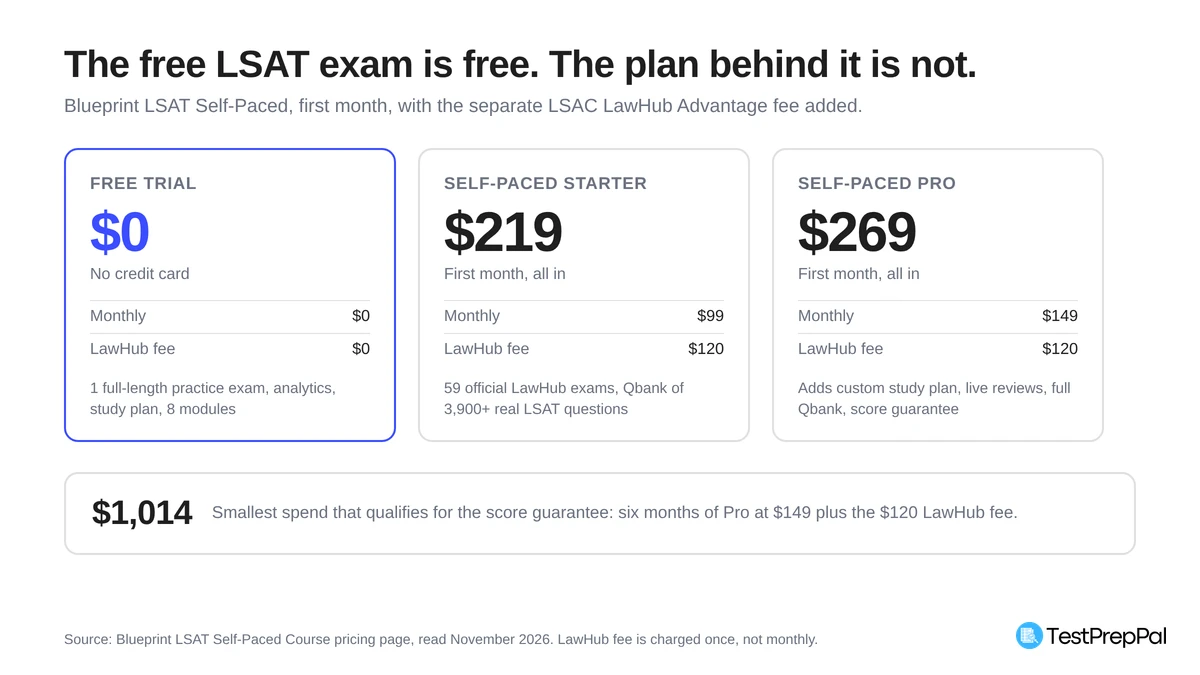 Blueprint LSAT Self-Paced, first month all in. Source: Blueprint's Self-Paced Course pricing page, read November 2026.
| Plan | Monthly | LawHub Advantage fee | First month, all in |
|---|---|---|---|
| Free trial | $0 | None | $0 |
| Self-Paced Starter | $99 | $120 | $219 |
| Self-Paced Pro | $149 | $120 | $269 |
The $120 LSAC LawHub Advantage fee is a footnote on the Self-Paced page, and it appears nowhere on the free-trial page. It is charged once rather than monthly, so a long subscription dilutes it, but it lands in full in the first month on both tiers.
The score increase guarantee is Pro only and needs a subscription of six months or more, which puts the smallest qualifying spend at $1,014. The terms also require a baseline, either an official LSAT taken within six months of starting or Practice Exam 1 taken within two weeks of logging in, at least five practice exams completed, and your official LSAC score report sent within 90 days of the course expiring.
One gap worth naming. Blueprint does not publish how long the free trial stays open. It is absent from the free-trial page, the free resources page, the Self-Paced Course page, the course comparison page and the signup form itself. The practical answer is to sign up on a day you can actually sit a timed exam, not weeks ahead.
How to read the score it gives back
The LSAT is scored 120 to 180, and the raw score is just the number of correct answers with no deduction for wrong ones, so there is no reason to leave anything blank. A cold score is a floor, not a forecast.
For context on where a number lands, LSAC's percentile table covering the 2023-2024 through 2025-2026 testing years puts 150 at the 36.56th percentile, 154 at 50.43 (the first scaled score above the median), 160 at 71.06 and 170 at 94.48. A diagnostic in the 140s is ordinary for someone who has not opened a book.
What to do with the number is a longer conversation, and our guide to the LSAT diagnostic test works out what ten points of improvement is worth in percentile terms from each starting band. The short version: the same ten points move you furthest from the middle of the scale. For the full table, see LSAT score percentiles.
Who Blueprint's Free LSAT Practice Exam Is Best For
- Students who have never sat a timed LSAT and want a baseline before choosing a course
- Anyone comparing prep companies who wants to try Blueprint's platform without paying
- Students who want their diagnostic broken down by question type, not just scored
- People deciding between self-study and a paid course, who need to know how far they are from target
When You Might Look Elsewhere
- You want an official released test. Take a free LSAC PrepTest on LawHub instead. No analytics, but it is the real thing.
- You want structure before you test. The LSAC Strategy Booster is free and teaches you how to interpret results and build a plan, which pairs well with a diagnostic.
- You already know your weak areas and want drilling. 7Sage and LSAT Demon are built around analytics and daily practice rather than a one-off baseline.
Final Verdict
Take it. The exam is free, it is full length and timed, and Blueprint puts the question-type analysis on the free tier rather than holding it for paying students. For a student at the start of prep, that combination is hard to beat at zero dollars.
Sit it cold, read the question-type breakdown rather than the score, and then decide about the paid plan with $219 in mind rather than $99. If you want to start, Blueprint's free LSAT trial is the signup.
Blueprint LSAT Free Practice Exam FAQs
Is Blueprint's LSAT practice exam really free?
Yes. The exam sits inside a free Blueprint account and the signup form states that no credit card is required. The same free account also carries exam analytics, a study schedule and 8 learning modules from the paid Self-Paced Course.
Is it an official LSAT PrepTest?
No. Blueprint describes it as a diagnostic exam that looks and feels like the real test, and it does not claim the questions are a released LSAC form. The 59 official LawHub exams are listed as a feature of the paid Self-Paced plans, which also carry a separate $120 LSAC LawHub Advantage fee.
How long does the free trial last?
Blueprint does not publish a length for the LSAT trial on any of the pages that sell it, including the signup form. Sign up on a day you can sit a full-length timed exam rather than weeks in advance.
What does Blueprint LSAT cost if I continue after the free exam?
Self-Paced Starter is $99 a month and Self-Paced Pro is $149 a month, and both add a one-time $120 LSAC LawHub Advantage fee. That makes a first month $219 on Starter and $269 on Pro. The score increase guarantee is Pro only and needs six months or more, so the smallest qualifying spend is $1,014.
Should I take this or a free LSAC PrepTest?
Take Blueprint's if this is your first diagnostic and you want a question-type breakdown attached to the score at no cost. Take an official LSAC practice test through LawHub if you want a released form, which matters more the closer you get to test day. Doing both is reasonable, and neither has to be first.
We may earn commissions from some links on this page, but this does not affect our reviews or your experience.
Our Verdict
Blueprint's free LSAT practice exam is a genuinely free full-length test with section analytics, and it is the best free first move for anyone who has not taken a timed LSAT yet. It is not an official released PrepTest, and Blueprint does not publish how long the trial account stays open. Take it for the baseline, then decide about the paid plan with the LawHub fee counted.