


Reading Comprehension is 27 of the 77 scored questions on the LSAT, which is 35 percent of your score decided inside one 35-minute section. Spread across four passage sets, that makes a single passage worth about seven scored questions, so what you do in the first 90 seconds of a passage matters more here than anywhere else on the test.
Most Reading Comprehension advice treats all four sets as one problem and gives you one routine for them. The sets are not the same problem. LSAC draws them from four different subject areas, and one of them may not be a single passage at all.
- LSAC publishes the scored counts: 27 Reading Comprehension questions and 50 Logical Reasoning questions, 77 in total.
- One passage set carries about 8.8 percent of your scored questions. One Logical Reasoning question carries 1.3 percent.
- A section is four sets of five to eight questions, drawn from the humanities, social sciences, sciences and law.
- Comparative reading is not guaranteed. LSAC says a section has either one comparative set or none.
- From August 2027 the section runs 52 minutes for six passages and always comes first.
How much is LSAT Reading Comprehension actually worth?
More than the section count suggests, and LSAC gives you the exact figure.
In its explanation of the format change coming in August 2027, LSAC states that both the current test and the new one carry 27 scored Reading Comprehension questions and 50 scored Logical Reasoning questions. That is 77 scored questions in total, and Reading Comprehension is 27 of them, or 35 percent.
Run that down to the passage. Four sets share those 27 questions, so an average set is 6.75 scored questions. Against a 77-question scored total, one passage decides 8.8 percent of your scored test. One Logical Reasoning question decides 1.3 percent.
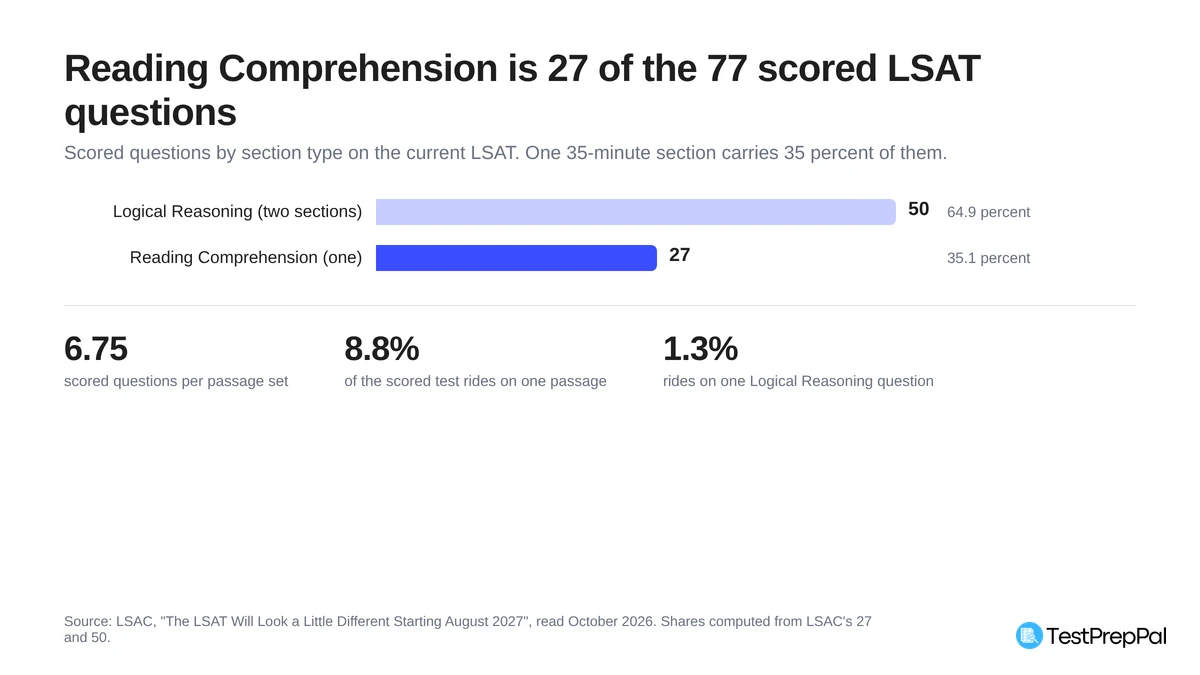 Scored questions by section type on the current LSAT. Source: LSAC, read October 2026.
Losing one passage set costs you roughly what losing seven Logical Reasoning questions costs. That is the argument for finishing all four sets at 75 percent accuracy rather than finishing three at 95 percent.
This is also why the weighting changed under everyone's feet. When Logic Games disappeared after June 2024, the scored test went from four sections to three, and Reading Comprehension kept its one. Our breakdown of the LSAT sections runs that arithmetic, and the same shift is why the two Logical Reasoning sections now deserve two thirds of your drilling time rather than half.
What is actually inside a Reading Comprehension section
LSAC's Reading Comprehension page is specific, and three details on it change how you should prepare.
First, the section is four sets. Each set is a selection of reading material followed by five to eight questions. The four sets on the scored section add up to 27, so a short set of five questions means a long set of eight is waiting somewhere.
Second, the reading comes from four subject areas: the humanities, the social sciences, the biological and physical sciences, and areas related to the law.
Third, and this is the detail nearly every prep page skips: a section includes either three or four single passages, and either one comparative reading passage or none. Comparative reading is not a fixed feature of every LSAT. You might sit a section without one.
| What LSAC fixes | What varies |
|---|---|
| Four sets per section | Five to eight questions per set |
| 27 scored questions | How those 27 split across the sets |
| 35 minutes | Which subject areas appear |
| Comparative sets: one or none | Whether your form has one at all |
Plan for a comparative set, because preparing for one you do not get costs nothing, while meeting one cold costs you a full set.
Tips by passage type
The four subject areas fail you in different ways. Match the reading to the failure mode.
Humanities passages
These are the ones built on a critic's position about an artist, a movement, or a text. The danger is not vocabulary, it is attribution. Humanities passages stack viewpoints, and the author's own view often arrives late and quietly.
Mark every viewpoint shift as you read. When you reach a question asking what the author believes, you want a mark to return to, not a memory. The most common miss in this family is an answer that is true of somebody in the passage but not of the author.
Social science passages
Expect a claim supported by a study, then a complication. These passages reward the same instinct that Logical Reasoning rewards: find the conclusion, find what supports it, notice what the author concedes.
Read the hedges exactly. "Suggests" and "demonstrates" are different claims, and the answer choices will test whether you noticed which one the passage used.
Science passages
Dense terminology, low argumentative content. Do not try to understand the mechanism. You need to know where each piece of it is described, so that a detail question becomes a lookup rather than a recall.
Science passages are where most people lose time, and they are also where the questions most often point at a specific line. Reading them faster and returning more often is the right trade.
Law-related passages
The trap here is prior knowledge. If you have read about a legal doctrine, you will be tempted to answer from what you know rather than from what the passage says. The passage is the only authority. Treat a familiar topic as a warning rather than a gift.
Comparative passages are a different task
When a comparative set appears, it is two shorter related passages instead of one long one, and the questions are mostly about the relationship between them.
LSAC names the relationships it uses: generalization and instance, principle and application, point and counterpoint. Those three are worth memorizing, because naming the relationship is usually the whole battle. Once you can say "Passage A gives the rule, Passage B applies it to a case", half the answer choices collapse.
Three habits that work on comparative sets:
- Read both passages before any questions. Reading A, answering the A-only questions, then reading B wastes the comparison you are being tested on.
- After passage B, say the relationship out loud in one sentence before touching the questions.
- Watch for agreement questions. The answer is a statement both authors would endorse, which is often blander and more limited than anything either one actually wrote.
The hardest comparative questions ask what one author would say about a specific claim from the other. Those are transfer questions, and they are the family covered next.
Match your first move to the question family
LSAC lists ten things a Reading Comprehension question may ask about. They collapse into six families, and each family has a different correct first move.
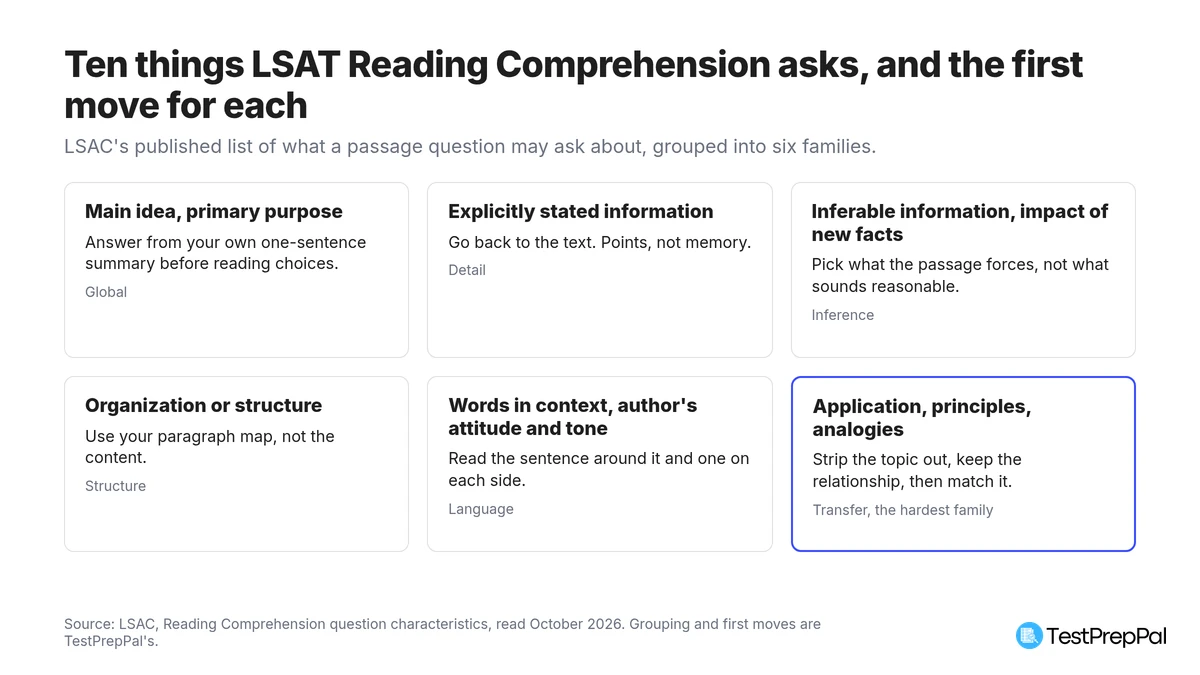 LSAC's published question characteristics, grouped into six families. Source: LSAC, read October 2026.
| Family | What it asks about | First move |
|---|---|---|
| Global | Main idea, primary purpose | Answer from your own summary before reading the choices |
| Detail | Explicitly stated information | Return to the text, every time |
| Inference | What follows, how new information lands | Choose what the passage forces, not what sounds sensible |
| Structure | Organization of the passage | Use your paragraph map, not the subject matter |
| Language | Words in context, author's attitude and tone | Read the sentence and its neighbors |
| Transfer | Application to a new context, principles, analogies | Strip the topic out, keep the relationship, then match |
Transfer questions are the ones worth drilling separately. The answer choices usually sit in a completely different subject area from the passage, which makes them feel wrong even when the logic matches exactly. The skill is identical to parallel reasoning in Logical Reasoning, so if you are strong there, borrow the method here.
What 35 minutes actually buys you
Here is the pacing math most pages leave as "about eight minutes a passage".
Thirty-five minutes is 2,100 seconds. Divided by four sets, that is 525 seconds, or 8 minutes 45 seconds, for reading and answering a complete set. Divided by 27 scored questions, it is 77.8 seconds per question, but that figure includes the reading, which is not spread evenly.
| Budget | Time |
|---|---|
| Whole section | 35 minutes |
| One passage set, start to finish | 8 minutes 45 seconds |
| Reading a single passage | 3 to 4 minutes |
| Each question after the reading | 42 to 51 seconds |
| Average across all scored questions | 77.8 seconds |
That question row is the one worth sitting with. Read for 3 minutes and you leave 345 seconds for about 6.75 questions, which is 51 seconds each. Read for 4 minutes and you leave 285 seconds, which is 42 seconds each. The familiar advice to give a Reading Comprehension question a minute does not fit inside the set, whichever way you read.
Treat 8 minutes 45 seconds as a hard ceiling rather than a target. A set that runs to 11 minutes has taken its time out of another set, and the other set is worth the same 6.75 questions.
The practical rule: if you are still on the same question 90 seconds after finishing the passage, pick your best remaining choice, mark it, and move. You can return. You cannot return to a passage you never opened. Working timed sets from the free LSAT practice questions is the cheapest way to find out where your reading time actually goes, and LSAC's own free drill sets on LawHub give you official passages with explanations.
What changes for Reading Comprehension in August 2027
If you are testing in August 2027 or later, the section you sit will not look like the one you have been practicing.
LSAC is moving to embedded pretesting. The standalone unscored section goes away and its questions get folded into the three scored sections. For Reading Comprehension that means 52 minutes for six passages and 40 questions: four passages and 27 questions scored, two passages and 13 questions not.
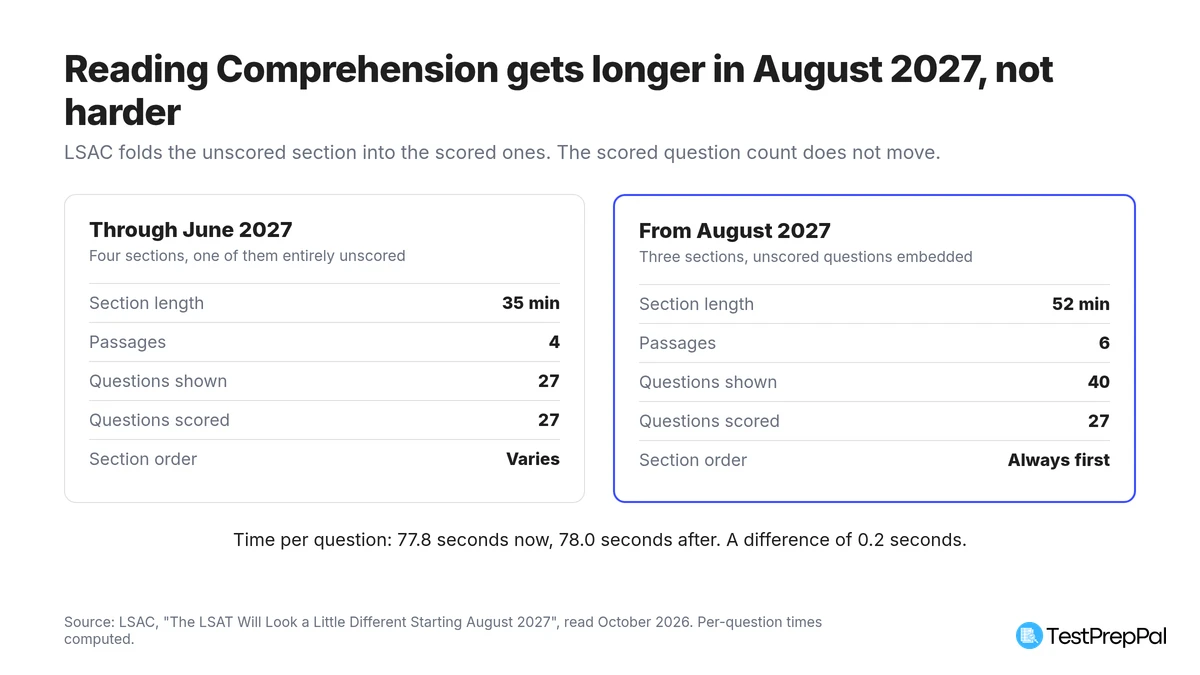 Reading Comprehension before and after the August 2027 change. Source: LSAC, read October 2026.
Three things follow for your preparation.
Your scored total does not move. It is 27 questions either way, and LSAC confirms that scores of 120 to 180 keep the same meaning. Check the LSAT score range if you are setting a target against older data.
Your time per question does not move either, and the arithmetic backs the claim up. Now it is 2,100 seconds over 27 questions, or 77.8 seconds each. After the change it is 3,120 seconds over 40 questions, or 78.0 seconds each. The gap is two tenths of a second.
What does change is stamina and order. Every test taker will start with Reading Comprehension, then take two Logical Reasoning sections, with a 10-minute break after each of the first two. You will meet six passages in one sitting, cold, with no earlier section to warm up on. You also cannot tell which two passages are unscored, so all six get full effort.
LSAC says practice tests in the new format arrive in LawHub in February 2027. If your test date falls in June 2027 or earlier, the current four-section format is still what you are preparing for, so check your LSAT test dates before you buy materials, and build the schedule around the format you will actually sit with the LSAT study plan generator.
How to practice Reading Comprehension so it actually improves
Volume alone does not move this section. Three habits do.
Review by cause, not by score. After a timed set, write down why each miss happened: misread the author's view, answered from memory instead of the text, picked a true statement that did not answer the question, ran out of time. Four sessions of that will show you one dominant cause.
Drill the family you avoid. Most people are weakest on transfer and structure questions and strongest on detail questions, then practice by doing whole sections, which keeps the ratio fixed. Pull 20 transfer questions out of old sections and do them back to back.
Use official passages. Prep-company passages are written to imitate the LSAT and they are usually cleaner than the real thing, which trains you on prose that will not appear. LSAC's official practice tests are the baseline, and if you want a method book rather than more reps, PowerScore sells a Reading Comprehension Bible as its own volume, with chapters on passage structure and comparative reading. Our LSAT hub collects the rest of the preparation options by budget.
LSAT Reading Comprehension FAQs
How many Reading Comprehension questions are on the LSAT?
Twenty-seven scored questions, spread across four passage sets. LSAC publishes that figure, and it holds for both the current format and the one arriving in August 2027. Each set carries five to eight questions, so the split across the four sets varies while the total stays at 27.
How long is a Reading Comprehension section on the LSAT?
Thirty-five minutes on the current format, which gives you 8 minutes 45 seconds per passage set. From the August 2027 administration the section runs 52 minutes and holds six passages instead of four. Time per question is almost identical under both, at roughly 78 seconds.
Does every LSAT have a comparative reading passage?
No. LSAC says a section contains either one comparative reading passage or none, alongside three or four single passages. Prepare for one anyway, because a comparative set you have never practiced will cost you an entire passage group, which is about 9 percent of your scored questions.
Does the LSAT still have Reading Comprehension?
Yes, and it matters more than it used to. Logic Games was removed after June 2024, which left three scored sections instead of four. Reading Comprehension kept its single section, so its share of your scored questions rose to 35 percent.
We may earn commissions from some links on this page, but this does not affect our reviews or your experience.