


LSAC approved 98.9% of LSAT accommodation requests in the 2024-2025 testing year, 44,153 out of 44,666 submitted. What disqualifies people is almost never the decision, it is the calendar: your accommodation request is due on the day registration closes for that administration, and LSAC states there are no exceptions to that deadline.
Those approval figures are not an estimate. They come from LSAC Technical Report TR 26-01, which covers the seven testing years through 2024-2025. Almost nothing written about the LSAT uses them, so the process gets described at length while the odds go unmentioned.
- 98.9% of requests were approved in 2024-2025. LSAC denied 513 requests out of 44,666.
- The accommodation deadline is the registration deadline for your test date. Requests filed after it are not reviewed at all.
- 16.0% of all LSATs administered in 2024-2025 were accommodated, up from 4.6% in 2018-2019.
- Only 62.7% of approved requests became a test. 16,493 approved registrants did not sit that LSAT.
- Law schools are never told. LSAC does not annotate accommodated scores and does not notify schools that you requested or used accommodations.
- Approval carries forward. A previously approved LSAT accommodation is automatically approved for the same or equivalent accommodation on future LSATs.
What share of LSAT takers test with accommodations
Accommodated testing is no longer a rare case. In the 2024-2025 testing year, 27,660 of the 173,341 LSATs administered worldwide were taken with accommodations. That is 16.0%, or roughly one test in six.
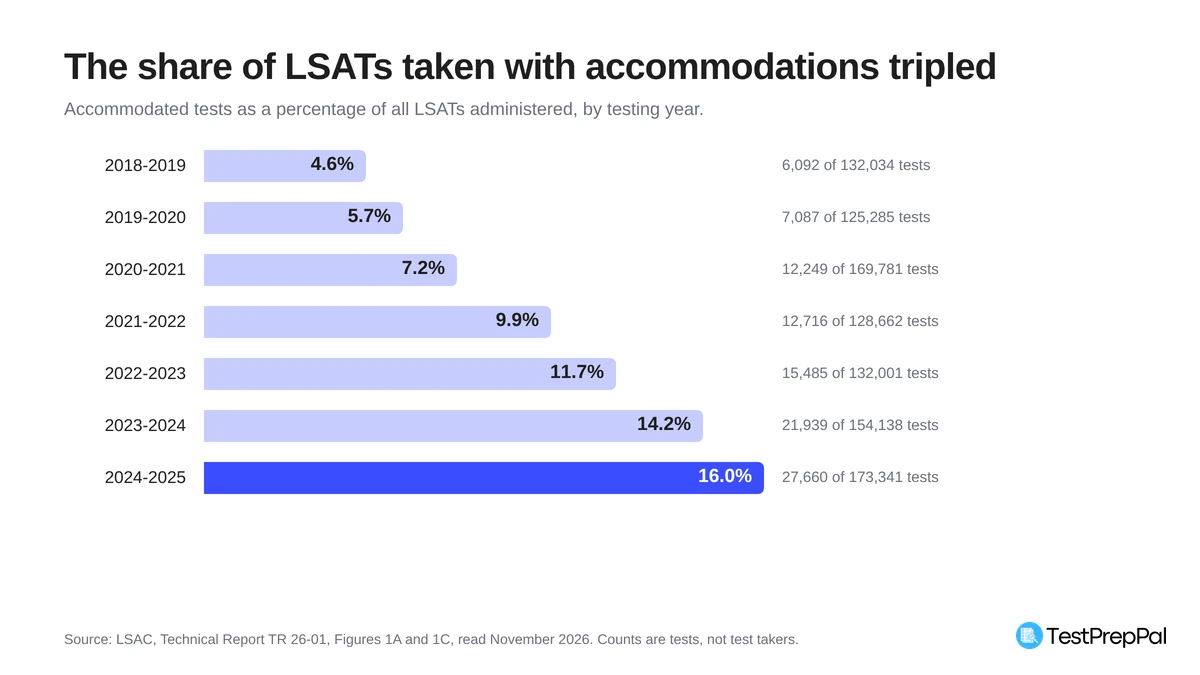 Accommodated tests as a share of all LSATs administered. Source: LSAC Technical Report TR 26-01, Figures 1A and 1C.
Seven years earlier the share was 4.6%. The number of accommodated tests grew from 6,092 to 27,660 over that period, a 4.5-fold increase, while total LSAT volume grew by about a third. The share has risen every single year, with no reversal.
| Testing year | Requests | Approved | Accommodated tests taken |
|---|---|---|---|
| 2018-2019 | 8,680 | 8,368 | 6,092 |
| 2019-2020 | 12,657 | 12,252 | 7,087 |
| 2020-2021 | 20,627 | 20,041 | 12,249 |
| 2021-2022 | 22,035 | 21,697 | 12,716 |
| 2022-2023 | 25,026 | 24,618 | 15,485 |
| 2023-2024 | 33,928 | 33,342 | 21,939 |
| 2024-2025 | 44,666 | 44,153 | 27,660 |
One caveat matters when you read these rows, which come from Figures 1A and 1C of TR 26-01. LSAC counts tests, not people, so a repeat test taker appears once for each LSAT they sit. The share is the share of exams given under accommodations, which is not quite the same as the share of candidates who hold an approval.
The deadline is what actually disqualifies people
The single most expensive mistake is treating the accommodation request as something you do after you register. LSAC is explicit: the accommodation request deadline "is always the same as the test registration deadline for any given administration of the LSAT," and requests "will not be reviewed if not submitted on time."
There is one narrow piece of slack, and it is worth knowing precisely. Late documentation in support of a request that was itself filed on time may still be considered. A late request cannot be. The online system simply stops accepting submissions for an administration once its deadline passes.
So the order of operations is fixed:
- Register for a specific LSAT administration. You cannot request accommodations without being registered for a date.
- Gather your documentation from a qualified professional before the registration deadline, not after it.
- Submit the request and the documentation through JD Services by the deadline.
If JD Services gives you trouble, LSAC accepts the request by email to accom@LSAC.org, and it must arrive by 11:59 p.m. ET on the deadline day tied to your registration. Check your administration's exact date against our LSAT test dates and deadlines page before you plan backwards, because the registration deadline typically falls six weeks or more before the test window opens. Note that the fee structure is unchanged by an accommodation request, so our breakdown of what the LSAT costs still applies.
How likely is approval, really
Very likely, and the trend is toward more approvals rather than fewer. LSAC approved 98.9% of requests in 2024-2025, denying 513 of 44,666.
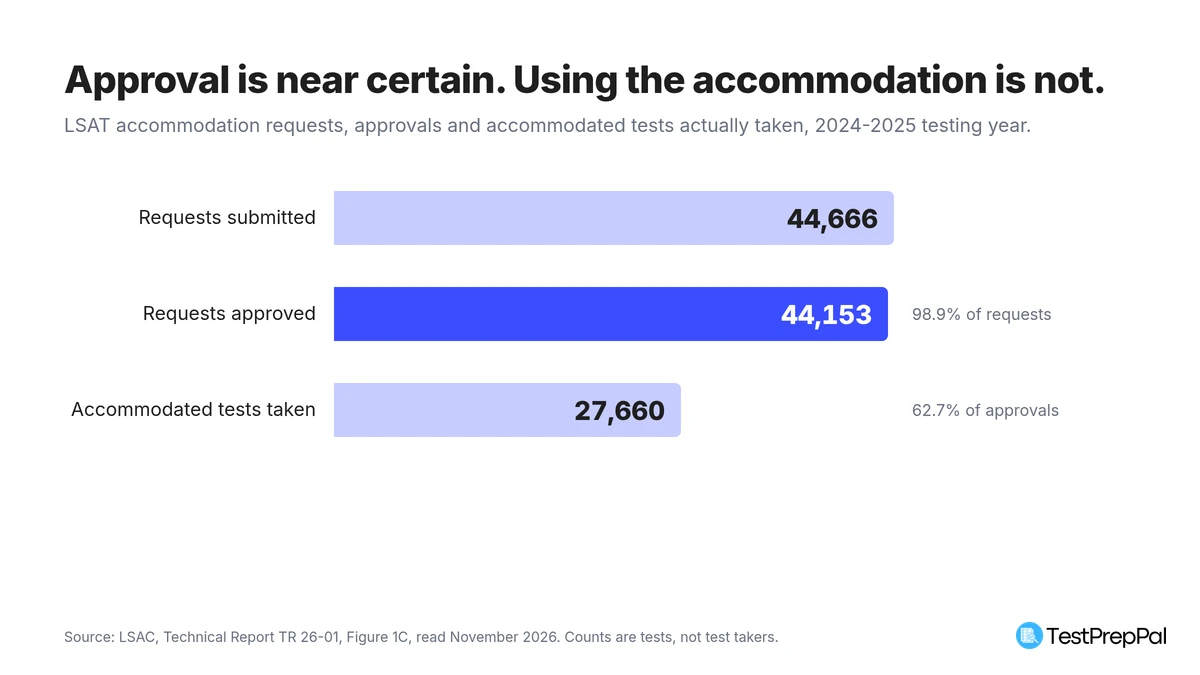 LSAT accommodation requests, approvals and accommodated tests taken, 2024-2025. Source: LSAC Technical Report TR 26-01, Figure 1C.
The more interesting number is the one underneath it. Only 62.7% of approved requests turned into an accommodated test, which leaves 16,493 people who were approved and then did not sit that LSAT. LSAC flags this directly in the report, noting that "only 63% of registrants with approved accommodations ended up taking the LSAT." Some of that is ordinary withdrawal and rescheduling, which happens across all test takers. It is still a reminder that an approval is not a commitment, and that pushing your date is an option if the preparation is not there. Our LSAT retake policy guide covers what moving a date does to your record.
Across all seven testing years, requests citing a diagnosis of ADHD were the largest group at around 37% of requests, and hearing accommodations the smallest at around 1%. LSAC counts a single request under more than one disability category when the documentation supports it, so the category totals overlap and cannot be added into a clean pie.
What you can actually request
LSAC publishes a non-exhaustive list of accommodations that may be available, and decides each request case by case. The main categories are extended testing time, additional breaks between multiple-choice sections, stop/start breaks of up to 60 minutes in a single test day, assistive technology, braille and tactile materials, a human reader, and a scribe.
Two points here are frequently reported wrongly elsewhere.
First, LSAC does not publish fixed extra-time tiers. You will see "50% extra time" and "100% extra time" stated as if they were menu options. LSAC's own pages list "extended testing time" without percentages and say each request is reviewed individually. Ask your evaluator to document the extra time your functional limitations actually require, rather than requesting a tier you read about.
Second, there is a hard ceiling on the test day itself.
For the multiple-choice LSAT, testing time plus breaks cannot exceed eight hours in one day. If your approved combination would run longer, LSAC administratively approves testing over two days and tells you before the test date.
Assistive technology available in Prometric centers includes the JAWS screen reader, ZoomText magnification and Dragon voice recognition. Alternative formats include Unified English Braille books, paper and pencil in regular print at 9.5 point, and large print at 18 point by default or larger on request. Anyone approved for a paper or braille test must test in a testing center rather than remotely.
That last point is becoming the norm regardless. For the 2026-2027 cycle, LSAC is moving to in-center testing for almost all test takers, with narrow exceptions for certain disability-related accommodations and for candidates more than 180 miles or three hours' drive from a Prometric center with capacity. Accommodations that apply to the written section are requested the same way, and our LSAT Argumentative Writing guide explains how that part is administered. If you are mapping a study schedule around a two-day administration, the LSAT study plan generator is a reasonable starting point, and the LSAT sections breakdown shows what each timed block contains.
A separate list of personal medical items needs no request at all: non-tinted eyeglasses, hearing aids, medication, a heart monitor, a sling, a cast, a brace, a cane, crutches, a walker, a wheelchair, diabetic testing and treatment supplies, a TENS unit, and a service animal. The exception is Bluetooth-enabled medical devices, which must be preapproved as an accommodation.
What law schools see
Nothing. This is the worry that drives most of the searching on this topic, and the answer is unambiguous.
LSAC does not annotate the score reports of candidates who test with accommodations, including extended time. All scores are reported the same way. LSAC also does not notify or communicate to law schools that a candidate requested or tested with accommodations. There is no marker, no asterisk, and no separate category in what a school receives.
Candidates who are approved may also decline any approved accommodation and test under standard conditions instead, which is worth knowing if you are approved for something you decide you do not want on the day. That decision has no bearing on how your score is reported either.
If your request is denied
The appeal windows are short, and they start when the decision letter is posted to your online account rather than when you read it.
| Step | Deadline |
|---|---|
| Notify LSAC that you intend to appeal | 2 business days after the letter is posted |
| Submit documentation supporting the appeal | 5 calendar days after the letter is posted |
| LSAC returns the appeal result | Within one week of your submission |
Because the clock runs from posting, check JD Services actively in the weeks after you submit rather than waiting for an email to arrive.
One rule removes this problem entirely for repeat test takers. If you were previously approved for an LSAT accommodation, you are automatically approved for the same or equivalent accommodation on future LSATs, with limited exceptions set out in LSAC's policy on prior testing accommodations. Candidates approved for a paper and pencil format are the notable exception: since the August 2025 administration that format is treated as a Category 3 accommodation and requires a fresh request even from people previously approved for it.
If documentation is the obstacle rather than the deadline, LSAC publishes its documentation requirements and a list of common reasons submissions are judged insufficient. Reading those before your evaluator writes anything is the cheapest way to avoid an appeal. For broader preparation decisions once your accommodations are settled, our LSAT prep course reviews compare what each option actually provides.
LSAT accommodations FAQs
What percentage of LSAT takers get accommodations?
About 16% of LSATs administered in the 2024-2025 testing year were taken with accommodations, or 27,660 of 173,341 tests. That share has risen every year since 2018-2019, when it was 4.6%. Note that LSAC counts tests rather than individual candidates, so repeat test takers are counted once per test.
Can law schools see if you took the LSAT with accommodations?
No. LSAC does not annotate accommodated score reports and does not tell law schools that you requested or used accommodations. Accommodated and non-accommodated scores are reported identically, including for extended time.
What do I need to get accommodations on the LSAT?
Three things, all before the registration deadline for your chosen administration: a completed registration for that specific test date, a request submitted through JD Services, and supporting documentation from a qualified professional describing your diagnosis and its functional effect on timed testing. Requests submitted after the deadline are not reviewed.
Do I need to request an accommodation to bring medication to the LSAT?
No. Medication, non-tinted eyeglasses, hearing aids, diabetic supplies, mobility aids and a service animal are permitted for all test takers without prior approval. Bluetooth-enabled medical devices are the exception and must be preapproved as a testing accommodation.
We may earn commissions from some links on this page, but this does not affect our reviews or your experience.