


Yes, you can retake the LSAT. LSAC's limits page lists two numerical caps, read on October 29, 2026: five attempts within the current reportable score period and seven over a lifetime.
For most applicants neither cap is what stops them. The calendar is. As of today, registration has closed for every 2026-2027 administration through November, and the earliest score a new registrant can still earn arrives on February 3, 2027.
- Two caps, not three. Five attempts in the current reportable score period, seven in a lifetime. LSAC's current policy page lists no per testing year limit.
- The reportable period is six testing years wide: the current one plus the previous five, which today means since July 2021.
- Cancelled scores count against both caps. Absences and withdrawals do not.
- Against a February 1, 2027 deadline, zero attempts are still reachable. The January 2027 score is released February 3.
- LSAC's own figure for a second attempt in the same testing year is an average gain of 2 to 3 points.
How many times can you take the LSAT?
Five times within the current reportable score period, and seven times total over a lifetime. Those are the only two numerical limits on LSAC's policy page.
If you have read that you can test three times per testing year, that figure is not on the page today. The limits page lists the five and the seven and nothing else, so plan against those two.
A few rules decide what actually counts:
| Event | Counts toward the caps? |
|---|---|
| A scored sitting | Yes |
| A cancelled score, including one cancelled with Score Preview | Yes |
| An absence or a withdrawal | No |
| Any test taken before September 2019 | No |
| The May, June, July and August 2020 LSAT-Flex tests | No |
Two more conditions sit on top. If you have already scored a 180 within the current reportable score period, you may not retake at all. And LSAC estimates the policy affects less than 1 percent of all LSAT takers, which is a useful reality check: almost nobody is stopped by the caps.
If you are stopped by one, there is an appeal. You email TTL@LSAC.org with your LSAC account number, the test date you want and your documentation, at least five business days before that administration's registration deadline. LSAC answers within five business days and the decision is final. An exemption from one limit leaves the other in force, so an approved sixth attempt in the period still counts against your lifetime seven.
The five-attempt window is six testing years wide, and it moves every July
This is the part that gets described wrong. The cap is often called five tests in five years. LSAC's retake page defines the reportable period as all valid scores from the current testing year and the previous five testing years, and the limits page puts today's window at "since July 2021".
Count them: 2026-2027, plus 2025-2026, 2024-2025, 2023-2024, 2022-2023 and 2021-2022. That is six testing years, not five, and it confirms that testing years begin in July.
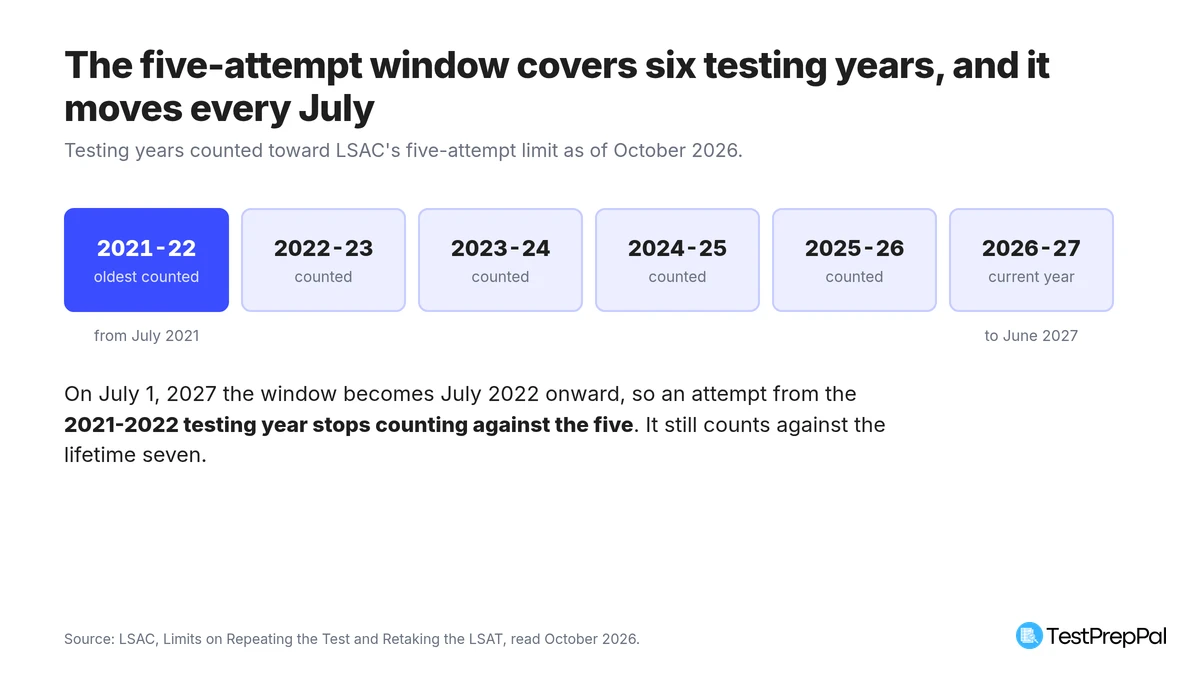 The reportable score period as of October 2026. Source: LSAC, Limits on Repeating the Test.
Because the window is anchored to the current testing year, it rolls forward every July. On July 1, 2027 it becomes July 2022 onward, and an attempt taken in the 2021-2022 testing year stops counting against your five. It keeps counting against the seven, which is a lifetime number and never resets.
That matters if you are close to the cap and applying in a later cycle. Waiting until July can hand you an attempt back.
How many attempts you have left before your deadline
Your real number is the smallest of three things: five minus your attempts since July 2021, seven minus your lifetime attempts, and the number of administrations that still report a score before your application deadline. For most people the third number is the binding one.
Registration has closed for the September, October and November 2026 administrations, whose deadlines were July 28, August 27 and October 1. Four US and Canada dates are still open, and LSAC's dates page gives each one a fixed score release:
| Administration | Register by | Score released |
|---|---|---|
| January 2027 | December 1, 2026 | February 3, 2027 |
| February 2027 | December 29, 2026 | March 3, 2027 |
| April 2027 | February 25, 2027 | April 28, 2027 |
| June 2027 | April 29, 2027 | June 30, 2027 |
Lining those releases up against a deadline gives the count directly.
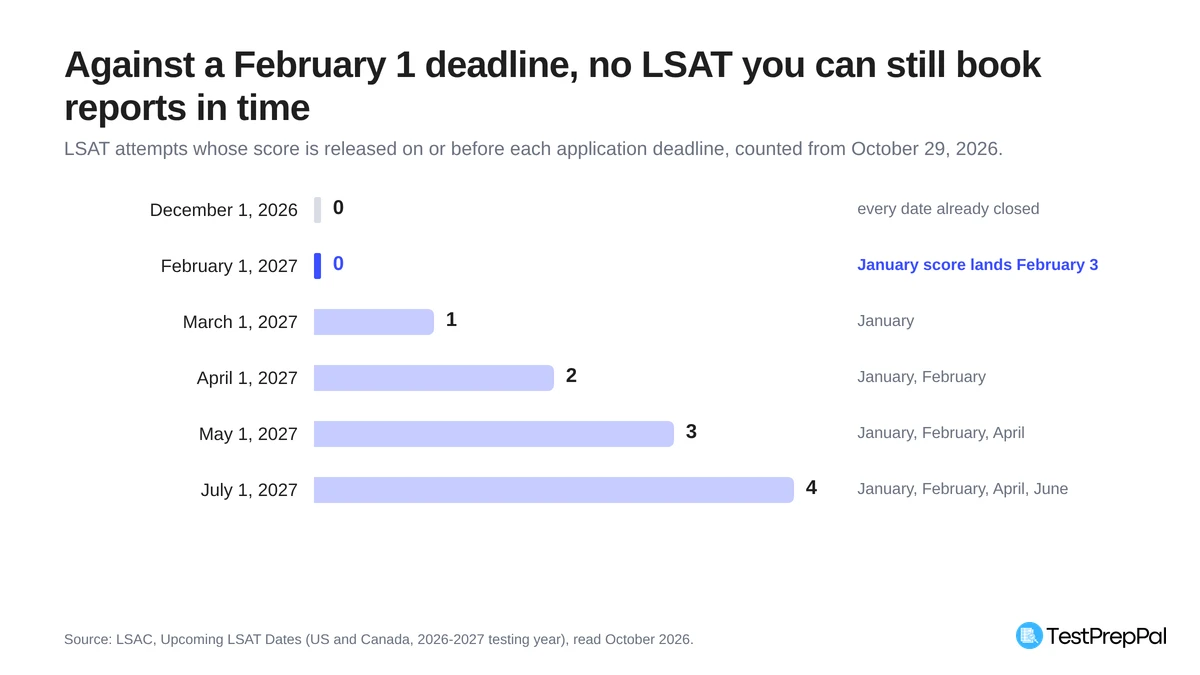 Attempts whose score is released on or before each deadline, counted from October 29, 2026. Source: LSAC Upcoming LSAT Dates.
Against a February 1, 2027 deadline you have zero attempts left. The January 2027 score is released February 3, two days late.
A March 1 deadline leaves one. April 1 leaves two. You do not reach three until May 1, and four until July 1, by which point you are applying in the following cycle. If your list is full of February deadlines, the decision in front of you is not whether to retake but whether to apply next cycle with a better score, and the full 2026-2027 LSAT date table shows how the rest of the calendar falls.
One more consequence of dropping the per year cap: seven US and Canada administrations run in a single testing year now. The five-attempt limit, not the calendar, is what stops someone from sitting all of them.
Cancelling costs you an attempt, withdrawing does not
This asymmetry is worth more than it looks. A withdrawal or an absence costs you nothing against either cap. A cancelled score counts, even though it is never released to law schools.
That includes scores cancelled through LSAT Score Preview, which lets you look at your score and gives you six days to decide whether to keep it. On LSAC's fee table Score Preview costs $46 if you sign up before the first day of testing and $87 if you sign up during the window after testing ends, and it is available no matter how many times you have tested.
So Score Preview buys you control over what schools see. It does not buy you an attempt back. If you already know on test day that the sitting has gone badly, withdrawing is the cheaper move in attempt terms.
The money has its own clock. A test date change is free through that administration's registration deadline, then $153 for seven days, then $253 from eight days after the deadline through the day before testing. Since registration itself is $253, a late change costs as much as the seat did. For most administrations the registration deadline is also the last day for a full refund, and LSAC notes those deadlines sometimes vary by administration, so a backup date is a purchase rather than a reservation. Our full breakdown of LSAT costs has the CAS and report fees that stack on top.
What law schools see when you retake
Every reportable score. The admission committee receives all of your valid scores from the current testing year and the previous five, which is the same six year window that governs the caps. A score you cancelled is not among them, because LSAC does not add it to your file.
On how schools weigh multiple scores, the common claim is that schools ignore everything but your highest. LSAC's own answer is more careful: LSAC advises law schools that a candidate's average LSAT score is the best predictor of ability, and says some schools place more weight on the highest. Both practices exist, and each school sets its own, so the only reliable way to know is to ask the schools on your list.
In practice this changes the arithmetic of a small retake. If a school averages, moving from 160 to 164 gives you a 162 on the measure that school uses, not a 164. Our guide to what counts as a good LSAT score and the current percentile table are the place to check whether the gain you are chasing actually clears a median.
Is a retake likely to help?
LSAC publishes a number for this, and it is smaller than most people expect. Test takers who sit a second test in the same testing year increase their scores by an average of 2 to 3 points.
That average hides real spread. Some scores do not move and some fall. The honest test is whether something specific went wrong the first time and whether you have fixed it. A documented bad test day, an unfinished section, or prep that never included timed full sections are all fixable. A score that matches your timed practice average is usually not.
Run the comparison before you register. Score your last few timed sections, put the raw count through our LSAT score converter, and compare the result to the score you are unhappy with. If the converted score is not meaningfully higher, a retake is buying you the 2 to 3 point average, not the jump you have in mind.
The cost is the same every time: $253 per attempt, first sitting or fifth. An approved Tier 1 fee waiver covers up to two LSATs within the two year waiver period, while a Tier 2 waiver does not include a retake. One thing you do not have to repeat is the writing sample. A single completed LSAT Argumentative Writing on file is enough for every sitting.
If the answer is that your prep was the problem, fix the prep before you book the date. Our LSAT prep course roundup compares the full options, the 7Sage review covers the one most retakers ask about, and the free LSAT resources page lists what LSAC gives away before you spend anything. The LSAT hub tracks format and scoring changes for whichever cycle you end up testing in.
LSAT retake FAQs
How many times can you retake the LSAT?
Five times within the current reportable score period and seven times over a lifetime. LSAC's limits page lists no per testing year cap, so the five and the seven are the only numbers to plan against. Tests taken before September 2019 and the May through August 2020 LSAT-Flex administrations do not count toward either.
Can you cancel an LSAT score after you get it?
Yes, if you bought Score Preview. It shows you your score and gives you six days to decide whether to keep or cancel it, and a cancelled score is never added to your file or released to law schools. The catch is that the cancelled attempt still counts against your five and your seven.
Should I retake the LSAT if I got a 157?
It depends on your target medians and on your practice average, not on the number itself. If your recent timed sections convert to a meaningfully higher score, a retake is worth it. If 157 is where your practice already sits, LSAC's average second attempt gain of 2 to 3 points is the realistic outcome, which lands you around 159 or 160.
Do law schools see all your LSAT scores?
Yes. Admission committees receive every reportable score from the current testing year and the previous five. LSAC advises schools that your average score is the best predictor of ability, though some weigh the highest more heavily, so confirm the policy with each school on your list.
We may earn commissions from some links on this page, but this does not affect our reviews or your experience.