


Acuity Insights, the company that writes and scores Casper, publishes four official sample scenarios and the eight questions that go with them, and publishes no answers at all. This page answers all four, twice each: one response that matches what Acuity says higher-quartile applicants did, and one that reads perfectly well and misses it.
The second answer is the useful one. Almost every Casper example online is a single response labelled good, which shows you the ceiling and nothing about the floor.
- Acuity publishes exactly 4 sample scenarios: 3 video-based and 1 word-based. Every other example online was invented by a prep company.
- Each sample carries 2 questions, like the real test, which runs 11 scenarios and 22 separately scored questions.
- All 4 official second questions begin with the word "Imagine" and hand you a fact the first question did not contain.
- Acuity names 5 things higher-quartile applicants did: effort, empathy, impartiality, communication, and familiarity with the format.
- The most common gap between a weak answer and a strong one is the word "why". Raters read for your reasoning, not your decision.
- A weak Casper answer is usually fluent, polite and finished early. It is not a typing problem.
Where real Casper examples come from
One set of Casper examples definitely resembles the real test, and it sits on Acuity's own About Casper page. Four scenarios, three presented as videos and one as a single written sentence, each followed by the two open-ended questions a test taker would see. Acuity is careful to say the content of every Casper test is different, so these are a preview of the shape, not a leak.
What that page does not include is a single answer. Neither does anyone else, for those specific questions.
| Official sample scenario | Format | Your role | What it is really about |
|---|---|---|---|
| A customer wants a refund | Video-based | Store manager | Applying a rule to a person |
| Paul stops contributing to a group assignment | Video-based | Group member | Illness, fairness and workload |
| Mary's thank-you note to Chloe includes money | Video-based | Co-worker | Acting before you have the facts |
| A time you made a sacrifice to reach a goal | Word-based | Yourself | Your own life, with evidence |
Three of the four put you in a role. One asks about your own life. A prep plan built only on ethical dilemmas leaves you stuck when a scenario asks what you did in your second year of college.
The best-ranked alternatives are thinner than they look. The Successful Match does publish a weak and a strong answer side by side, but it was last updated in July 2024 and still teaches the retired timing of 90 seconds per typed response and three questions per scenario. Med School Insiders publishes 16 sample questions with no worked responses at all, which leaves you with prompts and no boundary.
Example 1: the customer who wants a refund
Acuity's first sample scenario puts you behind the counter. The role prompt is "you are the store manager", and the two questions are:
- As the store manager, would you give this customer a refund? Why or why not?
- Imagine that you decide to refuse to give a refund. How would you communicate your decision to the customer? Explain your response.
Here are two answers to the first question, written under the same clock.
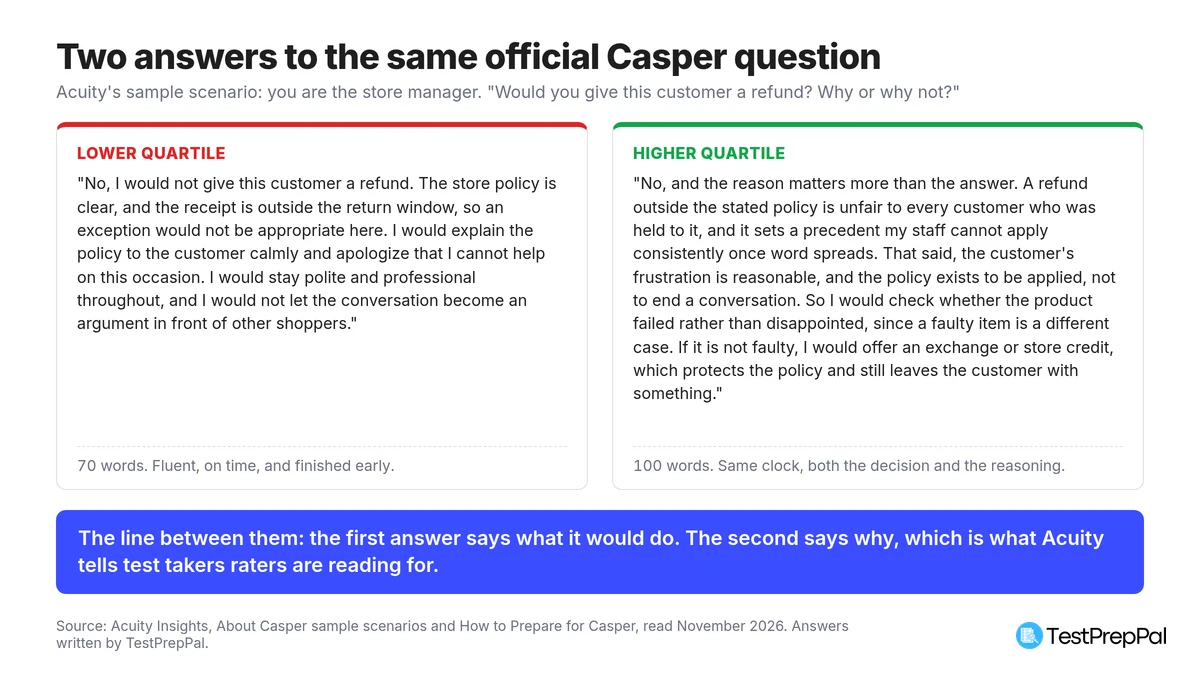 Two answers to the same official Casper sample question. Source: Acuity Insights sample scenarios, with answers written by TestPrepPal.
The weak answer is not rude, rushed or off topic. It picks a defensible position and explains the policy. What it never does is say why the policy should hold in this case, and Acuity is unusually direct about that gap: strong responses explain both what you would do and why you would do it.
The second question is where people lose a mark without noticing. It removes the decision from you and asks only about delivery. Answer it by re-arguing the refund and you have answered question one twice and left question two blank, which is two separately scored marks.
Example 2: the group member who stopped contributing
Role: you are a group member. Paul has stopped contributing to a group assignment because of a medical condition.
The first question asks how you and the group should handle it. The second asks you to imagine Paul had already contributed a significant amount before putting his courses on hold, and whether that changes your answer.
An answer that would struggle: "We should redistribute Paul's sections among the remaining members so the assignment is finished on time. I would email the group, split his work evenly, and set a new internal deadline so nobody is scrambling the night before. I would also let the instructor know Paul has not submitted his portion, so the grade reflects what each of us actually contributed. The priority has to be delivering a complete assignment by the deadline."
That is organized and sounds responsible. It also never contacts Paul, never considers what a medical condition means for him, and reports him to the instructor as a first move rather than a last one.
An answer that would do better: "The first thing is to find out what Paul actually needs, so I would message him privately, ask how he is, and ask what he can realistically commit to, without pressing for medical details he has not offered. A medical condition is not a choice, and treating this as a workload problem first would be unfair to him. Then I would bring the group together and agree a redistribution that keeps the assignment deliverable, with Paul taking a smaller piece if he wants to stay involved. If the workload becomes genuinely unmanageable, I would ask the instructor for an extension for the group rather than reporting Paul."
The rubric line here is empathy, which Acuity defines on its quartile page as having considered all perspectives in a meaningful way. The first answer considers the group's perspective thoroughly and Paul's not at all.
Example 3: the thank-you note with money in it
Role: you are a co-worker. Mary, the volunteer coordinator, sent thank-you notes to both Chloe and Eric, but only Chloe's note included money. What, if anything, should Chloe do?
An answer that would struggle: "Chloe should split the money with Eric. They both volunteered, so it is not fair for one of them to be paid and the other not, and Mary has clearly shown favoritism here. If I were Chloe I would transfer half to Eric and tell him what happened, so he knows he was not overlooked deliberately. Keeping money that was given unevenly would damage her relationship with Eric and make the whole team uncomfortable."
Fluent, decisive, generous, and built on an assumption the scenario never states. Mary might have been reimbursing an expense, paying for something Chloe bought, or making a clerical error.
An answer that would do better: "Chloe does not know enough yet to act, so the first step is asking Mary, privately and without accusation, whether the money was a reimbursement, a prize or a mistake. There are reasonable explanations that have nothing to do with favoring one volunteer, and acting on the assumption of unfairness would be unfair to Mary. If it turns out the money was a general thank-you Eric should have received too, Chloe should say so and ask Mary to put it right at the source, which protects Eric better than a quiet private transfer. If it was specific to something Chloe did, she can accept it and has no reason to hide it."
Gathering information before judging is the most transferable habit in Casper, and it maps onto the criterion Acuity calls impartiality: respect for other people's experiences and needs, including the person you are tempted to blame.
Example 4: the sacrifice you made
The word-based sample is one sentence long: "Think of a time when you had to make a sacrifice in order to accomplish a goal." The first question asks you to describe the situation and the sacrifice. The second asks how you would have felt if the sacrifice had not worked.
Personal questions are where fluent answers go to die. There is nothing to reason about and nowhere to hide.
An answer that would struggle: "During my undergraduate degree I had to sacrifice a lot of my social life in order to keep my grades up. It was difficult because my friends were going out most weekends and I was in the library, but I knew my long-term goals mattered more. In the end the sacrifice was worth it and I achieved what I set out to do."
Nothing in that paragraph is wrong. Nothing in it is yours, either. It would fit any applicant in any year, and it finishes with most of the clock unspent.
An answer that would do better: "In my second year I was working 20 hours a week at a pharmacy and my organic chemistry grade was slipping. I gave up the shifts I liked most, the weekend ones that paid best, and asked for weekday evenings instead so I could keep Saturdays for problem sets. That cost me about a quarter of my income for two terms, which meant moving back in with my parents and a 50-minute commute each way. I chose it because the degree was the thing I could not retake cheaply and the money was recoverable. My grade went from a C plus to a B plus, and I still had the job when I needed a reference."
Same clock. The difference is specifics, and Acuity asks for exactly that: as much detail as possible, especially about your motivations.
Every official second question starts with "Imagine"
Line the four sample scenarios up and a pattern appears that no prep page names.
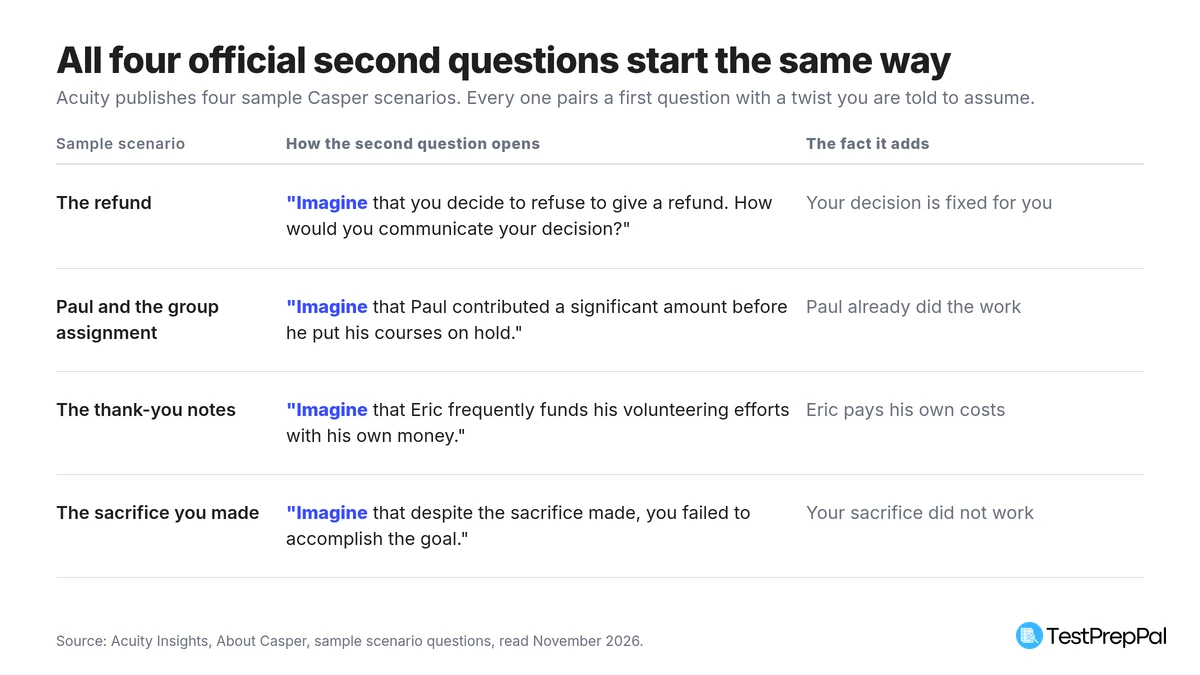 All four official second questions introduce a fact the first question did not contain. Source: Acuity Insights, About Casper.
Every second question hands you one new fact and asks what it changes. Two of the four use the phrase "how, if at all", which is an invitation to say it changes nothing, as long as you say why.
That shape has a trap built in. The reflex is to reverse your position to show flexibility. The better instinct is to decide whether the new fact actually bears on your reasoning, then commit. If Paul already did his share, that genuinely changes the fairness calculation. If Eric funds his own volunteering, it strengthens the case for asking Mary rather than redistributing in secret.
What actually separates the two answers
Acuity publishes no rubric, but it does publish what higher-quartile applicants tended to do. Five things, in its own words:
| What Acuity names | What it looks like in an answer |
|---|---|
| Effort | Explained the position fully and used the full amount of time |
| Empathy | Considered all perspectives in a meaningful way |
| Impartiality | Showed strong respect for other people's experiences and needs |
| Communication | Articulated ideas clearly, above the average |
| Familiarity with the format | Did not lose time to the interface on test day |
Three of those five are about how far you take an answer, not what position you take. That fits how the test is assembled: both questions in a scenario go to the same rater, but each question is scored independently, and your final score is built from every individual question score. Raters are told to ignore spelling and grammar and read your thought process, judgment and communication instead.
If you finish a Casper answer with time to spare, you have not finished it. Acuity's own advice is to use the time to add or clarify why you chose the stance you did. An answer that stops at the decision is the most common way a competent applicant lands lower than they should.
How to practice with these four examples
Read them once, then stop reading and start timing. A typed scenario gives 3.5 minutes for both questions, about 105 seconds each, which is nothing like composing an answer in your own time. One quirk: Acuity puts that same 3.5-minute instruction on all four samples, including the three video-based ones. On the real test a video-response question gives 60 seconds and no second take, so practice those out loud against a phone timer.
Three things worth doing in order:
- Answer all eight official questions above under the clock, writing them out rather than thinking them.
- Run a full-length simulation. Our free Casper practice test is 11 original scenarios and 22 questions on the real timing, with model answers and a rubric for each, and uses different scenarios from these four so you are not scoring yourself on material you have already read.
- Take the official practice test in your Acuity Insights account once you have reserved a date. It is free, repeatable, and the only way to meet the real interface before test day.
Acuity states that test takers who use third-party preparation materials, or who do not prepare at all, tend to do worse than those who use its free resources. Weigh that before you spend. If you still want structured feedback rather than self-scoring, the Casper prep courses we have reviewed set out what each includes, including BeMo CASPer Prep, and our review methodology explains how we assess them.
For the mechanics, our guide to how the Casper test is scored covers the quartile system and the 22-question arithmetic, how to prepare for the Casper test sets out a 2 to 4 week plan, and the Casper exam hub collects dates, fees and test types.
Casper test example FAQs
What are some examples of Casper prompts?
Acuity's four official samples are a customer asking for a refund while you are the store manager, a group member named Paul who stops contributing because of a medical condition, a thank-you note to one of two volunteers that includes money, and a word-based prompt about a time you made a sacrifice to reach a goal. Every other sample circulating online was written by a prep company, and the content of every real Casper test is different.
How long do you get to answer each Casper example?
A typed-response scenario gives 3.5 minutes for both questions together, roughly 105 seconds per answer if you split evenly. A video-response question gives 60 seconds, recorded one at a time with no retakes. The full test is 11 scenarios and runs 65 to 85 minutes including two optional breaks.
What are the 10 skills Casper looks for?
Acuity currently names nine, not ten: collaboration, communication, empathy, ethics, fairness, motivation, problem solving, resilience and self-awareness. The figure of ten comes from older descriptions and is still widely repeated. Either way, these are qualities the scenarios draw out of a genuine answer, not a checklist to work through.
Is it hard to pass the Casper test?
There is nothing to pass. Casper is not pass or fail and there is no cut score. Your responses are rated by trained humans, then standardized against everyone who took the same test type, and you receive a quartile about 4 to 5 weeks later. Acuity notes that the first quartile is not a failure and that most programs consider all quartiles.
We may earn commissions from some links on this page, but this does not affect our reviews or your experience.