


The Casper test is an open-response situational judgment test made up of 11 scenarios and 22 separately scored questions, taken in 65 to 85 minutes. There is no content to revise, no pass mark, and you never see your own score: programs receive it, and about 4 to 5 weeks later you receive a quartile.
That makes Casper an unusual thing to prepare for. What decides your result is not what you know but how well you use a clock that is shorter than most applicants realize.
- Casper is an open-response situational judgment test. Nothing to memorize, nothing to pass.
- The 2026 to 2027 test is 11 scenarios: 4 video response, then 7 typed response, each with 2 questions.
- That is 22 questions, and every one is scored on its own. A skipped answer is a forfeited mark, not a weaker scenario.
- Video gives you 1 minute per question. Typed gives you 3.5 minutes for both questions together, not for each.
- Acuity Insights names nine skills Casper is built to show. The "ten criteria" you will see quoted comes from an older description of the test.
- Certified human raters score it, grammar and spelling are explicitly ignored, and your quartile arrives about 4 to 5 weeks later.
What is the Casper test?
Casper is built and scored by Acuity Insights, which describes it as an open-response situational judgment test designed to show your social intelligence and professionalism. You are dropped into realistic situations, asked what you would do, and asked to explain why.
Three things follow from that design, and they explain most of what feels strange about the test.
It is scored by certified human raters rather than by AI. Your score goes straight to the programs on your distribution list, not to you. And each program decides on its own how much weight Casper carries in its process, so there is no universal answer to how much it matters.
There is also no single Casper. Acuity runs different test types by field of study, location and language, and they are not interchangeable. Applying to programs in two countries can mean sitting Casper twice. Your Casper exam hub page collects the practical side of that.
What does Casper actually measure?
Acuity lists nine skills that contribute to social intelligence and professionalism, and these are what the scenarios are built to draw out:
| Skill | What a rater is looking for |
|---|---|
| Collaboration | Working with other people rather than around them |
| Communication | Explaining your thinking so someone else can follow it |
| Empathy | Recognizing how the situation lands for everyone in it |
| Ethics | Applying a principle, not just an instinct |
| Fairness | Treating competing claims consistently |
| Motivation | Caring enough to engage with the problem fully |
| Problem solving | Reaching a workable next step |
| Resilience | Handling pressure and setbacks in the scenario |
| Self-awareness | Knowing the limits of your own position |
If you have searched this before, you have probably seen "ten behavioral criteria" instead. That number comes from an older description of the test and it is still repeated on prep sites today. Acuity's own page names nine. The list is worth reading not to memorize it but to notice what is missing: no clinical knowledge, no ethics vocabulary, no right answer.
The Casper test format, section by section
Acuity publishes the structure by admission cycle on its format and length page, updated in March 2026. For the 2026 to 2027 cycle:
| Section | Scenarios | Questions each | Clock | How questions appear |
|---|---|---|---|---|
| 1. Video response | 4 | 2 | 1 minute per question | One at a time |
| 2. Typed response | 7 | 2 | 3.5 minutes for both | Both on one page |
The order is fixed. Two optional breaks are built in: 10 minutes after the video section, then 5 minutes after the first four typed scenarios. Total estimated time is 65 to 85 minutes.
Add the clock up and the shape of the test changes.
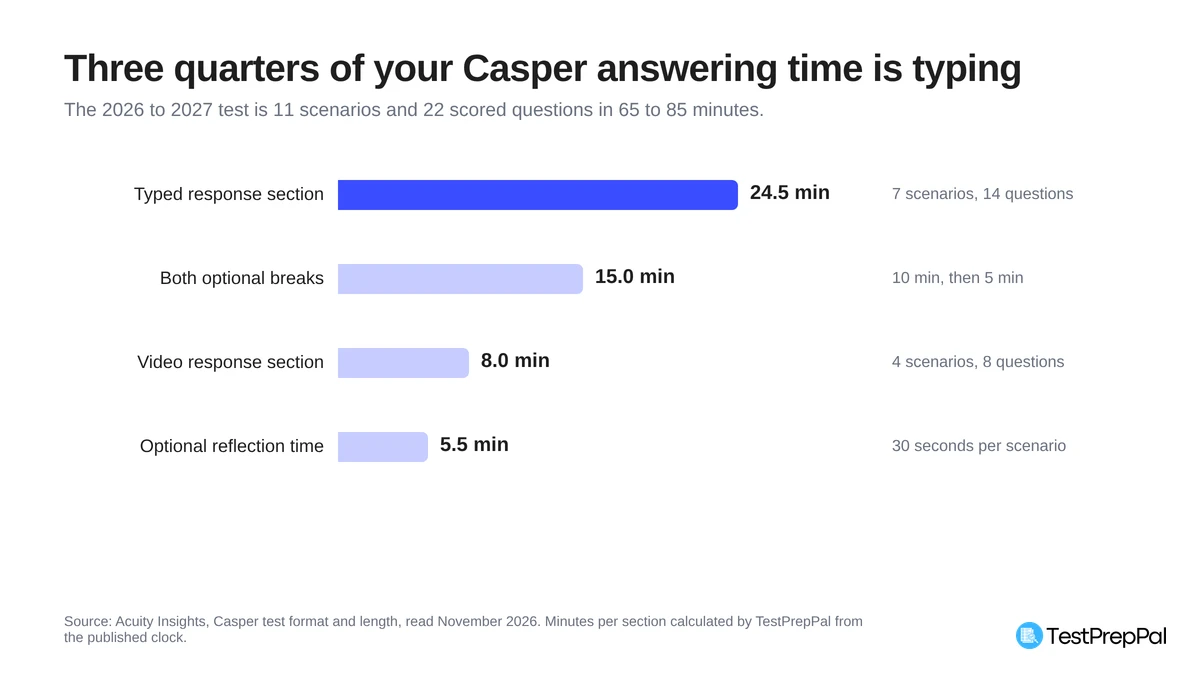 Minutes per section, calculated from Acuity's published clock. Source: Acuity Insights, Casper test format and length.
The video section is 8 questions at 1 minute each, so 8 minutes of answering. The typed section is 7 scenarios at 3.5 minutes each, so 24.5 minutes. Out of 32.5 minutes of total response time, 24.5 minutes is typing. Counted in questions rather than minutes it is the same story: 14 of the 22 scored questions are typed.
Most prep energy goes into the video section because recording yourself feels harder. The marks are mostly somewhere else.
Every scenario runs the same way
Each scenario gives you a role prompt such as "you are a co-worker", then the scenario itself, then an optional 30-second reflection period before the questions appear. Video responses add a 10-second countdown before recording starts, with your role prompt shown again during it.
One distinction catches people out. How a scenario is presented (as a video or as text) is separate from how you must respond (by recording or by typing). A word-based scenario can require a video answer. Switching response formats is not allowed, and speech-to-text tools are not permitted unless pre-approved under accommodations.
Australian Undergraduate and Postgraduate Teacher's Education programs take a shorter version: 8 scenarios made of 2 video and 6 typed, one 10-minute break, 45 to 65 minutes. Everything else here applies to it.
If you read advice describing 12 sections, three questions per scenario, or five minutes per scenario, it is describing a retired format. Check any guidance you find against the cycle it names.
What the 3.5 minute clock means for your answers
This is where the format stops being trivia. A typed scenario gives you 3.5 minutes for two questions. Not 3.5 minutes each.
Work out what that buys you at your own typing speed, and the standard advice about answer length starts to look wrong.
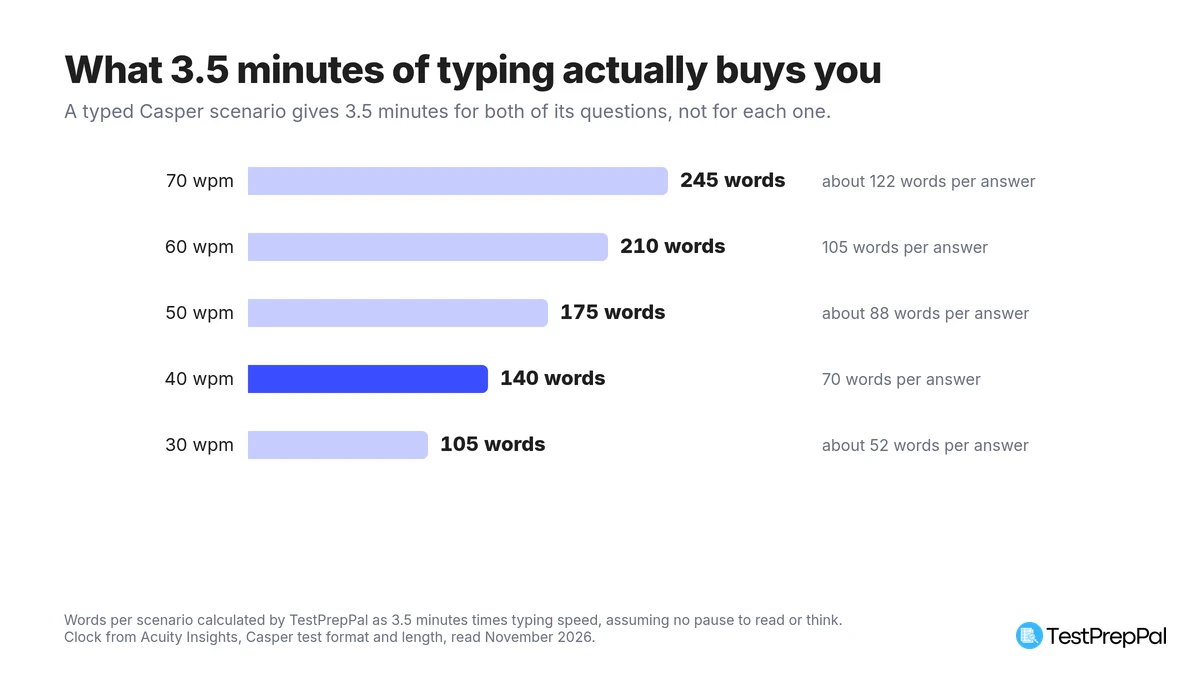 Words per scenario is 3.5 minutes times typing speed, assuming no pause to read or think. Calculation by TestPrepPal from Acuity's published clock.
At 40 words per minute you get 140 words for the pair, about 70 each. At 60 wpm you get 210 words, about 105 each. And that is pure typing, with nothing deducted for reading the scenario, choosing a position, or re-reading what you wrote.
Now run it backwards against the target most Casper advice quotes, which is 90 to 130 words per answer. Two answers of 90 words is 180 words in 3.5 minutes, and that needs 51 wpm sustained without pausing. Two of 130 words is 260 words, which needs 74 wpm. The target is reachable, but only at a typing speed most applicants have never actually measured.
Hitting 90 to 130 words on both questions in a scenario means typing at 51 to 74 wpm with no pause to think. If that is not your speed, write two short complete answers rather than one long one. An unanswered question is a forfeited mark, not a shorter scenario.
So the first thing to measure is not your ethical reasoning, it is your words per minute. Decide your position during the 30-second reflection, split the 3.5 minutes roughly in half, and let each answer be a short paragraph. Our free Casper practice test runs the real clock with a live word count, which is the fastest way to find out what your own speed gives you.
How the Casper test is scored
Acuity's scoring and evaluation page is specific, and the detail that matters most is easy to miss.
Both questions in a scenario go to the same rater, who sees the full context. But each question is scored independently. There is no score for a scenario, only scores for questions, and the final result is calculated from all of them.
So the test is 22 marks, each worth about 4.5 percent of your scored responses. Running out of time on the second question of a typed scenario does not weaken that scenario. It forfeits one of 22 marks outright. Finishing both answers briefly beats finishing one answer beautifully.
The rest of the mechanics:
- Responses are anonymized. Raters do not see your name, age or photo.
- No rater scores the same applicant more than once, so nobody's reading of you carries across the test.
- Raters are instructed to focus on substance, judgment and communication, and explicitly not on grammar or spelling.
- All individual ratings are averaged, then standardized against the applicant pool.
That last point is why polishing sentences is wasted time. The thing being rated is your reasoning, and the clock is too short to produce both.
What your Casper quartile means
You get a quartile by email about 4 to 5 weeks after your test, through your Acuity Insights account. Programs usually have the underlying score well before that.
Acuity's quartile score page explains that quartiles compare you with other applicants on the same test type, z-scored against the strength of your peers' responses. Four quartiles, a quarter of test takers in each, by construction.
Placing in the first quartile does not mean you failed. It means other applicants were rated more strongly on the same scenarios, in a pool Acuity describes as containing many high-caliber applicants. Acuity's position is that quartile placement should not dissuade you from applying anywhere, and that most programs treat Casper as one data point among many.
Because the comparison is against a pool, the same performance can land differently on a different day. Acuity gives three reasons a repeat test can shift: scores sitting near a quartile boundary, for example the 74th and 76th percentiles, a differently composed applicant pool, and genuine improvement from being more familiar with the format.
Its own list of what higher-quartile applicants do differently is worth reading as a checklist: effort, meaning they explained their position fully and used the full time rather than finishing early, empathy, impartiality, communication, and familiarity with the format. Three of those five are rehearsal rather than character.
Who takes Casper, and what to sort out first
Casper is used by programs in health sciences and in teacher education, but the requirement sits with the individual program, not with Acuity. The only reliable way to know whether you need it, and which version of it, is the admissions page of each program you are applying to.
Three logistics decisions are worth making early:
- Test type. It depends on your field of study, location and language, and types are not interchangeable. Register for the wrong one and the score does not transfer.
- Accommodations. A request form must be submitted at least four weeks before your test date, so this is a decision for the week you register, not the week you test.
- Fee assistance. Applicants approved for a participating program such as AAMC, AACOMAS, CASPA, ADEA or a UCAS bursary may have Casper fees waived or reduced.
How much preparation does Casper need?
Less than the volume of material for sale suggests, and Acuity is unusually blunt about it: test takers who use third-party preparation materials, or who do not prepare at all, tend to do worse than those who use Acuity's free resources. Its official practice test lives in your account once you have reserved a test.
What preparation actually buys you here is format fluency: knowing the clock, having typed under it, and not meeting the recording interface for the first time on test day. Acuity's own Casper test examples are the one sample set worth starting from, and we answer all four of them twice, strong and weak. Our guide on how to prepare for the Casper test sets out a 2 to 4 week plan and a response framework.
If you want structured feedback on your answers rather than self-scoring, the Casper prep courses we have reviewed cover what each one provides and what it costs, including BeMo CASPer Prep. Read Acuity's caution first, and see our review methodology for how we assess these products.
Casper test FAQs
What is the Casper test for?
It gives programs a structured read on social intelligence and professionalism, the part of an application that transcripts and test scores do not show. Programs use it alongside grades, entrance exams and interviews, and each one decides how much weight it carries. Acuity scores it and distributes it, but it does not set the role it plays in admissions.
What are the 10 skills Casper looks for?
Acuity currently names nine, not ten: collaboration, communication, empathy, ethics, fairness, motivation, problem solving, resilience and self-awareness. The "ten criteria" figure comes from older descriptions of the test and is still widely repeated on prep sites. Either way, these are qualities the scenarios draw out, not a checklist to work through in an answer.
Is it hard to pass the Casper test?
There is nothing to pass. Casper is not pass or fail, and there is no cut score. Your responses are rated and then standardized against everyone who took your test type, so the difficulty is relative to a strong applicant pool rather than to a fixed standard.
Is Casper as important as the MCAT?
That depends entirely on the program, because each one decides how and when to use the score. Some use Casper as a screen before interviews, some fold it into a composite, and some treat it as a minor factor. Check the admissions page of each program you are applying to rather than assuming a general ranking.
How long is the Casper test?
65 to 85 minutes for the standard 11-scenario version, including both optional breaks, and 45 to 65 minutes for the shorter Australian Teacher's Education version. Only about 32.5 minutes of the standard test is actual response time, split 24.5 minutes of typing and 8 minutes of recorded video.
We may earn commissions from some links on this page, but this does not affect our reviews or your experience.