

Free Casper Practice Test
11 original scenarios · 22 questions · real Casper timing — 4 video-response scenarios at 60 seconds per answer, then 7 typed-response scenarios at 3.5 minutes per scenario
Or drill a single scenario
This simulator never asks for your camera or microphone. The video section rehearses the timing and the content of a spoken answer — you speak out loud to yourself and keep notes. Nothing is recorded, uploaded, or scored automatically.
About This Casper Practice Test
This is a full-length Casper simulator: 11 original scenarios and 22 questions, running on the same clock as the real assessment. The video-response section comes first, exactly as it does on test day, then the seven typed-response scenarios, with the optional breaks in the right places.
Everything here is original. Acuity Insights owns and copyrights the real scenarios, so what you get instead are dilemmas written to the same blueprint: no clinical knowledge required, no clean right answer, and a deliberate spread across personal, workplace, academic-integrity, healthcare-adjacent, and social situations.
| # | Scenario | Section | Situation type | Competencies probed |
|---|---|---|---|---|
| 1 | The Screenshot | Video | Personal · friendship | Ethics, communication, empathy, self-awareness |
| 2 | Covering Shifts | Video | Workplace · team | Professionalism, collaboration, empathy, self-awareness |
| 3 | The Last Appointment | Video | Healthcare-adjacent | Equity, empathy, problem solving, professionalism |
| 4 | The Bursary Panel | Video | Academic integrity · equity | Ethics, equity, communication, problem solving |
| 5 | The Outlier | Typed | Research integrity | Ethics, professionalism, resilience, communication |
| 6 | Three Weeks | Typed | Personal · living situation | Empathy, communication, self-awareness, resilience |
| 7 | The Fourth Member | Typed | Academic · teamwork | Collaboration, empathy, professionalism, communication |
| 8 | The Queue | Typed | Healthcare-adjacent · service | Equity, empathy, professionalism, communication |
| 9 | The Community Group | Typed | Social issue · family | Communication, empathy, ethics, motivation |
| 10 | The Reference | Typed | Workplace · ethics | Ethics, professionalism, empathy, communication |
| 11 | The Retreat | Typed | Equity · student leadership | Equity, collaboration, problem solving, motivation |
Each question returns, in the review screen, a model answer written the way a prepared applicant would actually type it under time pressure, the competencies that question is probing, a checkable rubric, and the specific mistakes that sink real applicants on that scenario.
How the Casper Test Actually Works
A lot of Casper advice online still describes a 14-scenario, typed-only test. That version is gone. Here is the current structure for the 2026–2027 cycle, taken from the Acuity Insights help centre:
| Video response section | Typed response section | |
|---|---|---|
| Order | First | Second |
| Scenarios | 4 | 7 |
| Questions per scenario | 2, presented one at a time | 2, shown together |
| Time | 1 minute per question | 3.5 minutes for both questions |
| Reflection period | Optional 30 seconds after the scenario | Optional 30 seconds after the scenario |
| Before answering | 10-second countdown before recording begins | Clock starts when you begin |
| Break after | 10-minute optional break | 5-minute optional break after the first 4 scenarios |
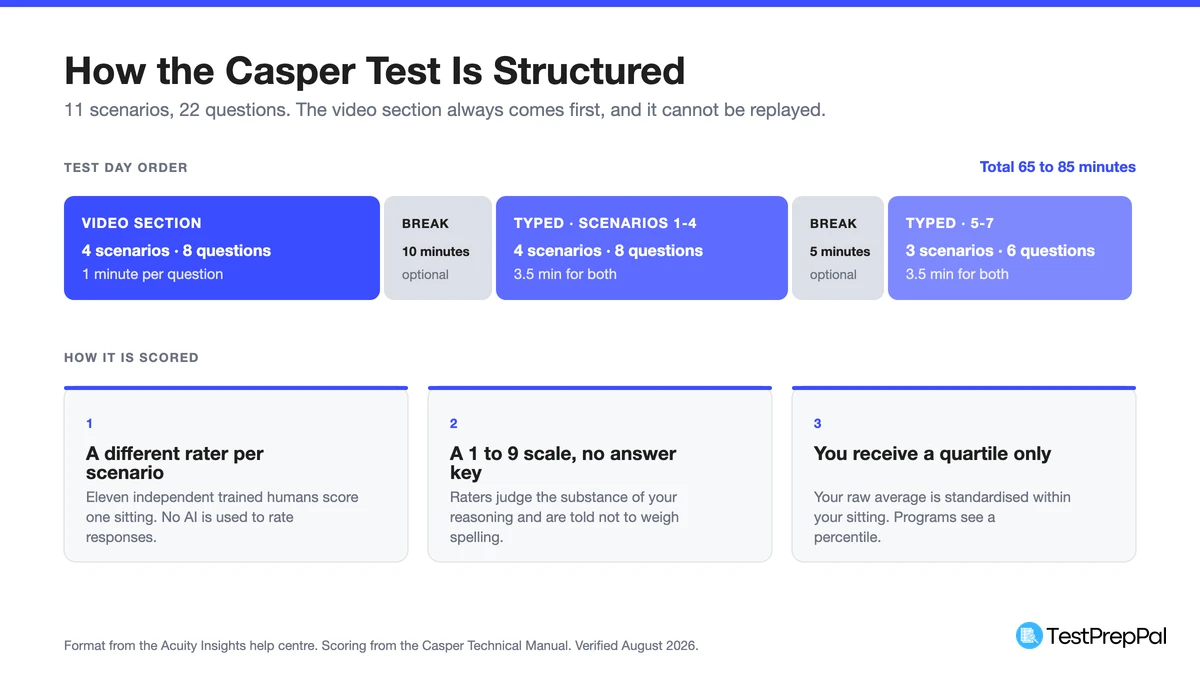 The current 2026-2027 structure. Video first, always, and the recording uploads whether or not you are finished.
Total test time is 65 to 85 minutes. Scenarios are presented as either short filmed clips with actors or as text, and you cannot replay a video scenario. Video responses cannot be reviewed or re-recorded — Acuity states the recording uploads when you submit or automatically when the one-minute timer runs out. A shorter form (2 video, 6 typed scenarios, 45–65 minutes) exists for Australian teacher education applicants.
Format and timing confirmed against the Acuity Insights help centre article What is the Casper test format and length? and About Casper, verified August 28, 2026.
How Casper Is Scored
This is the most misunderstood part of the assessment, and understanding it changes how you prepare.
Every scenario is scored by a different trained human rater. Not one rater per test, not one per section — a different person for each scenario, which means a single Casper sitting is reviewed by a large number of independent people whose only shared reference is the training they received. Acuity Insights states plainly that AI is not used to score, rate, or evaluate Casper responses.
Raters work on a 1 to 9 scale and are not given an answer key. They are told which concepts are central to a scenario and asked to judge the substance of your reasoning. They are explicitly instructed not to weigh spelling, and they must live in the same country as the applicants they rate, so that cultural context is read correctly.
Your ratings across all 11 scenarios are averaged into a raw score. That raw score is then standardised within your specific test sitting — converted to a z-score and a percentile, which is what participating programs receive. As an applicant, you receive only a quartile, and Acuity confirms that applicants do not receive their Casper score itself.
Three consequences follow, and they should shape your prep:
- Your result is relative, not absolute. You are ranked against the people who sat your test form. There is no score to "hit."
- A single bad scenario is survivable. With eleven independent raters, one flat answer moves an average; it does not decide it. Recovering from a bad scenario matters more than perfecting a good one.
- Consistency beats brilliance. The rater reading scenario nine has never seen scenarios one through eight. Every scenario has to stand on its own.
Sources: Understanding Casper: How Are Casper Tests Rated?, the Casper Technical Manual, and Will I receive my Casper score?, all verified August 28, 2026.
The 10 Competencies Casper Probes
The Casper Technical Manual names ten aspects of social intelligence and professionalism that inform scenario writing, question writing, test blueprints, and rating. They are not scored as separate subscores — you receive one combined result — but knowing them tells you what a rater is reading for.
| Competency | What it looks like in an answer | How to show it |
|---|---|---|
| Collaboration | You treat other people as part of the solution, not obstacles | Say who you would involve and what you would ask them |
| Communication | Structure, directness, and actual words | When you say you would talk to someone, write what you would say |
| Empathy | Naming what a specific person feels and why | Include the person behaving badly, without excusing them |
| Equity | Noticing that a rule or cost lands harder on some people | Address the barrier, not just the individual in front of you |
| Ethics | Naming competing obligations and choosing one | State the obligation you are setting aside and why |
| Motivation | Acting from a durable reason, not convenience | Explain why this matters beyond avoiding trouble |
| Problem solving | A concrete next step someone could take tomorrow | Say what happens if your first step fails |
| Professionalism | Respecting confidentiality, scope, and reporting lines | Do not claim authority the scenario has not given you |
| Resilience | Accepting an uncomfortable outcome | Name the cost you would pay rather than engineering a costless answer |
| Self-awareness | Naming your own bias or stake and adjusting | Do not just assert that you would be objective |
The single most common failure across all ten is hedging. A response that surveys options without committing reads as indecision, not nuance. Pick a position, then defend it.
The Real Constraint Is Words Per Minute
Most applicants do not lose Casper points on ethics. They lose them on throughput.
A typed scenario gives you 210 seconds for two questions — about 105 seconds each. Here is what that buys you at different typing speeds, assuming you also spend part of that time thinking:
| Sustained typing speed | Words in 105 seconds | Realistic output after thinking |
|---|---|---|
| 30 wpm | 52 | ~35 words — too thin to score well |
| 40 wpm | 70 | ~50 words |
| 50 wpm | 87 | ~65 words |
| 60 wpm | 105 | ~80–90 words |
| 70 wpm | 122 | ~100–120 words |
A strong typed answer lands at roughly 90 to 130 words. Below about 60 words you generally cannot name the stakeholders, commit to an action, and justify it — the three things a rater is looking for. That means sustained typing in the 55–70 wpm range is close to a prerequisite, and if you are below 45 wpm, spending two evenings on typing practice will do more for your quartile than another week of reading about ethical frameworks.
Video is the mirror image. Sixty seconds of natural speech is 120 to 140 words — more content than a typed answer, delivered under worse conditions. There is no editing, no backspace, and you cannot re-record. The fix is the same: speak your practice answers out loud, at full volume, for the whole minute. Rehearsing silently trains nothing, because the thing that fails on test day is fluency, not reasoning.
A structure that survives both formats, in this order: what is happening → who is affected → what I would do → why → what it costs. That last clause is what separates third quartile from fourth. Anyone can propose an action; showing you know what your action gives up is the evidence of judgement.
How to Use This Simulator
Take the full 11-scenario run first, cold, with no preparation. The point of the first attempt is diagnostic — you want to find out whether your bottleneck is deciding, typing, or editing, and you cannot learn that from a scenario you have already thought about.
Then work the review screen honestly. Tick a rubric criterion only if your answer actually did the thing, not if you were thinking it. The gap between "I would have said that" and what is on the page is exactly the gap a rater sees.
After that, use single-scenario mode to drill the specific failures. If your answers are consistently under 70 words, the problem is typing speed. If they are long but hedged, practise committing to a position within the 30-second reflection window before typing a single character. If you go blank in the video section, run the four video scenarios back to back until a minute stops feeling long.
Keep Practicing
Work through our full guide on how to prepare for the Casper test for a week-by-week study plan, the test-day logistics checklist, and the mistakes recent test-takers report most often.
For everything else Casper — including our comparison of paid prep options — start at the Casper hub. If you want structured feedback on your own written answers rather than self-scoring, our independent reviews of BeMo's Casper prep and Casper Booster cover what each one actually includes, and the full list sits under Casper prep courses.
One last thing worth repeating: Acuity Insights provides a free official practice test inside your Casper account, and it is the only place you will experience the real interface. Use this simulator to build volume and diagnose your pacing, then take theirs to remove any surprise from the software itself.
We may earn commissions from some links on this page, but this does not affect our reviews or your experience.