
UWorld Vs. Kaplan MCAT: Which Self-Paced Course Wins In 2026?

by John Reed· Last Updated: Oct 11, 2026

UWorldOur Pick
Includes
- ✓3,000+ MCAT-level questions written by UWorld's in-house experts
- ✓6 print and digital science review books
- ✓2 print and digital CARS review books
- ✓450 concept check questions across lessons
- ✓1,300+ high-yield video lessons
- ✓2 UWorld MCAT full-length practice exams
- ✓AAMC Online-Only Bundle with 7 official AAMC practice exams ($405 list, $336.15 direct)
- ✓4,000 end-of-lesson flashcard quiz questions
- ✓UAsk AI tutor trained on UWorld's own explanations
- ✓Adaptive study planner, digital notebook, and performance analytics
Pros
- +Answer explanations are the most detailed and heavily illustrated in MCAT prep
- +Includes the AAMC Online-Only Bundle and its 7 AAMC practice exams, which costs $336.15 bought direct
- +1,300+ expert-taught video lessons integrated with the 8-book set
- +4,000 spaced-repetition flashcard quiz questions built by UWorld's authors
- +7-day free trial with 100 QBank questions, no credit card required
Cons
- −$1,199 buys only 90 days; the 180-day package most students need is $1,449
- −No live instruction or included tutoring at any tier
- −AAMC access ends with your UWorld subscription (renewing restores it, capped at 360 days), while a direct AAMC purchase lasts 365 days

Kaplan
Includes
- ✓10,000+ total practice questions
- ✓3,000+ customizable QBank questions
- ✓90+ content refresher videos
- ✓18 full-length practice tests
- ✓7-book subject review set
- ✓All official AAMC practice materials
- ✓Personalized study plan and placement quizzes
- ✓Mobile companion app
Pros
- +18 full-length MCAT practice exams
- +Includes all official AAMC practice materials
- +7-book MCAT subject review set included
- +Multiple prep formats: self-paced, live online, and in-person
- +Mobile companion app for QBank, videos, and flashcards
- +Higher score guarantee options (eligibility requirements apply)
Cons
- −Premium pricing versus some competitors
- −Some students find Kaplan full-lengths harder than AAMC material
- −Best guarantee terms are tied to specific programs and strict requirements
Both of these companies sell a self-paced MCAT course that promises to be the only thing you buy: books, videos, a question bank, full-length exams, and the official AAMC materials, all on one platform. UWorld calls its version the Comprehensive Prep Course and lists it from $1,199. Kaplan calls its version On Demand and lists it from $1,599.
That $400 gap is not the story, because Kaplan discounts almost constantly and the two courses are usually within about $100 of each other by the time you check out. The real difference is what each one is built to do. UWorld is built to teach you the content and then explain, in exhausting visual detail, why you got a question wrong. Kaplan is built to bury you in test-like practice and then back it with a money-back guarantee.
Here is the full breakdown, with every number checked against both companies' own course pages on 3 September 2026.
UWorld Vs. Kaplan MCAT Comparison Table
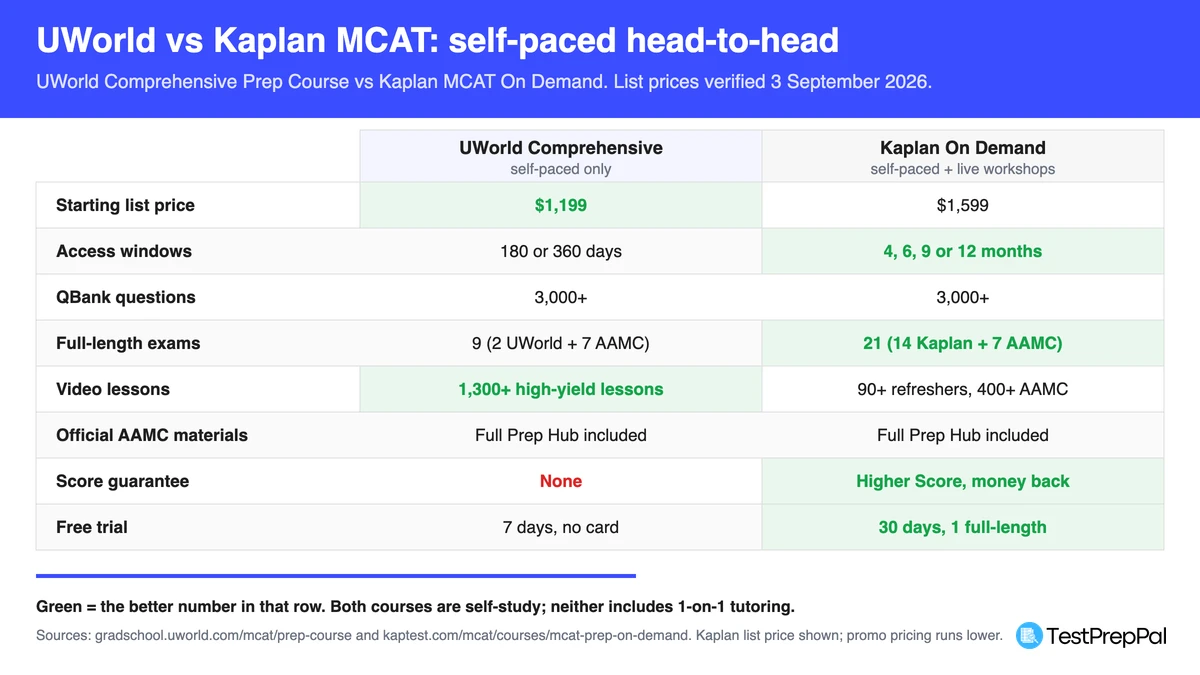 The self-paced head-to-head at a glance. Kaplan list prices shown; promotional pricing runs lower.
| Feature | UWorld Comprehensive Prep Course | Kaplan MCAT On Demand |
|---|---|---|
| Starting list price | From $1,199 (90 days) | From $1,599 |
| Typical promo price | $50 off with our code | $1,299 to $1,899 in the current sale |
| Access windows | 90, 180, or 360 days | 4, 6, 9, or 12 months |
| Format | Fully self-paced | Self-paced plus unlimited live workshops |
| QBank questions | 3,000+ | 3,000+ |
| Other practice questions | 450 concept checks, 4,000 flashcard quiz questions | 10,000+ total practice questions across the course |
| Full-length exams | 9 total (2 UWorld + 7 AAMC) | 21 total (14 Kaplan + 7 AAMC) |
| Video lessons | 1,300+ high-yield lessons | 90+ content refreshers, plus 400+ AAMC question explainers |
| Review books | 8 (6 science + 2 CARS), print and digital | 7-book subject review set, 3,000+ pages |
| Official AAMC materials | AAMC Online-Only Bundle included | All official AAMC practice materials included |
| AI tutor | UAsk | Kaplan AI Tutor |
| Study planner | Adaptive, 3 plan options | Adaptive, driven by placement quizzes |
| Mobile app | Yes | Yes |
| Score guarantee | None | Higher Score Guarantee, money back |
| Free trial | 7 days, no credit card | 30 days, includes one full-length |
What Each Course Actually Includes
UWorld's Comprehensive Prep Course is the top of a three-tier lineup. The $339 standalone QBank sits at the bottom, the $599 Core course adds the 8-book set and 450 concept check questions, and the Comprehensive tier (from $1,199) adds the 1,300+ video lessons, the 4,000 flashcard quiz questions, the 7 AAMC practice exams, and the AAMC Online-Only Bundle. The 2 UWorld full-lengths and the UAsk AI tutor come with every tier. All three run on the same platform. Our UWorld MCAT course review breaks the tiers down in more detail if you are not sure the top one is the tier you need.
Kaplan's On Demand course has no tiers. There is one course, sold in four access lengths, and every length includes the same materials.
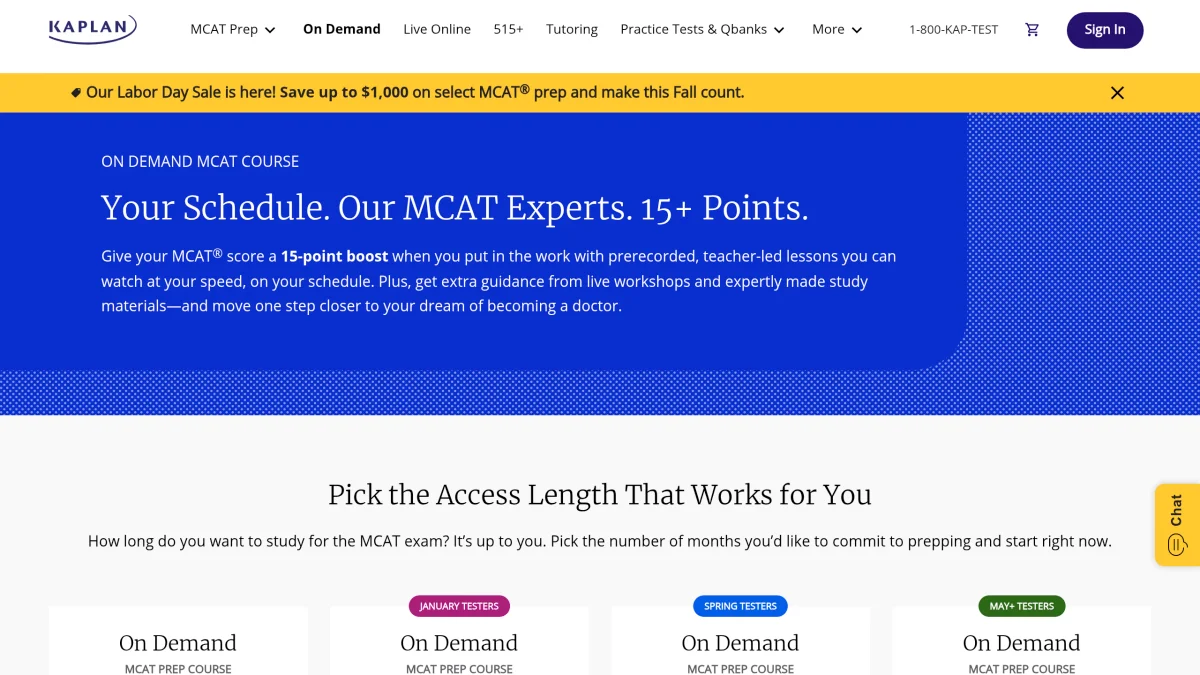 Kaplan's On Demand course page. Source: kaptest.com (captured September 2026).
What you get in Kaplan On Demand: prerecorded teacher-led lessons, the 3,000+ question QBank, the 7-book subject review set, 21 full-length practice tests, all the official AAMC materials, 90+ content refresher videos, explainer videos for 400+ hard AAMC questions, unlimited livestreamed workshops, the mobile companion app, Kaplan's AI tutor, and CARS Skillbuilders. Kaplan totals it at over 700 hours of guided prep and practice.
One thing worth flagging before the category breakdown: Kaplan's own course FAQ says 8 books while the On Demand product page says a 7-book subject review set. Seven review books is the number you can count on.
UWorld Vs. Kaplan MCAT Detailed Comparison In 2026
Price And What You Actually Pay
UWorld sells the Comprehensive course at $1,199 for 90 days, $1,449 for 180 days, and $1,549 for 360 days (verified on UWorld's checkout on 11 October 2026), with Affirm financing from about $109 per month. It does not run public coupon sales.
Kaplan does the opposite. The list prices are $1,599 for 4 months, $1,999 for 6, $2,399 for 9, and $2,599 for 12. As of 3 September 2026 a Labor Day sale was running those down to $1,299, $1,499, $1,799, and $1,899 with the codes 300GOAL, 500GOAL, 600GOAL, and 700GOAL. Kaplan has had some version of that sale live for most of the year, so treat the list price as an anchor rather than a real number.
Compare like for like and the gap mostly closes. UWorld's $1,199 buys only 90 days, against about 120 days for Kaplan's discounted $1,299. At six months, UWorld's 180-day package is $1,449, or $1,399 with our code, against Kaplan's $1,499 sale price: a gap of $50 to $100. The gap only opens up at a full year, where UWorld's 360 days cost $1,549 ($1,499 with our code) against Kaplan's $1,899 for 12 months.
UWorld does not publish coupons, but our readers can use code IMP4PREPPAL50 for $50 off the 180-day or 360-day Comprehensive course. It does not work on the 90-day package, the Core course, or the standalone QBank. Details are on our UWorld MCAT discount page.
UWorld wins on price, but by less than the sticker suggests. For a six-month plan the two are within about $100. For a full year UWorld is around $350 cheaper. Kaplan is the only one of the two with a 9-month option.
Content Review: Books And Video
This is UWorld's clearest win, and it is not close.
UWorld's 8-book set is built around 4,000+ illustrations with interactive hyperlinks, and the 1,300+ video lessons are embedded inside the book chapters rather than parked in a separate library. Lessons run 3 to 6 minutes and are taught by the same PhD and MS-level authors who wrote the chapter, so the diagrams and vocabulary match. When you get stuck on a page, the video for that page is on that page.
Kaplan's 7-book set is genuinely good and is one of the best-regarded print resources in MCAT prep, with 3,000+ pages and a recently revamped CARS approach. The video side is thinner. You get 90+ content refresher videos covering the highest-yield topics, plus Lesson-on-Demand videos on the four AAMC reasoning skills. That is a fraction of UWorld's library, and Kaplan's video style is drier: competent, structured, and not especially memorable.
UWorld wins. If you are relying on the course to teach you biochemistry from close to scratch, UWorld's read-then-watch loop is the better teaching engine.
Practice Questions
Both ship a 3,000+ question QBank, and on the QBank alone this is close to a tie.
The counts diverge once you add everything else. UWorld layers 450 concept check questions inside the book lessons and 4,000 end-of-lesson flashcard quiz questions with spaced repetition on top of the QBank. Kaplan advertises 10,000+ total practice questions across the course, spread across lesson quizzes, homework, workshops, and the QBank.
Both numbers are real and both are padded in the same way, because a flashcard quiz question and an MCAT-style passage question are not the same unit of work. Judge the QBanks, and there both companies are at 3,000+.
Call it a tie on volume. UWorld's questions are more widely reported to track AAMC style and difficulty closely, which is a separate question we dug into in is UWorld harder than the MCAT.
Full-Length Practice Exams
This is Kaplan's clearest win, and it is a big one.
Kaplan includes 21 full-length practice tests, and its own FAQ confirms that figure includes all 7 official AAMC tests. So you get 14 Kaplan-built full-lengths plus the 7 AAMC exams, integrated into the study schedule rather than dumped in a folder.
UWorld gives you 2 of its own full-lengths, scored on the 472 to 528 scale, plus the same 7 AAMC exams. That is 9 total, and only 2 of them are third-party.
The honest caveat cuts both ways. Kaplan's full-lengths have a long-standing reputation for being harder than the real MCAT and heavier on low-yield recall, so they are better used as stamina and gap-finding tools than as score predictors. We cover that in our Kaplan MCAT review. But "these are imperfect predictors" is a much smaller problem than "there are only two of them." If you are a retaker who has already burned the AAMC exams, UWorld leaves you with almost nothing new to sit.
Kaplan wins, decisively.
Answer Explanations
UWorld's answer explanations are the reason the company has the reputation it has. Every question gets a rationale for the correct answer and for each wrong one, and the explaining is done by flowcharts, annotated passage data, colour-coded tables, and diagrams rather than paragraphs of text. Review is slow, and that is the point: 20 questions with an hour of review beats 50 skimmed. Our UWorld questions per day calculator works out the pace your test date actually allows.
Kaplan's QBank explanations are solid but brief and text-first. They tell you why an answer is right or wrong without much visual scaffolding.
Kaplan does have one asset here that UWorld cannot match: explainer videos for 400+ difficult, high-yield questions on the official scored AAMC practice tests, plus step-by-step explanations for over 500 QBank CARS questions. AAMC's own explanations are famously terse, so having a Kaplan instructor walk through the hard ones is genuinely useful, and it is not something you can buy from UWorld at any tier.
UWorld wins on the depth of a single explanation. Kaplan wins on explaining the AAMC's own questions.
Official AAMC Materials
Watch out for this one, because it is where a lot of comparisons get UWorld's pitch wrong.
UWorld's strongest price argument is that the Comprehensive tier bundles the AAMC's Online-Only Bundle, which UWorld markets as a "$405 value" and the AAMC currently sells for $336.15: Practice Exams 2 through 6, both Section Bank volumes, the CARS Question Bank, the four science Question Packs, and the Independent Question Bank. Against a course that does not include AAMC materials, that argument is strong.
It does not work against Kaplan, because Kaplan includes all the official AAMC practice materials too, at every course level. So that $336 does not come off UWorld's side of the ledger in this particular matchup.
One mechanical difference does matter. UWorld's AAMC access matches your subscription window, so the 90-day package means only 90 days of AAMC access. Renewing restores it, but AAMC access through UWorld is capped at 360 days from your original start date. Pick a window that covers your whole timeline, including the final weeks when you will be taking the AAMC full-lengths.
Tie on what you get, with a scheduling trap on UWorld's side.
Study Planning And Structure
Both build you a schedule, and both adapt it.
UWorld's adaptive planner produces a plan in under a minute and offers three options, including an expert-built curriculum plan for students who do not want to make sequencing decisions at all. Kaplan's planner is driven by placement quizzes: you test out of material you already know, and assignments update accordingly, on a calendar that dictates daily tasks.
Kaplan also has something UWorld does not: unlimited livestreamed workshops, including CARS strategy sessions, and a private student community. That makes "self-paced" slightly inaccurate for On Demand. There is a live element you can lean on, and for students who drift without external structure it matters more than any feature-count comparison suggests.
Kaplan wins on accountability. UWorld wins on getting out of your way.
Score Guarantee
UWorld does not advertise a score guarantee on any MCAT tier. Kaplan's On Demand course is on the Higher Score Guarantee eligible list, so if you complete the program and your official MCAT does not beat your baseline, you can take your money back or 12 more weeks of access for free.
Read the conditions before you weight this too heavily. You have to be a first-time Kaplan student, pay in full, establish a baseline with a Kaplan-proctored diagnostic or a previous official score, complete every program requirement, sit the real MCAT within 60 days of finishing, submit your score report inside 60 days, and return all your course materials to get cash back. Fees paid by a third party are not refundable.
Also note what On Demand does not get. Kaplan's headline 515+ or 15-point guarantee applies only to the 515+ Course, Premium Tutoring, and Online Bootcamp. On Demand's guarantee is "you will score higher than your baseline," which is a much lower bar than the marketing implies.
The same goes for the 15-point claim on the On Demand page. Kaplan's own footnote says that average applies only to students who completed 4,400+ practice questions and 550+ study activities, and that it measures the gain from a student's first practice exam to their highest practice exam. It is not a 15-point gain on the real MCAT.
Kaplan wins, because a guarantee with conditions still beats no guarantee at all.
Free Trials
UWorld's trial is 7 days with no credit card: 100 QBank questions, the first interactive lesson from every subject, sample videos, the planner, flashcards, the mobile app, and performance reporting.
Kaplan's is 30 days and centres on one full-length practice test with a score analysis, plus a QBank preview, foundational video modules for all four sections, a study calendar preview, and a look at the AI tutor.
Kaplan wins on length and on giving you a baseline score. UWorld wins on the thing that actually decides this purchase, which is whether its explanation style works for your brain. A week inside the UWorld QBank will tell you that faster than any review.
Verdict: Which One Is Better?
For most students buying one self-paced MCAT course, UWorld Comprehensive is the better purchase. It costs less at list, the 8-book and 1,300-video content engine is stronger than Kaplan's 7 books and 90 refreshers, and the answer explanations do more teaching per question than anything else on the market. If your content knowledge is the weak link, that is the course that fixes it.
UWorld's weakness is real and you should not talk yourself out of it: 2 third-party full-length exams is not enough. If you finish the QBank and the AAMC tests with six weeks left, you will be buying practice exams from somebody else.
Kaplan On Demand is the better purchase in four specific situations. You want a large bank of full-lengths, especially as a retaker who has already used the AAMC exams. You want a money-back guarantee and you are willing to meet its conditions. You need 9 or 12 months of access. Or you know you drift without structure, in which case the calendar, the livestreamed workshops, and the student community are worth more to you than better diagrams.
Our pick for self-paced MCAT prep:
UWorld MCAT Comprehensive Prep Course
Exclusive TestPrepPal code: $50 off the 180-day ($1,449) or 360-day ($1,549) Comprehensive Prep Course.
IMP4PREPPAL50180/360-day Comprehensive only
Pros
- Answer explanations are the most detailed and illustrated in MCAT prep.
- Includes the AAMC Online-Only Bundle and its 7 practice exams ($336.15 bought direct).
- 1,300+ video lessons and 8 print + digital books in the same platform.
Cons
- No live classes or tutoring at any tier; the course is fully self-paced.
There is also a third answer worth naming. Neither of these is our top overall MCAT pick. Blueprint's self-paced course starts at $1,099, ships 15 full-length exams, and carries a score increase guarantee, which is close to the best of both columns above. See our UWorld vs Blueprint comparison and our Kaplan vs Blueprint comparison, or the full best MCAT prep courses roundup.
And if your content review is already solid, skip both courses. The $339 UWorld QBank has the same 3,000+ questions and the same explanations as the Comprehensive course for a third of the price.

Kaplan MCAT
Are you looking for a guaranteed way to ace the MCAT? This is for you.
Get up to $500 OFF today!Pros
- Personalized study plan
- High score guarantee
- All options available: in-person, live online or self-paced.
Cons
- It can get expensive especially if you opted for in-person course.
You can check out the other comparisons we did on MCAT prep resources below:
- UWorld Vs. Blueprint MCAT
- Kaplan MCAT Vs. Blueprint
- Kaplan MCAT vs Princeton Review
- Altius Vs. UWorld MCAT
- Altius Vs. Kaplan MCAT
UWorld Vs. Kaplan MCAT FAQs
Is UWorld Or Kaplan Better For The MCAT?
UWorld is better if you need the course to teach you content, because its books, 1,300+ embedded video lessons, and visual answer explanations do far more explaining per question. Kaplan is better if you need practice volume and accountability, because it includes 21 full-length exams to UWorld's 9, unlimited live workshops, and a money-back score guarantee.
Is Kaplan MCAT Worth $400 More Than UWorld?
At list price, usually not. In practice you rarely pay list. Kaplan discounts its On Demand course most of the year, and in the September 2026 sale the 6-month option was $1,499 against UWorld's $1,449 for 180 days ($1,399 with our code). At $50 to $100 apart, the decision comes down to whether 12 extra third-party full-lengths and a score guarantee matter more to you than better explanations and a bigger video library.
How Many Practice Tests Do You Get With UWorld Vs Kaplan?
Kaplan includes 21 full-length practice tests, which its FAQ confirms covers all 7 official AAMC tests, so 14 are Kaplan-built. UWorld's Comprehensive course includes 2 UWorld full-lengths plus the same 7 AAMC exams, for 9 total. That is the single biggest feature gap between the two courses.
Does Kaplan MCAT On Demand Have A Score Guarantee?
Yes, but not the one in the ads. On Demand is covered by Kaplan's general Higher Score Guarantee: complete the program, sit the real MCAT within 60 days, and if you do not beat your baseline you can request your money back or take 12 more weeks of access free. The 515+ or 15-point guarantee is limited to the 515+ Course, Premium Tutoring, and Online Bootcamp. UWorld offers no score guarantee at any tier.
Do Both Courses Include The Official AAMC Materials?
Yes. UWorld bundles the AAMC Online-Only Bundle at the Comprehensive tier, and Kaplan includes all official AAMC practice materials in every course format. That means UWorld's usual "the AAMC bundle is a $405 value" argument does not give it an edge here, because Kaplan matches it. UWorld's AAMC access ends with your subscription window (renewing restores it, up to 360 days from your start date), so choose a window that covers your full study timeline.
Can You Use UWorld And Kaplan Together?
It is a common pairing, but buying both full courses is wasteful because you would pay twice for two 3,000-question QBanks, two book sets, and two copies of the AAMC materials. The efficient version is one course plus the other company's cheaper standalone piece: Kaplan On Demand for the structure and the 21 full-lengths, plus the $339 UWorld QBank for the explanations.
Which Is Better For An MCAT Retaker?
Kaplan, in most cases. A retaker has usually already used the AAMC exams and needs fresh full-lengths more than fresh content review, and Kaplan's 14 third-party exams are the biggest supply either company offers. The exception is a retaker whose score reflects content gaps rather than test-taking problems, since UWorld's explanations diagnose why an answer was wrong better than anything Kaplan ships.
We may earn commissions from some links on this page, but this does not affect our reviews or your experience.
Learn more about UWorld
Read our full review →
Learn more about Kaplan
Read our full review →