
Kaplan MCAT Vs. Princeton Review: 2026 Comparison

by John Reed· Last Updated: Jan 30, 2026

KaplanOur Pick
Includes
- ✓10,000+ total practice questions
- ✓3,000+ customizable QBank questions
- ✓90+ content refresher videos
- ✓18 full-length practice tests
- ✓7-book subject review set
- ✓All official AAMC practice materials
- ✓Personalized study plan and placement quizzes
- ✓Mobile companion app
Pros
- +18 full-length MCAT practice exams
- +Includes all official AAMC practice materials
- +7-book MCAT subject review set included
- +Multiple prep formats: self-paced, live online, and in-person
- +Mobile companion app for QBank, videos, and flashcards
- +Higher score guarantee options (eligibility requirements apply)
Cons
- −Premium pricing versus some competitors
- −Some students find Kaplan full-lengths harder than AAMC material
- −Best guarantee terms are tied to specific programs and strict requirements

Princeton Review
Includes
- ✓18 full-length practice tests
- ✓All official AAMC materials
- ✓4,900+ practice questions
- ✓500+ hours of video lessons
- ✓12 section/subject practice tests
- ✓8-9 MCAT books depending on plan
- ✓Smart Study Planner
- ✓Interactive score reports
Pros
- +Broad MCAT course lineup from self-paced to intensive immersion
- +18 full-length practice tests and all official AAMC materials
- +4,900+ practice questions in flagship plans
- +500+ hours of video lessons and strong structured curriculum
- +MCAT Topic Focus sessions in higher-tier plans
- +Score-improvement money-back guarantees on eligible programs
Cons
- −Premium pricing, especially for higher-tier plans
- −Guarantee terms require strict eligibility and completion criteria
- −Feature sets vary significantly by plan, so careful selection is needed
Kaplan and Princeton Review are both well-recognized names in the test prep industry.
So how do you decide between Kaplan and Princeton Review MCAT courses?
Well, that's exactly what we aim to establish in this in-depth Kaplan Vs. Princeton Review MCAT comparison.
So let's dive right in, shall we?
Spoiler alert: Kaplan is superior.

Kaplan MCAT
Are you looking for a guaranteed way to ace the MCAT? This is for you.
Get up to $500 OFF today!Pros
- Personalized study plan
- High score guarantee
- All options available: in-person, live online or self-paced.
Cons
- It can get expensive especially if you opted for in-person course.
Kaplan MCAT Vs. Princeton Review Comparison Table
| - | Kaplan MCAT | Princeton Review MCAT |
|---|---|---|
| Price Range | From $1,599 to $7,299+ | From $1,599 to $13,499+ |
| Content Access Period | Varies by plan (4+ months; longer options on select plans) | Varies by plan (e.g., 6/12 months self-paced; 365 days tutoring resources) |
| Live Online Instruction | 42 Hours (Live Online) | 123 Hours (515+/Ultimate), up to 215 hours (Summer Immersion) |
| On-Demand Videos | 90+ | 500+ hours |
| Full-Length Practice Tests | 18 | 18 |
| Diagnostic Exams | None | 35 |
| MCAT Prep Books | 7 | 8-9 (varies by plan) |
| In-Person Prep Option? | Yes | Yes |
| Mobile App? | Yes | Yes (MCAT Flashcards app) |
| Higher Score Guarantee? | Yes | Yes |
Kaplan Vs. Princeton Review MCAT Overview
Founded in 1938, Kaplan is widely recognized as an authority when it comes to prepping students for standardized tests such as the Medical College Admission Test.
The company offers many MCAT test prep resources, including tutoring services, in-person and online programs, print books, and a horde of other online materials.
Here's an overview of the MCAT study options offered by Kaplan:
| Kaplan MCAT Courses | Pricing |
|---|---|
| On-Demand Course | From $1,599 |
| Live Online Course | From $2,699 |
| In-Person Course | From $3,199 |
| Private Tutoring + Live Online Course | From $3,599 |
| 515+ Course | $3,599 |
| 5-Week Online Bootcamp | $7,299 |
The Princeton Review, founded in 1981, is a similarly well-recognized authority when it comes to preparing students for standardized tests. It is worth noting that the Princeton Review is not affiliated with Princeton University.

The Princeton Review offers test prep courses, tutoring services, and guidebooks, which are more or less the same MCAT resources offered by Kaplan.
Specifically, here's an overview of the MCAT study options offered by Princeton Review:
| Princeton Review MCAT Courses | Pricing |
|---|---|
| Self-Paced Course | $1,599 (6-month) / $1,999 (12-month) |
| Ultimate Course | $2,899 |
| MCAT 515+ Course | $3,499 |
| 515+ Immersion Course | $7,349 |
| Summer Immersion (In-Person) | From $13,499 |
| Private Tutoring | From $183/hr |
Now let's take a keener look at the differences between Kaplan and Princeton Review and help establish once and for all which of the two is a more suitable MCAT prep option.

Kaplan MCAT Vs. Princeton Review Detailed Comparison In 2026
Pricing & Content Access Periods
One of the striking differences between Kaplan and Princeton Review is how they package pricing and access by product tier.
Kaplan's entry point starts lower (On Demand from $1,599), while Princeton Review's self-paced starts at $1,599 for 6 months and $1,999 for 12 months. At the premium end, Princeton Review's Summer Immersion pushes into a much higher range.
So, depending on which tier you are comparing, either company can look more affordable. Kaplan is generally stronger on entry-to-mid pricing flexibility, while Princeton Review has a wider spread at the top end.
Content Coverage
Both Kaplan and Princeton Review offer very intense, content-heavy curriculums that comprehensively cover everything you need to know to successfully get you through the MCAT and into med school.
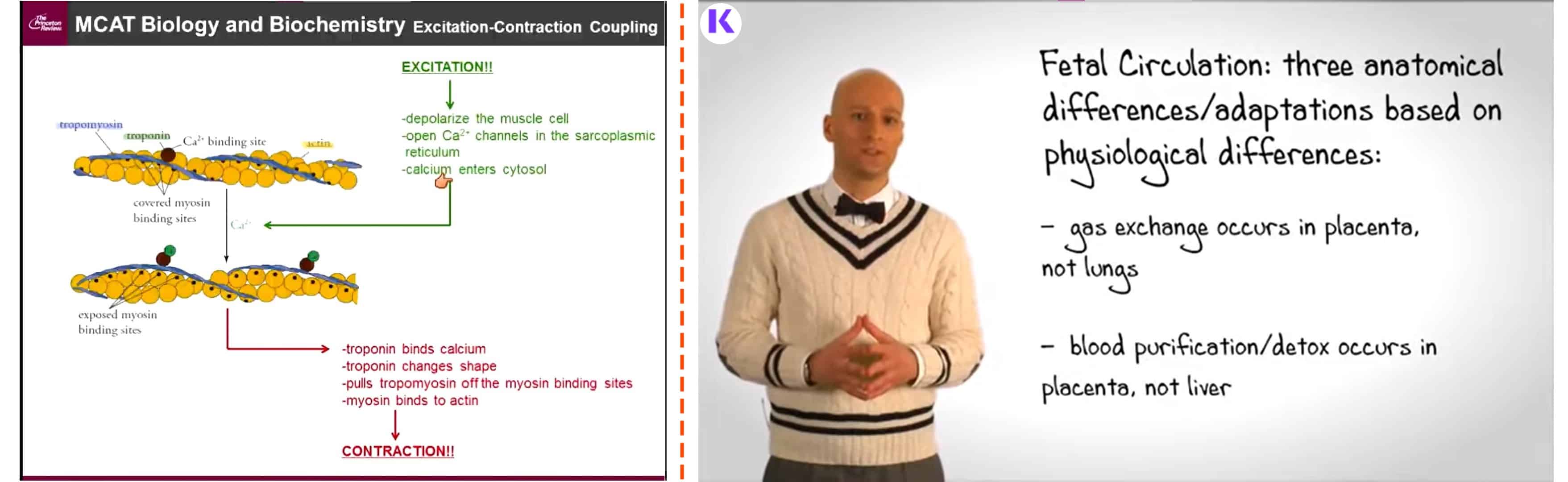
The Kaplan MCAT prep curriculum is very concise, with very little fluff. However, they do throw a ton of formulas at you, along with plenty of overview information that is incredibly helpful but, at the same time, can feel quite overwhelming.
On the other hand, the Princeton Review MCAT prep curriculum is incredibly dense to the point the program appears to be giving too many details that can feel similarly overwhelming and overbearing.
While having too much content going into great detail may appear to be a good thing, it isn't necessarily so. Princeton Review's over-detailed nature can make it hard for students to tell the depth of knowledge they need to know on a specific topic.
As such, while Kaplan is more tailored toward the average pre-med test-taker, Princeton Review would be best suited for the non-traditional pre-med students who took their prerequisites quite a while back and are, therefore, in need of a more intense refresher course.
Tutoring Options
Both companies offer robust tutoring, but the packaging differs.
Kaplan tutoring includes a Live Online course and is sold in 10, 20, 30, or 40-hour tutoring bundles. Princeton Review offers tutoring plans with explicit hourly pricing (starting at $183/hr) and multiple hour tiers.
So if you want a tutoring-first structure with transparent hourly framing, Princeton Review is more straightforward. If you want tutoring plus a bundled course ecosystem, Kaplan is very competitive.
Here's a comparison of their basic tutoring packages:
Kaplan Vs. Princeton Review Basic Tutoring Packages Comparison
| - | 10 Tutoring Hrs. | 20 Tutoring Hrs. | 40 Tutoring Hrs. |
|---|---|---|---|
| Kaplan MCAT | From $3,599 | Varies by package | Varies by package |
| Princeton Review MCAT | $3,299 | $5,200 | $8,800 |
As you can see, while Princeton Review is cheaper than Kaplan when it comes to the self-paced and live-online MCAT prep courses, Kaplan is the cheaper option when it comes to one-on-one tutoring.
Office Hours & Workshops
One major advantage of taking any MCAT prep course is the Office Hours that come with your package.
These are an incredibly valuable resource, and taking full advantage of Office Hours could very well make the difference between a 99th percentile scorer and an 80th percentile scorer.
Simply put, Office Hours are interactive lecture sessions led by an expert MCAT instructor whereby the sessions take a much more nuanced and detailed look at topics than what you get in a typical class lecture.
You not only ask questions and receive immediate feedback from a highly-qualified MCAT instructor but also get to receive additional instruction on how best to approach a certain topic or concept that you may be struggling with.
Kaplan includes unlimited livestreamed workshops and additional support layers across its MCAT ecosystem.
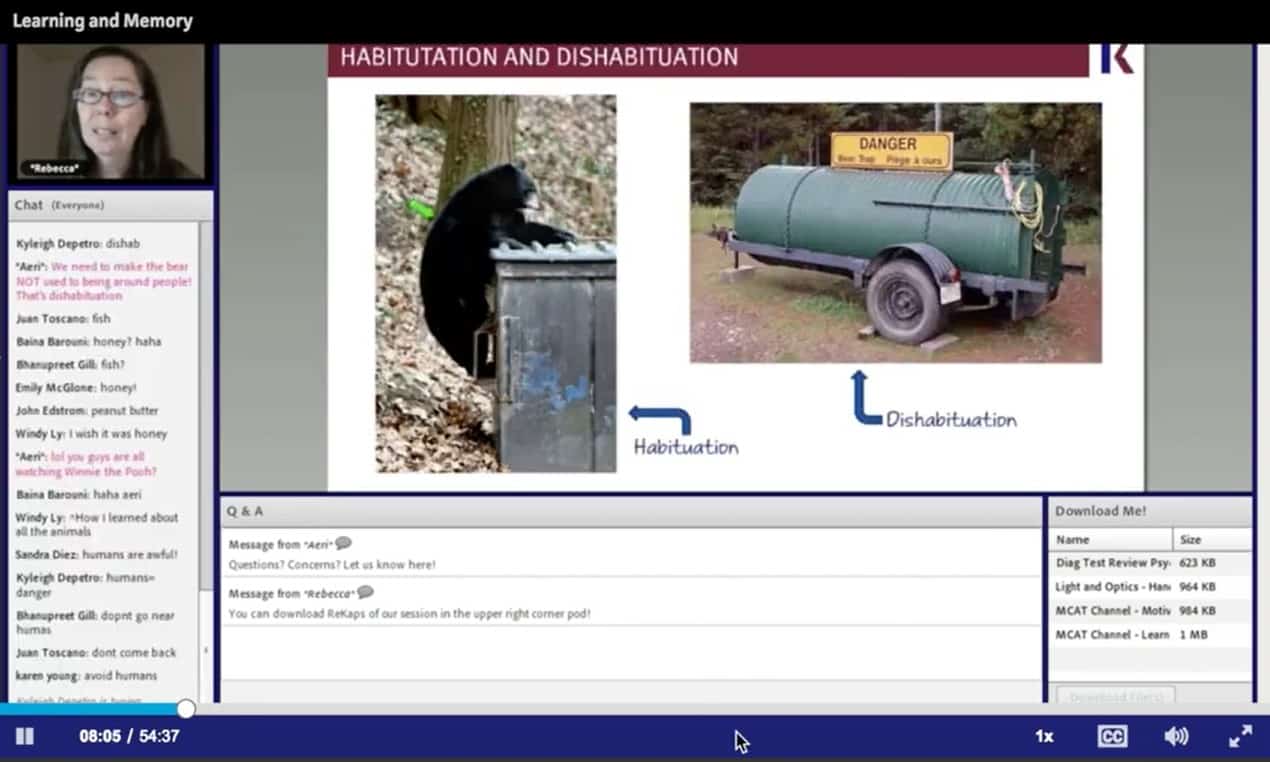
Conveniently, the huge advantage here is that these workshops apply to each Kaplan MCAT prep course, including the lowest-priced one.
Princeton Review also includes structured live support (such as Topic Focus and Q&A sessions), including in current self-paced ecosystems.
So, all things considered, both programs now provide meaningful live-support options, but Kaplan still has a strong edge in workshop availability across plan tiers.
Practice Materials
The practice material provided by Princeton Review comprises 35 diagnostic exams, 18 full-length practice tests, 12 subject-specific exams, and thousands of practice questions complete with detailed explanations.
Kaplan MCAT offers a variety of practice resources as well, including 21 full-length practice tests (14 Kaplan-built plus the 7 official AAMC exams) and a 3,000+ QBank within a broader 10,000+ practice-question pool.
Additionally, both test prep companies include access to all the official AAMC practice materials available, with all their MCAT courses.
Neither Princeton Review nor Kaplan offers very representative practice. The full-length exams, especially the Princeton Review ones, are extremely difficult. Kaplan's tests are deflated by around 10 points or so.
Also, Kaplan's CARS practice is particularly disappointing, seeing as the company doesn't really do a great job at replicating the AAMC CARS.
The content tested on Kaplan tests is very niche overall, and they include a wider range of lower-yield topics.
So overall, while the two companies are excellent for content review, they are not necessarily all that great when it comes to offering representative practice or testing MCAT logic.
MCAT Books
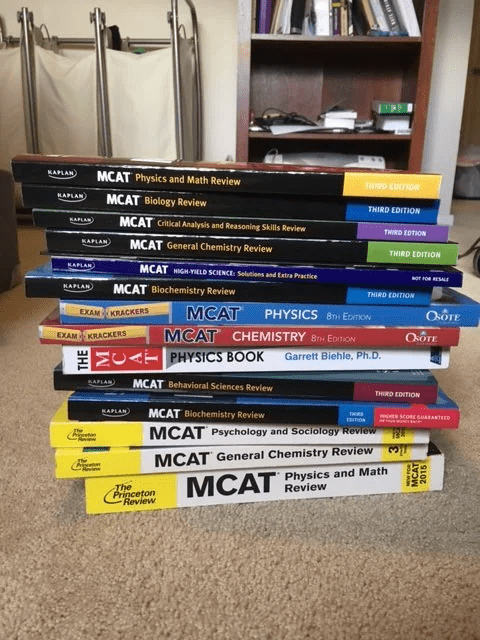
Both Kaplan and Princeton Review provide MCAT books that give a comprehensive review of all the MCAT subjects, which are Biochemistry, Biology, CARS, General Chemistry, Organic Chemistry, Behavioural Sciences, and Physics and Math.
The Kaplan MCAT books come very highly recommended. They not only offer detailed subject reviews but they are written in a way that's very easy to understand and come with plenty of valuable resources such as the concept checks and end-of-chapter summaries.
Rather than assuming that the learner has physician-level knowledge, Kaplan does a great job of explaining everything clearly, right from the basics, while still keeping things concise.
With their excellent breadth and depth of content, these books are spot-on when it comes to covering exactly what you need to know for the MCAT.
In particular, the Kaplan books are especially excellent when it comes to their coverage of the Chem/Phys and Bio/Biochem sections. However, they do fall short in the CARS and Psych/Soc sections.
The Princeton Review MCAT books are incredibly dense and in-depth to the point of being overwhelming. You would easily get lost in all the information provided, making it hard for you to tell the depth of knowledge you need on a particular topic.
One upside is that Princeton Review covers the Psych/Soc section incredibly well, providing good explanations and content coverage.
However, they do fall incredibly short when it comes to the Biochemistry book. While this section counts for a massive chunk of the MCAT, it is the thinnest book in the Princeton Review series and its content coverage is really scanty and not helpful at all.
Princeton Review's book count varies by package (commonly 8 in major course tracks and up to 9 in tutoring bundles), including exclusive titles in some tiers.
Now when it comes to these additional Princeton Review prep books, the Science and CARS workbooks are absolute gold.
So overall, while the Kaplan MCAT review books excel in the Bio/Biochem and Chem/Phys section, the Princeton Review MCAT books are perfect for CARS and Psych/Soc.
Guarantees
Kaplan offers a higher score guarantee framework, plus a 515+/15-point money-back guarantee on select premium programs (515+ Course, Premium Tutoring, and Bootcamp), subject to baseline and completion requirements.
Similarly, Princeton Review offers better-score guarantees across much of its MCAT lineup, and its 515+ programs use a baseline-based guarantee structure (515+ if starting score is 500+, or +15 points if under 500), with terms and eligibility requirements.
Verdict: Which One Is Better?
Princeton Review and Kaplan are both priced much higher than other MCAT prep courses in the market. So with such high stakes, deliberating between the two test prep companies becomes that much more challenging.
There are plenty of similarities between the two. Both offer extensive, content-heavy curriculums, and just like Princeton Review MCAT, Kaplan MCAT also doesn't necessarily offer the best MCAT practice in terms of representativeness.
With either test prep company, the full-length exams are quite difficult. However, this is not necessarily such a bad thing.
Challenging MCAT practice exams can be great for building your stamina, and if you can get by with a decent score, then you are definitely guaranteed to do well on the real thing.
While the Princeton Review courses are much more in-depth to the point of being overbearing, Kaplan's content coverage is much more concise such that it doesn't feel overwhelming.
From Princeton Review's video lessons to their classroom instruction and even to their books, you can easily drown in all the information provided, making it hard for you to tell the level of knowledge you need on a particular topic.
Kaplan, however, has excellent breadth and depth of content, covering exactly what you need to know for the MCAT.
Aside from that, while Princeton Review books are superior in covering Psych/Soc and CARS, Kaplan books dominate the Bio/Biochem and Chem/Phys sections.
So objectively speaking, each of the two test prep companies has its pros and cons, as well as its strengths and downfalls.
Your choice between the two options will have to boil down to what you are looking for in an MCAT test prep course and which MCAT section you are particularly struggling with.
If it has been a long time since you took the prerequisites, or are struggling with the Psych/Soc or CARS section, then Princeton Review MCAT will be a better fit for you. On the other hand, if you still have a good grasp of the MCAT concepts and just need a mild refresher, or are struggling with the Bio/Biochem or Chem/Phys sections, then Kaplan MCAT will be a better fit for you. Overall, I'd say Kaplan has a clear upper hand over Princeton Review.
Kaplan offers better studying flexibility by allowing you to choose your desired study length, create your own custom quizzes, and even take in-person MCAT prep classes, depending on where you are located.
Furthermore, they have a mobile app that's the perfect companion for studying on the go, and the Kaplan MCAT books are incredibly well-written and resourceful.
So Kaplan Vs. Princeton Review MCAT: which is the better choice?
Well, overall, Kaplan wins.
You can check out the other comparisons we did on other MCAT prep resources below:
- Kaplan MCAT vs Princeton Review
- Prep 101 vs Kaplan MCAT
- Prep101 Vs. Princeton Review
- UWorld Vs. Blueprint MCAT
- Memm Vs. Anki
- Blueprint MCAT vs Princeton Review
Kaplan Vs. Princeton Review MCAT FAQs
Is Princeton Review Better Than Kaplan MCAT?
No, Princeton Review is not better than Kaplan MCAT.
For starters, Kaplan MCAT has better content coverage in terms of conciseness. Furthermore, they have a number of premium features, such as unlimited workshops included even in their budget self-paced course option.
Just as well, the Kaplan books are far better written, with excellent breadth and depth of content covering exactly what you need to know for the MCAT. No more, no less.
The one area where Princeton Review is better than Kaplan is in CARS.
From the books to the practice tests, Kaplan is not good at replicating AAMC CARS, whereas the Princeton Review CARS workbook is an absolute godsend.
Princeton Review Vs. Kaplan MCAT Books: Which Ones Are Better?
Princeton Review is better than Kaplan MCAT when it comes to their Science and CARS workbooks.
However, the Kaplan Bio/Biochem and Chem/Phys books are far better than the Princeton Review ones.
Are Kaplan MCAT Practice Tests Harder Than Princeton Review?
No, the Princeton Review MCAT practice tests are extremely difficult, much harder than the Kaplan exams.
We may earn commissions from some links on this page, but this does not affect our reviews or your experience.
Learn more about Kaplan
Read our full review →
Learn more about Princeton Review
Read our full review →