


Princeton Review MCAT Review
by Princeton Review
Premium MCAT prep with score guarantee
✓Pros
- ✓Broad MCAT course lineup from self-paced to intensive immersion
- ✓18 full-length practice tests and all official AAMC materials
- ✓4,900+ practice questions in flagship plans
- ✓500+ hours of video lessons and strong structured curriculum
- ✓MCAT Topic Focus sessions in higher-tier plans
- ✓Score-improvement money-back guarantees on eligible programs
✗Cons
- ✗Premium pricing, especially for higher-tier plans
- ✗Guarantee terms require strict eligibility and completion criteria
- ✗Feature sets vary significantly by plan, so careful selection is needed
Highlights
- ✓18 full-length practice tests
- ✓All official AAMC materials
- ✓4,900+ practice questions
- ✓500+ hours of video lessons
- ✓12 section/subject practice tests
- ✓8-9 MCAT books depending on plan
- ✓Smart Study Planner
- ✓Interactive score reports
Price
$1,599 - $7,349
What Students Are Saying
Sign in to leave a review

The MCAT is the kind of exam you only want to sit for once and happily be completely done with it.
As such, students often need all the help they can get to guarantee an excellent score that will get them into a good medical school without having to retake the exam.
One approach many often opt for is to sign up for a reliable and competent test prep course that will provide them with the necessary material and much-needed structure during their MCAT study period.
However, is it worth paying thousands of dollars for an MCAT test prep program? Well, let us dive into this Princeton Review MCAT review and find out.
Princeton Review MCAT Options Compared
| MCAT® Self-Paced | MCAT® Ultimate Course | MCAT® 515+ Course | MCAT® 515+ Immersion | |
|---|---|---|---|---|
| Price | $1,599 (6-month) / $1,999 (12-month) | $2,899 | $3,499 | $7,349 |
| Access Period | 6 or 12 Months | 365 Days | 365 Days | 365 Days |
| Live Instruction | 90+ hours topic-specific | 123 Hours | 123 Hours | 195 Hours |
| Video Lessons | 500+ hours | 500+ hours | 500+ hours | 500+ hours |
| Diagnostic Quizzes/Exams | 35 | Varies by schedule | 89 diagnostic quizzes | Course diagnostics + required tests for guarantee |
| Full-Length Practice Tests | 18 | 18 | 18 | 18 |
| Subject Practice Tests | 12 | 12 | 12 | 12 |
| MCAT Books | 8 | 8 (course set) | 8 | 9 |
| AAMC Practice Materials? | Yes | Yes | Yes | Yes |
| Personalized Study Plan Tools? | Yes | Yes | Yes | Yes |
| On-Demand Tutoring? | No | No | No | Yes |
Princeton Review MCAT Prep Overview
Princeton Review offers a variety of MCAT test prep courses tailored to different students’ study needs. The courses are:
- MCAT® Self-Paced
- MCAT® Ultimate Course
- MCAT® 515+
- MCAT® 515+ Immersion
As of this update, Princeton lists Self-Paced, Ultimate Course, 515+, and 515+ Immersion under its official MCAT prep page.
As currently listed, Princeton’s core course ecosystem includes:
- Thousands of practice questions (4,900+ in flagship plans).
- 18 full-length practice tests.
- All official AAMC practice materials.
- 500+ hours of MedFlix-style video lessons.
- 8-9 MCAT books depending on program.
- Interactive score reports.
- Money-back/satisfaction guarantee terms that vary by product.
a) MCAT® Self-Paced
This is Princeton’s most flexible on-demand MCAT prep option and currently offers 6-month and 12-month access plans.
Self-Paced currently advertises:
- 90+ hours of topic-specific instruction support.
- 18 full-length tests and 12 subject-specific tests.
- 35 diagnostic exams.
- 4,900+ additional practice questions.
- 8 MCAT books.
b) MCAT® Ultimate Course
The Ultimate Course is a structured live option that currently starts at $2,899 and includes 123 hours of live instruction.
c) MCAT® 515+
The MCAT 515+ course currently starts at $3,499 and includes:
- 123 hours of live instruction.
- 18 full-length practice tests.
- 4,900+ additional practice questions.
- 89 diagnostic quizzes.
- 12+ MCAT Topic Focus sessions.
- 8 MCAT books (including an exclusive title).
- 365 days of online resource access.
d) MCAT® 515+ Immersion
This intensive course currently starts at $7,349 and features:
- 195 hours of live instruction.
- Unlimited 24/7 On-Demand Tutoring.
- 18 full-length tests and 12 section-specific tests.
- 4,900+ additional practice questions.
- 9 MCAT books.
- 365 days of online resource access.
Princeton Review MCAT Review For 2026
LiveOnline Classroom
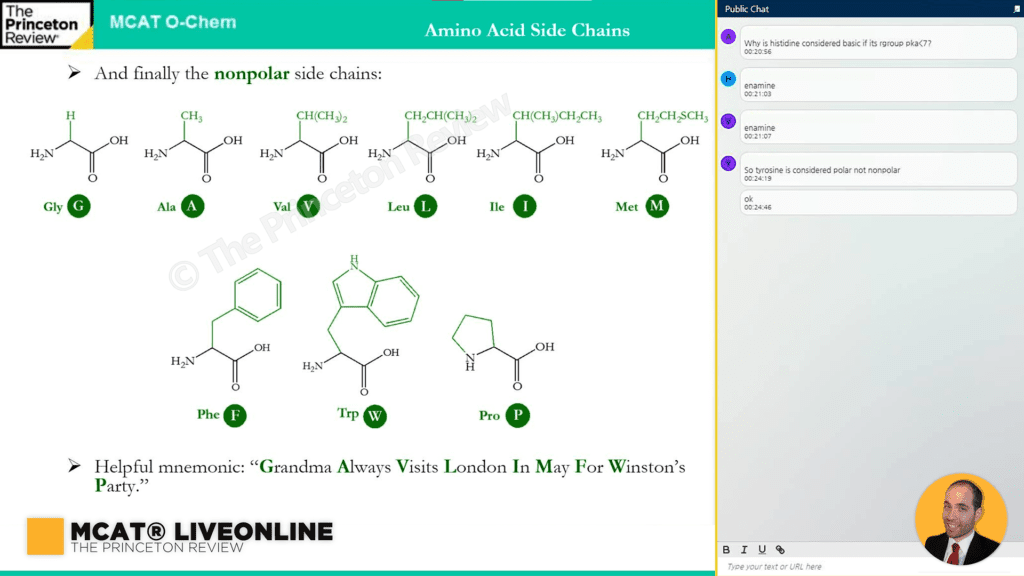
Princeton’s MCAT in-class experience is pretty incredible.
First off, the Princeton Review MCAT classes are led by highly trained online teaching experts who are very knowledgeable in their respective topics of specialization. At the same time, the teachers are very engaging, effectively conveying the important concepts in a timely manner.
Aside from the top-notch teachers, the interactive classroom allows you to interact with your teacher and classmates in real-time as you follow along with the lesson.
Scheduling options are pretty flexible, ranging from early morning to late night. You even have the option of scheduling your classes for specific days of the week. So you never have to worry about missing any classes, even if you have a crazy hectic schedule.
Better yet, every LiveOnline lesson is recorded, so you can go back and rewatch a specific lesson any time you want while reviewing tough concepts or if you simply need a refresher.
MCAT Books
Depending on the course, Princeton currently lists 8 or 9 MCAT books, including core subject-review books and course-exclusive titles.
These books provide in-depth subject review coverage and thousands of practice questions and passages to cement your content grasp. The well-written books feature diagrams, full-color illustrations, and tables to aid visual comprehension.
Additionally, the chapter summaries and extensive glossaries are handy when you need an immediate reference or a quick review. These books also include techniques and test-taking strategies so you can take the MCAT effectively.
Higher-tier plans include additional exclusive titles beyond the core set.
Medflix Content Videos
Crafted by experienced instructors, Princeton’s Medflix content videos are short videos designed to target specific content areas. This way, whenever the need arises, you can focus your review exactly where you need it.
Each of these on-demand videos is about 5-20 minutes long, and they work pretty well to reinforce any areas you may be weak in.
Because Princeton Review’s MCAT books are rather lengthy and content-heavy, the idea is that students who have already completed their content review and do not wish to go into that much detail may opt to watch these short video lessons instead.
Better yet, these videos correlate to the book chapters in the MCAT books, so you may as well use both resources side by side for a more comprehensive review.
Flashcards App
Available on both Apple and Android, the Princeton Review MCAT Flashcards app gives you access to 550 flashcards so you can study on the go.
The in-depth flashcards cover concepts in all the MCAT subjects in the form of bite-sized detailed concept definitions to enhance quick absorption. Better yet, you can create your own custom cards using themed decks for a personalized study experience.
From within this App, you can favorite flashcards, set alerts, and even reach out to customer service in case you need any help.
You can also track your progress from the convenient progress report page available on the App. This allows you to see your progress in all concepts, with stats including the cards you have mastered and those you need to study again.
Section-Specific Practice
This relatively new feature contains fresh content based on the recent trends in the MCAT exam.
The various online materials provided include new section-specific practice tests, new subject-specific Topic Focus modules, and new homework passages.
Diagnostic Exams
The first thing to note is that diagnostic quizzes/exams are not the same as full-length practice tests.
While a practice test is a mock MCAT designed to look and feel like the actual exam, diagnostic exams are much longer because they are meant to be content-comprehensive, covering all MCAT content.
The exact diagnostic volume depends on the course. For example, Self-Paced currently lists 35 diagnostic exams, while the 515+ course advertises 89 diagnostic quizzes.
These diagnostics are intended to identify weak content areas early, then guide your study schedule and follow-up assignments.
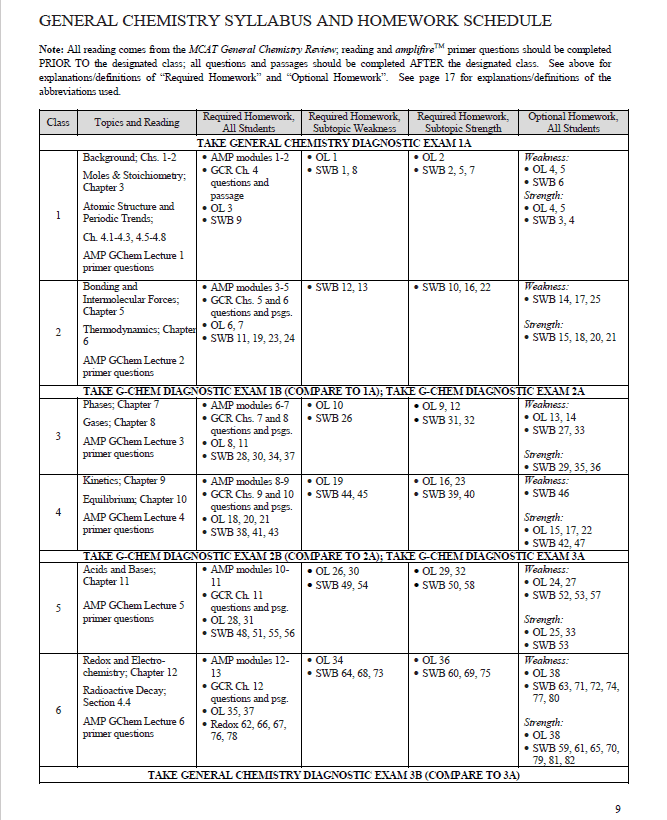
A subject syllabus and study plan are provided to help sequence diagnostics and practice work throughout the course.
Timed CARS-focused work is built in because pacing is critical for CARS performance.
Interactive Score Reports
Princeton Review provides Drill score reports, Diagnostic exam score reports, and Practice test score reports after every drill, diagnostic exam, and practice test.
While the practice test scores are reported in a similar style to the official MCAT score, the scores for the drills and diagnostic exams are reported simply as a percentage and do not correlate with MCAT scores.
Nevertheless, your overall diagnostic exam score is less important than your performance in the individual subtopics, which is where your focus and attention should lie.
The score reports provide a detailed explanation of each question on every test.
It allows you to easily determine the subjects, subtopics and CARS question types you are weakest in and need to improve on. This information will then help guide your homework and study throughout the course.
Study Planning & Accountability
Princeton now emphasizes an auto-generated Smart Study Planner, structured coursework milestones, and regular progress tracking tools to keep students on track.
In practice, this means students can map prep to their test date, monitor assignment completion, and adjust their weekly plan as needed.
MCAT Topic Focus
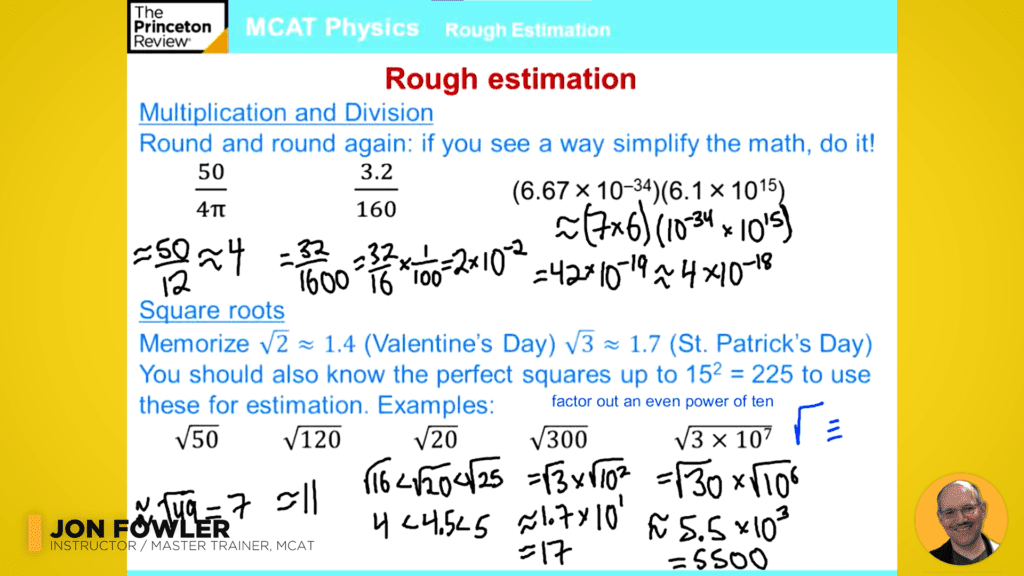
A feature highlighted in higher-tier live plans, MCAT Topic Focus refers to expert-led sessions targeting specific weak areas and high-yield concepts.
There are 12+ sessions a week which you can attend as you wish, based on your areas of weakness and any specific questions you may have.
This flexibility to attend the Office Hours sessions ensures that you focus your full attention only where you truly need the help and additional support.
The subject-specific sessions in maybe Physics, Organic Chemistry, Biology, etc., are led by your questions, and these sessions are about 1-hour long.
On the other hand, the topic-specific session in Genetics, IUPAC Nomenclature, etc., will include guided practice and in-depth passage explanations, and these sessions typically last about 1.5 hours.
Medical School Admissions Advantage Sessions
Led by admissions-focused experts, these sessions aim to help students strengthen overall application strategy alongside MCAT prep.
You start off by touching base with your coach in an hour-long session whereby they perform an overall assessment.
The coach will professionally measure where you currently stand as a medical school applicant, taking into consideration your GPA, MCAT score, current academic record, and experiences. With this information, they can then assess where and how you can improve.
From helping you compile a list of schools and programs based on your strengths and interest to helping you plot your strategy for letters of recommendation, the Medical School Admissions Advantage sessions are invaluable.
Princeton Review MCAT Prep Pros & Cons
PROS
– Offers in-depth content review through live classes, MCAT books, and video lessons.
– Has excellent MCAT-style practice questions and passages.
– Every Princeton Review course includes access to all AAMC practice materials.
– The numerous prep resources offer excellent value for money.
– Perfectly structured courses with a logical flow.
CONS
– A bit too pricey compared to other options in the market.
Verdict
Princeton Review is a tried and tested content-heavy MCAT prep course that does an excellent job at preparing students for the exam to guarantee better scores.
Whether you go for the private tutoring option or one of the self-study programs, you will love Princeton's vast amount of course materials.
Another thing you are bound to love is the flexibility. You can attend a LiveOnline class at 10 pm if that's what works for you, and choose your preferred days, so you never have to miss out on that Friday afternoon hangout with your friends.
Ultimately, studying for the MCAT can be consuming. Still, it is all about balance, and Princeton’s flexibility allows you to retain a semblance of sanity even while you are deep in the trenches of MCAT prep.
The subject syllabi and homework schedules help guide and structure your studying to effectively and efficiently utilize all the MCAT resources provided.
Overall, the Princeton Review may be a little pricey compared to other MCAT prep course programs in the market. However, this prep company provides a myriad of prep resources that offer excellent value for money.
So, if you can afford it, go ahead and sign up for the Princeton Review prep course that best aligns with your study needs. You won’t regret it!
Princeton Review MCAT Prep FAQs
Is The Princeton Review Good For MCAT Prep?
Yes, the Princeton Review is good for MCAT prep. (but we think Prep101 is better than Princeton. Find out why in this article)
From the myriad of study resources offered to the flexible scheduling options to the immersive subject- and topic-specific review sessions available, you are guaranteed to get excellent MCAT prep.
Better yet, the comprehensively detailed content review is guaranteed to eliminate any knowledge gaps you might have, even for non-traditional students who have been away from the classroom for a few years.
Princeton Review Vs. Kaplan For MCAT?
Kaplan and Princeton Review are two respected names in the MCAT industry.
Both test prep companies are very content-heavy, offering excellent MCAT practice to prepare their students for the real exam.
While Kaplan has far better video lessons that are more engaging and have better production quality, Princeton Review’s content is better structured to have a more logical flow.
At the same time, Princeton’s higher-tier guarantee tracks a 515 threshold or 15-point increase depending on baseline score, with eligibility requirements.
Ultimately, your choice between the two will depend on your specific study needs and just how much you are willing to spend to guarantee admission into your dream Medical School.
Are Princeton Review Practice Tests Harder Than MCAT?
Yes, Princeton Review practice tests are harder than the MCAT.
All 3rd party test prep tests are typically designed this way to ensure you get excellent practice to eliminate any knowledge gaps you may have.
At the same time, harder practice tests are a good thing because the real exam will feel that much easier in comparison, making you feel more composed and at ease on exam day.
We may earn commissions from some links on this page, but this does not affect our reviews or your experience.