

Blueprint MCAT Vs. Princeton Review in 2026

by John Reed· Last Updated: Jan 30, 2026

Blueprint
Includes
- ✓160 learning modules
- ✓500+ instructional videos
- ✓AI-powered QBank with 5,000+ questions
- ✓15 full-length practice exams
- ✓1,600+ high-yield flashcards
- ✓Live review sessions 6 days a week
- ✓6 MCAT content review eBooks
- ✓All online AAMC practice resources
- ✓Advanced analytics dashboard
Pros
- +15 full-length practice exams included
- +AI-powered QBank with 5,000+ MCAT questions
- +160 learning modules with 500+ videos
- +Personalized study planner with live review sessions 6 days/week
- +Score increase guarantee available (eligibility requirements apply)
Cons
- −No live classroom instruction in the Self-Paced plan
- −Premium pricing compared with some lower-cost MCAT resources

Princeton Review
Includes
- ✓18 full-length practice tests
- ✓All official AAMC materials
- ✓4,900+ practice questions
- ✓500+ hours of video lessons
- ✓12 section/subject practice tests
- ✓8-9 MCAT books depending on plan
- ✓Smart Study Planner
- ✓Interactive score reports
Pros
- +Broad MCAT course lineup from self-paced to intensive immersion
- +18 full-length practice tests and all official AAMC materials
- +4,900+ practice questions in flagship plans
- +500+ hours of video lessons and strong structured curriculum
- +MCAT Topic Focus sessions in higher-tier plans
- +Score-improvement money-back guarantees on eligible programs
Cons
- −Premium pricing, especially for higher-tier plans
- −Guarantee terms require strict eligibility and completion criteria
- −Feature sets vary significantly by plan, so careful selection is needed
Blueprint is a well-recognized MCAT test prep company that's highly acclaimed by many students.
But then again, the exact same thing can be said of Princeton Review, hence the great Blueprint Vs. Princeton Review MCAT debate.
On the one hand, you have a prep course with an excellent, logically laid out MCAT curriculum, while on the other hand, you have an incredibly in-depth prep course covering all the MCAT subjects in great detail.
So how do you decide between Blueprint MCAT Vs. Princeton Review?

Blueprint MCAT
#1 pick of 13 MCAT courses we tested
Free for 14 days. Full access to lessons, practice exams, and the study planner.
No credit card required
Pros
- Free trial includes a practice exam and customizable study planner.
- Best video lessons for MCAT in the industry.
- Score increase guarantee
Cons
- Mobile app is not the best

Blueprint MCAT Vs. Princeton Review Comparison Table
| - | Blueprint MCAT | Princeton Review |
|---|---|---|
| Price Range | From $1,099 to $3,419+ | From $1,599 to $13,499+ |
| Access Period | 3, 6, or 12 months (self-paced) | 6 or 12 months (self-paced) |
| Diagnostic Exams | 1 | 35 |
| Full-Length Practice Tests | 15 | 18 |
| Practice Questions | 5,000+ | 4,900+ |
| Customizable Study Plan? | Yes | Yes |
| Inclusion Of AAMC Practice Materials? | Yes | Yes |
| MCAT Books | 6 | 8 |
| Mobile App? | Limited (iOS Qbank) | Yes |
| Score Increase Guarantee? | Yes | Yes |
Blueprint MCAT Vs. Princeton Review Overview
Blueprint MCAT is particularly known for its stellar curriculum and incredibly representative MCAT practice material that closely replicates what you should expect on the actual exam.
The company offers different MCAT prep options, with the self-paced course currently starting at $1,099 and tutoring packages starting at $3,419.
In between the two ends of that range, your other choices include Live Online and 515+ course tracks.
At the most basic level, here's what you get once you sign up for any of the Blueprint MCAT courses:
- 160 interactive learning modules.
- Customizable study planner tool.
- Live office hours 6 days per week.
- Access to recorded Office Hour sessions.
- AI-powered Qbank with 5,000+ discrete and passage-based questions.
- Custom-tailored MCAT practice sets.
- Ability to test out of lessons.
- An online note-taking journal tool.
- 1,600+ MCAT flashcards.
- 15 full-length MCAT practice exams with detailed explanations.
- 6 MCAT content review books.
- Access to all official AAMC online resources.
- Advanced analytics to target weak areas.
- Score increase guarantee.
Princeton Review is best known for its exceptionally detailed content review that comprehensively covers virtually everything you need to know going into med school.
Their cheapest MCAT prep course is the Self-Paced course at $1,599 (6-month access), while premium options such as Summer Immersion can run much higher.
Aside from the self-study and tutoring options, your other choices include the LiveOnline course, the 513+ course, and the 515+ summer immersion.
Here's what's contained in the basic Princeton Review MCAT prep package:
- 500+ expertly crafted, on-demand content videos.
- 18 full-length online practice tests with detailed explanations.
- 8 MCAT review books.
- MCAT flashcards.
- 6- or 12-month access options, depending on the plan.
- Unlimited access to subject-specific live Q&A office hour sessions.
- All official AAMC materials and online Flashcards.
- Thousands of practice questions.
- Access to Medical School Admissions Advantage Sessions.
- Better score guarantee.
Blueprint MCAT Vs. Princeton Review Detailed Comparison In 2026
Price
One of the biggest differences between Blueprint and The Princeton Review is pricing structure and plan variety.
Blueprint's advertised entry pricing starts lower, while Princeton Review offers more premium live-lecture and immersion tiers.
Current advertised starting prices (official sites):
| Course Type | Blueprint MCAT | Princeton Review |
|---|---|---|
| Self-Paced | From $1,099 | $1,599 (6 months) / $1,999 (12 months) |
| Live Online | From $1,899 | Ultimate Course: $2,899 |
| 515+ Track | From $2,399 | 515+ Course: $3,499 |
| Tutoring | From $3,419 | Private Tutoring: $183/hr |
| Highest listed premium option | Tutoring packages (varies by hours) | Summer Immersion: from $13,499 |
So, at the entry level, Blueprint is cheaper. Princeton Review generally gets more expensive in its high-touch, live-immersion options.
If Blueprint is still on your shortlist, use the latest Blueprint MCAT discount page to compare the real out-of-pocket price before deciding.
Course Curriculum
One of Blueprint's highlights is the organization of its MCAT content.
Their syllabus comprises 160 learning modules, split into 130 content modules and 30 strategy modules. Combined, you get hundreds of hours of visually engaging and entertaining video content.
Blueprint's MCAT course border is designed around spaced repetition. A concept is first introduced and then later built upon gradually in the course of your study period.
Better yet, all this has already been laid out for you in your personalized study plan, so you won't waste valuable study time wondering how to approach the modules, which module to tackle first, and so on.
Rather than only studying a particular subject a week, Blueprint's curriculum allows you to work through multiple science content areas each week. This helps to keep things engaging, helping you remain focused throughout your MCAT prep period.
At the same time, the modules are organized cumulatively, starting off with simpler content, such as the foundations of a given subject, then gradually building up to more challenging MCAT concepts and material.
Content modules are interspersed among the strategy modules such that by the time you encounter a concept in a strategy module, you've already covered it in a content module and so are prepared to experience the application of the content learned.
Overall, Blueprint's organization of their MCAT study material is highly commendable, allowing learners to experience a fun and logical study process that optimizes content retention.
Princeton Review has a very intense, content-heavy curriculum.
On the one hand, this could work for non-traditional students who covered their prerequisites quite a while back and would need a deeper refresher before facing the MCAT.
On the other hand, this incredibly dense syllabus can easily come across as overbearing and overwhelming as students try to sift through the information distinguishing between high-yield and low-yield concepts.
The Princeton Review MCAT course has too much content, going into great detail. This is not necessarily a good thing, as students can be left feeling overwhelmed, confused, and unmotivated.
Furthermore, with Princeton Review, it is really hard to tell how much knowledge you need to possess in the various areas. All MCAT subjects have been covered extensively, but the actual MCAT does not necessarily test each subject to such great knowledge depth.
So as far as the course curriculum goes, Blueprint MCAT has the upper hand here for having an impeccably organized MCAT course syllabus that's easy to follow through, allowing students to cover more ground faster.
Content Video Lessons
Blueprint's video lectures are very helpful, concisely covering high-yield MCAT topics in a direct and easy-to-understand manner.
The fun, bite-sized video lessons featuring animations, illustrations, and graphics are not only highly engaging, but they also enhance content retention.
Complex biological systems and chemical processes have been illustrated in a manner that's very easy to visualize, offering a far better explanation for complex concepts than what you'd find in any textbook.
Blueprint's dynamic video lessons apply to both the pre-recorded on-demand videos and the live instruction lectures.
Princeton Review's video lessons are rich in detail and content, and the knowledgeability of the instructors is very evident in each lecture.
They have an extensive library of over 500 on-demand lessons known as MedFlix videos.
These on-demand Medflix videos are rather humdrum, leaving much to be desired. These videos are neither visually appealing nor engaging, so you will often find your mind lacking focus and stimulation while watching the lessons.
Nevertheless, the lecturers do a pretty great job at covering every single MCAT concept. But because there is so much ground to cover, the lecturers tend to move through the material rather quickly.
If you are not particularly inclined toward visual engagement, you may actually be just fine going through Princeton Review's on-demand videos. However, their live lectures are far more interesting than their on-demand lessons.
All in all, Blueprint's video lessons, both the live instruction and the pre-recorded ones, are stellar in their content coverage, visual appeal, and learner engagement, keeping the MCAT material fun, concise, and easy to comprehend.
Practice Materials
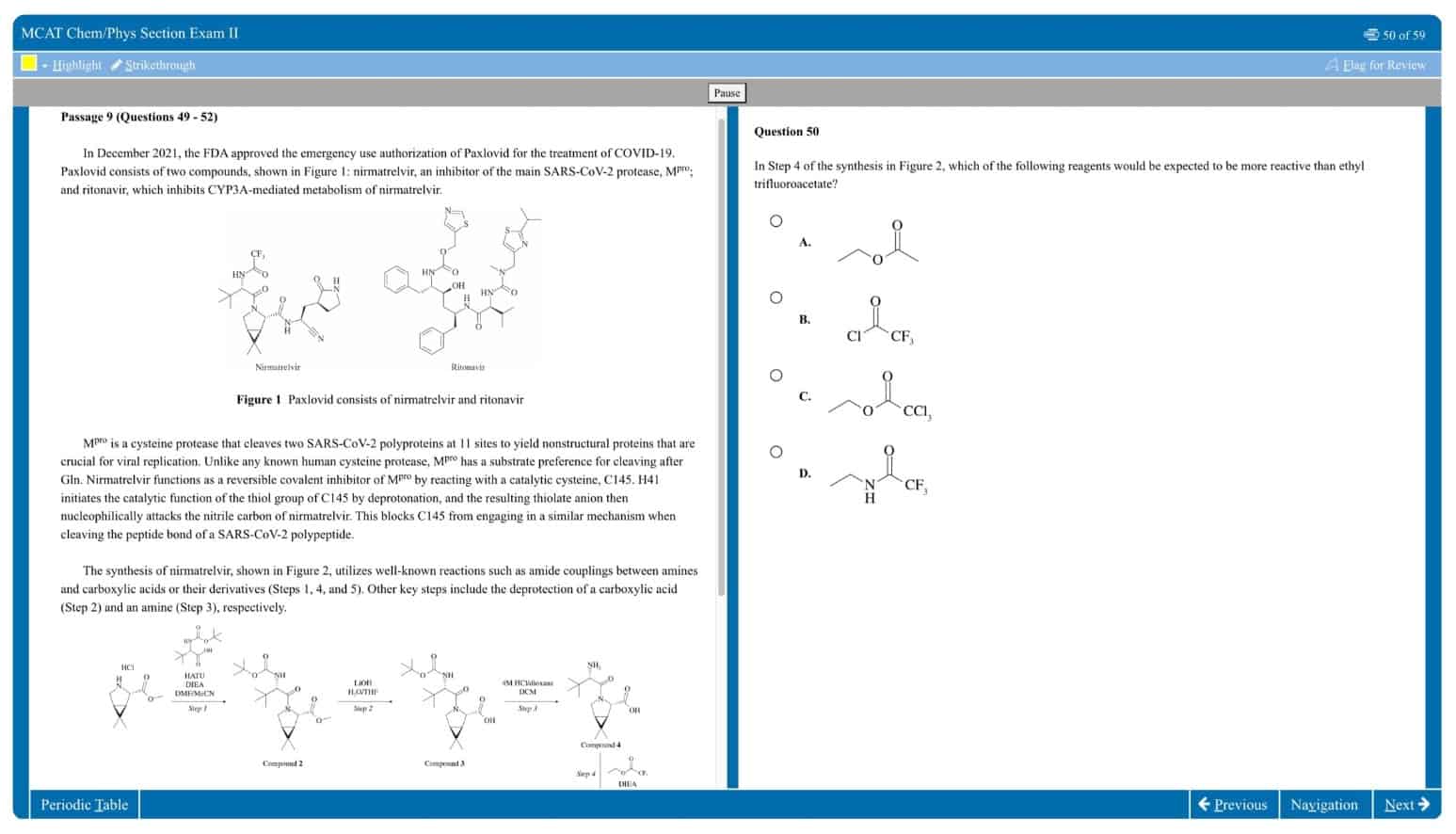
Blueprint comes packed with a ton of both free and premium MCAT practice material. You have a diagnostic test, module assessment quizzes, end-of-chapter exams, 15 full-length practice exams, and over 5,000 practice questions in the QBank.
Blueprint practice exams are very representative of the real MCAT. In fact, in comparison to other MCAT prep providers, Blueprint is widely recognized as being highly representative of the actual MCAT.
They offer very realistic practice regarding the content tested and how the questions are structured and worded.
As for free MCAT practice material, Blueprint offers a half-length diagnostic MCAT exam and a free full-length practice exam.
Princeton Review similarly comes packed with plenty of MCAT practice material. You have several subject-based tests and diagnostic exams, 18 full-length exams, and 4,900+ practice questions.
Princeton Review's tests are incredibly hard and not representative of the real MCAT. Nonetheless, these offer great practice for content review. At the same time, these exams are great for building your stamina and working on your test timing.
Overall, Blueprint MCAT has far better practice material than Princeton Review. Their tests offer more realistic MCAT practice, and their free practice materials are definitely a bonus.
Office Hours
One crucial element of any MCAT prep course, even beyond the content review and the practice material, is the Office Hours.
During your MCAT prep, you are bound to come across certain MCAT concepts that are simply more difficult to comprehend than others. And no matter how hard you try and how much it's been taught to you, you simply cannot seem to comprehend the concept at hand.
Office Hours are an excellent opportunity to go over those hard-to-understand topics with an expert MCAT instructor.
Blueprint and Princeton Review both include live instructor support in their self-paced ecosystems.
Let's closely examine what each company offers within the Office Hours of their self-paced programs.
For Blueprint, Office Hours occur 6 days a week. They comprise group sessions, and students have unlimited access to any Office Hours they wish to attend.
Each session lasts about 2 hours, and besides taking a deep dive into a particular focus area, they also include open Q&A so you can ask the instructor anything on any subject.
For Princeton Review, sessions are also subject-specific, with recurring Q&A by subject area (Biology/Biochemistry, CARS, General Chemistry, Organic Chemistry, Physics, and Psychology/Sociology).
With Blueprint MCAT, you can ask broad questions during open Q&A blocks. With Princeton Review, support is more track-based by subject session, so questions are usually routed to the relevant subject block.
So, for lasting longer, being more diverse, and offering more flexibility in its structure, Blueprint takes the upper hand when it comes to Office Hours.
Course Personalization
Ultimately, all students have their unique MCAT journeys, and no one person's preferences are precisely similar to another's.
As such, the best MCAT prep course should reflect this as well, allowing for personalization of the course to best suit your content knowledge, learning style, and MCAT goal score.
Blueprint MCAT provides a tailored study experience in the following ways:
- Allows the option of testing out of lesson modules.
- Provides a customizable online study planner.
- Uses an AI-driven QBank.
- Offers flexible live office hours.
- Has flexible, reschedulable live class schedules.
These personalization tools allow each student to have a truly unique MCAT prep experience even though they may be using the very same Blueprint MCAT course.
You get to use the study materials and practice resources as they best suit you, based on your diagnostic exam base score and your respective strengths and weaknesses, learning pace and style, study time availability, etc.
Princeton Review now also includes personalization features such as an auto-generated study plan, an AI-powered study recommendation tool, and progress tracking in its updated dashboard.
Blueprint still has the edge on fine-grained customization, but Princeton Review is no longer a one-size-fits-all platform.
MCAT Books
Both Blueprint and Princeton Review include MCAT review books, though Blueprint emphasizes digital eBooks while Princeton Review includes physical books in many course packages.
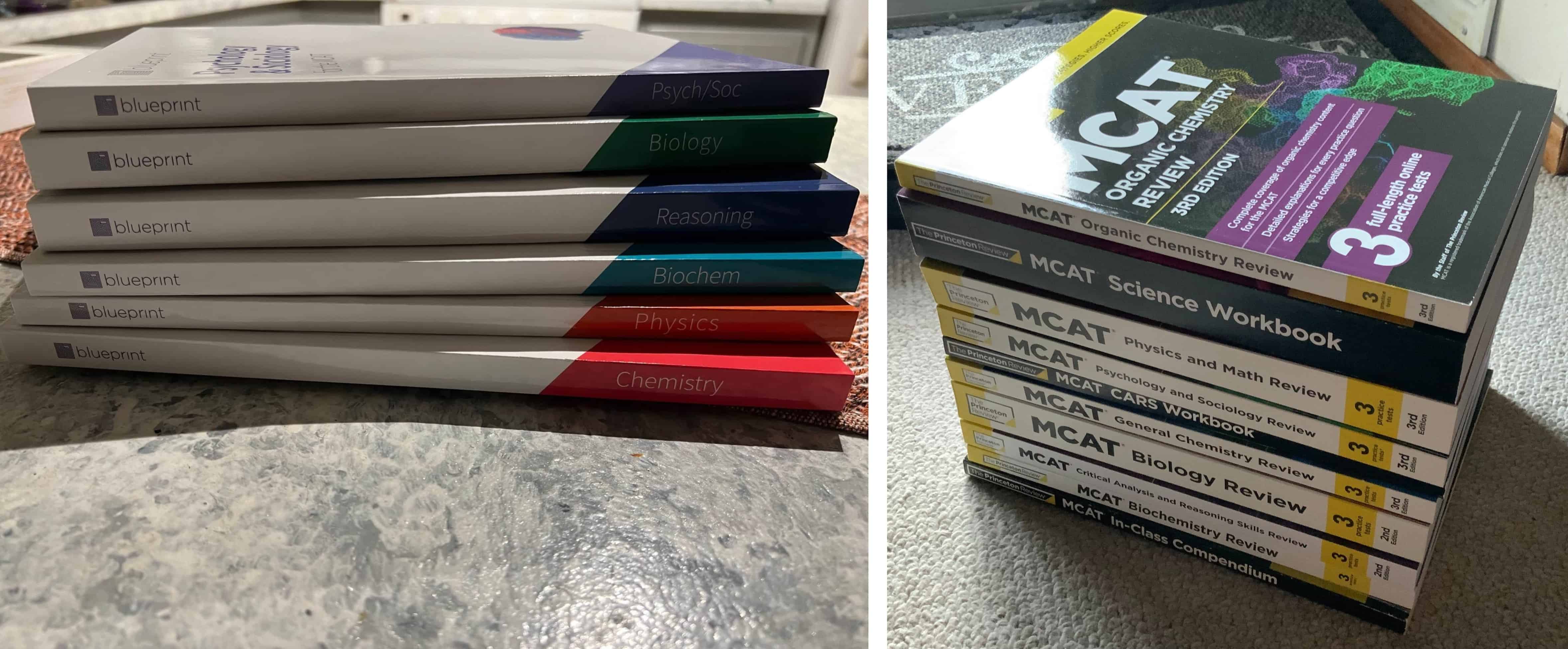
Similar to their content videos, Blueprint MCAT prep books are concise and very easy to understand, filled with pictures and fun animations.
Blueprint has structured its MCAT books and lesson plans to go hand-in-hand. Each lesson video highlights exactly what chapter and section you need to review in the books if you need to understand the topic better. That's quite handy.
Furthermore, the books' end-of-chapter practice questions are available online, allowing for a nice seamless integration with Blueprint's online courses.
The Princeton Review MCAT books are very detail-packed and in-depth, similar to their content video lessons. Their content review is incredibly comprehensive, giving a deep dive into all the MCAT subjects.
Overall, Blueprint's books are more of a supplement to their content lessons, while Princeton Review books give an independent deep dive into MCAT content review.
Verdict: Which One Is Better?
Blueprint MCAT prep has plenty of commendable aspects to it.
First off, they have a very detailed curriculum covering exactly what you need to know for the MCAT exam. There is no fluff, and high-yield concepts have all been covered in great detail.
Not to mention that the course structure, broken down into modules, is very well organized for effective studying and content retention.
This test prep course doesn't just teach MCAT test content. Instead, they teach you how to take the MCAT exam.
From their video lessons to their Office Hours and MCAT books, Blueprint MCAT students are equipped with a ton of MCAT-specific skills, techniques, and test-taking strategies, showing you how to connect and apply specific MCAT knowledge to various question scenarios.
Another commendable thing is their visually appealing lessons and written material, full of helpful animations and illustrations that help make the MCAT material much easier to grasp and remember in the long term.
Lastly, Blueprint's QBank feels endless, and the quality of their practice is top-notch, considering that Blueprint practice tests are among the most representative of any MCAT prep providers.
The one downside to this prep course is that strong feature depth can still make total cost add up quickly as you move into higher-tier plans.
Nonetheless, Blueprint MCAT really does give value for money.
Princeton Review MCAT prep also has plenty of commendable elements to it.
To begin with, their deep and extensive curriculum is perfect for non-traditional applicants who are looking for more detailed content reviews.
Aside from that, their live online classes are really well done, taught by a team of 4-6 subject matter MCAT experts who truly know their content.
Their practice exams are not as representative as Blueprint MCAT practice tests, but they are still valuable in building your mental endurance and stamina.
Blueprint and Princeton Review are both solid MCAT prep options, but ultimately, one has to have a clear upper hand over the other.
Blueprint is the better MCAT prep option, owing to its customized study schedule, top-notch on-demand lessons, highly representative practice materials, and perfectly laid out course curriculum that concisely covers just what you need to know for the MCAT.
Prepping for the MCAT isn't just a matter of learning the content tested. Rather, you need to know how the material is actually tested, and in that regard, Blueprint MCAT prep does an absolutely stellar job.
Blueprint MCAT Vs. Princeton Review FAQs
Is Princeton Review Better Than Blueprint MCAT?
Princeton Review is better than Blueprint MCAT if you are looking for a prep course that goes into great detail and depth in its material coverage.
The only downside is that you will easily get lost in all the information presented, feeling overwhelmed and unable to tell the extent to which you should grasp certain MCAT concepts.
On the other hand, Blueprint MCAT is better than Princeton Review in that it offers a highly customizable MCAT study curriculum, has very representative practice tests, and provides plenty of free MCAT resources.
Blueprint MCAT Vs. Princeton Review: Which One Is Best For Content Review?
Blueprint MCAT is the best MCAT content review for the average student. Its material coverage is concise yet detailed, covering just what you need to know for the MCAT; nothing more and nothing less.
Not to mention that Blueprint does a great job of presenting even the most complicated MCAT concepts in a fun, entertaining manner that enhances content retention.
On the other hand, Princeton Review offers great content reviews for non-traditional students who haven't reviewed MCAT material in a long time and are therefore looking for something more in-depth and extensive.
Are Blueprint MCAT Tests More Accurate Than Princeton Review?
Yes, Blueprint MCAT tests are more accurate than Princeton Review practice tests, giving a better idea of the content that's tested on the MCAT and how questions are phrased and formatted.
While Blueprint's practice test scores are deflated by around 4-7 points, Princeton Review's test scores are heavily deflated by over 10 points.
We may earn commissions from some links on this page, but this does not affect our reviews or your experience.
Learn more about Blueprint
Read our full review →
Learn more about Princeton Review
Read our full review →