


PowerScore LSAT Practice Tests Review
by Powerscore
A free 12 month account with 3 official LSATs, and a $35 a month platform holding every official LSAT-licensed practice test
✓Pros
- ✓The free LSAT Self-Study account holds 3 official LSATs for 12 months, with no card and no LSAC LawHub Advantage subscription required
- ✓The score report breaks Logical Reasoning down by question type and Reading Comprehension by passage type, which official LawHub scoring does not do
- ✓The paid Testing and Analytics platform lists every official LSAT-licensed practice test in two forms, one with an experimental section and one without
- ✓Custom drills isolated by question and concept type, plus individual full sections from past LSATs
- ✓Prices, renewal terms and cancellation rules are set out in a dated enrollment agreement rather than only on a sales page
✗Cons
- ✗The paid platform costs $434 for a year against $124 a year for LSAC LawHub Advantage, which licenses PowerScore the same official PrepTests
- ✗Subscription fees are not refundable once a billing period begins, and cancelling mid month brings no prorated refund
- ✗PowerScore does not say which 3 official LSATs the free account holds
- ✗The free LSAT practice test page PowerScore used to run returns 404, and nothing on its LSAT prep page points to the free Self-Study account
Highlights
- ✓LSAT Self-Study: a free account with an online practice test platform containing 3 official LSATs, for 12 months
- ✓Practice test performance analytics that break results down by question type and passage type
- ✓Explanations for thousands of official LSAT questions
- ✓Starter Access: a free 7 day trial with the same 3 official LSAT practice exams and 6+ hours of lessons, no card required
- ✓Testing and Analytics Package: every available official LSAT-licensed practice test, custom drills by question and concept type, and individual full sections, at $49 then $35 a month
Price
✓Free
What Students Are Saying
Sign in to leave a review

Expert Rating
PowerScore gives you three official LSATs for nothing, in a free account that lasts twelve months and reports your score broken down by question type. Everything beyond those three tests lives in the PowerScore Testing and Analytics Package, a subscription at $49 for the first month and $35 a month after that.
If you went looking for PowerScore's old free LSAT practice test page, that is why you could not find it. The URL powerscore.com/lsat/free-lsat-prep/free-lsat-practice-test now returns a 404, and PowerScore's sitemap has no free practice test page at all. The free tests moved into an account most students never hear about. This review sets out what each tier holds, what it costs over a real prep cycle, and how it compares with the other LSAT practice tests we review.
Summary Table
| Feature | PowerScore LSAT Practice Tests |
|---|---|
| Price | Free, or $49 first month then $35 a month |
| Free full-length tests | 3 official LSATs |
| Free access period | 12 months (LSAT Self-Study) |
| Paid library | Every available official LSAT-licensed practice test |
| Each PrepTest offered | With an experimental section, and without |
| Score report detail | By question type and by passage type |
| Official LSAT questions | Yes, licensed from LSAC |
| LawHub Advantage required | No, for the two free tiers |
| Drills | Custom drills by question and concept type |
| Guarantee | None |
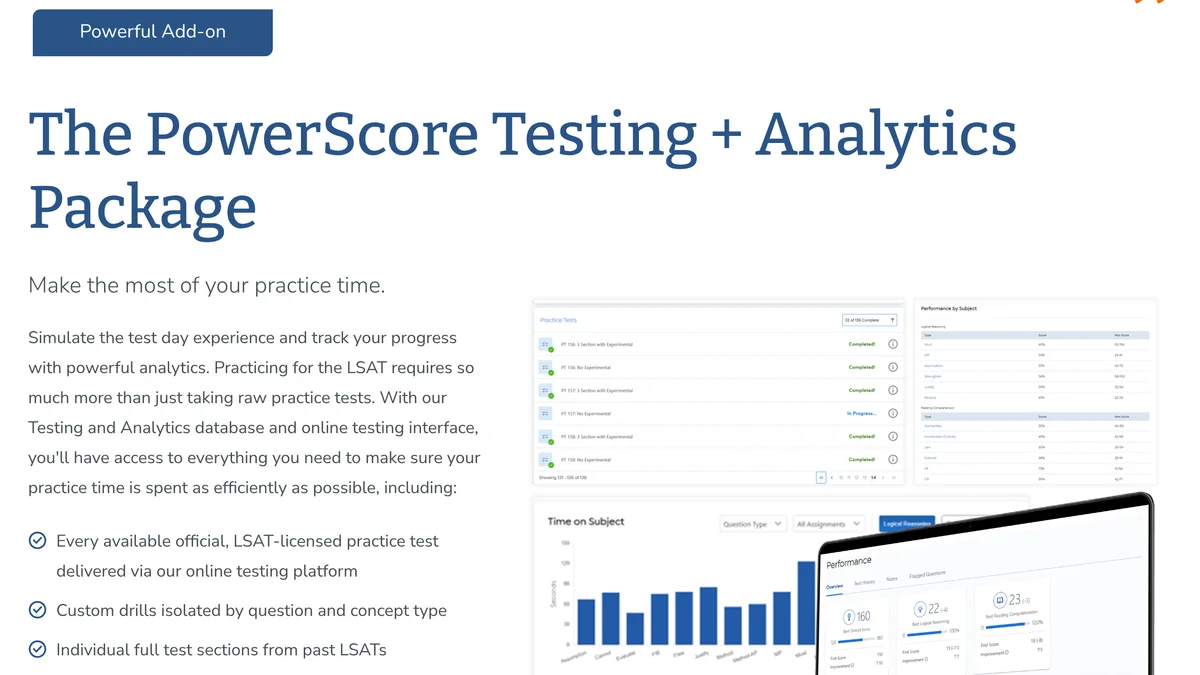 The Testing and Analytics package on powerscore.com, captured November 2026. The dashboard list is PowerScore's own product image.
PowerScore LSAT Practice Tests Overview
PowerScore says it has taught the LSAT for 30 years, and it is now a BARBRI company. Most students know it for the LSAT Bibles and the PowerScore LSAT course. The practice tests are a separate product, and they reach you through three doors.
LSAT Self-Study is a free account on the PowerScore LSAT Self-Study Site. It includes an online practice test platform containing 3 official LSATs, practice test performance analytics that gauge your strengths and weaknesses, explanations for thousands of official LSAT questions, recommended study calendars built around your test date, and supplemental video lessons from LSAT Bible authors Jon Denning and Dave Killoran. PowerScore's enrollment agreement puts the access period at twelve months and says in writing that a LawHub subscription is not required for it.
Starter Access is the free seven day trial of the On Demand course, listed on the LSAT prep page as free with no credit card required. It carries the same 3 official LSAT practice exams plus three or more hours each of Logical Reasoning and Reading Comprehension lessons.
Testing and Analytics is the paid platform. PowerScore describes it as every available official LSAT-licensed practice test delivered through its online testing platform, with custom drills isolated by question and concept type, individual full test sections from past LSATs, practice sets and preview videos updated to reflect recent testing trends, and a performance tracking system that works across single tests and your whole prep.
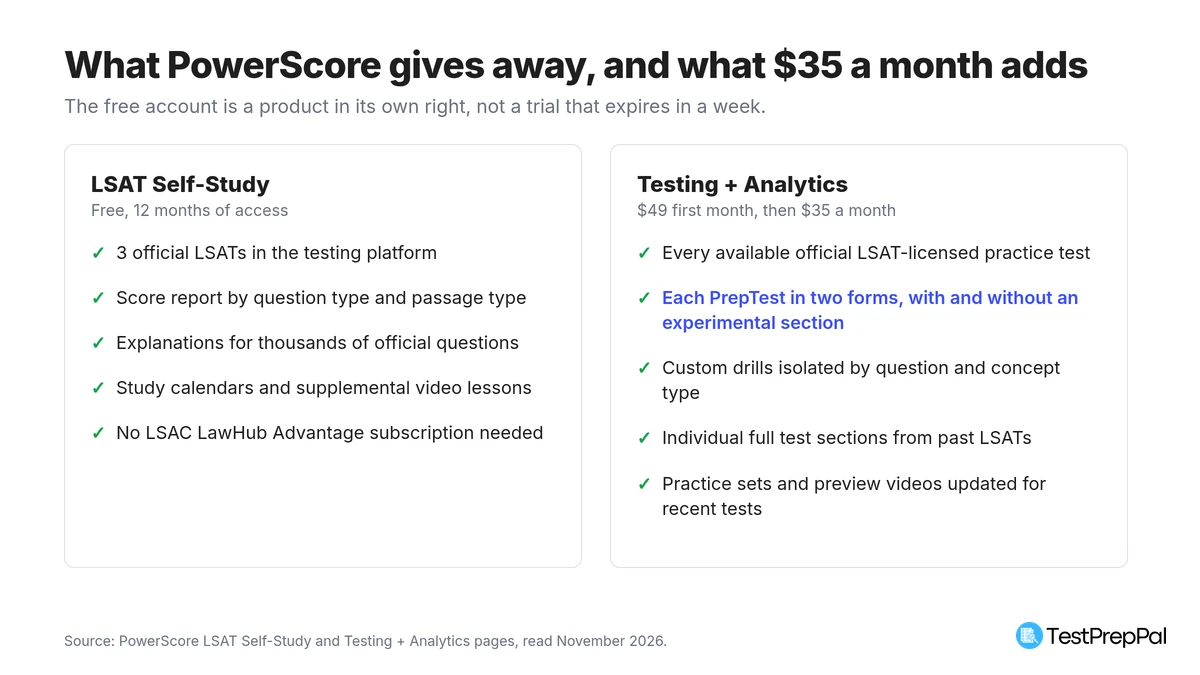 What the free account holds and what the subscription adds. Source: PowerScore product pages, read November 2026.
PowerScore LSAT Practice Tests Review For 2026
The score report names the question types you are losing points on
This is the thing that separates a practice test platform from a PDF of a PrepTest, so it is worth being precise about the evidence.
PowerScore's own product dashboard for the Testing and Analytics package shows a Performance by Subject panel. Logical Reasoning is split into rows for Must, MP, Assumption, Strengthen, Justify and Resolve, each with a percentage and a raw score. Reading Comprehension is split by passage type: Humanities, Humanities Diversity, Law, Science and CP. A second panel charts your seconds per question type under the heading Time on Subject.
That is a level of detail LSAC's own scoring does not give you. A LawHub score report tells you what you scored. This tells you that your Assumption questions are at 57 percent while your Resolve questions are at 67 percent, and how long each type is costing you.
The free Magoosh LSAT practice test is the only other product on this hub that reports percent correct by question type, and it does so on one test that is not an official LSAT.
Every PrepTest comes in two versions, with and without the experimental section
The dashboard in PowerScore's product image lists its tests as pairs: PT 156: 3 Section with Experimental and PT 156: No Experimental, then the same two rows for PT 157 and PT 158. The pagination at the foot of that panel reads 131 to 136 of 136.
Treat the 136 as what PowerScore chose to show in a marketing screenshot rather than as a published specification, because PowerScore does not state a test count anywhere in words. The pairing is the part that matters, and it is a real product decision.
Since August 2024 the LSAT has been three scored sections and one unscored experimental section, a change we cover in our guide to the LSAT sections. An official PrepTest as LSAC delivers it is the scored material. Sitting a version with an experimental section is a different exercise: four sections of work, one of which does not count, which is the stamina test you will actually face on test day. Being able to choose between the two before you start is something LawHub does not offer.
What PowerScore does not tell you
Three gaps are worth knowing before you commit.
PowerScore does not say which 3 official LSATs the free account holds. There is no PrepTest number on the Self-Study Site page, so you cannot tell whether they overlap with the official tests you have already sat.
It does not tell you the free account exists. Nothing on the main LSAT prep page links to the Self-Study Site, the old free practice test URL 404s, and the pages across the web that still point at that URL send students to an error page.
It does not say, either way, whether the paid Testing and Analytics package needs a LawHub Advantage subscription. PowerScore's enrollment agreement is explicit that LSAC LawHub is required for the Live Online course, and equally explicit that it is not required for Starter Access or LSAT Self-Study. On Analytics the agreement says nothing. The LSAT course FAQ, meanwhile, describes LawHub Advantage as a prerequisite that all prep providers must abide by for online official LSAT content. Ask before you subscribe if that $124 matters to your budget.
Pricing
Every price below was read on powerscore.com and in the PowerScore LSAT Course Enrollment Agreement, reviewed 1 November 2026, on 27 November 2026.
| Route | Price | What you get | Access |
|---|---|---|---|
| LSAT Self-Study | Free | 3 official LSATs, analytics, explanations, study calendars | 12 months |
| Starter Access | Free | 3 official LSAT practice exams, 6+ hours of lessons | 7 days |
| Testing and Analytics | $49 first month, then $35 a month | Every available official LSAT-licensed practice test, drills, sections | Monthly, rolling |
| On Demand course | $149 a month | The above plus 50+ hours of video lessons | Monthly, rolling |
| Live Online course | $995 | The above plus 10 live core lessons (30+ hours) and 4 test specific lessons (8 hours) | 120 days from the start date |
The subscription maths is the part to sit with. Six months of Testing and Analytics is $224. Twelve months is $434. The Live Online course requires an active LawHub Advantage subscription on top, which the agreement prices at $124.
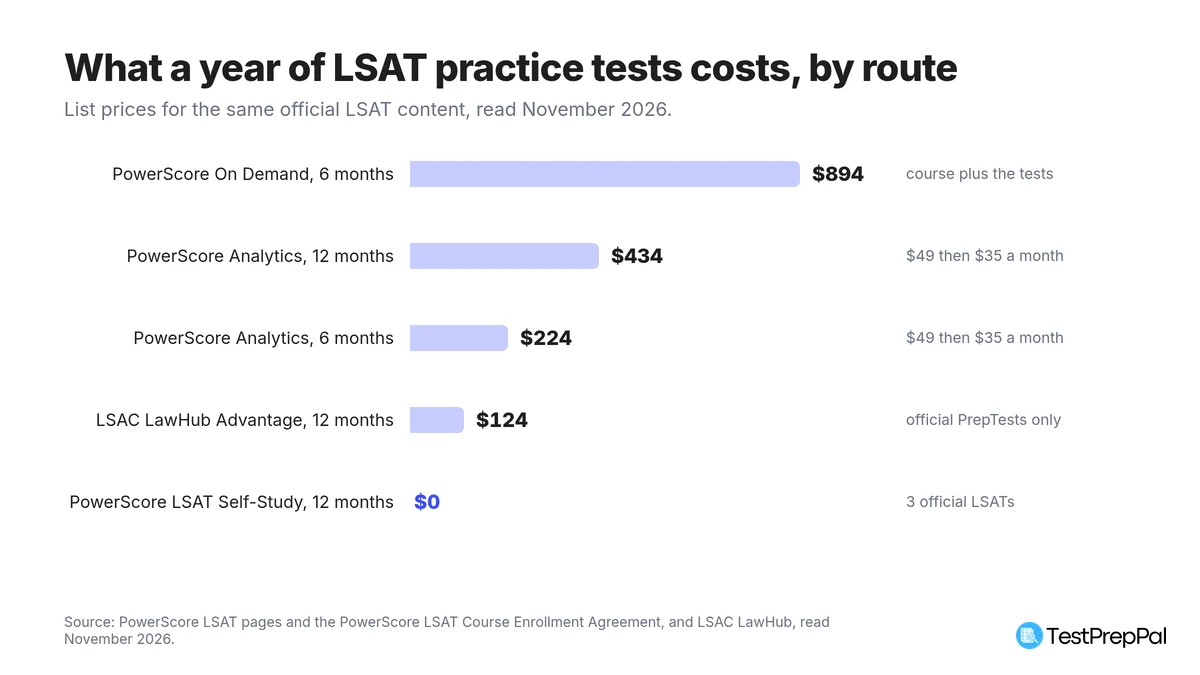 The same official LSAT content, five prices. Source: PowerScore LSAT pages and enrollment agreement, and LSAC LawHub, read November 2026.
Read that chart as a question about what you are buying. LSAC sells an extensive library of official PrepTests through LawHub Advantage for $124 a year. PowerScore licenses official LSAT content and sells access to it for $434 a year. The $310 difference buys the testing interface, the experimental section variants, the drills by question type and the analytics. For a student who already knows their weak question types, that is a lot of money for a dashboard. For a student who has plateaued and cannot say why, it is the cheapest diagnosis available.
Two subscription terms matter as much as the price. Subscription fees are not refundable once a billing period begins, and cancelling partway through a month brings no prorated refund. You can cancel at any time before the next renewal date, and cancelling stops future charges only, so set a reminder rather than relying on noticing the charge.
Who PowerScore LSAT Practice Tests Are Best For
- Students who have used up LSAC's free official PrepTests and want more official material at no cost, which the free Self-Study account gives for twelve months
- Students who are plateauing and cannot name the question types costing them points, because the score report names them
- Students who want to rehearse four sections with an experimental section in place, rather than the three scored sections alone
- Students already using the PowerScore Bibles, since the Self-Study Site carries drills and reading supplements that expand on the books
- Students who want to drill one question type at a time against official questions rather than sit another full test
When You Might Look Elsewhere
You want the official tests at the lowest price. LawHub Advantage is $124 a year direct from LSAC for an extensive library of official PrepTests, against $434 for a year of PowerScore Analytics. Our LSAC practice tests review covers what the free LawHub tier includes before you pay anyone.
You want one free test tonight and nothing else. The Princeton Review free LSAT practice test is a single on demand test with a score report and no account to build. It is not an official LSAT and it documents no question type breakdown, but it takes two minutes to start.
You want a cheap one off pack with no subscription. Peterson's sells two tests for $29.95 with 90 days of access, though its LSAT pages still teach the retired Logic Games section, so read our review first.
You want teaching rather than testing. The practice platform is the same one inside PowerScore's courses, so compare those on our PowerScore LSAT course review or across the LSAT hub if you are still choosing a study route.
Final Verdict
Rated 3.9. The best free practice test offer on this hub that LSAC does not run, wrapped in a product nobody can find.
Three official LSATs, twelve months of access, a score report that names your weak question types, explanations for thousands of official questions, and no card and no LawHub subscription required. Measured against the single non-official test that Magoosh and Princeton Review each give away, that is not a close contest. It is the first thing an LSAT student should open once the free official PrepTests are gone.
Buy it if you have plateaued and need a diagnosis, or if you want to rehearse the full four section experience. Skip it if you mostly need more tests, because LSAC sells those for a quarter of the price. Our review methodology explains how we score free products against paid ones on this hub, where free official material is the baseline everything else has to beat.
PowerScore LSAT Practice Tests FAQs
Does PowerScore have a free LSAT practice test?
Yes, three of them, though not where most links point. PowerScore's old free LSAT practice test URL now returns a 404. The free tests live in the LSAT Self-Study account, which includes an online practice test platform containing 3 official LSATs, performance analytics and explanations for thousands of official LSAT questions. The enrollment agreement puts access at twelve months and charges no fee.
How much do PowerScore LSAT practice tests cost?
The Testing and Analytics package is $49 for the first month and renews automatically at $35 a month, which comes to $224 for six months or $434 for a year. The free LSAT Self-Study account and the seven day Starter Access trial cost nothing. The LSAT courses, which include the same platform, are $149 a month for On Demand and $995 for Live Online.
Are PowerScore LSAT practice tests official LSATs?
Yes. PowerScore describes the paid library as every available official LSAT-licensed practice test, and the free account as containing 3 official LSATs. The questions are LSAC's, licensed to PowerScore, so the provenance is the same as LawHub. What differs is the delivery: PowerScore offers each PrepTest both with and without an experimental section, adds drills isolated by question type, and reports results by question type and passage type.
Do you need a LawHub Advantage subscription to use PowerScore practice tests?
Not for the free tiers. The PowerScore LSAT Course Enrollment Agreement reviewed 1 November 2026 states that LSAC LawHub is not required for Starter Access and not required for LSAT Self-Study. It does require an active LawHub subscription for the Live Online course, priced at $124. For the standalone Testing and Analytics package the agreement says nothing either way, so confirm with PowerScore before subscribing.
Can you cancel the PowerScore Testing and Analytics subscription?
Yes, at any time before the next renewal date, which stops future charges. It does not refund the period you are in: PowerScore's refund policy makes subscription fees non-refundable once a billing period begins, with no prorated refund for cancelling partway through. If you are buying it for a specific stretch of prep, diary the cancellation date when you subscribe.
We may earn commissions from some links on this page, but this does not affect our reviews or your experience.
Our Verdict
PowerScore's free LSAT Self-Study account is the most generous free practice test offer on this hub after LSAC's own, because it holds 3 official LSATs for 12 months, reports your score by question type, and needs no LawHub Advantage subscription. The paid Testing and Analytics platform at $49 then $35 a month adds every official LSAT-licensed practice test, each one in a version with an experimental section and a version without, plus drills isolated by question type. The catch is arithmetic: a year of that costs $434 against $124 for the LSAC subscription that sells the same official PrepTests, so you are paying for the interface and the analytics rather than for the questions.