


Target Test Prep Free GMAT Diagnostic Test Review
by Target Test Prep
A free 64-question GMAT diagnostic covering Quant, Verbal, and Data Insights, with a per-topic analytics report.
✓Pros
- ✓64 questions across Quant, Verbal, and Data Insights, so it covers the whole Focus Edition rather than one section
- ✓Free with a name and email, no credit card and no trial signup
- ✓Per-topic analytics report showing exactly which areas are weak, which is what a diagnostic is actually for
- ✓Saves your two free GMAC official practice exams for later in your prep, when a real score estimate matters more
- ✓Can be paused and resumed from the same link if you cannot finish in one sitting
✗Cons
- ✗Returns a strengths and weaknesses report, not a scaled 205-805 score, so it will not tell you where you would land today
- ✗Questions are TTP-written to imitate the GMAT, not retired official GMAC questions
- ✗Signing up puts you on TTP's marketing emails
- ✗Reviewing the full explanations pushes you toward the paid TTP course
Highlights
- ✓64-question GMAT diagnostic (Quant, Verbal, Data Insights)
- ✓Detailed post-test analytics report
- ✓Per-topic strengths and weaknesses breakdown
- ✓Guidance from TTP's team on how to improve from your result
Price
✓Free
What Students Are Saying
Sign in to leave a review

Expert Rating
Target Test Prep gives away a 64-question GMAT diagnostic covering Quant, Verbal and Data Insights, and the number matters more than it looks: the real GMAT is also 64 questions. So this free test matches the exam's length exactly, and it still will not give you a score.
We opened the product page and the signup form on 29 September 2026 and recorded what the test asks for before question one, what the results screen returns afterwards, and how 64 TTP questions compare with the 64 on the real exam. That is what this review is built from.
Summary table
| Feature | Target Test Prep free GMAT diagnostic |
|---|---|
| Price | Free |
| Questions | 64, matching the real exam's count |
| Sections covered | Quantitative Reasoning, Verbal Reasoning and Data Insights |
| Scaled score | None, no 205 to 805 Total Score and no percentile |
| What you get back | Accuracy by question type, timing split by correct and incorrect, a preparedness rating |
| Section order | Fixed, no choice on the form |
| Delivery | In the browser, on TTP's own platform |
| Account needed | First name, last name and email, no credit card |
| Results | Shown on screen and emailed to you |
| Can you pause it | Yes, resumable from the same email |
| Guarantee | None, it is a free assessment |
| Our rating | 3.9 out of 5 |
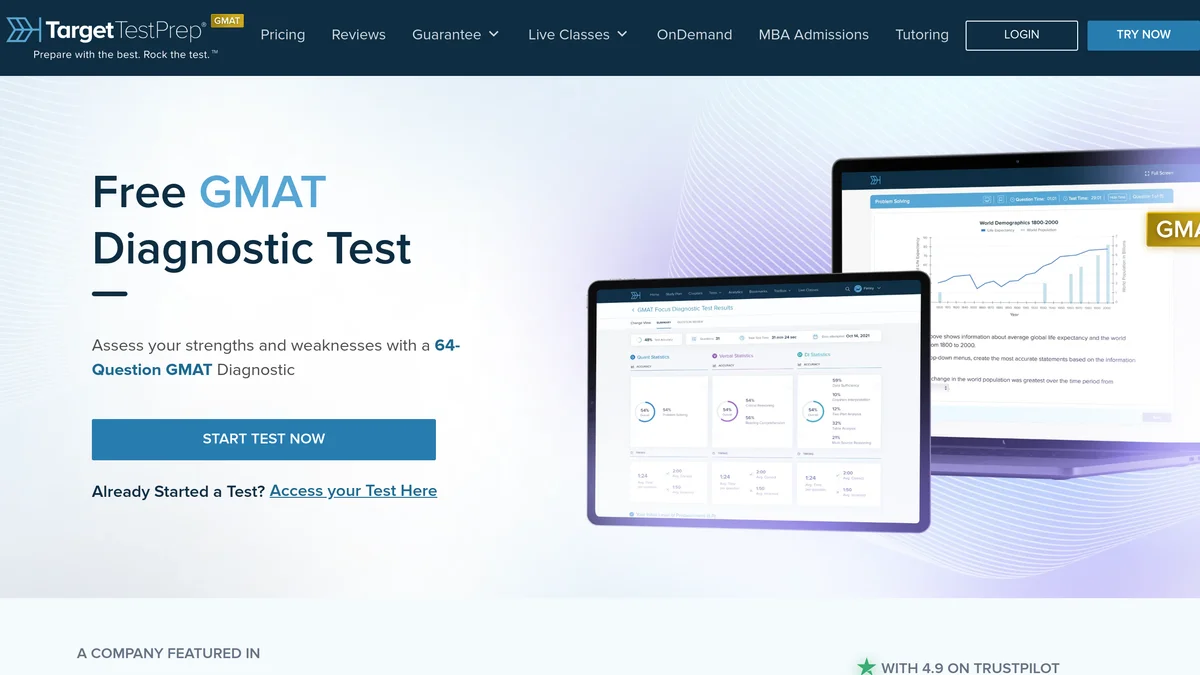 The free diagnostic page on gmat.targettestprep.com, captured September 2026. The tablet shows the results dashboard you land on when the test ends.
Sponsored
Target Test Prep GMAT
One of the most complete GMAT prep platforms we've reviewed. Try full access for 5 days.
No code neededPros
- Very large GMAT content and practice library
- Strong analytics, error tracking, and custom test tooling
- 130-point score improvement guarantee
Cons
- Higher tiers become expensive quickly
Target Test Prep GMAT diagnostic overview
This is an assessment, not a practice exam, and TTP's own subtitle sets the goal plainly: assess your strengths and weaknesses with a 64-question GMAT diagnostic. You take it once, at the start, to find out which question types are costing you points, then you go and study those.
It is free in the way that matters. The form asks for a first name, last name and email, and there is no credit card field and no trial signup anywhere on it, so taking the diagnostic does not enroll you in TTP's paid course. TTP is using the test to introduce you to its platform, and the pitch for the full GMAT course is one click away throughout. That is the trade, and for a free 64-question test it is a fair one.
What the test includes:
- 64 questions spanning Quantitative Reasoning, Verbal Reasoning and Data Insights
- A post-test analytics report broken down by question type
- Timing data for each section, split into correct and incorrect answers
- An Initial Level of Preparedness rating
- Results on screen and a copy emailed to you
- The ability to stop and resume later from the email you registered
The Start Test Now button carries a gmat_focus parameter, so this is built for the current Focus Edition rather than the retired format. The report's own categories confirm it: Verbal breaks out Critical Reasoning and Reading Comprehension with no Sentence Correction, and Data Sufficiency sits under Data Insights, which is how GMAC arranges the exam today.
Target Test Prep GMAT diagnostic review for 2026
Sixty-four questions, and why that number is a trap
The real GMAT is 2 hours 15 minutes and 64 questions: Quantitative Reasoning 21 questions in 45 minutes, Verbal Reasoning 23 in 45 minutes, Data Insights 20 in 45 minutes. TTP's diagnostic is 64 questions across the same three sections. On length and on section coverage, it is a one-to-one match, which is rare for a free test that is not GMAC's own.
Two differences do the damage. The first is adaptivity: GMAC's own practice exams run on the real scoring algorithm, and TTP claims nothing of the kind for this diagnostic. The second is section order. GMAC is explicit that on test day "you can answer the three sections in any order", and that you can take the optional 10-minute break after the first section or the second. TTP's signup form offers no such choice. Its GRE sibling does let you pick which measure comes first, so this is a gap in the GMAT version rather than a house rule.
The real exam also has a Question Review and Edit screen at the end of each section, where you can revisit bookmarked questions and change up to three answers. Neither the product page nor the signup form mentions that tool. If part of what you want from a first test is rehearsing GMAT-specific mechanics, this one does not rehearse them.
What the report gives back, and what it does not
There is no Total Score anywhere in the result. Neither the product page nor the signup form mentions a 205 to 805 figure, a percentile, or a predicted score, and TTP does not claim one.
What you get instead is a dashboard, and the sample on the product page shows its exact shape: overall test accuracy, question count and total test time across the top, then Quant, Verbal and DI panels. Each panel carries an accuracy block, with an overall figure plus accuracy per question type, and a timing block giving average time per question against the average on the ones you got right and the ones you got wrong. Underneath sits an Initial Level of Preparedness rating.
That split of time by correct and incorrect is the most useful thing on the screen. Two students with identical accuracy can have completely different problems, and the one burning two minutes on the questions they get wrong needs a different plan from the one who is rushing.
Worth knowing before you read too much into the example: the sample results image on TTP's page is not a picture of this test. Its header reads 31 questions, a total test time of 31 minutes 24 seconds, and a date attempted of 14 October 2021. The layout is the layout you will get. The numbers in it are from a much shorter, much older sitting.
What the score bands on the form are actually worth
Before the test starts, the form asks for your target GMAT score range and offers five bands: Good, up to 525. Very Good, 535 to 575. Advanced, 585 to 635. Expert, 645 to 675. Expert+, 685 or higher.
Price those labels against GMAC's own percentile table and they read differently. Across 509,182 test takers from 2021 to 2026, the mean GMAT Total Score is 554.94, and a 555 sits at the 47th percentile. So the band TTP calls "Very Good", 535 to 575, is the band that contains the average GMAT score. "Good" tops out below it. At the other end, 655 is the 90th percentile and 705 is the 98th, which puts "Expert+" above most test takers but short of the top few percent.
None of that makes the test worse. It does mean you should pick the band you actually want rather than the one whose label sounds appropriately modest, because it is the frame your report gets presented against. Our good GMAT score guide prices every band against the same official table, and the GMAT percentile calculator converts a score in one step.
Pricing
The diagnostic is free, with no card and no trial signup. The real pricing question is what the alternatives cost, because a free GMAT baseline is not scarce and each option returns something different.
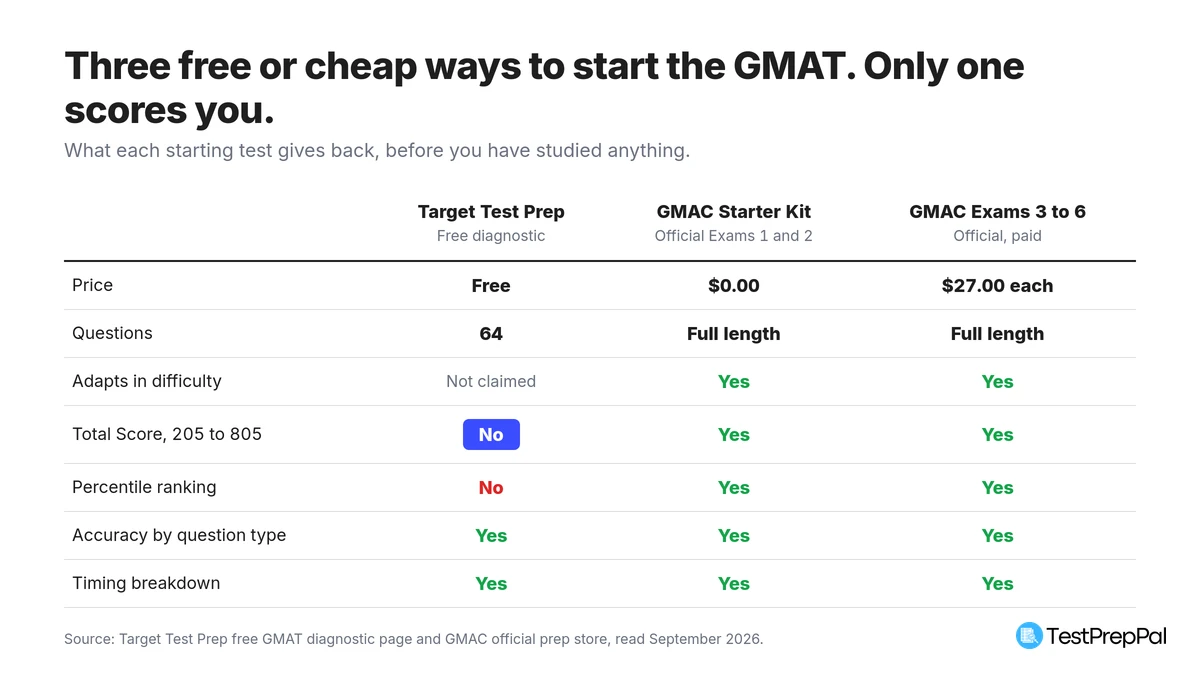 What each free or cheap GMAT starting test returns. Source: Target Test Prep and the GMAC official prep store, read September 2026.
GMAC gives away the Official Starter Kit at $0.00. It carries two full-length official adaptive practice exams, Exams 1 and 2, plus more than 70 official questions, and those exams run on the same scoring algorithm as the real GMAT, so they return a Total Score with percentile rankings. Official Practice Exams 3 to 6 cost $107.99 for the set, which works out at $27.00 per exam. Our GMAC practice test review goes through the whole official ladder.
That is the case for taking TTP's diagnostic first. Your two free official exams are the most accurate score signal you will get without paying, and spending one in week one, before you have studied anything, wastes it. Take the free 64-question diagnostic to find your weak question types, study for a month, then spend an official exam when a realistic number actually means something.
If the diagnostic sells you on the platform, TTP's paid GMAT plans were $249 a month, $799 for four months and $899 for six months when we checked on 29 September 2026, each discounted from list prices of $299, $949 and $1,099 in a sale running to 30 September with code SAVE20. TTP OnDemand, which adds masterclass video lectures to six months of self-study, was $1,299 from $1,599, and LiveTeach, which adds 40 hours of live classes, was $1,799 from $2,199. Every plan includes 4,000-plus practice questions, 1,500-plus lessons and 2,200-plus instructor-led video solutions. The self-study plans carry a 130-point score improvement guarantee; OnDemand and LiveTeach carry a 715-plus guarantee instead.
One inconsistency to flag, since it decides whether you reach for a card. The plans page calls the 5-day course trial free, in those words, more than once. The diagnostic page's own course CTA prices the same trial at $1 and links to the same signup anchor. Read the checkout before you enter anything, and note that neither price applies to the diagnostic itself, which is free either way.
Who the Target Test Prep GMAT diagnostic is best for
It is best for the student who has decided to take the GMAT and has not started studying. You need a list of weak question types before you need a score, and 64 questions in one sitting produces that list without costing you an official exam.
It suits budget prep especially well. Paired with the free tools on our GMAT hub, it lets you build a study plan without spending anything, and it keeps both official practice exams in reserve. If you want the plan built for you afterwards, the GMAT study plan generator turns a test date and your weekly hours into a week-by-week schedule.
It is a poor fit inside a month of test day. At that point you need adaptive difficulty, a score you can trust, and rehearsal of section order and the review-and-edit screen. This test provides none of those. It is also the wrong tool if you already know your weak areas, since the report will hand you back a list you could have written yourself.
When you might look elsewhere
- You want a score, not a question-type map. The official GMAC practice exams are the only ones that produce a real 205 to 805 result, and the two in the free Starter Kit are the closest thing to a free score estimate that exists.
- You want adaptive mocks with deeper analytics. e-GMAT layers score estimates, difficulty breakdowns and timing against the median, and Manhattan Prep is the usual paid alternative for realistic full-lengths.
- You want to drill rather than test. A question bank is the better first purchase in that case, and the GMAC Official Guide question bank is where most students start.
- You want to see the rest of the field first. Everything we have assessed in this category sits on our GMAT diagnostic tests page, and how we test each one is on our review methodology page.
Final verdict
Take it in week one, write down the three weakest question types on the report, and go and fix those. Then let an official exam tell you your score once the number is worth knowing, and use our how to study for the GMAT guide to fill the weeks in between. If you want to start now, the test opens from TTP's diagnostic page.
Target Test Prep GMAT diagnostic FAQs
Is the Target Test Prep GMAT diagnostic really free?
Yes. The form asks for your first name, last name and email, then a target score band. There is no credit card field, and taking it does not enroll you in TTP's 5-day course trial, which is a separate offer. Expect marketing emails afterwards, since the email address is what TTP gets out of the deal.
Does the TTP GMAT diagnostic give you a GMAT score?
No. It returns accuracy by question type, timing data and a preparedness rating rather than a 205 to 805 Total Score or a percentile. Neither the product page nor the signup form claims otherwise, so treat the result as a map of what to study, not an estimate of where you would land.
How long does the TTP GMAT diagnostic take?
TTP publishes no time limit, and at 64 questions it matches the real exam's question count, which runs 2 hours 15 minutes with an optional 10-minute break. Budget something close to that and sit it in one go, because the timing data in the report is only meaningful if you take it the way you would take the real thing.
Should I take this or a free official GMAC exam first?
Take this one first. GMAC's free Official Starter Kit gives you two full-length adaptive exams that return a real Total Score, and they are worth saving until you have studied enough for that number to mean something. A free question-type diagnostic in week one costs you nothing you cannot get back.
Does the diagnostic cover Data Insights?
Yes. All three Focus Edition sections are included, and the report breaks Data Insights out by question type: Data Sufficiency, Graphics Interpretation, Two-Part Analysis, Table Analysis and Multi-Source Reasoning. That is the section most students have the least practice material for, so it is a genuine reason to take this over a Quant-only free test.
We may earn commissions from some links on this page, but this does not affect our reviews or your experience.
Our Verdict
A genuinely free 64-question diagnostic across Quant, Verbal and Data Insights that hands back accuracy and timing by question type instead of a score. It is the right thing to open in week one, because it costs nothing and leaves both free official GMAC practice exams unspent. It is the wrong thing to open later: there is no 205 to 805 Total Score, no percentile, and no choice of section order, so it cannot tell you where you would land today.