

e-GMAT SIGma-X Mocks Review
by e-GMAT
5 full-length adaptive mocks plus 70 or more sectional tests, bundled with the course.
✓Pros
- ✓70 or more sectional mocks allow repeated targeted work on a single weak area
- ✓Sectional and full-length pools are separate, so drilling never burns a full-length
- ✓Results feed ability-level analytics rather than raw accuracy
- ✓Strong Verbal reputation, unusual among GMAT providers
✗Cons
- ✗Not sold standalone, so the mocks require buying a full course plan
- ✗Only 5 full-length exams, which works out to $49.80 each on the cheapest plan
- ✗Questions are original rather than retired official GMAT items
- ✗e-GMAT's own pages give two different sectional mock counts, 70+ and 90
- ✗Shortest access tier is 2 months
Highlights
- ✓5 full-length SIGma-X adaptive mock exams covering all three sections
- ✓70 or more sectional mocks, 20 or more each in Quant, Verbal and Data Insights, 45 minutes each
- ✓Sectional and full-length mocks drawn from separate question databases, so sectionals never consume a full-length
- ✓A question picker that draws from 5 difficulty bands rather than the usual 3
- ✓Ability-level proficiency analytics by sub-section, difficulty band and topic
- ✓Timing analysis against median time, flagging rushed and over-long questions
Price
$249 - $499
What Students Are Saying
Sign in to leave a review

Expert Rating
SIGma-X is e-GMAT's mock engine, and it is the best sectional practice tool in GMAT prep attached to one of the weakest full-length counts. You get 5 full-length adaptive mocks and 70 or more sectionals, and you cannot buy either on its own: the entry price is a two-month e-GMAT course plan at $249. That is a good deal if one weak sub-section is capping your score, and a bad one if what you are short of is full-length tests.
There is a number problem worth clearing up first, because every roundup repeats it, ours included until today. e-GMAT's pricing plan card says "5 Full + 90 Sectional Mocks". Its own SIGma-X product page says 70 or more, in four separate places. Everything below was read on 14 September 2026.
Summary Table
| Feature | e-GMAT SIGma-X Mocks |
|---|---|
| Price | $249 for 2 months, $379 for 4 months, $499 for 6 months |
| Sold separately | No. SIGma-X comes with an e-GMAT course plan |
| Full-length mocks | 5, adaptive, covering all three sections |
| Sectional mocks | 70 or more, at least 20 each in Quant, Verbal and Data Insights |
| Question pools | Sectional and full-length draw from separate databases |
| Adaptivity | Question-level, from 5 difficulty bands rather than the usual 3 |
| Analytics | Score estimate, sub-section scores, difficulty bands, topic filter, timing |
| Access | 60, 120 or 180 days, depending on the plan you buy |
| Guarantee | 7-day money back, full refund, no questions asked |
| Cost per full-length | $49.80 on the $249 plan, $99.80 on the $499 plan |
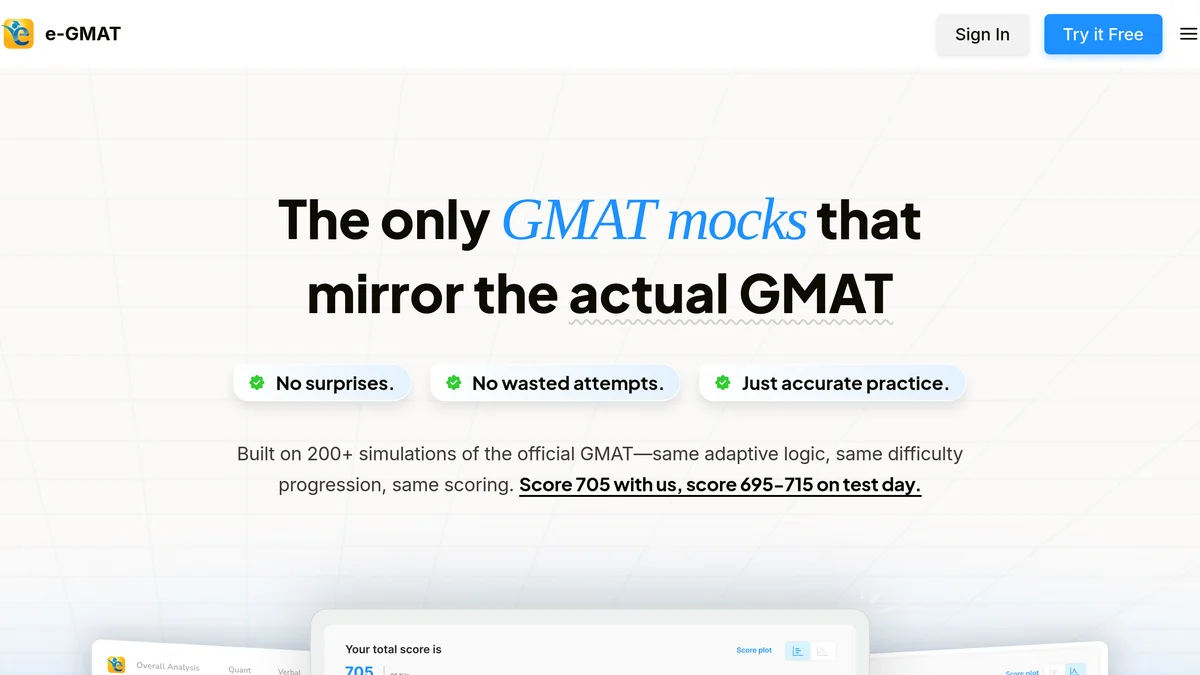 The SIGma-X product page at e-gmat.com, captured September 2026.
e-GMAT SIGma-X Mocks Overview
SIGma-X is the assessment half of the e-GMAT platform. Scholaranium is where you drill questions; SIGma-X is where you sit timed tests under adaptive conditions and get a score back.
Two products sit under the one name, and keeping them apart is the whole point of understanding this engine:
- 5 full-length mocks. All three sections, adaptive, with a complete score report on the 205 to 805 scale.
- 70 or more sectional mocks. One section at a time, 45 minutes each, with at least 20 available in Quant, Verbal and Data Insights.
Every plan carries the same content. The only difference between $249 and $499 is how long you keep access, which is unusual and worth knowing before you let the per-month figures talk you into the long plan.
How many sectional mocks is it really
e-GMAT publishes two different answers, and the conflict is on a single page. The pricing page plan card says "5 Full + 90 Sectional Mocks" on all three plans. Scroll down that same page to Solution Details and the sectional mocks line says "70+ tests", with a separate line directly above it for 90 or more expert-designed cementing quizzes.
The SIGma-X product page sides with 70. It says 70 or more in its section header, in its comparison table, and in the first answer of its FAQ, and it gives the split that makes the figure checkable: 20 or more Quant sectionals, 20 or more Verbal, 20 or more Data Insights.
So the most likely reading is that the plan card borrowed the 90 from the cementing quizzes one block below it. Treat 70 as what you are buying. The practical difference is small, because 70 sectionals is already more than most students will finish, but a plan card that overstates the count is worth knowing about before you trust the rest of its numbers.
e-GMAT SIGma-X Mocks Review For 2026
The separate question pools are the real feature
This is the mechanic that distinguishes SIGma-X from a pack of mocks, and no roundup mentions it.
Sectional and full-length mocks draw from completely separate question databases. e-GMAT states that taking 20 sectional Quant mocks never reduces your full-length availability, and that you will not see a question repeat between the two.
That solves the problem every GMAT student runs into. You hold six official exams, you are weak in Data Insights, and every attempt to practise Data Insights under timed conditions costs you either a full-length or a question you wanted to save. With SIGma-X you can sit ten Quant sectionals in a fortnight, at 45 minutes each rather than the better part of an afternoon, and still have all 5 full-lengths intact for the weeks when stamina is what you are testing.
Five full-lengths is genuinely thin. Experts' Global sells 15 for less than a quarter of the price, and GMAT Club bundles more than five into its paid tiers. The answer e-GMAT gives is that you should not be burning full-lengths on diagnosis in the first place, and on that specific point it is right.
The adaptivity is more granular than most
Most third-party mocks pull from three difficulty banks: easy, medium, hard. e-GMAT says its question picker draws from five, and that each mock's pool holds three times the questions a single sitting needs, so the engine always has the right difficulty ready no matter how well you perform. The SIGma-X product listing names the method: Item Response Theory, rather than the simpler question-by-question adaptation most mocks use.
The picker also looks at your full answer history rather than only the last question. e-GMAT says the engine was built on 200 or more simulations of the official GMAT and that each question's difficulty is calibrated through 400 or more student attempts.
The analytics that come back are the strongest part of the product. Five layers: an overall estimate with percentile, scores by sub-section, accuracy broken out at Medium, Medium-Hard and Hard, a topic-level filter, and a timing view that compares your time against the median question by question and flags four patterns, including rushing and spending too long. A report that tells you your Two-Part Analysis sits at the 82nd percentile while Multi-Source Reasoning sits at the 31st is a study plan. A report that says "work on Data Insights" is not.
Take the accuracy claim as a vendor claim
e-GMAT's headline is that 94 percent of students score within 20 points of their SIGma-X mock average, validated against a student community of 10,000 or more. Score 705 with us, the product page says, and expect 695 to 715 on test day.
There is no way to audit that from outside, and it is self-reported, so treat it as e-GMAT's claim rather than as a finding. What is more interesting is that e-GMAT's own comparison table on the same page concedes the point most vendors fight: it lists GMAC's official mocks as "most accurate", the "official test maker", the "gold standard for accuracy", and notes they use retired official questions. SIGma-X gets "20-point precision" in the same row.
That is a fair and unusually honest table. It sits a few hundred pixels above a student testimonial on the same page claiming SIGma-X "is more accurate than the official mocks itself", which the table itself does not support. Believe the table.
The other honest limitation is the one every third-party engine shares. These are original questions written to imitate the GMAT. Only GMAC's official practice exams use retired real questions and the exam's own scoring algorithm, which is why they stay the tests you calibrate against no matter what else you buy.
Pricing
One course, three durations, identical content. Prices below were read on the pricing page on 14 September 2026.
| Plan | Price | Per month | Per full-length | Per test, sectionals counted |
|---|---|---|---|---|
| 2 months | $249, listed at $499 | $124 | $49.80 | $3.32 |
| 4 months | $379, listed at $999 | $94 | $75.80 | $5.05 |
| 6 months | $499, listed at $1,499 | $83 | $99.80 | $6.65 |
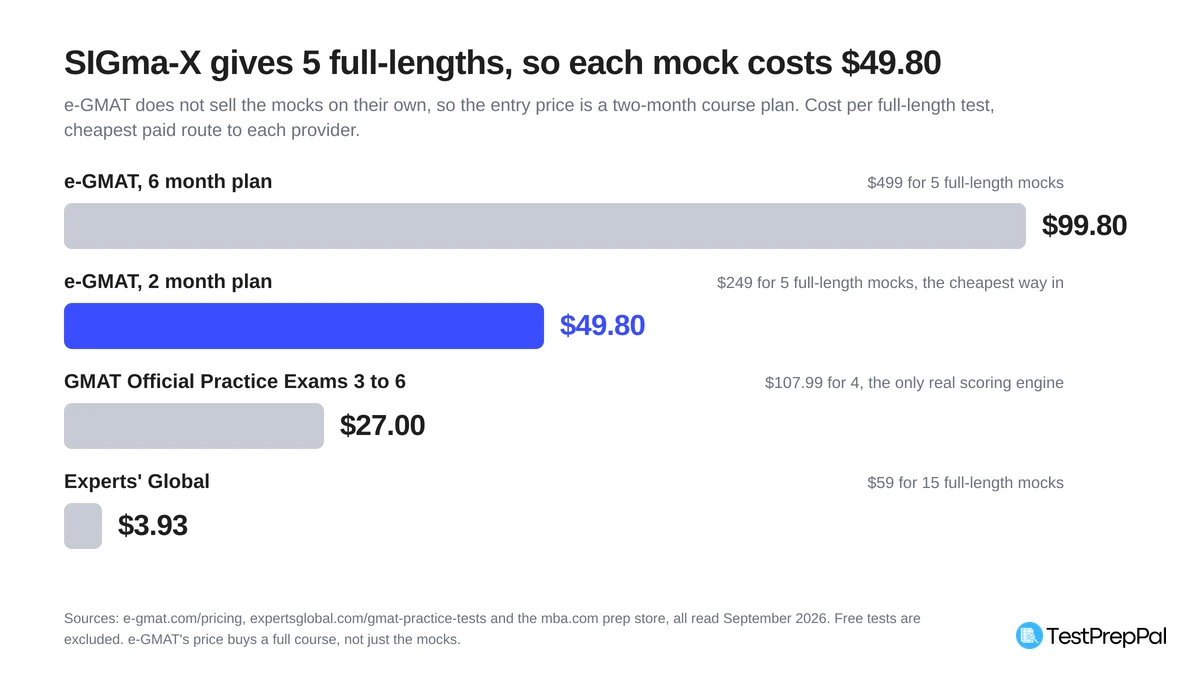 Cost per full-length test at each provider's cheapest paid option. Sources: e-gmat.com, expertsglobal.com and the mba.com prep store, read September 2026.
Those last two columns are the argument in one line. Judge SIGma-X on full-lengths and it is the most expensive option in GMAT prep: $49.80 a test at best against $27.00 for GMAC's Exams 3 through 6 at $107.99 and $3.93 for Experts' Global's 15 mocks at $59. Judge it on all 75 tests and it lands at $3.32 each, which is reasonable for an engine with these analytics attached.
Neither number is the honest one on its own, because $249 does not buy mocks. It buys a course with 250 or more hours of video, 7,500 practice questions, three live sessions a week and a mentor, and the mocks come with it. The question is not whether the mocks are worth $249. It is whether you want the course.
If you want full-length volume, this is the wrong product and the arithmetic is not close. If you want to drill one weak sub-section under timed conditions without spending a full-length to do it, nothing else on the market is built for that.
Do not count on a free mock to try it first. e-GMAT's SIGma-X landing page is titled "Free GMAT Mock Tests and Practice Exams Online" and carries three "Try it for Free" buttons, but the free trial contents listed at the bottom of that same page are 15 or more hours of video lessons, 400 or more practice questions and 7 or more live webinars. No mock appears in that list.
What does make this low risk is the refund. Every plan carries a 7-day money back guarantee, a 100 percent refund with no questions asked. Buy the two-month plan, sit a full-length and three sectionals in the first week, and the decision costs you nothing if the analytics do not suit you.
Who e-GMAT SIGma-X Mocks Is Best For
- Students stuck on one sub-section who need timed practice on it repeatedly, which is exactly what 20 or more sectionals per section and a separate question pool are for.
- Retakers who already know their score is capped by Verbal or Data Insights and want a diagnosis by sub-section and difficulty band rather than another total.
- Anyone buying the e-GMAT course anyway, for whom the mock engine is a strong bonus rather than a purchase.
- Students who plan their prep around official mocks and want somewhere else to do their volume, so GMAC's six stay unspent until they mean something.
When You Might Look Elsewhere
- You want accurate score prediction. GMAC's official practice exams are the only mocks built on retired real questions and the exam's own scoring algorithm. Two are free in the Starter Kit, and Exams 3 through 6 are $107.99 together. e-GMAT's own comparison table agrees.
- You want full-length volume and nothing else. Experts' Global sells 15 full-lengths for $59 with the first one free. At $3.93 a test against $49.80, this is not a close call.
- Quant is your bottleneck and you want it harder than the real thing. GMAT Club Tests are deliberately tougher than the exam, with one full adaptive test free forever. Our e-GMAT and Target Test Prep comparison covers the other side of that choice.
- You want unlimited custom sets rather than a fixed number of tests. Target Test Prep builds as many targeted practice sets as you like over a 4,000 question bank, though it sells no full-length adaptive mocks at all.
Final Verdict
SIGma-X earns 4.0 from us, and the score is a split decision rather than a compromise. The sectional engine is the best of its kind: 70 or more tests, a separate question pool so drilling never costs you a full-length, five difficulty bands, and analytics that name the sub-section and the difficulty band where your points are going. Nothing else in GMAT prep is built to do that job.
The marks come off for the two things e-GMAT does not volunteer. Five full-lengths is thin, and at $49.80 each on the cheapest plan it is the most expensive full-length in the market. And the plan card you buy from says 90 sectional mocks while the product page says 70 or more, which is a small error on a page where the numbers are the pitch.
If you are still choosing, our GMAT practice test comparison ranks all seven options including the free ones, the study plan generator maps your weeks against your test date, and the free GMAT Quant practice questions give you a read on Problem Solving before you spend anything. The GMAT hub has the rest, and our review methodology explains how we score.
e-GMAT SIGma-X Mocks FAQs
How many mocks do you get with e-GMAT?
Five full-length adaptive mocks and 70 or more sectional mocks, with at least 20 sectionals each in Quant, Verbal and Data Insights. e-GMAT's pricing plan card says 90 sectionals, but its SIGma-X product page says 70 or more in four places and the Solution Details block on the pricing page itself says the same, so 70 is the figure to plan around.
Can you buy SIGma-X mocks without the course?
No. SIGma-X is bundled into e-GMAT's course plans, which cost $249 for 2 months, $379 for 4 months or $499 for 6 months, read on 14 September 2026. All three plans contain identical content and differ only in access length, so the two-month plan is the cheapest way to reach the mocks. e-GMAT's free trial exists, but the contents it advertises are video lessons, practice questions and webinars rather than a mock, so plan on paying. The 7-day refund is the safer way to test the engine.
How accurate are SIGma-X mock scores?
e-GMAT says 94 percent of students score within 20 points of their SIGma-X mock average, validated on a community of 10,000 or more students. That is a vendor claim with no independent audit behind it. e-GMAT's own comparison table still lists GMAC's official exams as the accuracy gold standard, so use SIGma-X for direction and official mocks for calibration.
Do sectional mocks use up your full-length tests?
No, and this is the feature that sets SIGma-X apart. Sectional and full-length mocks draw from completely separate question databases, so taking 20 Quant sectionals leaves all five full-lengths untouched and you will not meet a repeated question between the two. It is why the engine suits a student drilling one weak sub-section.
Are SIGma-X mocks better than the official GMAT practice exams?
Not for score prediction, and e-GMAT does not claim otherwise. The official exams use retired real questions and the real scoring algorithm, which no third-party mock can match. SIGma-X is better on volume, on sectional practice, and on analytics, since GMAC supplies no answer explanations at all and only basic score reports.
We may earn commissions from some links on this page, but this does not affect our reviews or your experience.
Our Verdict
SIGma-X is the best sectional practice engine in GMAT prep and an expensive way to buy full-length tests. The 70 or more sectional mocks draw from a separate question pool, so drilling Quant for a week never eats into your 5 full-lengths, and the analytics report ability by sub-section rather than raw accuracy. Buy it if one weak sub-section is capping your score and you want a course anyway. Skip it if full-length volume is what you are short of, because 5 full-lengths at $249 is $49.80 each.