

e-GMAT GMAT Course Review
by e-GMAT
AI-driven GMAT course with mocks, live sessions, and mentor support included.
✓Pros
- ✓7,500+ practice questions with detailed solutions
- ✓5 full-length adaptive SIGma-X mocks plus 90 sectional mocks included
- ✓Three live sessions per week and mentor support in every plan
- ✓AI-driven study planning, prioritization, and quiz feedback
- ✓Aggressive pricing: $249 to $499 for 2 to 6 months of full access
- ✓7-day no-questions-asked money-back guarantee
✗Cons
- ✗No long-term score-improvement guarantee (refund window is 7 days)
- ✗Shortest plan is 2 months; no rolling monthly option
- ✗Fully online platform with no printed materials
Highlights
- ✓Complete GMAT course (Quant, Verbal, Data Insights) at every tier
- ✓250+ hours of video lessons plus foundational modules for beginners
- ✓7,500+ practice questions with detailed solutions (Scholaranium)
- ✓5 full-length SIGma-X adaptive mocks and 90 sectional mocks
- ✓3 live sessions per week and onboarding coach sessions
- ✓Dedicated mentor with 1-business-day personalized improvement plans
- ✓Bonus GMAT Club tests (37 adaptive tests) included
Price
$249 - $499
What Students Are Saying
Sign in to leave a review

Expert Rating
e-GMAT is one course sold in three lengths: $249 for two months, $379 for four and $499 for six. The content is identical in all three, so the only thing your money buys is time, and that makes this a better deal for a patient student than for a rushed one.
Most reviews stop at those three prices and the 250 hour headline. This one does the arithmetic that actually decides which plan to buy, using the curriculum e-GMAT itemises on its own pages, read on 13 September 2026.
Summary Table
| Feature | e-GMAT GMAT Course |
|---|---|
| Price | $249 for 2 months, $379 for 4 months, $499 for 6 months |
| Format | Online and self-paced, with 3 live group sessions a week |
| Video lessons | 250 hours or more, itemised as 20 hours of foundations, 125 hours of concept files and 125 hours of application files |
| Practice | 7,500 questions in Scholaranium, 500 qualifying quizzes, a custom quiz engine |
| Full-length tests | 5 adaptive SIGma-X mocks, plus 90 sectional mocks |
| Bonus | 37 GMAT Club adaptive tests, which e-GMAT values at $79 |
| Support | Dedicated mentor, replies within 1 business day, plus 3 live sessions a week |
| Access | 60, 120 or 180 days, depending on the plan |
| Guarantee | 7-day money back, full refund, no questions asked |
| Free option | A free registration tier before you pay |
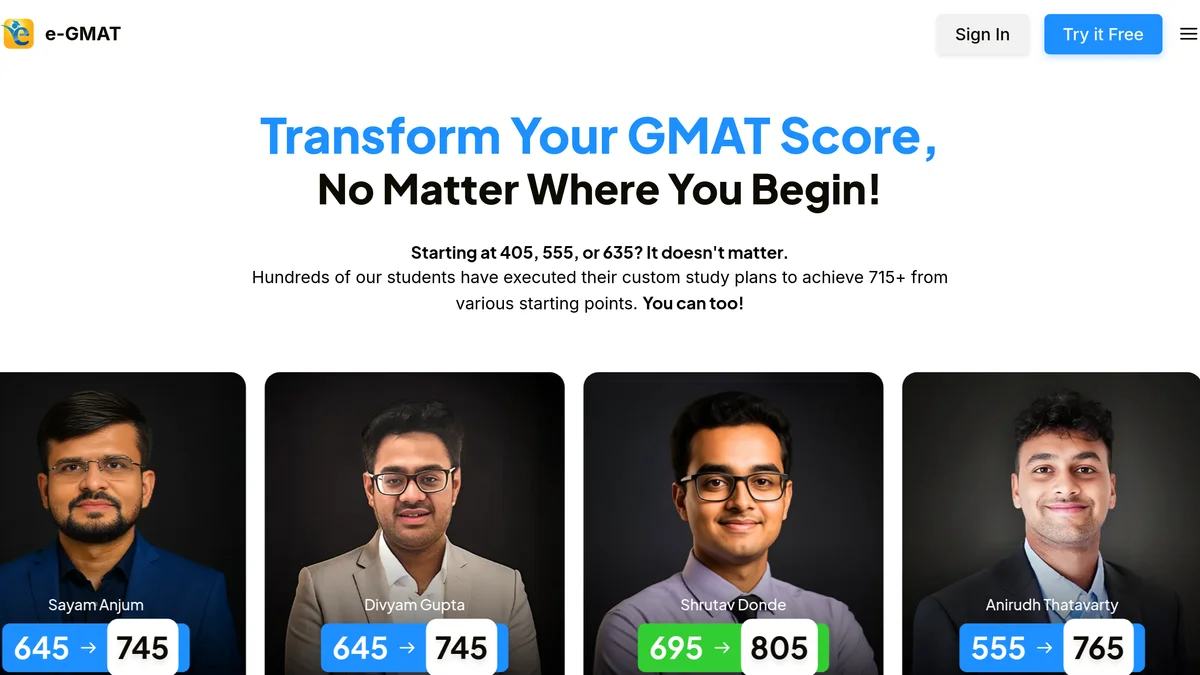 The e-GMAT course page at e-gmat.com, captured September 2026.
e-GMAT Course Overview
e-GMAT is an online GMAT Focus course built around a single idea: teach the concept, then teach the process for applying it, then make you practise it until a published accuracy threshold says you can stop. There are no printed books and no classroom option. Everything runs in the browser.
The unusual part is the pricing structure. Most providers put features behind tiers, so the cheap plan loses the mocks or the instructor access. e-GMAT does the opposite. Every plan, from the $249 one upward, contains:
- Foundation modules for students who need them, covering sentence structure for Verbal and arithmetic basics for Quant.
- Over 250 hours of video lessons across Quant, Verbal and Data Insights.
- 7,500 practice questions with written solutions in Scholaranium, the question bank we review separately in our e-GMAT Scholaranium review.
- 5 full-length adaptive SIGma-X mocks and 90 sectional mocks, covered in detail on our e-GMAT practice tests page.
- Three live sessions every week, for onboarding, progress checks and question-type deep dives.
- A dedicated mentor who reads your attempt data and writes an improvement plan within one business day.
- 37 bonus GMAT Club adaptive tests.
So the decision in front of you is not which plan has the features you need. It is how many days you need.
e-GMAT Course Review For 2026
Half the video hours teach application, not concepts
The "250+ hours" headline hides the split that matters. Further down the same pricing page, e-GMAT itemises the course as 20 hours of foundation modules, 125 hours of concept files across 10 courses, and 125 hours of application files across more than 130 files. That is an even split between learning a concept and learning how to use it on a real question.
This is the part of e-GMAT that competitors genuinely do not copy. In most courses you watch a lesson on weighted averages and then go answer weighted average questions, and the gap between those two things is where students stall. e-GMAT fills that gap with a second video layer, and it calls the application files an in-house exclusive.
Note that the itemised hours add up to 270, not 250, and e-GMAT's own learning page says 200 hours or more for the same course. Three figures for one curriculum is sloppy rather than dishonest, and the direction of the error is harmless, but it tells you to treat the headline as approximate.
The methods behind the lessons have names and are taught as processes: Pre-thinking for Critical Reasoning, Active Reading for Reading Comprehension, Process Skills for Quant, and an Owning the Dataset approach for Data Insights. e-GMAT publishes accuracy tables for Pre-thinking, claiming hard Critical Reasoning accuracy moves from 40 to 50 percent up to 70 to 80 percent. Those are the vendor's own numbers with no methodology attached, so read them as a description of what the method is for rather than as evidence.
P.A.C.E exists so that you skip most of the course
e-GMAT's adaptive engine, P.A.C.E, opens each module with diagnostic quizzes, works out which concepts you already know, and removes them from your path. The learning page says students save up to 90 hours this way.
That claim deserves attention because it contradicts the way the course is sold. The headline number is the size of the library, while the engine is designed to stop you watching most of it. If you are a strong Quant student who needs Verbal work, the honest expectation is not 250 hours of video. It is a fraction of that, decided by diagnostics in your first week.
The rest of the platform is instrumentation. Journey View grades the quality of your learning every 30 minutes against other test takers, an execution tracker turns your available hours into daily tasks, streak rings compare planned effort against actual effort, and PRISM explains why you missed the questions you missed. For a student who has stalled and cannot name the reason, this is the reason to pick e-GMAT. For a student who wants to open a course, watch a lesson and do 30 questions, it is a lot of dashboard.
Live sessions and a mentor are included, which is rare at this price
Three live sessions a week at every plan length is the feature most worth checking against competitors. At Target Test Prep, live instruction means the LiveTeach plan at $1,799 for 40 hours of classes. At e-GMAT the sessions come with the $249 plan.
They are group sessions, not tutoring, so treat them as office hours with a schedule rather than as one-to-one teaching. The mentor is the closer substitute for a tutor: e-GMAT says mentors analyse your course data and return a personalised improvement plan within one business day, and that 90 percent of subject matter queries get an answer in under an hour. For the final push it runs a Last Mile Push programme aimed at the final 50 to 70 points, with a 92 percent success rate that is again e-GMAT's own figure and not an audited one.
Pricing
One course, three durations, identical content. Prices were read on the official pricing page on 13 September 2026.
| Plan | Price | Per month | Days of access | Video hours a day to finish |
|---|---|---|---|---|
| 2 months | $249, listed at $499 | $124 | 60 | 4.2 |
| 4 months | $379, listed at $999 | $94 | 120 | 2.1 |
| 6 months | $499, listed at $1,499 | $83 | 180 | 1.4 |
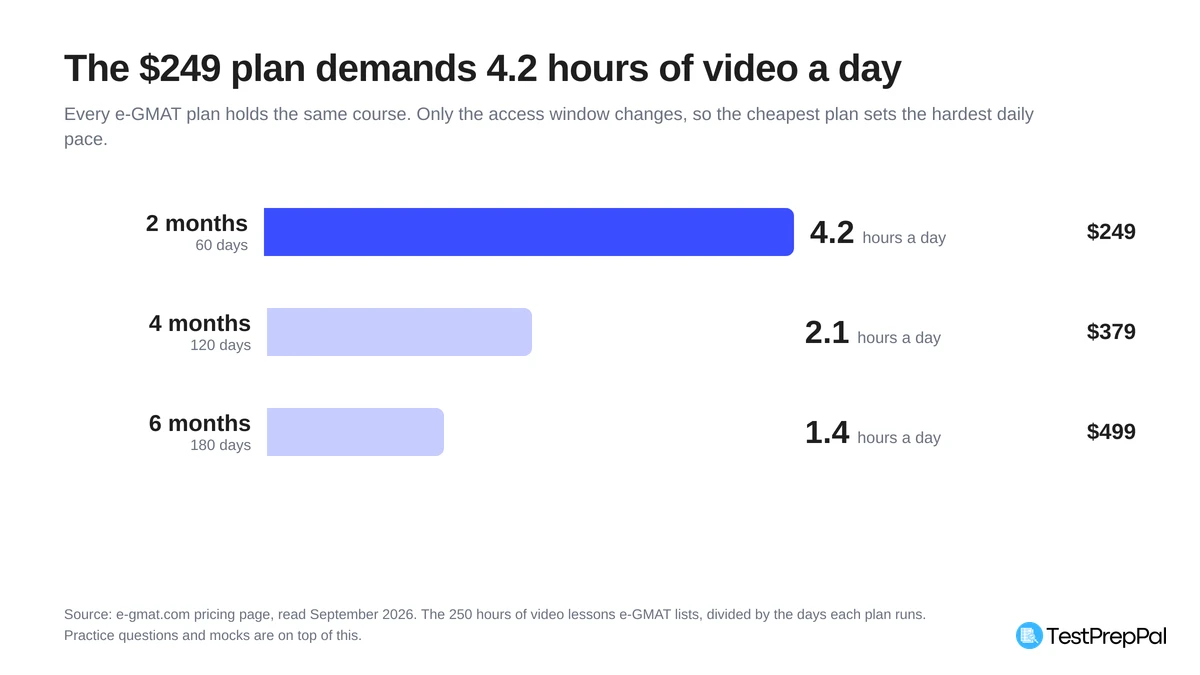 The 250 hours of lessons divided by the days each plan runs. Source: e-gmat.com pricing, read September 2026.
The last column is the one nobody publishes, and it changes the decision. Divide the 250 hours of video by the days each plan gives you and the $249 plan asks for 4.2 hours of video a day, every day, before you attempt a single practice question, take one of the five mocks, or attend a live session. The four month plan asks 2.1 hours a day and the six month plan asks 1.4.
P.A.C.E softens this, because a student who skips 90 hours of content needs about 2.7 hours a day on the short plan instead of 4.2. It does not remove it. e-GMAT's own published journey puts the first SIGma-X mock on Day 0, the study plan on Day 1, the foundation work from Day 2, cementing quizzes at Day 30 and test readiness mocks at Day 45, which fits inside 60 days only if nothing in your life goes wrong.
The plans hold the same course, so the price difference is not buying you more material. It is buying you a slower pace. Pick the length from the hours you can actually study each day, not from the sticker price.
Against the field, the value is strong. Six months of e-GMAT is $499 where six months of Target Test Prep Self-Study is $899 and its OnDemand course is $1,299, and e-GMAT includes mocks and live sessions that Target Test Prep either does not sell or puts in a higher plan. Our e-GMAT and Target Test Prep comparison puts the two side by side in full.
There is a 7-day money back guarantee on every plan, a full refund with no questions asked, and a free registration tier before that. Use both. A week inside the platform will tell you whether the analytics suit you far better than any review will.
Who e-GMAT Is Best For
- Students who have plateaued and cannot name the sub-section costing them the points. The diagnostics and the sub-section reporting are built for exactly this problem.
- Verbal-limited students, which is the section e-GMAT built its reputation on and where the Pre-thinking and Active Reading processes are aimed.
- Anyone who wants live contact and a named mentor without paying a live-class price.
- Students with three to six months and one to two hours a day, which is the pace the four and six month plans are built around.
- Budget-conscious retakers who want a full course, a question bank and mocks in one purchase instead of three.
When You Might Look Elsewhere
- You want a score guarantee. e-GMAT offers a 7-day refund window and nothing beyond it. Target Test Prep advertises a score improvement guarantee of up to 130 points on its plans page, and PrepScholar attaches a score guarantee to its GMAT course too. Both come with completion conditions, so read them, but they are a different kind of promise from a refund window.
- You need to study month to month. e-GMAT's shortest plan is two months. Target Test Prep sells Self-Study at $249 a month on a rolling basis, which suits a student whose test date keeps moving.
- You want the cheapest possible course. Magoosh is the budget option in our GMAT prep course roundup, with short video lessons and a much smaller library. You lose the mentor, the live sessions and most of the analytics.
- You want strategy rather than curriculum. If you are already scoring in the middle of the range and want tactics instead of 250 hours of instruction, EMPOWER GMAT is built for that, and Manhattan Prep is the stronger pick if you want a challenging classroom-style course.
Final Verdict
e-GMAT earns its reputation on instruction. The concept and application split is a real structural advantage over courses that teach a topic and then hand you questions, the analytics diagnose rather than just report, and putting live sessions and a mentor in a $249 plan is unusual at that price. Our 4.2 rating reflects a course that is priced well below the premium field and does not cut the features that usually get cut.
Two things keep it below the top of our rankings. The guarantee is a 7-day refund and nothing more, which is thin next to the 130-point promise attached to the main alternative. And the plan structure quietly shifts risk onto you: buy the cheapest plan, misjudge your schedule, and the material stops being yours before you finish it.
Before you buy, our GMAT prep course roundup ranks the courses we have reviewed, the study plan generator turns your test date into a weekly schedule so you can see which plan length is realistic, and the free GMAT Quant practice questions give you an honest baseline first. Our guide to how to study for the GMAT covers the sequencing, the GMAT hub has the rest, and our review methodology explains how we score products.
e-GMAT Course FAQs
How much does the e-GMAT course cost?
$249 for two months, $379 for four months and $499 for six months, read on the official pricing page on 13 September 2026. All three plans contain identical content and differ only in how long access lasts, so the per-month figures e-GMAT shows, $124, $94 and $83, are the honest way to compare them. A free registration tier lets you see the platform before paying.
Which e-GMAT plan should I buy?
The four or six month plan, unless you are close to your target already. The course holds roughly 250 hours of video plus 7,500 questions and five mocks, and the two month plan gives you 60 days to use them, which works out at 4.2 hours of video a day before any practice. The six month plan drops that to 1.4 hours a day and costs $250 more.
Does e-GMAT have a score guarantee?
No. e-GMAT offers a 7-day money back guarantee, a full refund with no questions asked, and no score improvement promise beyond it. If a guaranteed points increase is what you are shopping for, Target Test Prep and PrepScholar both attach one to their GMAT courses, with completion conditions.
Is e-GMAT better than Target Test Prep?
They win on different things. e-GMAT is better value and better equipped out of the box, with 7,500 questions, five full-length mocks and weekly live sessions at $499 for six months against $899 for six months of Target Test Prep Self-Study. Target Test Prep has the stronger Quant course, a score guarantee, monthly billing, and it is the course we have tested hands on.
Do I need anything else alongside e-GMAT?
Yes, official questions. No third-party course contains retired GMAT items, so pair e-GMAT with GMAC's Official Guide and the official practice exams for score prediction. e-GMAT's SIGma-X mocks are useful for sectional diagnosis, but the official mocks are the ones built on real questions and the exam's own scoring engine.
We may earn commissions from some links on this page, but this does not affect our reviews or your experience.
Our Verdict
e-GMAT sells one course in three lengths, and at $249 for two months it is the cheapest way to get a full GMAT course with live sessions and a dedicated mentor attached. The catch is the clock: the plans differ only in access time, so the $249 plan gives you 60 days to work through 250 hours of video and 7,500 questions. Buy the four or six month plan unless you are already close to your target score. The weakness is the guarantee, which is a 7-day refund window and nothing else.