


Plan on roughly 100 hours of GMAT study spread across two to three months. Those are both GMAC's own figures, and putting them together gives you the number nobody quotes: about 8 to 12 hours a week.
That weekly figure is the one worth planning around, because hours and months on their own do not tell you whether your schedule is survivable. This page converts the official guidance into a calendar, shows you what your score gap is actually worth on GMAC's percentile table, and explains why the widely quoted "90 hours" is not the target you think it is.
- GMAC's guidance is two to three months and a ballpark of over a hundred hours, which works out to about 8 to 12 hours a week.
- GMAC does not publish a median study time. The only hours figure it still publishes describes people who already scored in the 89th percentile.
- GMAC's own Official Study Planner is six weeks long, which implies nearly 17 hours a week at the same 100-hour ballpark.
- Fifty points is worth 22 percentile points if you start at 555, and 2 percentile points if you start at 705.
- You must wait at least 16 days between attempts, so build the retake window into your calendar before you book.

Target Test Prep GMAT
One of the most complete GMAT prep platforms we've reviewed. Try full access for 5 days.
No code neededPros
- Very large GMAT content and practice library
- Strong analytics, error tracking, and custom test tooling
- 130-point score improvement guarantee
Cons
- Higher tiers become expensive quickly
What GMAC actually says about study time
GMAC's guidance on how long to study makes three claims, and they are more careful than the summaries you will see elsewhere.
First, two to three months "is plenty of time to keep up the intensity it takes to prepare". GMAC is explicit that longer is not better: dragging out preparation "won't necessarily improve your score" because there are diminishing returns, and the risk at the far end is losing momentum.
Second, its research shows that top scorers "report studying over 90 hours for the test". GMAC defines those top scorers precisely, as test takers in at least the 89th percentile.
Third, and most usefully, GMAC suggests keeping "over a hundred hours of preparation as a ballpark figure for your practice". That is the number to plan with, and it is higher than the 90 that gets quoted.
Notice what is missing. GMAC publishes no median or average study time for ordinary test takers. If you have seen a tidy figure like "the median candidate studies 80 hours", it is not coming from GMAC's current materials. The mba.com page that once hosted test-taker survey data on study hours now serves GMAC's general prep page with no such data on it. Treat any precise median you encounter as unsourced until someone shows you where it lives.
Turn the hours into a calendar
A total hours figure is useless until you divide it by the hours you can actually find each week. The arithmetic is simple, and it is the part most advice skips.
At GMAC's 100-hour ballpark, here is what your weekly availability buys you:
| Hours a week | 90 hours | 100 hours | 150 hours |
|---|---|---|---|
| 5 | 18 weeks | 20 weeks | 30 weeks |
| 8 | 11 weeks | 12.5 weeks | 19 weeks |
| 10 | 9 weeks | 10 weeks | 15 weeks |
| 12 | 7.5 weeks | 8.3 weeks | 12.5 weeks |
| 15 | 6 weeks | 6.7 weeks | 10 weeks |
| 20 | 4.5 weeks | 5 weeks | 7.5 weeks |
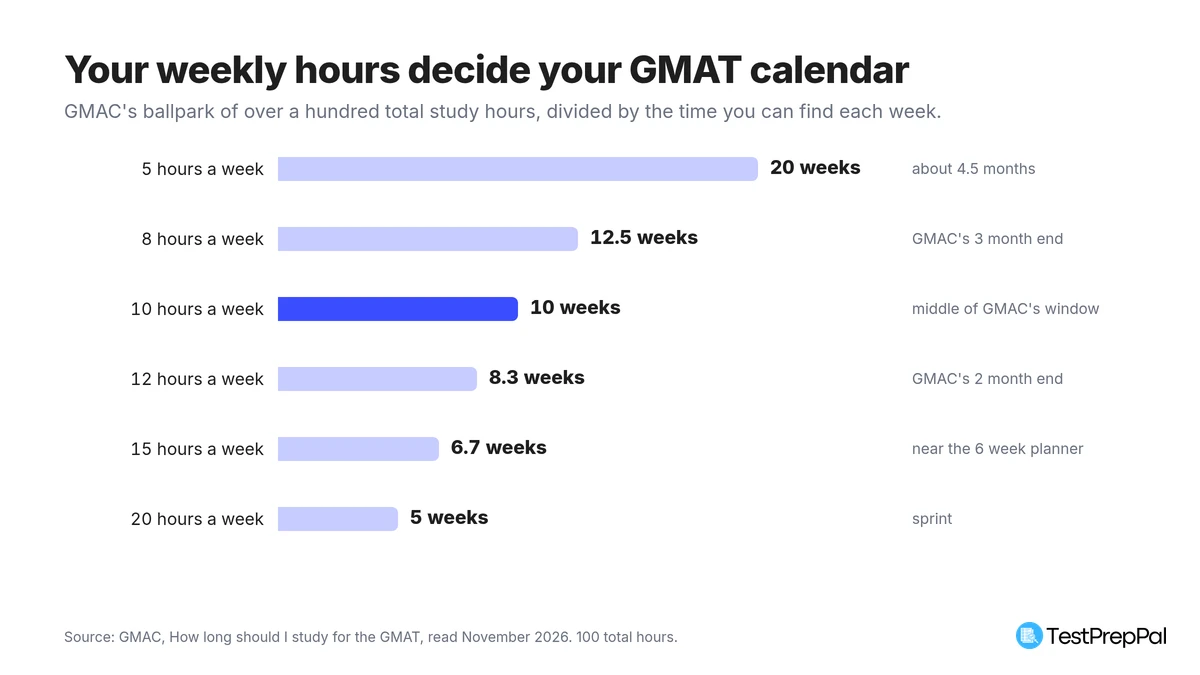 Weekly study hours against the resulting calendar length, at GMAC's stated ballpark of over a hundred hours. Source: GMAC, How long should I study for the GMAT, read November 2026.
Run GMAC's own window through that arithmetic and you get the weekly number. Two months is about 8.7 weeks, so 100 hours means 11.5 hours a week. Three months is about 13 weeks, so the same 100 hours means 7.7 hours a week. That is the 8 to 12 hours a week this page opened with, and it is simply GMAC's two figures multiplied together.
There is a wrinkle worth knowing about. GMAC also publishes a free Official Study Planner, and that planner is six weeks long, not two to three months. At the same 100-hour ballpark, six weeks demands nearly 17 hours a week. So GMAC's article and GMAC's planner describe two quite different commitments, and neither mentions the other. If you are using the six-week planner, go in knowing it assumes roughly double the weekly load of the three-month path.
Whichever you pick, put it against a real date. Our free GMAT study plan generator takes your test date, your weekly hours and your section priorities and returns a week-by-week schedule with a risk label, which is the same calculation above with your actual constraints in it. For the content of those weeks rather than their shape, how to study for the GMAT sets out the order to work in.
How big is your gap, and what is it worth
Hours only matter relative to the distance you are trying to cover, and the distance is not measured in points alone. It is measured in percentile, because that is what schools compare.
Here is GMAC's official total score percentile table, covering 509,182 tests from 2021 to 2026, with the percentile gained by each 50-point step added:
| Score | Percentile | Gained by the 50-point step to here |
|---|---|---|
| 455 | 16% | |
| 505 | 27% | +11 points |
| 555 | 47% | +20 points |
| 605 | 69% | +22 points |
| 655 | 90% | +21 points |
| 705 | 98% | +8 points |
| 755 | 100% | +2 points |
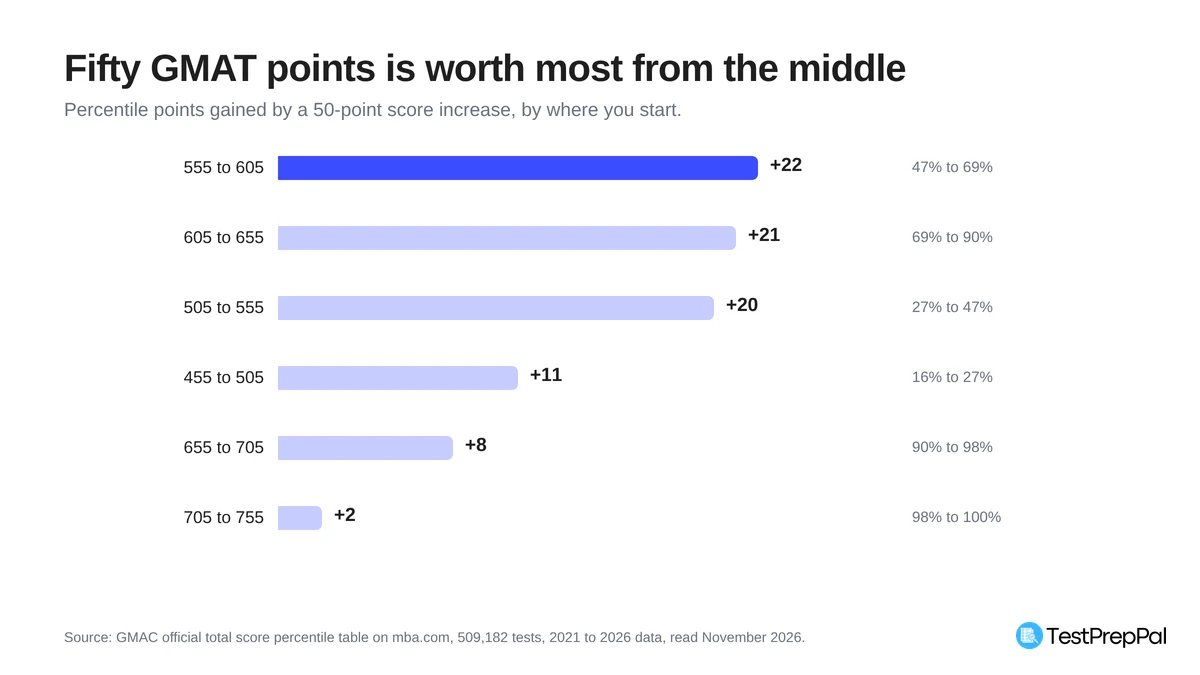 Percentile points bought by each 50-point gain, by where you start. Source: GMAC official score percentile table on mba.com, 2021 to 2026 data, read November 2026.
The shape of that column is the planning insight. Fifty points moves you 22 percentile points if you are starting around 555, and 2 percentile points if you are starting around 705. The field is densely packed through the middle, where the mean of 554.94 sits, and thins out sharply above 655.
So the same hours are worth dramatically different amounts depending on where your diagnostic lands. If you are in the 500s, a moderate, well-run block of study buys a large move in competitive position. If you are already near 705, you are paying a steep price for small percentile gains, which is exactly where GMAC's warning about diminishing returns bites hardest.
That makes the diagnostic the first task, not an optional one. Sit a full-length free GMAT practice test under timed conditions before you plan anything, then price the result with our GMAT percentile calculator and decide what counts as a good GMAT score for your target programs. Only then is the hours question answerable.
Sponsored
Target Test Prep GMAT
One of the most complete GMAT prep platforms we've reviewed. Try full access for 5 days.
No code neededPros
- Very large GMAT content and practice library
- Strong analytics, error tracking, and custom test tooling
- 130-point score improvement guarantee
Cons
- Higher tiers become expensive quickly
What the 90-hour number really measures
The "over 90 hours" figure is the most quoted number on this topic and the most misread. It describes people who already scored in the 89th percentile or above. It is a fact about a group defined by its results, not a dose that produced them.
Studying 90 hours does not place you in the 89th percentile. The 90 hours is what people who got there turned out to have done, which is a different claim entirely.
GMAC says so itself on the same page: "Spending more hours studying does not guarantee a high score." That sentence almost never travels with the number.
Read correctly, the figure is still useful. It tells you that a competitive score is rarely reached on 30 hours, and it sets a realistic floor. It does not tell you that hour 91 does anything in particular. Use it as a sanity check on an under-ambitious plan, not as a finish line.
One more detail on the percentile. GMAC's article puts the 89th percentile at "around 645 and above", which was accurate when it was written. On the current published table, 655 is the 90th percentile and the nearest listed row to that line. Percentile tables shift as the test-taking population changes, so anchor on the percentile rather than the three digits, the same way you should when reading what the GMAT scoring sections are worth.
Build the retake window in before you book
Most study timelines quietly assume one attempt. Plan for two and the calendar changes.
GMAC's exam policies require you to wait at least sixteen days after taking the exam before you can take it again, whether you sat it online or at a test center. You can test up to five times in a rolling 12-month period.
Sixteen days is the floor, not a plan. A genuine second attempt needs the wait plus enough time to fix whatever went wrong, which realistically means four to six weeks between sittings rather than sixteen days. Work backwards from your earliest application deadline and reserve that block before you book the first date.
The pressure comes off a little once you know your score lasts. A GMAT score is valid for five years, so a strong result taken early does not expire while you finish the rest of your application. Testing well before your deadlines, with room for one retake, is the cheapest insurance available. If you are weighing paid help to make a compressed timeline work, our GMAT prep course reviews compare what each option actually delivers, how hard the GMAT really is explains where the difficulty concentrates, and the GMAT hub covers the exam itself.
GMAT study time FAQs
How many hours should I study for the GMAT?
GMAC suggests keeping over a hundred hours as a ballpark figure. The only specific hours figure it publishes is that top scorers, meaning those in the 89th percentile or above, report studying over 90 hours. GMAC does not publish a median or average for all test takers, so treat precise "average hours" claims with suspicion.
What is the GMAT 16 days rule?
It is GMAC's minimum wait between attempts. You must wait at least sixteen days after taking the GMAT before you can take it again, and that applies whether you tested online or at a test center. You are also capped at five attempts in a rolling 12-month period. In practice you should leave four to six weeks between sittings so there is time to fix what went wrong.
Can I study for the GMAT in one month?
Arithmetically yes, if you can find the hours. Covering GMAC's 100-hour ballpark in four weeks means about 25 hours a week, which is close to a part-time job. GMAC's own Official Study Planner runs six weeks, which needs nearly 17 hours a week. A one-month plan is realistic mainly when your diagnostic is already close to your target and you are sharpening rather than learning.
Is two months enough to study for the GMAT?
Two months sits inside GMAC's stated ideal window of two to three months. At 100 hours of total study, two months works out to about 11.5 hours a week, which is demanding alongside full-time work but achievable. If your diagnostic shows a gap of 100 points or more, plan for the three-month end of that window instead and use our free GMAT resources to keep the cost down while you do it.
We may earn commissions from some links on this page, but this does not affect our reviews or your experience.