


The median Academic Average on the DAT was 410 for the first ten months of scores on the 200 to 600 scale, and the mean was 407.8. A good score starts above that line: an AA of 440 was reached by 28.8% of those scores, and 470 by 12.7%.
Those figures come from the ADA DAT User's Manual, which reports the scores earned between March 1 and December 31, 2025. Almost every other page answering this question quotes a different ADA table, and that table puts the middle of the pool one step lower. Both numbers are official. They just describe different groups of people, and the difference matters if you are deciding whether to retake.
- DAT scores are reported on a 200 to 600 scale in 10-point steps. The old 1 to 30 scale ended on March 1, 2025.
- For March to December 2025 administrations, the median AA was 410 and the mean was 407.8.
- 28.8% of those scores were an AA of 440 or higher. 12.7% reached 470 or higher.
- First-time test takers averaged an AA of 413.9. Repeaters averaged 396.3.
- The ADA's percentile guide and the ADA's own 2025 results put the same score up to 7 percentile points apart.
What counts as a good DAT score in 2026
There is no official cutoff. The ADA sets no passing score and publishes no admission threshold, so "good" has to be measured against what other candidates actually scored.
On that measure the 2025 results are clear. The median was 410, with 55.7% of scores at or below it. Scoring 430 or higher put a candidate in the top 36%, and 470 or higher in the top 12.7%.
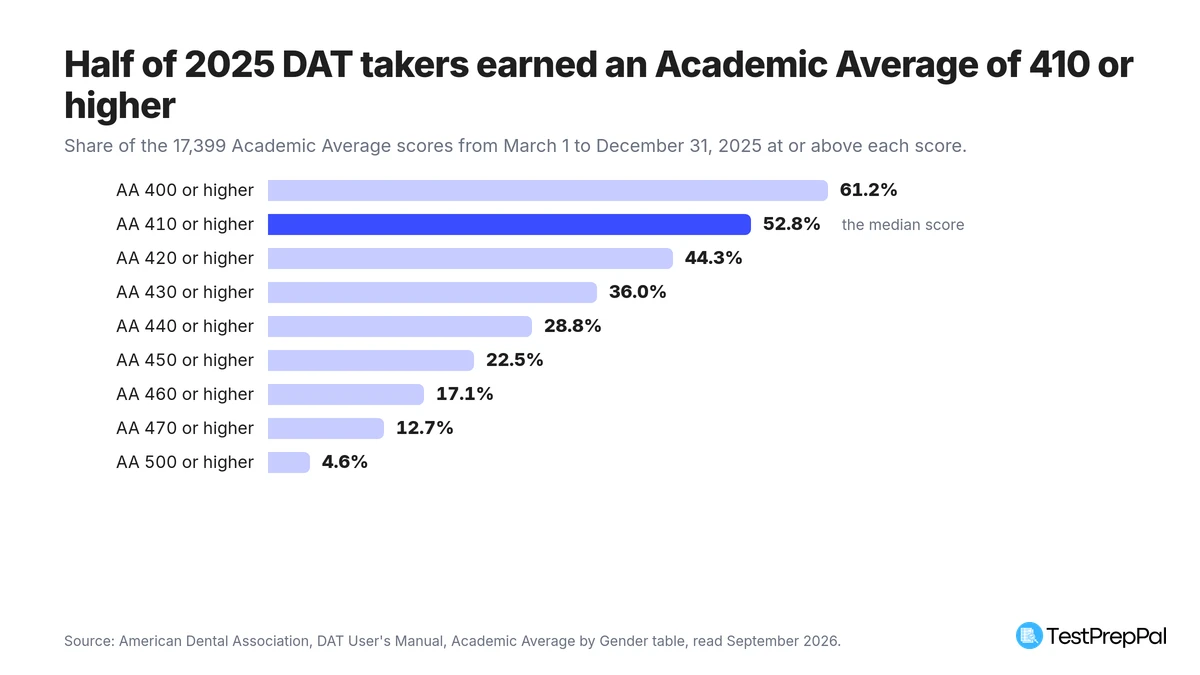 Share of the 17,399 Academic Average scores from March 1 to December 31, 2025. Source: ADA DAT User's Manual.
A practical way to read your own number:
- 410 and below is at or under the median. Roughly half the field is here.
- 420 to 430 is above average but common. About 44% of scores were 420 or higher.
- 440 to 460 is strong. Fewer than 3 in 10 scores reached 440.
- 470 and up is the top eighth of the field.
- 500 and up is rare. Only 4.6% of scores got there.
Those bands describe the testing pool, not any school's expectations. Programs publish their own admitted-student data, and the dental school acceptance calculator is the better place to weigh a score against a school list and a GPA.
Why two official percentile numbers exist for the same score
The ADA publishes percentile ranks in Understanding the New DAT Score Reporting Scale. A percentile rank there is the percentage of candidates who scored at that level or lower. Those are the numbers behind our DAT percentile calculator, and behind most of the score pages you will find.
That table is built on a normative sample of more than 30,000 attempts from a recent two-year period, scored under both the old and new systems. The User's Manual table is different: it is the actual distribution of scores from new-scale administrations in 2025. Same scale, different people, different answer.
| Academic Average | ADA percentile guide | 2025 administrations |
|---|---|---|
| 400 | 54th | 47th |
| 410 | 62nd | 56th |
| 420 | 69th | 64th |
| 430 | 75th | 71st |
| 440 | 81st | 78th |
| 450 | 85th | 83rd |
| 460 | 88th | 87th |
| 470 | 91st | 91st |
| 500 | 97th | 97th |
Both columns are percentile ranks in the ADA's sense, meaning the share scoring at that level or lower. The gap is largest around the middle of the score range and disappears at the top.
The practical consequence is small but real. If your AA is 410, the percentile guide says 62nd and the 2025 cohort says 56th. If your AA is 470 or above, the two agree and you can stop worrying about which table you are reading. The mechanics of how the scale itself is built are covered in our DAT scoring guide.
A good score is not the same number in every section
The Academic Average is one number built from five section scores, and those sections do not score alike. Reading Comprehension ran nearly 29 points above General Chemistry in 2025.
| Reporting area | Mean score, 2025 administrations |
|---|---|
| Reading Comprehension | 427.7 |
| Academic Average | 407.8 |
| Perceptual Ability | 406.8 |
| Biology | 405.3 |
| Quantitative Reasoning | 405.3 |
| Organic Chemistry | 402.1 |
| Survey of the Natural Sciences | 402.1 |
| General Chemistry | 398.8 |
So a 430 means two different things depending on where it sits. In Reading Comprehension it is barely above the section mean. In General Chemistry it is more than 31 points above it. A profile of 430s is not flat, and admissions readers who know the sections will see that.
The Academic Average is also the score the ADA's own research ties most closely to dental school performance. In its 2022 to 2024 meta-analysis, the AA had a corrected correlation of 0.60 with first-year preclinical biomedical science grades. Reading Comprehension alone had 0.20.
Section balance is the reason the AA is not the whole story. The DAT score calculator shows how a single weak science section pulls the average down, and the section breakdown covers what each one tests.
Is your score good enough to skip a retake
The 2025 data contains one number that most retake advice leaves out. First-time test takers averaged an AA of 413.9. Repeaters averaged 396.3, which is 17.6 points lower.
| Reporting area | First-time takers | Repeaters |
|---|---|---|
| Academic Average | 413.9 | 396.3 |
| Survey of the Natural Sciences | 408.7 | 389.5 |
| Biology | 411.4 | 393.6 |
| General Chemistry | 404.9 | 387.0 |
| Organic Chemistry | 409.6 | 387.8 |
| Quantitative Reasoning | 411.1 | 394.3 |
| Reading Comprehension | 432.5 | 418.5 |
| Perceptual Ability | 410.7 | 399.4 |
Read that carefully, because it is easy to misread. These are group means, not the same candidates measured twice. The ADA does not publish score changes across attempts for individual candidates. The gap tells you who retakes, which is mostly people whose first score was low. It does not tell you what a retake will do for you.
What the rules do tell you is the cost. The 2026 DAT Candidate Guide sets a 60-day wait between attempts and a maximum of four administrations in any 12-month period. Once you have three attempts behind you, testing again requires written permission and proof of a recent dental school application. Results take three to four weeks to reach schools, and if you have tested more than once, every attempt is reported.
That last point decides most retake questions. A retake does not replace your old score, it adds to it. If your AA is already at 430 and your sections are balanced, the time is usually better spent elsewhere in the application. If one science section is dragging a 400 AA down, a targeted retake has something specific to fix, and a DAT prep course built around that section is the cheaper move than a general second pass. Our guide to how hard the DAT is covers what a realistic second attempt takes.
How to read an older 1 to 30 score
Scores from before March 1, 2025 were reported on a 1 to 30 scale. The ADA scoring change notice confirms both formats remain valid, and that all scores sent to ADEA AADSAS now appear on the 200 to 600 scale, with older ones converted. The test content did not change.
The concordance table in the same ADA reporting scale guide gives the equivalents for the Academic Average:
| Old AA (1 to 30) | New AA (200 to 600) |
|---|---|
| 18 | 390 |
| 19 | 410 |
| 20 | 420 |
| 21 | 440 |
| 22 | 460 |
| 23 | 470 |
| 25 | 510 |
| 27 | 540 |
The old rule of thumb holds up well. A 19 was described as average performance on the old scale, and its equivalent, 410, is exactly the median of the 2025 results. The ADA's own DAT scores page still answers the reporting question in 1 to 30 terms, which is part of why the two scales keep getting mixed together in advice you will read online.
One change is easy to miss, and it is not a matter of scale conversion at all. Total Science was redefined on the same date.
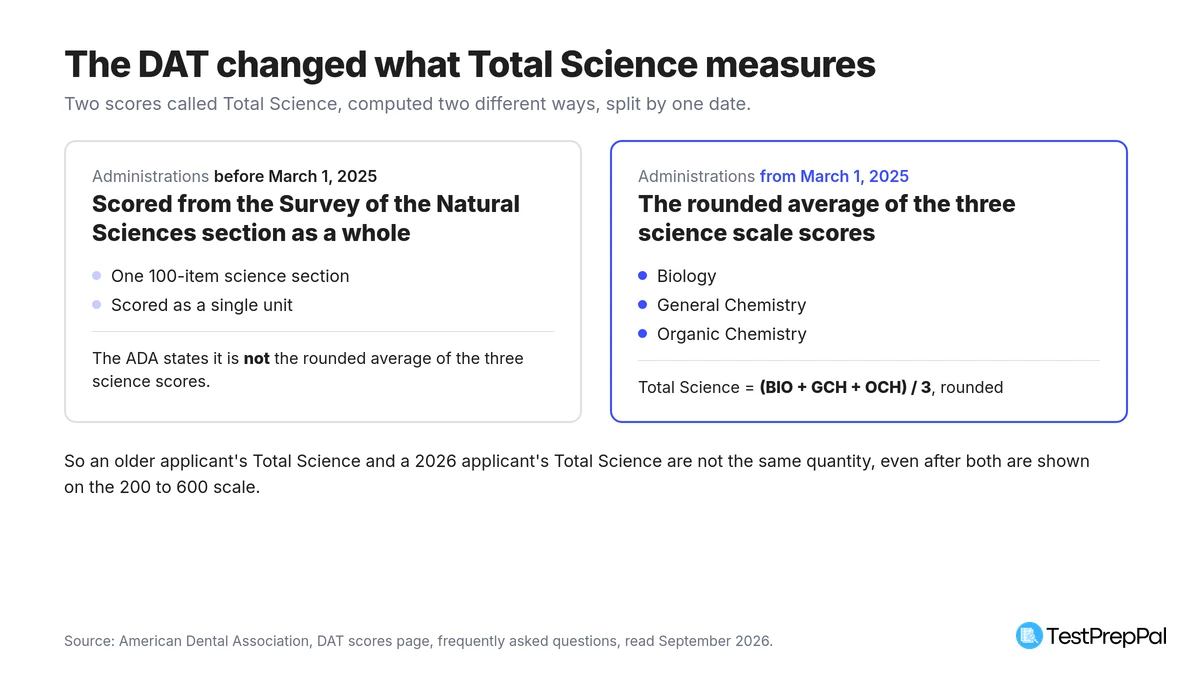 The Total Science definition changed on March 1, 2025. Source: ADA DAT scores page.
Before March 1, 2025, Total Science was scored from performance on the Survey of the Natural Sciences section as a whole, and the ADA states plainly that it was not the rounded average of the three science scores. From that date, it is exactly that rounded average of Biology, General Chemistry and Organic Chemistry. The 2025 means bear it out: those three sections averaged 402.06, against a reported Survey of the Natural Sciences mean of 402.08.
So if you are comparing your Total Science to a number from an applicant who tested in 2024, you are comparing two different quantities, even once both are shown on the same scale. Compare Academic Averages instead, or compare section by section.
One thing no conversion will give you is a raw score target. The ADA does not release how many questions you need to answer correctly for a given scale score, because difficulty varies by test form and is handled through psychometric adjustment. Anyone quoting you a raw number of correct answers for a 450 is guessing. For everything else about the exam, start at our DAT hub.
Good DAT score FAQs
Is a 470 on the DAT a good score?
Yes. A 470 Academic Average is the 91st percentile on the ADA's percentile table, and both the percentile guide and the 2025 results agree on that figure. Only 12.7% of Academic Average scores from March to December 2025 were 470 or higher. It is a competitive score for most programs, though each school publishes its own admitted-student data.
Is a 22 on the DAT good?
A 22 is an old-scale score, and it converts to 460 on the current 200 to 600 scale. That is the 88th percentile on the ADA percentile table, with about 17% of 2025 scores at 460 or above. It was a strong score then and it reads as a strong score now.
Is a 25 or a 27 a good DAT score?
Both are old-scale scores and both are well above average. A 25 Academic Average converts to 510 and a 27 converts to 540, which sit at the 98th percentile and above. Fewer than 1 in 20 of the 2025 scores reached 500 or higher.
What is the average DAT score?
For administrations between March 1 and December 31, 2025, the mean Academic Average was 407.8 and the median was 410. The ADA's separate percentile guide, built on a broader sample, places the midpoint just under 400. That is a difference of one to two 10-point steps, which is why sources disagree about the average. The average DAT score page breaks the same window down by reporting area and sets it against what dental school enrollees averaged.
What DAT score do I need for dental school?
The ADA publishes no minimum, and requirements vary by program. The one worked example the ADA gives is a program that historically required an Academic Average of 18 on the old scale, which it says should now require 390. Check each school's published admitted-student data rather than a single national number.
We may earn commissions from some links on this page, but this does not affect our reviews or your experience.