
NCLEX Bootcamp vs Kaplan (2026): Which One Should You Buy?

by John Reed· Last Updated: Oct 1, 2026

BootcampOur Pick
Includes
- ✓2,600+ NCLEX questions, updated weekly
- ✓50 Next Gen case studies with video walkthroughs
- ✓4 computer-adaptive (CAT) readiness exams with pass prediction
- ✓9-lesson Next Gen strategy course
- ✓Crash course videos with quizzes
- ✓140+ printable cheat sheets
- ✓Custom study schedule generator plus 1-, 2-, and 3-month PDFs
- ✓Ask Bootcamp AI
- ✓Pass Targets tracker and performance analytics
- ✓Mobile app for iOS and Android
- ✓Tutor support from NCLEX content experts
Pros
- +Built for the Next Gen NCLEX, with a question bank and 50 case studies that closely mirror the real exam
- +Detailed rationales for every answer choice that double as content review
- +Custom study schedule generator that rebalances when you fall behind
- +Crash course videos, 140+ cheat sheets, and Ask Bootcamp AI included on every plan
- +Four computer-adaptive (CAT) readiness exams with pass prediction
- +Full-refund pass guarantee on the 2- and 3-month plans
- +$59 to $129, a fraction of Kaplan or UWorld
Cons
- −No full-length content lectures (crash courses are targeted review)
- −No live classes or office hours
- −Pass guarantee does not cover the 1-month plan

Kaplan
Includes
- ✓Self-Paced and Live Online NCLEX paths
- ✓6-month access period
- ✓2,200+ QBank questions
- ✓3 NCLEX CAT exams
- ✓3 prep tests
- ✓300+ nursing content videos
- ✓Kaplan AI Tutor
- ✓NCLEX Channel live/recorded sessions
- ✓Companion app with QBank and flashcards
- ✓NCLEX content review eBooks
Pros
- +Strong structure for students who want a guided NCLEX study plan
- +Broad practice stack including 2,200+ QBank questions and CAT exams
- +Live-online path includes 18 hours of instruction and recorded access
- +Companion app supports QBank drills, flashcards, and performance tracking
- +AI Tutor and detailed rationales support active review
Cons
- −Pricing is premium compared with some NCLEX competitors
- −Some high-value features are tied to higher-tier plans
- −Guarantee terms are conditional and require policy compliance
We rate NCLEX Bootcamp the best all-around NCLEX prep course for most students in 2026, and nothing in this comparison changes that. But if we stopped there you would buy the wrong thing, because Kaplan beats Bootcamp on several points that are not marketing fluff.
Kaplan has been teaching nurses for decades. It has live instructors and a real content review library, two things Bootcamp still does not offer at any price. Computer-adaptive testing used to be on that list too, but Bootcamp rebuilt its readiness exams as CATs in 2026, so both now let you rehearse the adaptive format. Bootcamp is newer, far cheaper, and built from the ground up for the Next Gen NCLEX, which is why it usually wins. Usually is not always.
One note before the numbers. Kaplan's pricing moves with promotions, so treat every Kaplan figure here as a starting price read on kaptest.com on 26 September 2026, not a permanent one. Bootcamp's prices were read on bootcamp.com the same day.
NCLEX Bootcamp vs Kaplan at a Glance
| NCLEX Bootcamp | Kaplan NCLEX | |
|---|---|---|
| What it is | NGN-first question bank and strategy course | Full review course with live teaching |
| Entry price | $59 for 1 month, $99 for 2, $129 for 3 | Self-Paced from $349, Live Online from $399 |
| Cheapest way in | 1-month plan at $59 | CAT + Qbank bundle from $99 |
| Access period | 1, 2, or 3 months (pausable) | Up to 6 months on Self-Paced |
| Practice questions | 2,600+, every one written for NGN | 3,800+ total, 2,200+ in the Qbank |
| NGN case studies | 50, six items each, all with video walkthroughs | Included in the question pool, not a separate set |
| Video content review | Crash course videos only | 300+ topics, plus a 700-page ebook |
| Live instruction | None | 18 hours, live or on demand |
| Adaptive (CAT) exams | 4 CAT readiness exams, with pass prediction | 3 full-length CATs |
| Pass guarantee | Full refund, 2 and 3-month plans only | Refund or a free 3-month repeat |
| Free trial | No trial, but a free account with real content | 7-day Qbank trial |
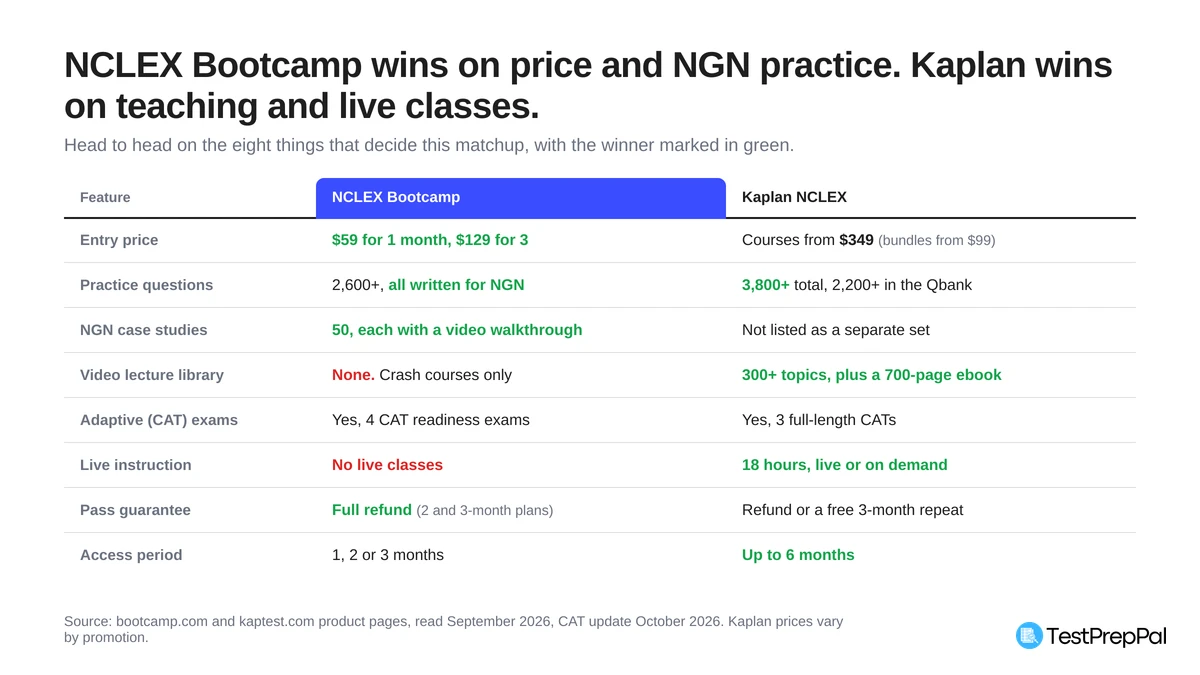 Bootcamp takes price, NGN depth, and the case study walkthroughs. Kaplan takes video teaching, live classes, and access length. Both now include adaptive exams.
Price
This is not close, and we are not going to pretend it is.
Bootcamp charges $59 for one month, $99 for two, and $129 for three, verified 26 September 2026, against list prices of $79, $159, and $239. Klarna and Afterpay installments are available, and you can pause your membership after buying, which is useful when your exam date slips.
Kaplan's NCLEX courses start at $349 for Self-Paced and $399 for Live Online, verified the same day on kaptest.com. That is five to seven times Bootcamp's entry price.
The fairer comparison is the bundles. Kaplan's CAT + Qbank package starts at $99 and the Practice Pack starts at $119, and those get you the Qbank and the adaptive tests without the course. At that price Kaplan is a real competitor rather than a different budget category.
Before you buy either, check the current NCLEX Bootcamp discount page, since the effective price moves.
Question Bank and NGN Coverage
Kaplan has more questions. Bootcamp has more Next Gen questions.
Kaplan lists 3,800+ practice questions in total with 2,200+ in the Qbank proper, the rest spread across quizzes and tests. Bootcamp lists 2,600+, updated weekly, and every single one was written for the Next Gen NCLEX rather than retrofitted from the old format.
That distinction matters more than the raw count. The NGN is a clinical judgment exam, and the item types are the whole point. Bootcamp also ships 50 NGN case studies with six items each, and every case study has a video walkthrough where someone talks you through the reasoning. Kaplan includes NGN items, but does not present case studies as a distinct, fully worked set the way Bootcamp does.
Bootcamp's content is aligned to the 2026 NCLEX-RN test plan that took effect on 1 April 2026. One real limitation: Bootcamp does not offer a separate NCLEX-PN question bank, and Kaplan has a dedicated PN track. That alone decides it for PN candidates.
If questions are all you want from Bootcamp, the Bootcamp NCLEX question bank breakdown goes deeper on how the bank is organized.
Video Lessons and Content Review
Kaplan wins this outright, and it is Bootcamp's biggest weakness.
Bootcamp gives you a nine-lesson Next Gen strategy course that runs about two hours, crash course videos on high-yield topics each followed by a quiz, and 140+ printable cheat sheets. That is strategy plus reinforcement. It is not a lecture series, and Bootcamp does not claim it is.
Kaplan gives you a video library covering 300+ topics, a comprehensive content review guide, and a 700-page ebook. If you finished nursing school feeling shaky on pharmacology or lab values, that is the material you need, and Bootcamp cannot replace it. Kaplan also teaches its Decision Tree method for breaking down unfamiliar questions, which is a coherent strategy framework rather than a collection of tips.
Bootcamp's answer is that its rationales do the teaching. That is partly true, and its walkthroughs are excellent. But learning content from rationales only works if you already mostly know the content.
Practice Tests and the CAT Format
This used to be the single biggest thing Kaplan had that Bootcamp did not. It no longer is.
Bootcamp gives you 4 CAT readiness exams. They were rebuilt as computer-adaptive tests in 2026, so like the real NCLEX they adjust difficulty to each answer instead of serving everyone the same fixed set, and each one ends with a pass prediction rated Low, Borderline, High, or Very High.
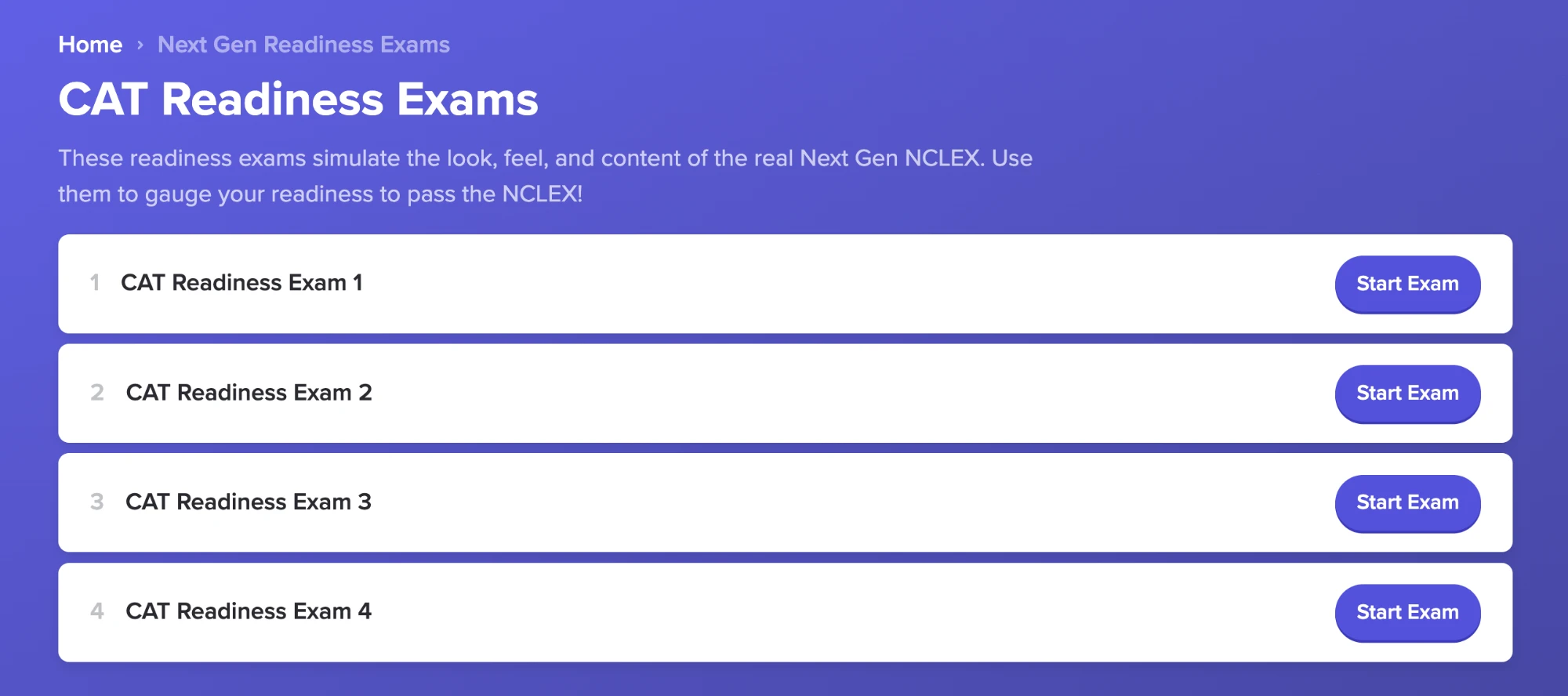 Bootcamp's four CAT Readiness Exams. Source: bootcamp.com (captured October 2026).
Kaplan includes 3 full-length computer-adaptive tests. If what unsettles you about the NCLEX is the format itself, the not knowing when it stops, the questions getting harder as you get them right, both courses now let you practice that feeling before test day.
If you want more adaptive reps than either gives you, Archer Review offers an unlimited number of CATs in plans starting around Bootcamp's price.
Study Planning and Support
Bootcamp's study schedule generator is better than anything Kaplan offers here. You give it a start date, an exam date, and your days off, and it builds a day-by-day plan that rebalances itself when you fall behind. Fixed one, two, and three-month PDF schedules are there too if you prefer something static.
Bootcamp also has an in-platform AI assistant that can turn a crash course video into structured notes, plus a Pass Targets tracker with three explicit thresholds: a 62% score, 85% of the question bank completed, and all 4 readiness exams attempted. Bootcamp says 99% of students who hit all three pass. Treat that as a company statistic, but concrete, checkable targets are worth having.
Kaplan's support is human rather than automated. Live events with Kaplan teachers run more than twice a week, the Live Online course puts you in a 3-day intensive with faculty, and tutoring can be added. Kaplan says 99% of its highly engaged students who complete the recommended prep pass on the first attempt, which is the same kind of self-reported, self-selected number as Bootcamp's.
On access length, Kaplan wins: up to 6 months on Self-Paced against Bootcamp's maximum of 3. Bootcamp partly offsets that by letting you pause your membership. Both ship mobile apps, and Bootcamp's holds a 4.9 rating across roughly 15,000 reviews.
Guarantees
Both guarantee a pass. They pay out differently, and Bootcamp's terms are cleaner.
Bootcamp refunds your money in full. It applies only to the 2 and 3-month plans, you must buy at least 30 days before your exam, you must meet all three Pass Targets, and you must supply the name of your accredited US or Canadian nursing program plus your failure result.
Kaplan gives you a choice between a 100% tuition refund and a free 3-month repeat. The eligibility rules are stricter: you generally need to be a graduate of an accredited program taking the exam for the first time within 6 months of graduating, you have to complete the required class sessions and Question Trainer tests, you must claim within a short window after your exam date, and taking the repeat forfeits the refund.
Neither is free money. Bootcamp's version is simpler to qualify for and pays cash rather than more coursework, which is why we score it ahead, but Kaplan's is a real guarantee and not a gimmick.
Who Should Pick Which
Pick NCLEX Bootcamp if:
- You want the strongest NGN-specific practice for the least money
- Your content knowledge is solid and you need reps, not lectures
- You want worked video walkthroughs of full case studies
- You want a study plan that adapts when life gets in the way
- You want a clean full-refund guarantee
- You are testing within three months
Pick Kaplan if:
- Computer-adaptive practice exams are non-negotiable for you
- You want live instruction and scheduled accountability
- Your content knowledge has real gaps and you need a lecture library and an ebook
- You are sitting the NCLEX-PN, which Bootcamp does not cover with a dedicated bank
- You want up to 6 months of access rather than 3
- You are a repeat test-taker who already tried self-study and it did not work
The Verdict
NCLEX Bootcamp wins, and for most readers it is not particularly close. You get NGN-native questions, the best case study walkthroughs in the category, a study planner that actually adapts, and a full-refund guarantee, all for between $59 and $129. That combination is why it sits at the top of our best NCLEX prep courses list.
But we would be doing you a disservice to call Kaplan overpriced legacy prep. Kaplan wins on live instruction, on content review depth, on access length, and on NCLEX-PN coverage. Those are four real advantages. What it no longer wins on is adaptive testing, since Bootcamp now has CAT readiness exams of its own.
The practical answer for most people: buy Bootcamp. Its CAT readiness exams cover the adaptive format, so there is no need to spend $349 on a second course for that. The exception is if you genuinely need teaching rather than testing. In that case pay Kaplan.
NCLEX Bootcamp vs Kaplan FAQs
Is NCLEX Bootcamp better than Kaplan?
For most students, yes. Bootcamp gives you better Next Gen NCLEX practice at a fraction of the price. Kaplan is better if you need live teaching or a content review library, neither of which Bootcamp offers. Both include computer-adaptive practice exams.
Does NCLEX Bootcamp have computer-adaptive tests?
Yes. Bootcamp's 4 readiness exams are computer-adaptive (CAT) and end with a pass prediction. Kaplan includes 3 full-length CATs, so Bootcamp actually gives you one more adaptive exam.
How much does Kaplan NCLEX cost in 2026?
As of 26 September 2026, Kaplan listed its Self-Paced NCLEX course from $349 and Live Online from $399 on kaptest.com, with a CAT + Qbank bundle from $99 and a Practice Pack from $119. Kaplan runs frequent promotions, so confirm the current price on their site before buying.
Which pass guarantee is better?
Bootcamp's, if you qualify. It pays a full refund, it covers the 2 and 3-month plans, and the conditions are three measurable Pass Targets. Kaplan lets you choose between a refund and a free 3-month repeat, but its eligibility rules are narrower and time-limited.
Can I use NCLEX Bootcamp for the NCLEX-PN?
Not well. Bootcamp does not offer a separate NCLEX-PN question bank. Kaplan has a dedicated PN track, so PN candidates should look at Kaplan or another PN-specific option.
Should I buy both?
Only if money is not tight and you have real content gaps. Bootcamp already covers adaptive practice with its CAT readiness exams, so the only reason to add Kaplan is its video lectures, content review book, and live classes.
We may earn commissions from some links on this page, but this does not affect our reviews or your experience.
Our Verdict
NCLEX Bootcamp wins for most students on price, NGN question quality, and case study walkthroughs, and it is what we recommend first. But Kaplan genuinely beats it on two things that matter to some people: 18 hours of live instruction and a real content review library with a 700-page ebook. Both now include computer-adaptive practice exams. If your content knowledge is shaky or you learn best from a live instructor, Kaplan is the better buy despite costing several times more.
Learn more about Bootcamp
Read our full review →
Learn more about Kaplan
Read our full review →