

Best MCAT Prep Books in 2026

by John Reed· Last Updated: Sep 15, 2026
MCAT book sets look interchangeable from the outside. Seven books, a few practice tests, roughly $200. The differences only show up once you are three weeks into studying and realize your set is either too shallow to get you past 510 or so dense you will never finish it.
The real split is between depth and speed, and it decides which set you should buy. We compared the seven sets most MCAT students actually consider, verified every price and specification directly against publisher pages in August and September 2026, and noted where the publishers contradict themselves.
Here's the bottom line:
- Kaplan MCAT Complete 7-Book Subject Review: Best overall starting set, and the most readable if you have been out of coursework for a while.
- Princeton Review MCAT Subject Review Complete Box Set: Best for students targeting 515+ who want the low-yield detail.
- Examkrackers MCAT Complete Study Package: Best for practice volume, with 44 mini-MCATs on top of 3 full-lengths.
- UWorld MCAT Prep Books: Best for visual learners, and the only set with two dedicated CARS books.
- The Berkeley Review Full 10-Book Set: Best for general chemistry, organic chemistry, and physics.
- Mometrix MCAT Prep Book: Best budget option at around $52, with a 1-year money-back guarantee on the printed copy.
- Blueprint Free Books & Guides: Best free supplement for equation sheets and a content checklist.
- No book set is enough on its own: every set here includes at most 3 full-length exams, and none of them are AAMC material, which is what actually predicts your score.
- Kaplan and Princeton Review solve opposite problems: Kaplan is faster to get through; Princeton Review carries the low-yield detail you need above the 90th percentile.
- Examkrackers gives the most practice per dollar: 3 full-lengths, 44 mini-MCATs, and a half-length exam, more online practice than any competing set.
- The Berkeley Review is the strongest physical sciences review in print, but it includes zero full-length tests and its CBTs expire 12 weeks after activation.
- Kaplan, Princeton Review, and Examkrackers do not sell direct: their own product pages route to Amazon, so prices move constantly and were all 32 to 52 percent below list when we checked.
Our recommended MCAT prep course:

Blueprint MCAT
#1 pick of 13 MCAT courses we tested
Free for 14 days. Full access to lessons, practice exams, and the study planner.
No credit card required
Pros
- Free trial includes a practice exam and customizable study planner.
- Best video lessons for MCAT in the industry.
- Score increase guarantee
Cons
- Mobile app is not the best
MCAT Prep Books Comparison Table
| Kaplan | Princeton Review | Examkrackers | UWorld | Berkeley Review | Mometrix | Blueprint | |
|---|---|---|---|---|---|---|---|
| Price | ~$197 (list $299.99) | ~$125 (list $259.99) | ~$159 (list $289) | $289 | $395 | $51.99–$56.99 | Free |
| Books | 7 | 7 | 7 | 8 | 10 | 1 | 12 PDFs |
| Full-Length Tests | 3 | 3 | 3 | 0 | 0 (paid add-on) | 3 | 0 |
| Extra Practice | Pre-chapter quizzes, no Qbank | Thousands of questions | 44 mini-MCATs + half-length | 450 concept checks | 800+ passages, 40+ sectionals | Video tutorials | Content checklist |
| Sold Direct? | No (Amazon) | No (Amazon) | No (Amazon) | Yes | Yes | Yes | Yes |
| Best For | Overall starting set | 515+ scorers | Practice volume | Visual learners and CARS | Physical sciences | Tight budgets | Free supplements |
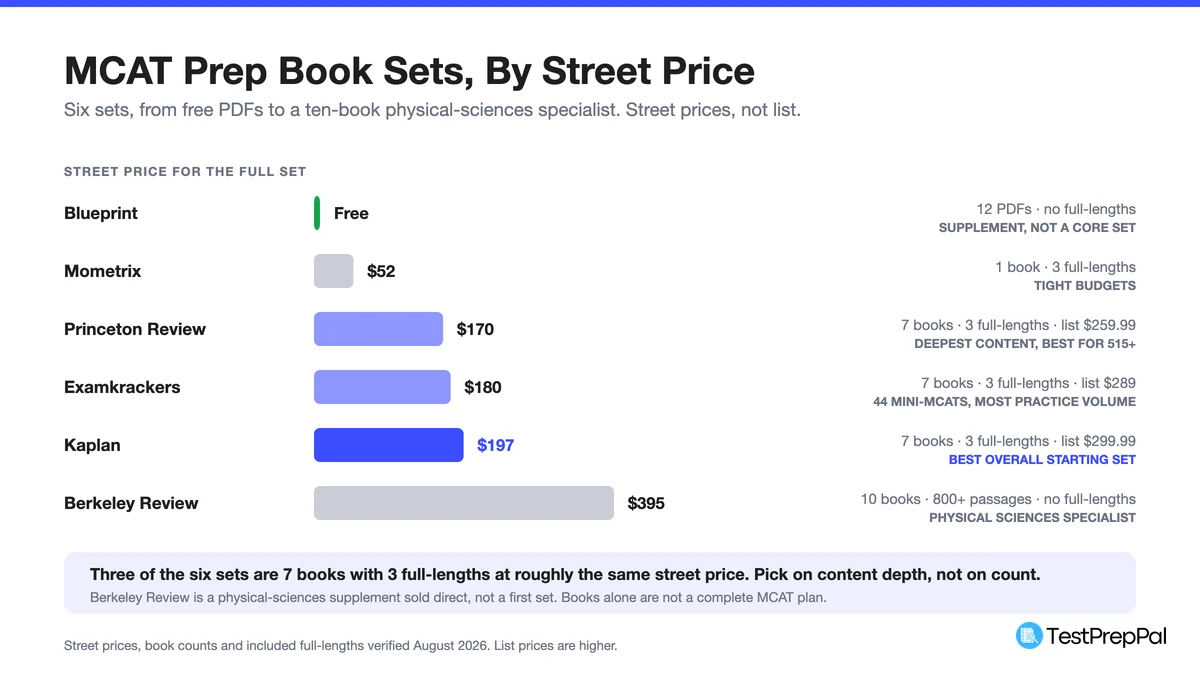 Street prices, not list. Three of these are 7-book sets with 3 full-lengths at nearly the same price. The chart predates the UWorld set, which sells direct at a flat $289, and Amazon has since moved Examkrackers to $158.75.
The 7 Best MCAT Prep Books, Reviewed In Depth
1. Kaplan MCAT Complete 7-Book Subject Review 2027-2028
Kaplan's 7-book set is the default recommendation for a reason. It covers all four MCAT sections across seven books, and the 2027-2028 edition adds 500+ new science images and a rewritten CARS book, with content updated through the September 2025 exam.
The feature that earns its keep is the High-Yield Badge system, which flags the concepts the AAMC tests most often. When you are trying to decide what to skip, that matters more than raw page count. The writing is also noticeably more accessible than Princeton Review's, which is why it is the common recommendation for non-traditional applicants returning to science coursework after a few years away.
You get 3 full-length online practice tests, pre-chapter quizzes, interactive eBooks with a flashcard builder, and 12 months of online access. There is no question bank, and Kaplan publishes no practice-question total for the set. Pricing sat at $196.76 on Amazon when we re-checked in September 2026, against a $299.99 list price.
Two honest caveats. Three full-lengths is thin for a $200 set, and the online access-code registration is a recurring failure point, particularly for international buyers dealing with the new 979-prefix ISBN. If the digital content matters to you, Kaplan's Self-Study Toolkit bundles the same seven books with 6 full-lengths and a 3,000+ question Qbank for $303.22, which is only $4.22 more than that Qbank costs on its own. Our Kaplan MCAT books review does the full comparison.
2. The Princeton Review MCAT Subject Review Complete Box Set, 5th Edition
The Princeton Review box set is the depth play. Published in November 2025, it spans seven books and includes 3 full-length online tests plus thousands of end-of-chapter and passage-style questions.
What separates it from Kaplan is the low-yield material. Princeton Review keeps the detail that other sets cut, and that is precisely what students chasing the 90th percentile and above say they needed. If your target is 515+, this is the set that will not leave gaps.
That depth is also the drawback. It is denser and slower to work through, and its CARS strategy is widely considered the weakest part of the set. One structural oddity worth knowing before you order: the component books ship at mismatched edition numbers, ranging from 3rd to 5th edition depending on the subject, which regularly confuses buyers into thinking they received the wrong product.
It was $125.32 on Amazon in September 2026, down from a $259.99 list price, making it the cheapest of the three major box sets by $33 despite being the most comprehensive. Our Princeton Review MCAT books review has the full breakdown, including why Princeton Review's one-volume book carries more online practice tests than the box set does.
3. Examkrackers MCAT Complete Study Package, 12th Edition
Examkrackers wins on practice volume, and it is not close. Alongside the 3 full-length MCATs in an AAMC-style simulator, you get 44 online 30-minute mini-MCATs used as chapter exams and 1 online half-length MCAT. No competing book set comes near that.
It is also the only mainstream set with a dedicated Laboratory Techniques book, which is genuinely useful given how the AAMC tests experimental design and data interpretation.
The writing style is deliberately conversational and overview-level. Students consistently describe it as engaging and easy to get through, which is a real advantage over months of studying, but it means Examkrackers works best as a second set or a fast first pass rather than your only content resource.
Two warnings. The packaging markets Krack University prominently, but KrackU is a separate product that costs $999 for 90 days, and buyers regularly report feeling misled by the box. Recent printings also carry noticeable typos and occasional duplicated paragraphs, which Examkrackers logs on a public errata page rather than fixing before the next reprint. It was $158.75 on Amazon in September 2026 against a $289 list price. Our full Examkrackers MCAT books review has the tier breakdown.
4. UWorld MCAT Prep Books (UBooks)
UWorld's 8-book set is the newest serious entrant and the most expensive mainstream set at a flat $289 direct. Six science books plus two dedicated CARS books, and no other set on this list ships two.
The differentiator is illustration. There are 4,000+ in-line images drawn in house and integrated with the text, plus hyperlinked visuals in the digital versions that jump you to related concepts across subjects. The CARS pair is the other reason to consider it: a strategy book that splits the AAMC's 3 skills into 19 subskills, and an annotated passage booklet showing the reasoning behind every passage in the practice book. If content simply is not sticking, this is the set that fixes that.
The value case is weaker than the teaching case. You get 450 concept check questions and zero full-length exams, against 3 full-lengths from Kaplan for $92 less, though Kaplan includes no question bank either. Digital access also expires after 180 days, though the printed books are permanent. And if you want UWorld's QBank alongside the books, do not buy them separately: books plus QBank comes to $628, while the Core Prep Course bundles both from $599.
5. The Berkeley Review Full 10-Book MCAT Review Set
The Berkeley Review is the specialist. Across 10 books and 4,000+ pages it delivers 800+ practice passages and 40+ sectional diagnostic exams, far more in-book passage practice than anything else on this list.
Its general chemistry, organic chemistry, and physics books have a long-standing reputation as the best physical sciences review in print, and that reputation is deserved. If those sections are what stand between you and your target score, this is the set to buy.
The problems are equally clear. It is uneven by subject: students who praise the physical sciences books are usually the same ones warning that the CARS, psychology, and biology books are weak. Density is the most common complaint across student forums. It is the most expensive book-only set at $395. And critically, no full-length tests are included. Computer-based tests are sold separately at $49 for one up to $149 for five, and each expires 12 weeks after activation.
Two things to know before ordering. Berkeley Review's own product page and home-study page disagree on both the edition year and the total question count, so we have not published either figure here. And unlike the sets sold through Amazon, this one carries no return window: the company's published policy makes every materials purchase final and non-refundable. Our Berkeley Review books review documents both.
6. Mometrix MCAT Prep Book 2026-2027
The Mometrix guide is a single volume, not a set, and it costs $51.99 as an ebook or $56.99 in print direct from Mometrix, down from an $88.99 regular price.
For that price you get 3 full-length practice tests, step-by-step video tutorials reachable through links embedded next to the relevant concepts, a test-taking strategy section, and a money-back guarantee that no other book here offers.
Read that guarantee carefully before you pick a format. Mometrix's store refund policy returns physical products up to one year after purchase but digital products within seven days, so the cheaper ebook carries a seven-day window rather than the year the product page advertises. Our Mometrix MCAT review has the full breakdown.
Be realistic about what one volume can do. The box sets run 3,000 pages or more, and the MCAT is a content-heavy exam. This is a strategy guide and review supplement, not a primary content resource. Diagrams are also black and white, which hurts for anatomy and organic chemistry.
We will also flag something our research turned up: Mometrix's high star rating rests on reviews that are largely not marked as verified purchases, and we found essentially no substantive discussion of it among actual MCAT students. Treat its ratings as weaker evidence than Kaplan's or Examkrackers'.
7. Blueprint MCAT Prep Free Books & Guides
Blueprint's free library is 12 separate PDF downloads: an MCAT Content Checklist, four section study guides, a Mnemonics Handbook with 50+ mnemonics, chemistry and physics equation sheets, a CARS Strategy Guide, a Guide to Retaking the MCAT, a 30-day sample schedule, and several admissions guides covering applications and interviews.
The equation sheets, content checklist, and mnemonics handbook are legitimately useful on their own, and covering admissions and interviews is more than most free resources bother with.
Two things to know. Every download sits behind its own form, six required answers each, asking for your name, expected graduation year, and planned MCAT date, so expect marketing follow-up. And these are short overview PDFs, not content review: our review of the library found only three of the 12 files are MCAT content reference, while four are medical school admissions guides. Nothing is dated or versioned either, so you cannot verify how current they are against the AAMC outline.
How to Choose the Right MCAT Book Set
Pick based on the constraint that is actually binding for you:
- Starting from scratch, or returning to science after time away: Kaplan. It is the fastest readable path through all four sections.
- Already scoring in the low 510s and stuck: Princeton Review. The gap at that level is usually low-yield detail.
- You need more reps, not more reading: Examkrackers, for the 44 mini-MCATs.
- You read a chapter and retain nothing: UWorld, for the illustrations, and for CARS.
- Physics and chemistry are your weak sections: The Berkeley Review, accepting that you will supplement CARS and psychology elsewhere.
- Budget is the constraint: Mometrix at $52, paired with Blueprint's free guides.
One rule applies regardless of which set you buy: books are not enough. Every option here tops out at 3 full-length exams, and none of them are AAMC material. The AAMC's own practice exams are what correlate with your real score, so budget for those separately.
Before you spend anything, run our free MCAT study plan generator to see how many weeks you actually have, and the MCAT study hours calculator to size your content review realistically. You can also pressure-test your content knowledge with our free MCAT biology practice questions and general chemistry practice questions before committing to a set.
MCAT Prep Books FAQs
Which MCAT prep book is best overall?
Kaplan's MCAT Complete 7-Book Subject Review is the best all-round starting set for most students. It covers all four sections, flags high-yield content explicitly, and is the most readable of the major sets. Students targeting 515+ generally do better with Princeton Review's box set, which carries more low-yield detail.
Are MCAT prep books enough to study for the MCAT?
No. Every book set here includes at most 3 full-length practice exams, and none of them are official AAMC material. Books handle content review well, but score prediction and test-day pacing come from AAMC practice exams and a dedicated question bank. Plan to pair a book set with both.
How much do MCAT prep books cost?
Between free and $395. Blueprint's guides are free, Mometrix runs $51.99 to $56.99, the three major box sets from Kaplan, Princeton Review, and Examkrackers sat between $125 and $197 in September 2026, UWorld's 8-book set is a flat $289 direct, and The Berkeley Review's 10-book set is $395. Note that the box set prices move constantly because those publishers sell through Amazon rather than direct.
Kaplan or Princeton Review for the MCAT?
Kaplan if you want to cover the essentials quickly and readably. Princeton Review if you want comprehensive depth and are aiming for a top-percentile score. Princeton Review is more thorough but denser and slower; Kaplan is easier to finish. Kaplan's CARS book is the stronger of the two, as Princeton Review's CARS strategy is its weakest section.
Which MCAT books are best for CARS?
UWorld is the only set with two books dedicated to CARS, a subskill-by-subskill strategy book and an annotated passage booklet, which makes it the strongest option here for CARS instruction. Among the box sets, Kaplan rewrote its CARS book for the 2027-2028 edition, while Princeton Review's and The Berkeley Review's CARS materials draw consistent criticism. For CARS specifically, dedicated daily passage practice works better than any book chapter. See our MCAT CARS practice roundup.
Do I need the most recent edition of an MCAT prep book?
Not usually. The MCAT content outline changes slowly, so an edition one or two cycles old covers nearly identical material and often costs far less used. The exception is when online access matters: access codes are frequently single-use and tied to a specific printing, so a used copy may arrive with the practice tests and Qbank already claimed.
We may earn commissions from some links on this page, but this does not affect our reviews or your experience.


