


Harvard Law School's 2025 ABA Standard 509 report puts its enrolled LSAT median at 174, its 25th percentile at 171 and its 75th at 176. Across the full T14 the medians run from 170 at Berkeley to 174 at Yale, Harvard and Chicago, and every one of those fourteen schools enrolled a quarter of its class below its own median.
That last part is the number almost nobody quotes. A median is the middle of the class, so half the class sits under it by definition, and the 25th percentile is the school's own evidence for how far under it goes. At Northwestern and Penn, a quarter of the entering class came in six scaled points below the median.
- T14 LSAT medians run from 170 to 174 on the 2025 ABA 509 reports, a four-point band across the whole group.
- Harvard's 509 median is 174. Its 25th percentile is 171, and its own Class of 2029 page now reports 172.
- The 25th percentile varies far more than the median: 166 at Georgetown up to 171 at Yale, Harvard, Chicago and Stanford.
- The gap between median and 25th percentile runs from 2 points at Stanford and Duke to 6 at Northwestern and Penn.
- No T14 school publishes a minimum score. The 25th percentile is the evidence that there is not one.
- GPA medians cluster from 3.88 to 3.99, a tighter band than the LSAT, and the 25th percentiles drop as low as 3.74.
What LSAT score each T14 school actually admits
Every ABA-approved law school files a Standard 509 Information Report each December. It is the only place the 25th, 50th and 75th percentile figures come from, and it covers the class that actually enrolled rather than the class that was admitted. The table below is the 2025 report for all fourteen T14 schools, read in November 2026. The ABA notes in its required disclosures database that the data is submitted by the law schools themselves.
| School | LSAT 25th | LSAT median | LSAT 75th | GPA 25th | GPA median | GPA 75th | Acceptance rate |
|---|---|---|---|---|---|---|---|
| Yale | 171 | 174 | 177 | 3.90 | 3.96 | 4.00 | 4.1% |
| Harvard | 171 | 174 | 176 | 3.89 | 3.96 | 4.00 | 9.2% |
| Chicago | 171 | 174 | 176 | 3.87 | 3.97 | 4.00 | 9.7% |
| Stanford | 171 | 173 | 176 | 3.87 | 3.96 | 4.00 | 6.1% |
| Columbia | 169 | 173 | 175 | 3.85 | 3.92 | 3.98 | 11.8% |
| Cornell | 168 | 173 | 175 | 3.75 | 3.92 | 3.97 | 18.2% |
| Virginia | 168 | 173 | 175 | 3.83 | 3.99 | 4.04 | 10.2% |
| Northwestern | 167 | 173 | 175 | 3.76 | 3.96 | 4.00 | 12.3% |
| Penn | 167 | 173 | 174 | 3.77 | 3.95 | 4.00 | 8.1% |
| NYU | 169 | 172 | 174 | 3.81 | 3.92 | 3.97 | 13.4% |
| Michigan | 168 | 171 | 173 | 3.74 | 3.88 | 3.95 | 8.6% |
| Georgetown | 166 | 171 | 173 | 3.75 | 3.93 | 3.98 | 15.8% |
| Duke | 169 | 171 | 172 | 3.83 | 3.91 | 3.96 | 12.9% |
| Berkeley | 167 | 170 | 172 | 3.84 | 3.92 | 3.99 | 14.8% |
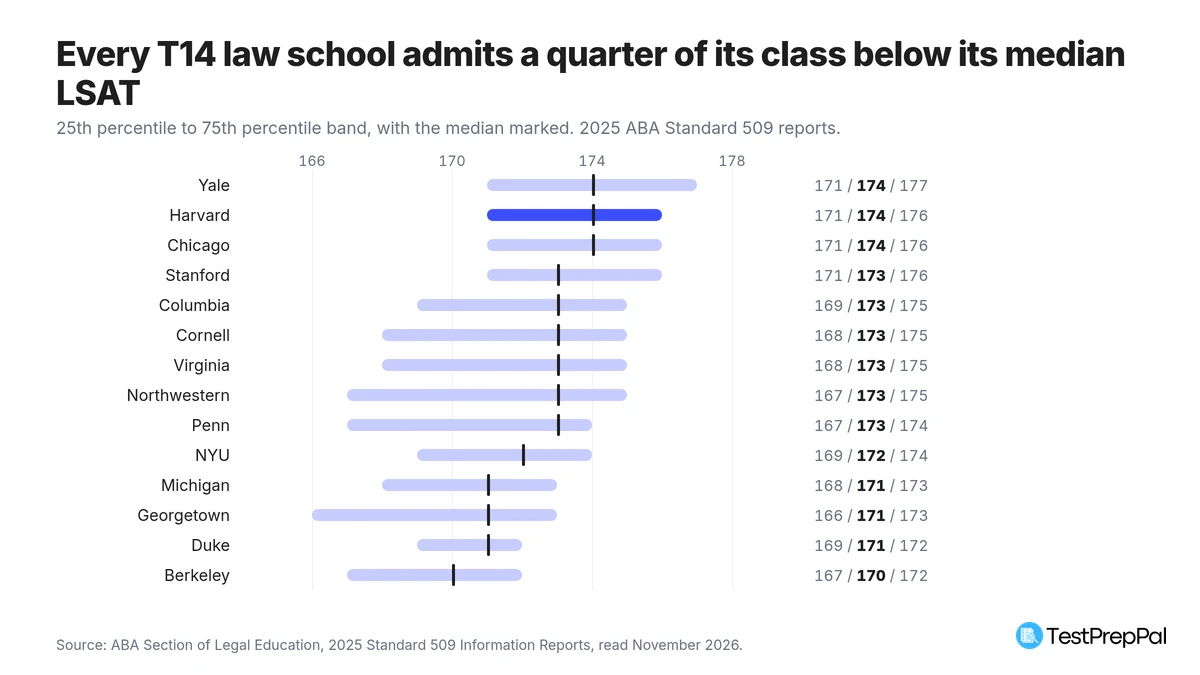 T14 LSAT bands, 2025 ABA Standard 509 reports. Harvard highlighted.
Two things stand out once the schools sit side by side. The medians are tightly packed, four points from top to bottom. The 25th percentiles are not: they spread five points, from Georgetown's 166 to the 171 shared by Yale, Harvard, Chicago and Stanford.
So the school with the most forgiving bottom quarter is not the one with the lowest median. Georgetown's median of 171 matches Michigan's and Duke's, but Georgetown enrolled a quarter of its class at 166 or below while Duke's quarter starts at 169.
How far below median each school fills its bottom quarter
Subtract the 25th percentile from the median and you get a column no source publishes. It is the clearest single measure of how much room a school leaves for an application that is not carried by the test.
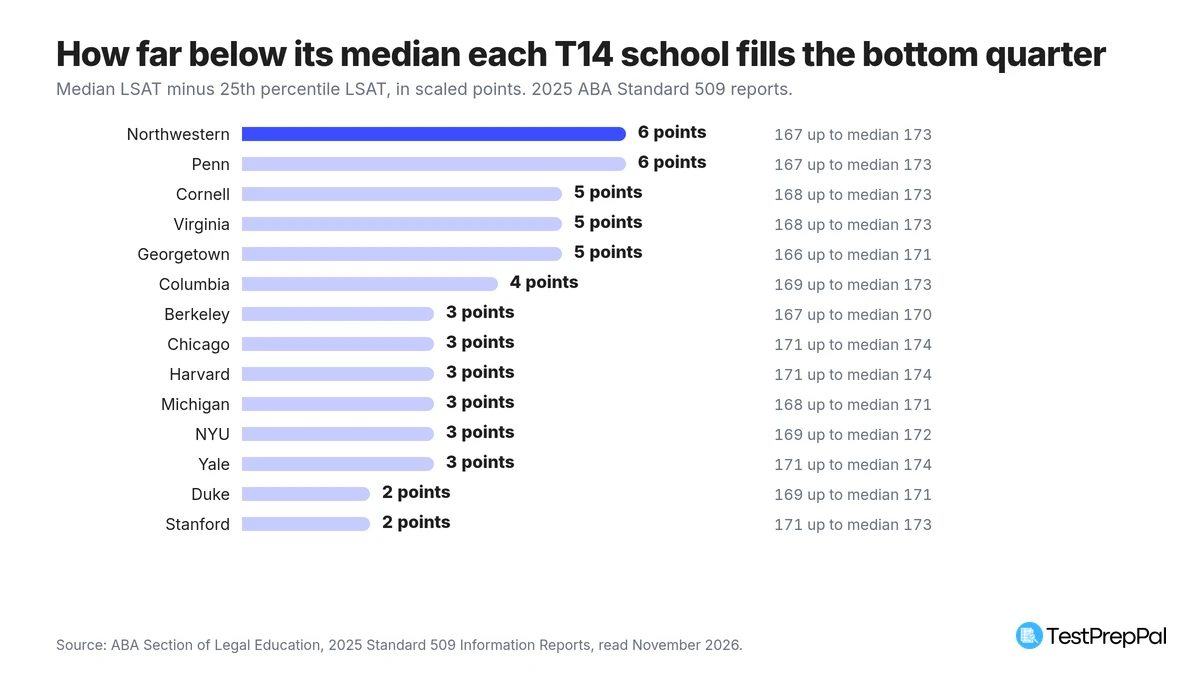 Median minus 25th percentile, 2025 ABA Standard 509 reports.
Northwestern and Penn both report a 173 median and a 167 at the 25th. That is a six-point drop. Stanford and Duke are the opposite: two points, 171 to 173 and 169 to 171. Columbia sits on its own in the middle at four.
Translated into the national distribution, the difference is larger than it looks. On LSAC's current percentile table, a 167 is the 89.5th percentile and a 173 is the 97.6th. So Northwestern's bottom quarter starts about eight percentile points below its median, while Stanford's starts about two.
A quarter of every T14 class is below the median you keep reading. At Northwestern and Penn that quarter starts six points down. Treating a school's median as a cutoff throws away the part of the class you are most likely to be in.
None of this makes a six-point deficit comfortable. Those seats go to files that are strong somewhere else, usually a GPA at or above the school's 75th percentile, and the schools with the widest LSAT gaps also report the lowest GPA 25th percentiles, which is the trade showing up in the same report.
What Harvard reports, and why the number you have seen is a year old
Harvard is the school this question gets asked about, so it is worth separating the two figures that circulate.
Its 2025 ABA 509 report, covering the class that entered in fall 2025, shows an LSAT split of 171, 174 and 176, a GPA split of 3.89, 3.96 and 4.00, and a 9.2 percent acceptance rate from 8,872 completed applications.
Harvard's own 1L profile and facts page has since moved on to the Class of 2029, which entered in fall 2026 and will not appear in a 509 report until December. That class reports 172, 174 and 176 on the LSAT, a GPA of 3.91, 3.97 and 4.00, 9,061 applications, 780 offers, 561 enrolled 1Ls and an 8.6 percent admit rate.
The practical difference is one point at the bottom. Google's AI summary for this question still quotes 171 as Harvard's 25th percentile, which was correct for the 2025 report and is no longer what Harvard publishes about its newest class.
Where the GPA half of your file sits
The GPA columns in the table above are tighter than the LSAT columns at the median and looser at the bottom. Medians run from 3.88 at Michigan to 3.99 at Virginia, barely a tenth of a point across the group, while the 25th percentiles run from 3.74 to 3.90.
That matters because the GPA a school reads is rarely the one on your transcript. LSAC recalculates it on a 4.33 scale and counts both attempts of any course you repeated, which is how Virginia ends up reporting a GPA 75th percentile of 4.04, above the 4.00 cap most people assume. Work out your real figure with our LSAC CAS GPA calculator before you decide which half of your application is the weak one.
Berkeley is the clearest case of the two halves moving independently. It has the lowest LSAT median in the group at 170, and a GPA median of 3.92 that sits ahead of Michigan, Duke and Cornell.
The schools that have already reported the 2026 entering class
Six T14 schools have published their Class of 2029 numbers ahead of the December 509 filing. Where they have, those figures are newer than anything in the table above.
| School | 2025 509 LSAT 25/50/75 | Class of 2029 LSAT 25/50/75 |
|---|---|---|
| Yale | 171 / 174 / 177 | 171 / 175 / 178 |
| Harvard | 171 / 174 / 176 | 172 / 174 / 176 |
| NYU | 169 / 172 / 174 | 170 / 173 / 175 |
| Michigan | 168 / 171 / 173 | median 172 |
| Cornell | 168 / 173 / 175 | 167 / 173 / 175 |
| Duke | 169 / 171 / 172 | 169 / 171 / 172 |
Four of the six moved up by a point somewhere, Duke held still, and Cornell's 25th percentile fell a point to 167. Michigan calls the Class of 2029 the highest median LSAT and median GPA in its history.
The direction is mildly upward, not dramatic. A target set from the 2025 reports is still a reasonable target, with a point of headroom at the schools that just moved.
How to turn this into your own target score
- Take the median of the school furthest up your list and treat it as the number that makes the test a non-issue, not the number you must have.
- Take that school's 25th percentile and look it up on the LSAT percentiles table to see what it is worth nationally.
- Check your recalculated GPA against the same school's GPA columns. If it clears the 75th, the six-point schools are the ones worth applying to below median.
- Set a range rather than a number, and read what each band is worth in our guide to what is a good LSAT score.
If your current band is several points short of the whole list, the question is whether a retake is realistic before the calendar runs out. The LSAT retake rules allow five tests in the current reportable period and seven over a lifetime, and our roundup of the best LSAT prep courses compares what each option costs and how much official PrepTest access it includes. Everything else LSAT sits on our LSAT hub.
T14 LSAT score FAQs
What LSAT score do I need for Harvard?
Harvard's current Class of 2029 page reports an LSAT median of 174, a 25th percentile of 172 and a 75th of 176. There is no minimum, so a 172 is already inside the band a quarter of the enrolled class came in at, and the rest of the file decides it from there.
Is there a minimum LSAT score for a T14 law school?
No T14 school publishes one, and the 509 reports are the evidence. Each school reports a 25th percentile precisely because a quarter of its class scored at or below it, which ranges from 166 at Georgetown to 171 at the four schools at the top.
Which T14 school has the lowest LSAT median?
Berkeley, at 170 on the 2025 ABA 509 report. Duke, Michigan and Georgetown follow at 171. Berkeley's 25th percentile of 167 is also among the lowest in the group, alongside Northwestern and Penn.
Can a high GPA make up for a below-median LSAT?
The 509 data shows that schools do enrol students well below their medians, and the schools with the widest LSAT gaps also report the lowest GPA 25th percentiles. It does not show which applicants those were, so treat the gap as evidence that the band exists rather than as a formula. The average LSAT score nationally is far below any of these numbers, which is a reminder that the T14 pool is self-selected.
What if my score is short of the whole list?
Widen the list before you widen the target. A handful of schools accept the GRE in place of the LSAT, and our guide to law schools that do not require the LSAT covers which ones and what their score-history rules do to an LSAT result you already hold.
We may earn commissions from some links on this page, but this does not affect our reviews or your experience.