


In testing year 2025, 92.8 percent of first-time INBDE candidates from CODA-accredited dental programs passed, and 65.1 percent of first-time candidates from non-accredited programs passed. Counting every group and both first attempts and retakes, 79.2 percent of the 12,239 INBDE administrations in 2025 ended in a pass.
Those figures come from Table 1 of the JCNDE annual report to the ADA House of Delegates, which is the only place the INBDE pass rate is published. One detail matters before you read any of it: JCNDE publishes failure rates, not pass rates. Every pass rate on this page is 100 minus the failure rate in that table, and both numbers are shown side by side so you can check the subtraction.
- The most recent published year is 2025. There is no 2026 INBDE pass rate yet, because the figures arrive in the following year's annual report.
- First-time candidates from CODA-accredited programs passed at 92.8 percent in 2025, down from 95.2 percent in 2024 and 99.6 percent in 2023.
- First-time candidates from non-accredited programs passed at 65.1 percent in 2025, down 19 points from 84.1 percent in 2023.
- The drop is not random. JCNDE implemented a new performance standard in June 2024 that, in its own words, increased the rigor of the examination.
- Retakes are the weakest group in every year published. Non-accredited retakes passed at 49.5 percent in 2025.
- 2025 was the busiest year the exam has had, with 12,239 administrations.
What is the INBDE pass rate in 2025?
2025 is the latest testing year JCNDE has published. The pass rate depends almost entirely on two things: whether your dental program is accredited by the Commission on Dental Accreditation (CODA), and whether this is your first attempt.
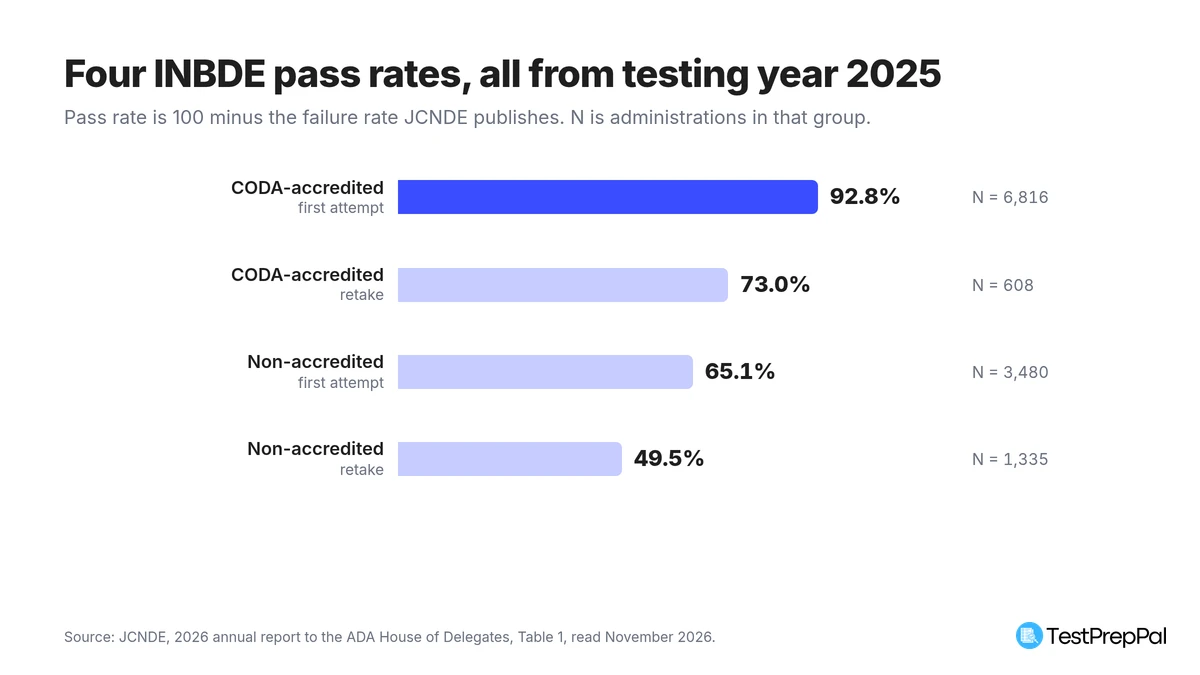 INBDE pass rates for testing year 2025, by candidate group. Source: JCNDE 2026 annual report, Table 1.
| 2025 candidate group | Pass rate | Failure rate as published | Administrations |
|---|---|---|---|
| CODA-accredited, first attempt | 92.8% | 7.2% | 6,816 |
| CODA-accredited, retake | 73.0% | 27.0% | 608 |
| Non-accredited, first attempt | 65.1% | 34.9% | 3,480 |
| Non-accredited, retake | 49.5% | 50.5% | 1,335 |
| All attempts combined | 79.2% | 20.8% | 12,239 |
Applied to the volumes in that table, the 2025 rates work out to roughly 491 first-time failures among accredited candidates and about 1,215 among non-accredited candidates. Those counts are our arithmetic, not JCNDE figures. The report publishes rates and administration counts, and leaves it there.
If you are trying to work out what a specific scale score means rather than what the cohort did, that is a different question, and our INBDE score calculator answers it against the 75 passing line.
INBDE pass rates by year, 2020 to 2025
This is the part almost nobody publishes. The INBDE launched in 2020, and JCNDE has reported performance every year since, so there are six years of data rather than a single number.
| Testing year | CODA, first attempt | CODA, retake | Non-accredited, first attempt | Non-accredited, retake | All attempts |
|---|---|---|---|---|---|
| 2020 | 99.0% (205) | 92.7% (69) | 61.2% (147) | 41.9% (117) | 75.5% (538) |
| 2021 | 98.7% (2,021) | 84.0% (245) | 66.9% (1,341) | 44.2% (971) | 77.7% (4,578) |
| 2022 | 99.2% (5,852) | 86.8% (234) | 74.7% (2,154) | 55.3% (1,145) | 87.9% (9,385) |
| 2023 | 99.6% (6,659) | 86.0% (136) | 84.1% (3,301) | 66.2% (1,212) | 91.3% (11,308) |
| 2024 | 95.2% (6,636) | 67.9% (168) | 74.7% (4,137) | 47.2% (919) | 83.9% (11,860) |
| 2025 | 92.8% (6,816) | 73.0% (608) | 65.1% (3,480) | 49.5% (1,335) | 79.2% (12,239) |
Administrations in that group are in parentheses. The early years are small because the INBDE was phasing in. Volume jumped once NBDE Part II was discontinued on December 31, 2022, and candidates who would have taken the old two-part sequence moved onto the INBDE instead.
Read down any column and the shape is the same. Rates improved through 2023, then turned in 2024 and kept going in 2025. The all-attempts pass rate peaked at 91.3 percent in 2023 and has given back 12.1 points since.
What the June 2024 standard change did to the numbers
The 2024 row in the JCNDE table carries an asterisk, and the footnote reads: "A new standard was introduced this year, based on updated standard setting activities."
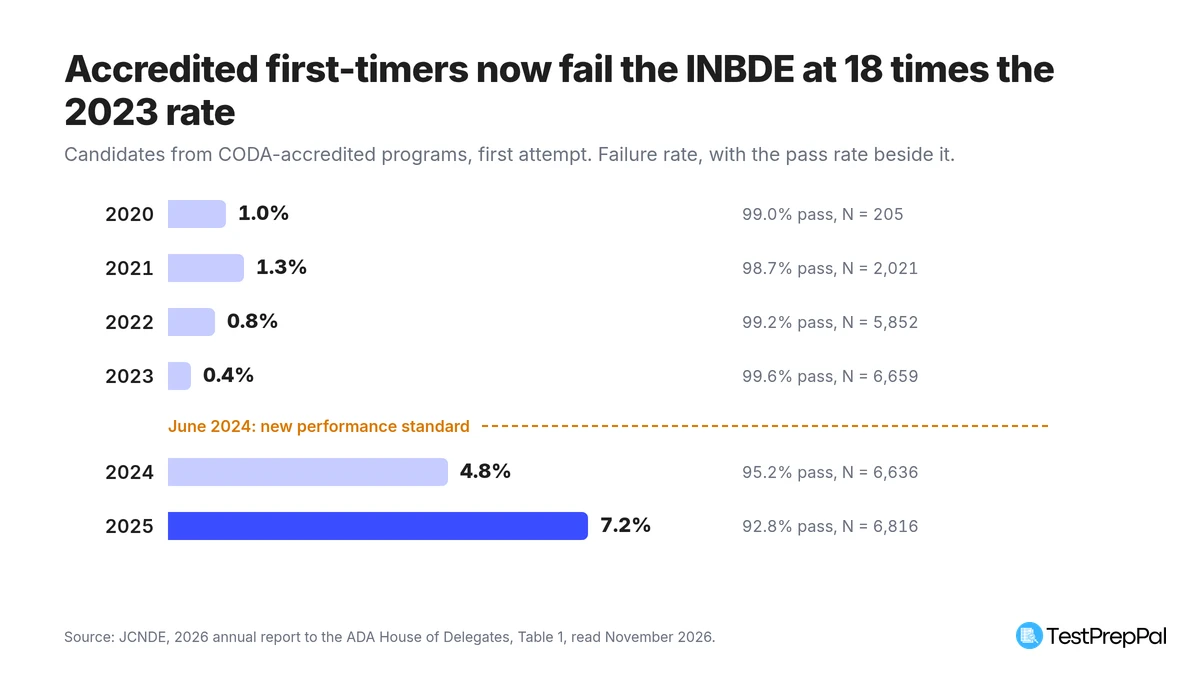 First-attempt failure rates for CODA-accredited candidates, with the June 2024 standard change marked. Source: JCNDE 2026 annual report, Table 1.
For first-time candidates from accredited programs, the failure rate went from 0.4 percent in 2023 to 4.8 percent in 2024 to 7.2 percent in 2025. That is 18 times the 2023 rate in two years. In pass-rate terms it is a fall from 99.6 percent to 92.8 percent, which sounds mild until you notice that the number of accredited first-timers who failed went from roughly 27 to roughly 491 while the cohort size barely moved.
JCNDE is direct about the cause. The report says failure rates "began increasing significantly in 2024 with the implementation of a new performance standard that increased the rigor of the examination." 2025 was the first full year run entirely under that standard, which is why the 2025 row, not the 2024 one, is the better guide to what you are sitting. The commission has a dental practice analysis scheduled across 2026 and 2027 that will inform the next round of content updates.
If you see a single INBDE pass rate quoted with no year attached, assume it is 2024 or earlier. The widely repeated "about 95 percent" is the 2024 accredited first-attempt figure, and "74.7 percent" for internationally trained candidates is 2024 as well. Both have been superseded by the 2025 numbers above.
CODA-accredited versus non-accredited candidates
The gap between the two groups is the largest single effect in the data, and it is present in all six years. In 2025 a first-time candidate from a CODA-accredited program passed at 92.8 percent. A first-time candidate from a program outside CODA accreditation passed at 65.1 percent. That is a 27.7 point spread on the same exam.
The standard change hit the non-accredited group harder. Their first-attempt pass rate had climbed steadily to 84.1 percent by 2023, which was the best year any non-accredited cohort has had. It fell to 74.7 percent in 2024 and then to 65.1 percent in 2025, giving back 19 points and landing below where the group sat in 2022.
JCNDE's reading is that candidates from CODA-accredited programs "are well-prepared to challenge the INBDE, as compared to those educated by non-CODA-accredited programs." If you trained outside the CODA system, the practical consequence is that the margin you are planning against is much thinner than the headline number suggests, and a structured question bank with real performance feedback matters more than it does for a candidate coming straight out of a US dental school.
Retake pass rates, and why they move most
Retake rates get quoted least and move most. A retaker is defined in the report as someone who previously attempted and failed the INBDE, NBDE Part I or NBDE Part II.
| Testing year | CODA retake pass rate | Non-accredited retake pass rate |
|---|---|---|
| 2020 | 92.7% | 41.9% |
| 2021 | 84.0% | 44.2% |
| 2022 | 86.8% | 55.3% |
| 2023 | 86.0% | 66.2% |
| 2024 | 67.9% | 47.2% |
| 2025 | 73.0% | 49.5% |
Two things stand out. Accredited retakes dropped 18 points in 2024, further than first-timers did, then recovered a little to 73.0 percent in 2025. And the number of accredited retake administrations went from 168 in 2024 to 608 in 2025, roughly 3.6 times as many, which is what you would expect a year after several hundred more first-timers failed.
For non-accredited candidates the retake rate has been close to a coin flip in every year except 2023. At 49.5 percent in 2025, a second attempt is not a formality, and treating it as one is how candidates end up on a third application and a third fee. The INBDE exam guide covers the retake mechanics, including the new application and fee required before every attempt.
What the pass rate does not tell you
The INBDE is reported as pass or fail. According to the JCNDE results page, candidates who pass receive no number at all, and a scale score is released only to candidates who fail, for remediation. Results arrive about three to four weeks after the test date.
That has a direct effect on how you should read these rates. There is no distribution of scores to place yourself in, no percentile, and no way to tell a narrow pass from a comfortable one. The pass rate is a cohort statistic, not a prediction about you, and a 92.8 percent group rate tells you nothing about your own position relative to the 75 cut.
Two more things the table does not capture. The counts are administrations, not people, so a candidate who tests twice in a year appears twice. And JCNDE does not publish pass rates by dental school, so any school-level INBDE figure you encounter came from the school itself, not from the commission. If you want to see how we handle numbers like these across the site, our review methodology explains the sourcing rules.
How to use these numbers when you plan
Three practical reads, which is about as far as this data honestly stretches.
First, plan against 2025, not against the pre-2024 era. Study plans and course marketing built on the 99 percent years were built against a standard that no longer exists. A 7.2 percent first-attempt failure rate among accredited candidates is small, but it is not the rounding error it was in 2023.
Second, if you are internationally trained, build in more runway. Your group's first-attempt rate moved 19 points in two years, and it moved down. Comparing INBDE prep courses on how much diagnostic and adaptive work they include is more useful than comparing total content hours.
Third, calibrate against official material rather than third-party percentages. The free JCNDE practice questions are sample items published by the body that writes the exam, so they show the integrated, patient-based format the real test uses better than any percentage a question bank reports back to you. For everything else about format, fees and scheduling, start from the INBDE exam hub.
INBDE pass rate FAQs
What is the INBDE pass rate in 2026?
There is no 2026 figure yet. JCNDE publishes INBDE performance once a year in its annual report, so 2026 results will appear in the report issued in 2027. The most recent published year is 2025, when first-time candidates from CODA-accredited programs passed at 92.8 percent and first-time candidates from non-accredited programs passed at 65.1 percent.
Is the INBDE getting harder?
The passing standard got stricter, which is not quite the same thing. JCNDE implemented a new performance standard in June 2024 that it describes as increasing the rigor of the examination, and failure rates rose in both years since. The exam content did not change at that point, the bar did.
What is the INBDE pass rate for internationally trained dentists?
Candidates educated in programs not accredited by CODA, which includes most internationally trained dentists, passed at 65.1 percent on a first attempt in 2025. That is down from 74.7 percent in 2024 and 84.1 percent in 2023. On retakes the same group passed at 49.5 percent in 2025.
What happens if you fail the INBDE?
You receive a scale score on the 49 to 99 range, which is released only to candidates who do not pass, so you can see how far from the 75 cut you landed. Retaking requires a new application and a new fee, and the 2025 retake pass rates were 73.0 percent for accredited candidates and 49.5 percent for non-accredited candidates.
Is the INBDE pass rate the same as the passing score?
No. The passing score is a fixed scale score of 75 on a 49 to 99 range, and it is the same for every candidate. The pass rate is the share of administrations that cleared that line in a given year, which changes annually and differs sharply by candidate group.
We may earn commissions from some links on this page, but this does not affect our reviews or your experience.