


The Dental Admission Test costs $580 to register in 2026, and the ADA refunds none of it under any circumstances. If you end up needing a second attempt, the number that actually matters is $1,160, because every DAT attempt requires a new application and a new full fee.
Most pages answering this question quote $535 or $540, both of which are out of date, and none of them price attempt two or attempt three. That is the part worth planning for, and it is also where the ADA's partial fee waiver does something almost nobody mentions: it discounts a retest as well as a first sitting.
- The 2026 DAT examination fee is $580, and it includes score reporting to every dental school you select when you apply.
- Nothing is refundable. There is no cancellation refund at all, so rescheduling is the only way to protect money you have already paid.
- Rescheduling costs $50, $70 or $150, set by how many business days of notice you give.
- Each attempt is a fresh $580. Two attempts cost $1,160 and three cost $1,740, with a 60 day wait between them.
- The partial fee waiver covers 50 percent of two administrations, not one, so two attempts cost a waiver holder $580.
- Waivers are first-come, first-served in batches that open January 1, April 1 and July 1 each year.
What the DAT costs in 2026
Every candidate pays the same examination fee, and the 2026 DAT Candidate Guide (PDF), updated on August 4, 2026, lists it alongside three optional charges:
| Fee | Amount | When you pay it |
|---|---|---|
| Examination fee | $580 | Every application, every attempt |
| Eligibility extension | $150 | To add 45 days to your eligibility window, once per application |
| Score audit | $105 | Optional recheck, within 30 days of your appointment |
| Score report | $55 per report | Only for schools you did not select when you applied |
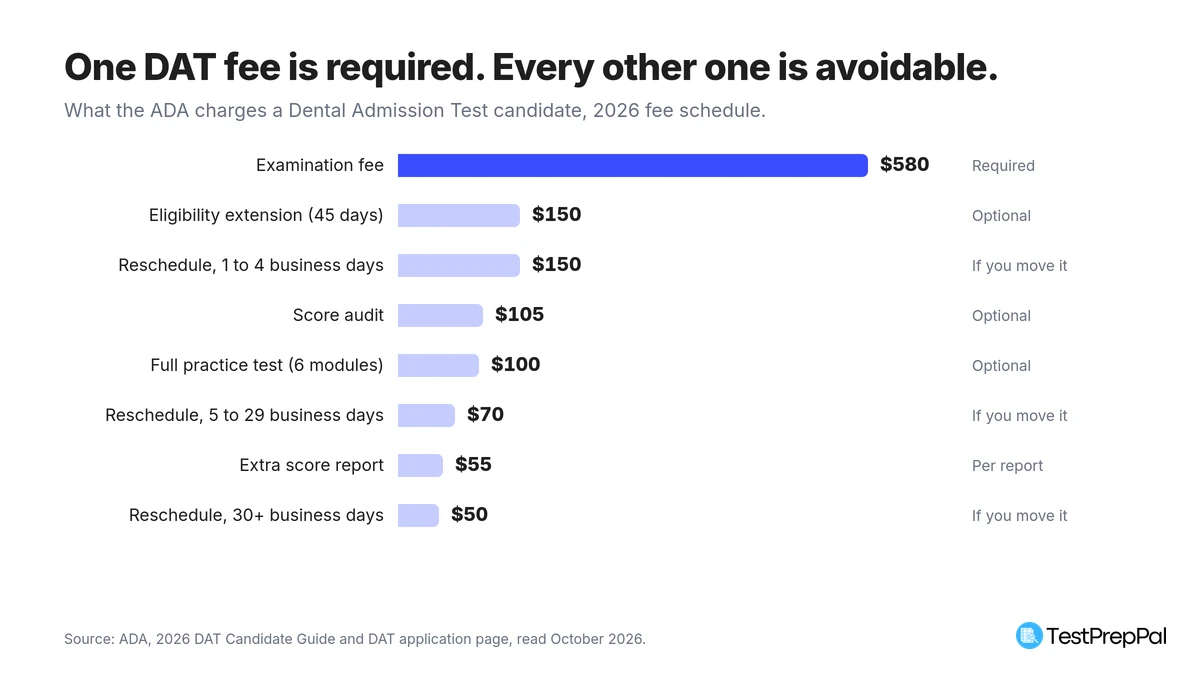 What the ADA charges a DAT candidate in 2026. Source: ADA 2026 DAT Candidate Guide and DAT application page.
The $580 covers the administration itself and official score reporting to the schools you pick on the application. There is no per-school charge: the guide is explicit that schools selected at the time of application are included in the fee regardless of how many you select. Adding one afterwards costs $55, and the list cannot be edited once the application is submitted.
That turns into one piece of free advice worth taking literally. Select every school you might plausibly apply to while you are filling in the application, including the reaches. Each school you leave off and add later is $55 for something that would have cost nothing an hour earlier.
Official practice material is priced separately on the ADA DAT application page: individual modules are $20 each, and the full six-module practice test is $100. These are written by actual DAT test constructors, which is what separates them from third-party material. If you are still deciding how much prep you need at all, how hard the DAT is is the better starting question.
There is no DAT refund, only a reschedule fee
This is the rule that catches people, and it has no exceptions. DAT fees are non-refundable and non-transferable. Cancel your appointment and you do not get $580 back, you do not get a partial refund, and you cannot hand the registration to someone else. If you fail to appear, or arrive more than 30 minutes after your start time and are refused admission, the full fee is forfeited and you start again with a new application.
So the only lever you have is rescheduling, and the ADA prices it on three steps:
| Notice before your appointment | Reschedule fee |
|---|---|
| 30 or more business days | $50 |
| 5 to 29 business days | $70 |
| 1 to 4 business days | $150 |
Read "business days" carefully, because it is doing real work here. Saturdays and Sundays do not count, so 30 business days is about six calendar weeks, not a month. A student who thinks they are comfortably inside the cheap tier five weeks out is actually in the $70 tier, and the gap between the top and bottom step is $100.
Two deadlines sit underneath the table. Changes must be made by the business day before your test and at least 24 hours in advance, and the local test center cannot do it for you: it goes through the administration vendor's scheduling tools. Miss that window and you are in no-show territory, which costs the entire $580.
Picking a date you can keep is most of the problem, and how DAT scheduling actually works covers the deadline that should drive the choice, which is your application cycle rather than your study calendar.
What a DAT retake actually costs
Every attempt needs a new application and a new full fee. There is no retake discount, so the arithmetic is simply $580 multiplied by the number of times you sit the exam.
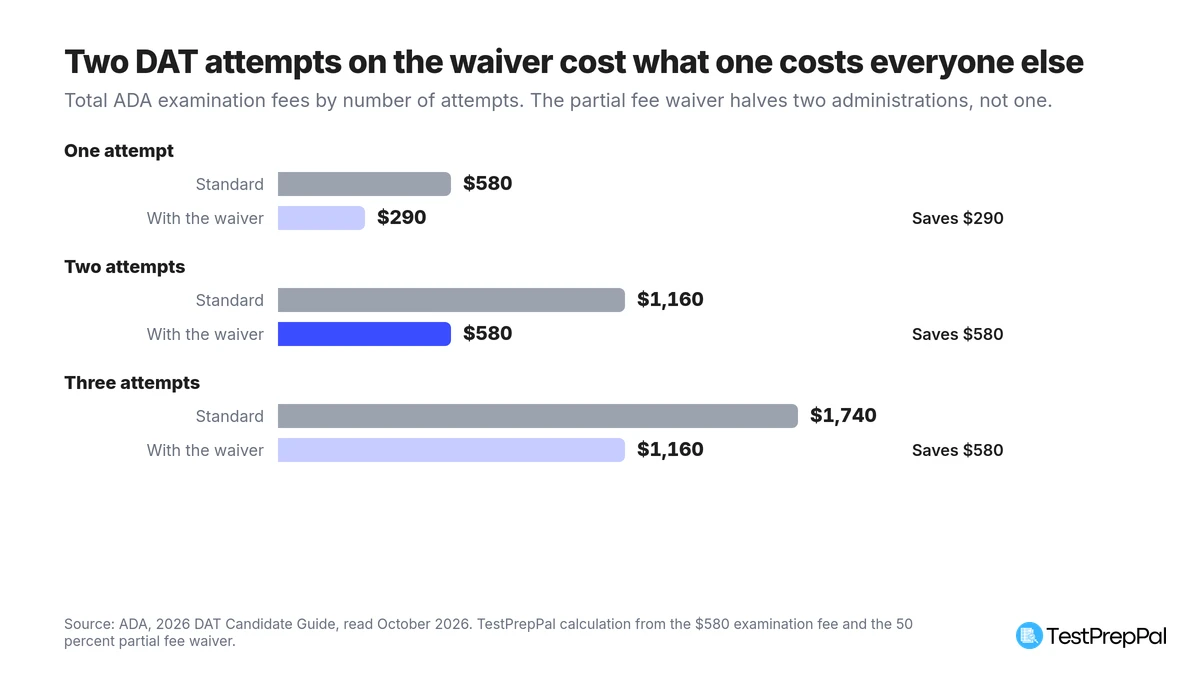 Total ADA examination fees by number of DAT attempts. Source: ADA 2026 DAT Candidate Guide, TestPrepPal calculation.
| Attempts | Standard cost | With the partial fee waiver | Waiver saves |
|---|---|---|---|
| One | $580 | $290 | $290 |
| Two | $1,160 | $580 | $580 |
| Three | $1,740 | $1,160 | $580 |
Four rules in the guide's retesting policy shape how fast you can spend that money:
- You must wait 60 days between attempts. The reschedule table above is the only place the guide counts in business days, so this one is 60 calendar days.
- Four administrations maximum in any 12-month period. If you use all four, a fifth has to wait until 12 months have passed from the first of those four.
- From your fourth attempt, you need permission. Candidates with three or more attempts must apply in writing to the DAT program and include evidence of applying to dental school within the previous 18 months, such as a submitted ADEA AADSAS application or a rejection letter.
- After a fifth attempt, you can test only once per 12-month period.
A testing attempt counts from the moment you sit at the computer and accept the confidentiality statement, so walking out partway through still burns an attempt and the fee. Partial testing is not allowed either: skip a section and the lowest possible scale score is reported for it.
The practical consequence is that the retake path is slow as well as expensive. Two attempts at the legal minimum spacing take 60 days plus the three to four weeks schools wait for results, which is most of a cycle. Before you spend $580 again, it is worth checking what a second sitting would need to achieve: what counts as a good DAT score and how DAT scoring works will tell you whether the gap you are chasing is one a retake usually closes.
The partial fee waiver discounts a retest too
The ADA makes a limited number of partial fee waivers available to candidates in severe financial hardship, and its terms are better than most summaries suggest. The waiver covers 50 percent of the examination fee for a first administration and 50 percent for a subsequent administration if the candidate chooses to retest. It also includes one free full DAT practice test, which is the $100 item from the first table.
Put against the $580 fee, that means $290 off each of two sittings. A waiver holder who tests twice pays $580 in total, exactly what a single attempt costs everyone else. The saving stops there, though: a third attempt is charged at the full $580, so the waiver is worth $580 in fees plus a $100 practice test, and no more.
What it does not cover is also specific. The waiver does not apply to rescheduling charges, or to score reports requested after your initial application. Those stay at full price.
Five conditions all have to be true to qualify:
- Demonstrated financial hardship.
- This is your first time taking the examination.
- You have not previously received a partial fee waiver.
- You are a US citizen, or a foreign national meeting the green card or substantial presence test in IRS Publication 519.
- You received financial aid at your educational institution.
Timing is the part that trips people up. Waivers are granted first-come, first-served in batches beginning on January 1, April 1 and July 1 of each calendar year, and all three 2026 batches have already opened, so the next one is January 1, 2027. You request it by signing into your DENTPIN account and choosing a waiver request, and the program asks for up to 10 business days to review. Because the first-time-taker condition is absolute, there is no way to claim it after you have already sat the exam.
What this page does not include
Everything above is money paid to the ADA for the exam itself. The much larger number in most predental budgets is preparation, and keeping the two apart is the only way the figure at the top of this page stays honest:
- Courses, question banks and books. Our DAT prep course roundup compares what the major providers charge and what each one includes.
- Free material, which covers more of the DAT than most candidates expect. The free DAT resources page collects what you can get without paying.
- Travel to a Prometric center, which matters most if you are not near a major metro.
- Dental school applications, billed separately through ADEA AADSAS once you have a score.
Fees change between candidate guides, and the ADA posts updated PDFs to its DAT program page when they do, so check the current guide before you pay. The DAT exam hub has the rest of the logistics, and the DAT score calculator will convert a practice result into the scale schools actually see.
DAT cost FAQs
How much does it cost to take the DAT?
The 2026 examination fee is $580, and it is non-refundable and non-transferable. That price includes the administration and official score reporting to every dental school you select at the time of application, with no per-school charge. Optional extras are priced separately: $55 for a score report requested later, $105 for a score audit, and $150 for a 45 day eligibility extension.
Can you retake the DAT, and what does it cost?
Yes. Each attempt needs a new application and the full $580 fee, so two attempts cost $1,160 and three cost $1,740. You must wait 60 days between attempts, and you are limited to four administrations in any 12-month period. From your fourth attempt onward you need written permission from the DAT program, supported by proof that you applied to dental school within the previous 18 months.
Does the ADA offer a DAT fee waiver?
It offers a limited number of partial fee waivers, not full ones. The waiver covers 50 percent of the examination fee for a first sitting and 50 percent for a retest, plus one free full practice test, so it is worth $580 in fees at the current price. You must be a first-time taker in demonstrated financial hardship who received financial aid, and waivers are granted first-come, first-served in batches starting January 1, April 1 and July 1.
How much are the official DAT practice tests?
Individual modules cost $20 each, and the full six-module practice test is $100. They are written by DAT test constructors and mirror the real test specifications, though they report only the number of correct answers rather than a scaled score. Our ADA official DAT practice test review breaks down which modules are worth buying separately. Candidates approved for a partial fee waiver get one full practice test at no charge.
We may earn commissions from some links on this page, but this does not affect our reviews or your experience.