


MCAT Self Prep Study Schedules Review
by MCAT Self Prep
Three free month by month MCAT schedule templates, with a $19.99 adjustable version behind them
✓Pros
- ✓All three schedules are free to read with no account, no email form and no paywall
- ✓Every template prints an hour budget for each month rather than a list of topics
- ✓Each plan names the score improvement it was built for, against a published rule of 50 study hours per point
- ✓A CARS passage cadence runs through every month of every plan, which most free schedules leave out
- ✓The adjustable spreadsheet version is a $19.99 one-time payment with lifetime access, not a subscription
✗Cons
- ✗The weekly hour labels understate the work: the 3.5 month template totals 750 hours, about 46 hours a week against a stated 40, and the 8 month template totals 1,050 hours, about 30 a week against a stated 20
- ✗The 6 month template asks 200 hours a month from the first month, which breaks the same page's advice to stay under 40 hours a week until the final month
- ✗The templates are pictures, so nothing adjusts, and the adjustable spreadsheet sits behind the $19.99 Basic Pro Plan
- ✗Every plan is built around MCAT Self Prep's own ten content modules and Bootcamp, so following one closely means adopting their course
Highlights
- ✓A 3.5 month summer schedule running 100, 200, 200 and 250 hours across four columns
- ✓A 6 month intensive schedule running 200 hours a month, rising to 250 and then 300
- ✓An 8 month part time schedule running 100 hours a month, rising to 150 and then 200
- ✓A modules to complete row and a CARS plan row on every template
- ✓A stated sizing rule of 50 study hours per point, 60 for students long out of the prerequisites, 75 for retakers and about 100 for CARS
Price
✓Free
What Students Are Saying
Sign in to leave a review

Expert Rating
MCAT Self Prep publishes three complete MCAT study schedules on one public page, free, with no account and no email form in the way. That makes them worth ten minutes of anyone's time, and it makes this the only free entry on our MCAT study planners list.
The catch is not a paywall. It is arithmetic. Add up the hours printed inside each template and all three ask for more weekly study time than the page says they do, by between 15 and 50 percent.
Summary table
| Feature | MCAT Self Prep study schedules |
|---|---|
| Price | Free to read, no account and no email. The adjustable spreadsheet is $19.99 |
| Format | Three schedule tables published as images on one public page |
| Plans offered | 3.5 month summer, 6 month intensive, 8 month part time |
| Hours printed inside | 750, 1,350 and 1,050 |
| What each table holds | Hours for the month, modules to complete, a CARS plan |
| Sizing rule | 50 study hours per point of improvement, with named exceptions |
| Adjustable | No. The templates are pictures |
| Access | No expiry on the free page. Paid plans are one-time payments with lifetime access |
| Guarantee | None on the free templates. 7 days on the paid Basic Pro Plan |
| Our rating | 3.5 out of 5 |
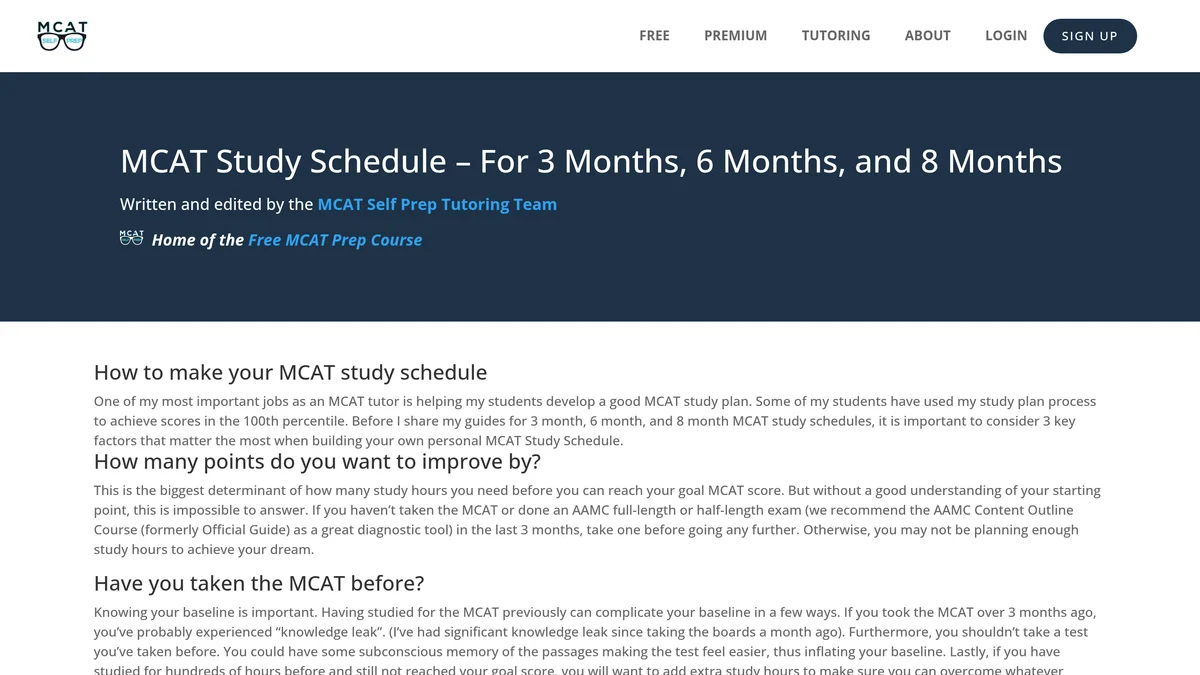 The study schedule page on mcatselfprep.com, captured November 2026. Nothing on it is gated: there is no signup wall between this heading and all three templates.
MCAT Self Prep study schedules overview
MCAT Self Prep is the company behind our review of its free MCAT prep course. The study schedules are a separate page, written and edited by its tutoring team and signed by tutor Timothy Nolan, and they sit outside the course entirely.
Before the templates, the page asks three questions that set the size of your plan: how many points you want to gain, whether you have taken the MCAT before, and how long ago you took the prerequisite courses. Then it gives its sizing rule. MCAT Self Prep's study schedule page puts it at roughly 50 hours of study per point of improvement, rising to about 60 for students long out of the prerequisites, 75 for retakers, and closer to 100 for CARS.
What is actually on the page:
- Three schedule tables, as images, covering 3.5 months, 6 months and 8 months.
- An hour budget for every month of every plan, printed in a "Time to Spend (hours)" row.
- A "Modules to complete" row naming which content modules belong in which month.
- A "CARS Plan" row giving a passage count and a weekly frequency for each month.
- Two pieces of general advice: study at least 15 to 20 hours a week if you are working, and stay under 40 hours a week on average until the final month, because more than that raises your burnout risk.
That last line matters more than it looks, and we will come back to it.
MCAT Self Prep study schedules review for 2026
The hours inside the templates do not match the labels outside them
Each of the three templates on that page prints an hour budget in its own row, month by month. Nobody appears to have added those rows up, so we did.
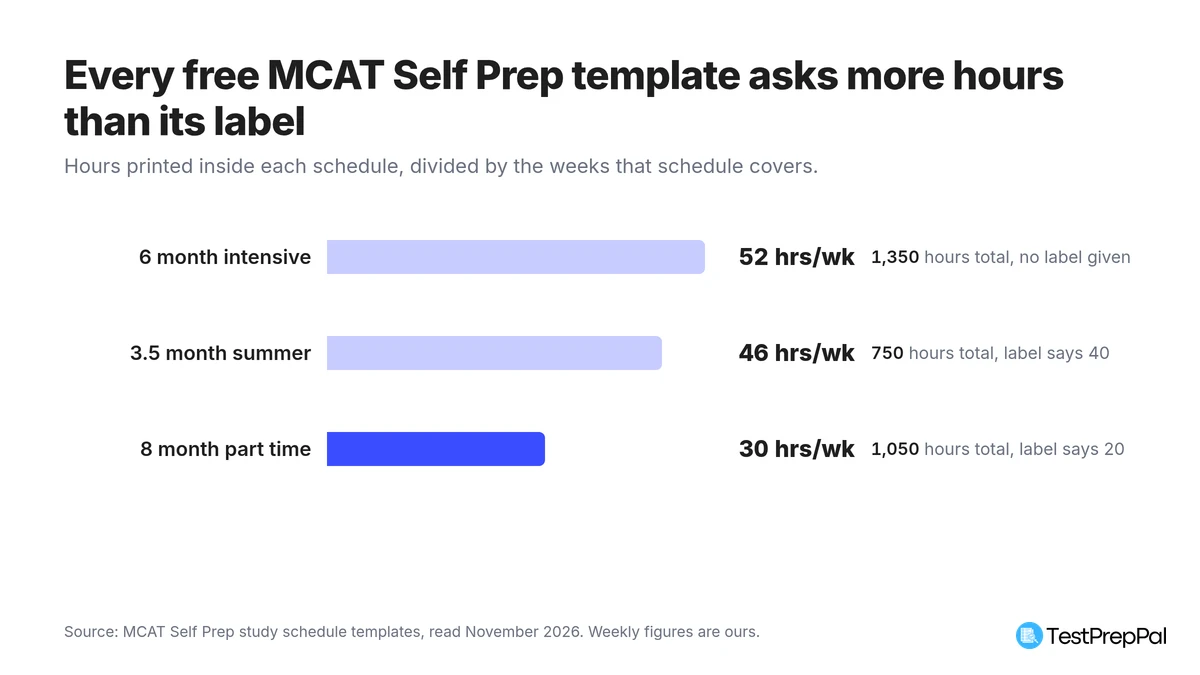 Hours printed inside each template, divided by the weeks that template covers. Totals are MCAT Self Prep's, the weekly figures are ours.
| Template | Hours printed | Months in columns | Hours a week | The page says |
|---|---|---|---|---|
| 3.5 month summer | 750 | 100, 200, 200, 250 | about 46 | 40 hours a week |
| 6 month intensive | 1,350 | 200, 200, 200, 200, 250, 300 | about 52 | no weekly figure |
| 8 month part time | 1,050 | 100, 100, 100, 100, 150, 150, 150, 200 | about 30 | 20 hours a week |
The 3.5 month plan runs from the second half of May to the first week of September, about 16 weeks, and its 750 hours work out at roughly 46 a week rather than the 40 the page names.
The 8 month plan is the bigger gap. Its 1,050 hours over roughly 35 weeks average about 30 a week against a stated 20. In fairness it ramps rather than running flat: 100 hours a month for the first four months is about 23 hours a week, and the final month at 200 hours is about 46. So 20 hours a week describes the opening of the plan, not the plan.
The 6 month plan is the one to be careful with. It asks 200 hours in its first month, which is about 46 hours a week, from the very first week. That is above the 40 hour ceiling the same page sets two paragraphs earlier to avoid burnout, and the template never drops below it.
The sizing rule is the best thing on the page
Set the labels aside and the underlying numbers hold up well, which is what keeps this a recommendation rather than a warning.
Checked against the page's own 50 hours per point rule, every template clears the improvement band it is sold for. The 3.5 month plan is offered for gains of 12 points or less and contains enough hours for 15. The 6 month plan is offered for 13 to 25 points and contains enough for 27. The 8 month plan is offered for under 15 points on a first attempt and contains enough for 21, or about 14 at the slower 75 hours per point the page gives retakers.
That is more honest planning than most free schedules manage, because most free schedules never state how they were sized at all. It also means you can do the calculation yourself in one line: take the gap between your diagnostic and your target, multiply by 50, by 60 if you have been away from the prerequisites for years, or by 75 if this is a retake, and you have a number to check any plan against. Our MCAT study hours calculator runs the same arithmetic from your own starting and target scores, and our MCAT study schedule guide gives the 6, 3, 2 and 1 month versions with start dates attached.
The per-month detail is good too. The CARS row is the part most free schedules skip entirely: three passages three times a week in month one of the 3.5 month plan, rising to five, and up to six passages four times a week in the 6 month plan. Steady CARS practice from the first month is the right instinct, and it is written into every column rather than left as advice.
What the templates will not do
Three things, and you should know all of them before you start.
They do not adjust. These are pictures of tables, not software. Miss a fortnight and there is nothing to reset: you redraw the plan yourself, or you buy the adjustable version. The Create-your-own Study Plan Course and its spreadsheet cost $19.99, which is a fair price for what it is, but it is a purchase rather than a feature of the free page.
They assume MCAT Self Prep's own materials. The "Modules to complete" row names ten content modules (Physics I and II, Chemistry I and II, Biochemistry I and II, Biology I and II, Behavioral Sciences I and II) and finishes with MCAT Bootcamp. Those are MCAT Self Prep's own, and they are free with an account, so this is not a hidden cost. It does mean that following a template closely amounts to adopting their course, and that a student building prep around another provider has to translate every row.
They assume AAMC material you have to buy separately. The 6 and 8 month templates ask for 40 AAMC practice problems per subject per month and place full lengths in specific columns, and the final column of every plan says to complete all AAMC questions. None of that comes with the templates, and the AAMC question bank material is a separate purchase. MCAT Self Prep points at the AAMC Content Outline Course questions as the diagnostic and prices them at $10.
One more thing worth saying plainly: all three template images are served from the site's May 2021 upload folder, and nothing on the page carries a later date. The hour budgets and the CARS cadences have aged fine, because neither depends on the exam changing. Treat the specific month names in the 3.5 month plan as an example calendar rather than this year's dates.
Pricing
The schedules themselves cost nothing and ask for nothing. There is no account, no email capture and no trial clock on the page, which is rarer than it should be in MCAT prep.
Everything below is the adjustable version and the course around it, from MCAT Self Prep's plan comparison page, read November 2026. All three are one-time payments with lifetime access rather than subscriptions.
| Plan | Price | What it adds | Guarantee |
|---|---|---|---|
| The three templates | Free | Nothing to buy, nothing to sign up for | None |
| Basic Pro | $19.99 | Create-your-own Study Plan Course, the study plan spreadsheet, score tracker, study portal, the video collection, all ten modules, ad-free study | 7 day money back |
| Advanced Pro | $199.99 | The flashcard collection and the practice question bank | 7 day money back |
| Deluxe Pro | $1,399.99 | Every mastery and strategy course on the site | 14 day money back, plus a score improvement guarantee |
Two details make the $19.99 tier easier to judge. Whatever you pay for a lower plan is credited in full against a later upgrade, so starting at Basic Pro costs nothing if you move up. And the study plan course itself is short: five lessons that MCAT Self Prep says take under five hours in total, two of which are sitting a diagnostic and two reviewing it. You are buying a method and a spreadsheet, not a term of instruction. Prices move on this site, and a flash sale was cutting Basic Pro to $15.99 when we read the page, so check the current figure before you buy.
Who the MCAT Self Prep study schedules are best for
- Students who want a shape, not software. Fifteen minutes with these tables tells you what a real MCAT plan looks like month by month, with hours attached. That is the whole value, and it is free.
- Anyone who has not yet sized their prep. The 50 hours per point rule, applied to your own diagnostic, is the single most useful number on the page.
- Students already using the free MCAT Self Prep course. The templates were built for those ten modules, so the "Modules to complete" row maps straight onto what you are studying.
- Part-time studiers who read the hour row. The 8 month plan is a genuinely sensible long runway, as long as you plan for about 30 hours a week on average rather than the 20 on the label.
When you might look elsewhere
- You want a planner that reschedules itself. The Blueprint MCAT study planner builds a dated calendar from your test date and redistributes unfinished work when you reset it. It is free for 14 days and then lives inside a course that starts at $1,199, which is the opposite trade to this one.
- You want something free that still adapts. Our MCAT study plan generator builds a week-by-week calendar around your test date with no account and no expiry.
- Your prep is not built on MCAT Self Prep's modules. Every "Modules to complete" cell names their content. Translating that to Kaplan or UWorld chapters by hand undoes much of the convenience.
- You need exact dates for a specific test day. The 3.5 month template is drawn around a May to September summer. Our MCAT study schedule guide gives start dates for each 2027 test date instead.
Final verdict
Judged as free material, this is good work. Three complete plans, an hour budget in every column, a CARS cadence nobody else bothers to write down, and a stated rule for how the totals were sized. No email form, no trial, no account. For a student who has never seen a month-by-month MCAT plan, it is a better first stop than most of what ranks above it.
Judged for accuracy, it has one real flaw and it is in the most visible place: the weekly hour figure printed beside each plan's name. All three understate what the template contains, the 8 month plan by half, and the 6 month plan walks straight through the burnout ceiling the same page sets. A student who plans a semester around "20 hours a week" and then meets a 200 hour month has been told something wrong by a page that had the right number two rows down.
That split is where the 3.5 comes from, and our review methodology explains how we weigh free material against the claims attached to it.
If you are choosing between planners, start with the MCAT hub or compare what we have written on the MCAT study planners we have checked.
MCAT Self Prep study schedule FAQs
Are the MCAT Self Prep study schedules free?
Yes. All three templates are published as images on a public page with no account, no email form and no trial clock. What costs money is the adjustable version: the Create-your-own Study Plan Course and its spreadsheet sit inside the Basic Pro Plan at $19.99, a one-time payment with lifetime access and a 7 day money back guarantee.
How many hours are in each MCAT Self Prep study schedule?
The 3.5 month summer plan totals 750 hours, the 6 month intensive plan 1,350, and the 8 month part time plan 1,050. Divided by the weeks each plan covers, that is roughly 46, 52 and 30 hours a week. The weekly figures printed beside the plan names, 40 and 20, are lower than what the tables actually contain.
How many study hours does MCAT Self Prep say you need per point?
About 50 hours of study for each point of improvement, which is the rule the page sizes its templates with. It raises that to roughly 60 hours per point for students who finished the prerequisite courses long ago, 75 for retakers, and closer to 100 for CARS specifically. Multiply your target gain by the figure that fits you and you have a total to check any plan against.
Which MCAT Self Prep schedule should I use?
Match the plan to the gain you need, not to the time you have. The 3.5 month plan is written for 12 points or less on a first attempt, the 6 month plan for 13 to 25 points or a 10 point retake gain, and the 8 month plan for under 15 points first time or under 10 on a retake. Then check the hour row against the hours you can genuinely protect each week.
Do the templates work if I am not using the MCAT Self Prep course?
Partly. The hour budgets, the CARS cadence and the sequencing all transfer to any provider. The "Modules to complete" row does not, because it names MCAT Self Prep's own ten content modules and its Bootcamp, so you would be mapping each cell onto your own books or course by hand.
We may earn commissions from some links on this page, but this does not affect our reviews or your experience.
Our Verdict
Three complete MCAT study schedules, free to read with no account and no email, and the only free option on this hub. They are more concrete than most paid planners: every month carries an hour budget, a module list and a CARS cadence. The problem is the labels. Add up the hours printed inside each template and all three ask for more time than the page says they do, and nothing adjusts unless you buy the $19.99 spreadsheet.