

Free DAT General Chemistry Practice Questions
30 discrete questions across 4 topic sets — matching the 30 general chemistry items in the Survey of the Natural Sciences. No passages, no calculator.
About These Free DAT General Chemistry Practice Questions
These 30 free DAT general chemistry questions run inside a replica of the DAT test interface — answer strikethrough, flag for review, question navigator, and a running timer. The count is deliberate: the real Survey of the Natural Sciences contains exactly 30 general chemistry items, so working through this page once is a full-length general chemistry block.
Every item is a standalone discrete question. There are no passages in DAT general chemistry — unlike the MCAT, the ADA presents each science question independently, and this tool matches that.
| Set | Topics | Questions |
|---|---|---|
| Stoichiometry, Gases, and Solutions | Empirical formulas, limiting reactant, percent composition, combined gas law, Dalton's law, Graham's law, colligative properties | 8 |
| Thermodynamics, Kinetics, and Equilibrium | Hess's law, Gibbs free energy, rate laws, half-life, Le Chatelier, manipulating K, catalysis, calorimetry | 8 |
| Acids, Bases, and Aqueous Equilibria | pH of strong and weak acids, Brønsted-Lowry pairs, buffers, titration stoichiometry, Ksp, dilution | 7 |
| Atomic Structure, Bonding, Periodicity, and Redox | Electron configuration of ions, VSEPR, periodic trends, oxidation numbers, intermolecular forces, cell potential, nuclear decay | 7 |

How Much General Chemistry Is on the DAT?
General chemistry is one of three subjects inside the first section of the exam, the Survey of the Natural Sciences. It is 30 of that section's 100 items, and it appears nowhere else on the test.
| DAT section | Items | Time |
|---|---|---|
| Survey of the Natural Sciences | 100 | 90 minutes |
| Perceptual Ability Test | 90 | 60 minutes |
| Reading Comprehension | 50 | 60 minutes |
| Quantitative Reasoning | 40 | 45 minutes |
| Survey of the Natural Sciences | Items |
|---|---|
| Biology | 40 |
| General Chemistry | 30 |
| Organic Chemistry | 30 |
The full administration runs 5 hours 15 minutes, which includes an optional 15-minute tutorial, an optional 30-minute scheduled break after the Perceptual Ability Test, and an optional 15-minute post-test survey. Scores are reported on a 200–600 scale in 10-point increments; that scale replaced the old 1–30 reporting scale on March 1, 2025.
Three logistical facts shape how you should prepare for this section specifically:
- No calculator. The ADA supplies a digital calculator for Quantitative Reasoning only, and slide rules, paper, and calculating devices are on the prohibited-items list for the secure testing area. You get two note boards and two fine-tip markers.
- A periodic table is provided on screen during the General Chemistry section, so molar masses and trends are available — but nothing else is.
- No guessing penalty, and some items on every form are unscored experimental questions.
All section counts, timings, content areas, the calculator and periodic-table provisions, and the score scale above are taken from the ADA's 2026 DAT Candidate Guide and the official DAT page, verified August 28, 2026.
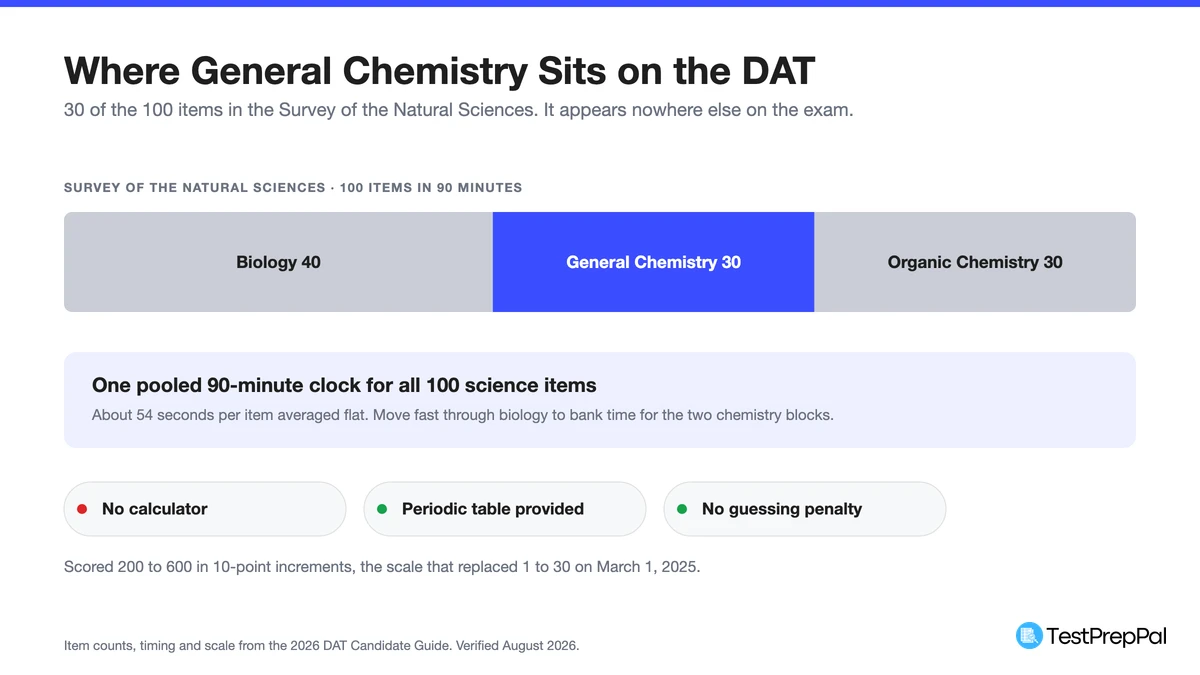 General chemistry is 30 of the 100 science items, and the 90 minutes are pooled across all of them.
The Formulas You Need to Have Memorized
The DAT gives you a periodic table and nothing else, so every constant, equation, solubility rule, and polyatomic ion has to be in memory before you sit down. We keep the complete reference in one place: the DAT general chemistry formula and constants sheet covers gases, thermodynamics, kinetics, equilibrium, acids and bases, solutions, electrochemistry, solubility rules, and the twenty polyatomic ions worth knowing.
Use it the same way you would use the set above, by reproducing each block from a blank sheet rather than rereading it.
What the ADA Says Is Tested
The 2026 DAT Candidate Guide lists thirteen general chemistry content areas. Here is the official list, mapped to where each is drilled in the sets above.
| ADA content area | Set |
|---|---|
| Stoichiometry and General Concepts | 1 |
| Gases | 1 |
| Liquids and Solids | 4 |
| Solutions | 1 and 3 |
| Acids and Bases | 3 |
| Chemical Equilibria | 2 and 3 |
| Thermodynamics and Thermochemistry | 2 |
| Chemical Kinetics | 2 |
| Oxidation-Reduction Reactions | 4 |
| Atomic and Molecular Structure | 4 |
| Periodic Properties | 4 |
| Nuclear Reactions | 4 |
| Laboratory | Not drilled here |
Laboratory technique, equipment, error analysis, and safety are on the official outline and do appear on the exam, but they are recall items rather than reasoning items and are better reviewed from a textbook chapter than from a question set.
How to Use These Practice Questions
- Do the arithmetic on paper, never in your head alone. The test center gives you two note boards and two markers, and that is the entire toolkit. Practicing mental math without writing anything down builds a habit you cannot use on test day.
- Reach for the relationship before the numbers. A question about how volume responds when pressure halves and temperature rises is answered by two ratios, not by solving PV = nRT twice.
- Track powers of ten separately from coefficients. Splitting 4.0 × 10⁻¹⁰ into "square root of 4" and "half of −10" is what makes a Ksp question a ten-second problem instead of a two-minute one.
- Sanity-check every sign. A galvanic cell potential is positive. A spontaneous reaction has negative ΔG. A strong acid at 0.02 M has a pH just under 2. Sign checks catch more errors than recomputation does.
- Read the explanation even on questions you got right — each one names the specific distractor logic the exam reuses, and that pattern recognition is what separates a first attempt from a retake.
Keep Practicing
General chemistry is only 30 of the 100 questions in the Survey of the Natural Sciences. Drill the largest piece of that section with our free DAT biology practice questions, then build speed on the section most students leave time on with our free DAT quantitative reasoning practice.
Once you have raw scores to work with, translate them with our DAT score calculator, and turn however many weeks you have left into an actual schedule with the DAT study plan generator.
For more free material, see our roundup of free DAT resources and our full breakdown of the DAT sections.
We may earn commissions from some links on this page, but this does not affect our reviews or your experience.